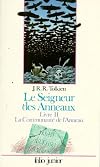
The Ring Goes South: Being the Second Book of The Lord of the Rings
by J. R. R. Tolkien
On This Page
Description
Sauron has gathered the Rings of Power - the means by which he will be able to rule the world. All he needs now is the Ruling Ring, which has fallen into the hands of the hobbit Bilbo Baggins. Frodo Baggins is entrusted to foil Sauron's plans.Tags
Recommendations













Member Reviews
To my surprise, I didn't like The Ring Goes South as much as the previous volume in the series. While The Ring Sets Out has a pretty firm focus on the Shire and the dangers facing it, The Ring Goes South is a little more disjointed, alternating between excitement and boredom, and a little too overcrowded.
Unfortunately, it leads off with boredom: "The Council of Elrond" ought to be a textbook case of how not to handle exposition. I like the idea of the backstory, but the way it's related meant I had to go back over it multiple times in order to absorb it all, as I kept on skimming through whether I wanted to or not. I did notice that though there are many songs sung in Rivendell, they're all by Bilbo; the elves themselves do not sing show more much if at all. It's a marked difference to the more mischievous elves of The Hobbit.
Finally, though, the Company gets underway, and things begin to pick up. There are an awful lot of characters in the Company, and inevitable short shrift is given to most of them. Pippin is there just to be mocked by Gandalf (I loved it when Gandalf threatened to bash his head against the Gate of Moria), but even outside of the hobbits, I found it took a long time to get a grip on any one character's personality, beyond the fact that no matter what plan you come up with, Boromir will think it's a bad idea. They do get some moments, though, especially when Gimli visits Lothlórien and takes issue with the elves' prescriptions... but is then saddened when they must leave.
The visit to the Mines of Moria was definitely my favorite part of the novel: Tolkien very vividly communicates Moria's creepiness, and I'm a complete sucker for stories where characters find a fragmented narrative telling of a past disaster. The journey to Lothlórien is a complete shift, and though it has its moments (the stuff with Gimli, the looking in the Mirror of Galadriel, Galadriel's rant), it feels a little disconnected, and repetitive to the already-long stay in Rivendell.
The last chapter, though, is amazing, from Boromir's breakdown to Frodo's use of the ring to see all Middle-earth to Frodo and Sam's amazingly brave decision. The end of the book left me excited to see what would happen next; I just wish it had cohered a little bit more in and of itself, and that there's been more time to spend with any of the nine principal characters. show less
Unfortunately, it leads off with boredom: "The Council of Elrond" ought to be a textbook case of how not to handle exposition. I like the idea of the backstory, but the way it's related meant I had to go back over it multiple times in order to absorb it all, as I kept on skimming through whether I wanted to or not. I did notice that though there are many songs sung in Rivendell, they're all by Bilbo; the elves themselves do not sing show more much if at all. It's a marked difference to the more mischievous elves of The Hobbit.
Finally, though, the Company gets underway, and things begin to pick up. There are an awful lot of characters in the Company, and inevitable short shrift is given to most of them. Pippin is there just to be mocked by Gandalf (I loved it when Gandalf threatened to bash his head against the Gate of Moria), but even outside of the hobbits, I found it took a long time to get a grip on any one character's personality, beyond the fact that no matter what plan you come up with, Boromir will think it's a bad idea. They do get some moments, though, especially when Gimli visits Lothlórien and takes issue with the elves' prescriptions... but is then saddened when they must leave.
The visit to the Mines of Moria was definitely my favorite part of the novel: Tolkien very vividly communicates Moria's creepiness, and I'm a complete sucker for stories where characters find a fragmented narrative telling of a past disaster. The journey to Lothlórien is a complete shift, and though it has its moments (the stuff with Gimli, the looking in the Mirror of Galadriel, Galadriel's rant), it feels a little disconnected, and repetitive to the already-long stay in Rivendell.
The last chapter, though, is amazing, from Boromir's breakdown to Frodo's use of the ring to see all Middle-earth to Frodo and Sam's amazingly brave decision. The end of the book left me excited to see what would happen next; I just wish it had cohered a little bit more in and of itself, and that there's been more time to spend with any of the nine principal characters. show less
I 5
Jan 4, 2025Spanish
Ratings
Members
- Recently Added By
Author Information

610+ Works 519,546 Members
A writer of fantasies, Tolkien, a professor of language and literature at Oxford University, was always intrigued by early English and the imaginative use of language. In his greatest story, the trilogy The Lord of the Rings (1954--56), Tolkien invented a language with vocabulary, grammar, syntax, even poetry of its own. Though readers have show more created various possible allegorical interpretations, Tolkien has said: "It is not about anything but itself. (Certainly it has no allegorical intentions, general, particular or topical, moral, religious or political.)" In The Adventures of Tom Bombadil (1962), Tolkien tells the story of the "master of wood, water, and hill," a jolly teller of tales and singer of songs, one of the multitude of characters in his romance, saga, epic, or fairy tales about his country of the Hobbits. Tolkien was also a formidable medieval scholar, as evidenced by his work, Beowulf: The Monster and the Critics (1936) and his edition of Anciene Wisse: English Text of the Anciene Riwle. Among his works published posthumously, are The Legend of Sigurd and Gudrún and The Fall of Arthur, which was edited by his son, Christopher. In 2013, his title, TheHobbit (Movie Tie-In) made The New York Times Best Seller List. (Bowker Author Biography) show less
Work Relationships
Common Knowledge
- Canonical title
- The Ring Goes South: Being the Second Book of The Lord of the Rings
- Disambiguation notice
- J.R.R. Tolkien's complete work The Lord of the Rings consists of six Books, frequently bound in three Volumes:
- Volume 1: The Fellowship of the Ring, consisting of Book I, "The Ring Sets Out" and Book II, ... (show all)"The Ring Goes South";
- Volume 2: The Two Towers, consisting of Book III, "The Treason of Isengard," and Book IV, "The Ring Goes East"; and
- Volume 3: The Return of the King, consisting of Book V, "The War of the Ring," and Book VI, "The End of the Third Age," with Appendices.
Classifications
Statistics
- Members
- 139
- Popularity
- 236,317
- Reviews
- 2
- Rating
- (4.33)
- Languages
- 5 — English, Finnish, French, German, Japanese
- Media
- Paper, Audiobook, Ebook
- ISBNs
- 10
- ASINs
- 1