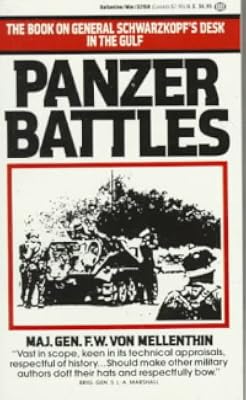
Panzer Battles: A Study of the Employment of Armor in the Second World War
by F. W. Mellenthin
On This Page
Description
Armored warfare assumed vital importance in World War II, and during the first years of the war despite inferiority in numbers and equipment, the German Army was master. The secret of Germany's early successes and the reason for its eventual failure are disclosed in this analysis by a brilliant former general of the German Army. Major General von Mellenthin, who saw action in every theater of the European war from 1939 to 1945, follows the panzer armies through Poland, France, the Balkans, show more across the deserts of North Africa and the frozen wastes of Russia, to the final defeat on the Western front. show lessTags
Recommendations












Member Reviews
Panzer Battles: a Study of the Employment of Armor in the Second World War by F. W. von Mellenthin is part memoir and part tactical treatise on the use of tanks in battle. The book covers the authors experiences in Poland, France, North Africa [on Rommel's staff], in Russia and finally in the West. The book has some problems when discussing the Eastern front. There's a very stereotypical analysis of Soviet tactics. There's no mention of deep operations everything is described as an attacking wave of humanity not thinking or learning.
The book is firmly in the "it was all Hitler's vault" tradition of World War II history. Apparently the German army never did anything wrong. There is also quite a bit of excuse making for example the show more treatment the Ukrainians received is excused by mentioning Western allies bombing of German cities.
This is interesting more for what it says about the thought processes of a member of the German staff then as a history. show less
The book is firmly in the "it was all Hitler's vault" tradition of World War II history. Apparently the German army never did anything wrong. There is also quite a bit of excuse making for example the show more treatment the Ukrainians received is excused by mentioning Western allies bombing of German cities.
This is interesting more for what it says about the thought processes of a member of the German staff then as a history. show less
From the 'we wuz robbed' school of German military history. The enemy - especially the Russians - are a faceless anonymous horde, while the Germans are all noble, selfless, honourable, brave, and determined. There are some interesting descriptions of battles and incidents, but the whole book needs to be read with a massive grain of salt.
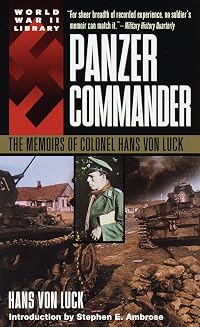
I read this one right after I finished von Luck’s great memoir Panzer Commander. I didn’t have very high expectations because von Luck was so good and the memoirs that I read (or tried to read in some cases) were not that great (to be kind to some of them). Being a pessimist does pay off from time to time, this was very good as well. My personal interest in the subject is at the tactical and grand tactical level, right were Hans von Luck spent most of his career. Mellinthin [Reviewer’s Note: The cover bills the author as ‘Major General F.W. von Mellinthin’, this is a rank that he retired at post WWII. During the war, I don’t believe he made it higher than Col.] spent more time on general staff duties and in larger show more operations. This is also a good view (especially if you are unfamiliar with the campaigns). You get to see the tremendous amount of staff work that went into planning and executing those operations that you have heard about other places. The average German soldier was only somewhat better trained and better equipped then everyone else at the beginning of WWII, but they did do their homework and that was the difference until everyone else learned the lessons that they were providing in ample quantities. I am not going to go into details about the book as it rips through WWII at a pretty good clip few surprise, but a good read none the less. For me, one of the best parts was his description of the North African campaign and how the details from his POV stack up with the detailed accounts given by Hans von Luck. I highly recommend reading these two books together as they complement each other nicely. I don’t think the order matters. It does stop at the end of the war (unlike von Luck’s, but then he wasn’t captured by the Soviets either). It does contain a lot more of the political sewage. Mostly going into great lengths as to how the (primarily Prussian) officer corps were duped by the Nazis and the he wasn’t one (which we will take on faith since out and out Nazi’s rarely had the old nobility tag ‘von’ in their name and were usually rapidly promoted way over their skill level (some of the SS generals, especially in ‘44 and ‘45 are excellent examples of this tendency)). show less
A clear account of this general's time on the Eastern front. It is quite technical, and deals with many actions that read well in the context of that phase of the Cold War. It also covers fighting in North Africa. There is very little of the personal in this book, but for military minded people a good investment of time.
Uncritical and somewhat self-serving early work by a German staff officer. Sections on Eastern front best avoided. Probably best remembered for Norman Schwarzkopf's endorsement.
Ratings
Members
- Recently Added By
Author Information

8 Works 595 Members
Some Editions
Series
Belongs to Publisher Series
Common Knowledge
- Important events
- World War II (1939 | 1945); Fall of France (1940-05-10 | 1940-06-25); North African Campaign (1940-06-10 | 1943-05-13); World War II, Eastern Front (1941-06-22 | 1945-05-05)
Classifications
Statistics
- Members
- 562
- Popularity
- 52,402
- Reviews
- 5
- Rating
- (3.75)
- Languages
- Dutch, English, German, Russian
- Media
- Paper
- ISBNs
- 14
- ASINs
- 16