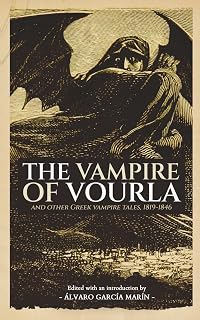
The Vampire of Vourla and Other Greek Vampire Tales, 1819-1846
by Lord George Gordon Byron
On This Page
Description
"Vampires are usually associated in the popular imagination with Transylvania and other Eastern European locales. But in this new collection, editor A?lvaro Garc?a Mar?n has uncovered the earliest appearances of vampires in English literature, revealing their surprising origin in Greece. This volume includes two seminal classic texts, Lord Byron's "Fragment of a Novel" and John William Polidori's "The Vampyre," together with five other rare and never-before-reprinted vampire tales from the show more early 19th century, including the important and inexplicably neglected "The Vampire of Vourla." Also featured is a scholarly introduction by Prof. Mar?n, delving into this forgotten field of vampire literary history and situating it within the larger Romantic era and 19th-century English attitudes toward Greece."-- Goodreads. show lessTags
Member Reviews
What should be regarded as an important and essential book for vampire lovers, this fantastic collection covers a variety of Nineteenth Century vampire tales (all pre-Dracula by at least half a century) all connected in some way to Greek and Turkish influences and one I enjoyed immensely.
The collection includes a mix of well known (Polidori's 'The Vampyre', Lord Byron's 'Fragment of a Novel') and undeservedly obscure titles (the particularly excellent 'The Vampire of Vourla' and 'The Vampire Knight and His Cloud Steed'). Every story though I found to be absorbing and whilst the language was often outdated (as expected from 19thC writing) with a great deal of unfamiliar colloquial and cultural terminology, the extra effort felt show more incredibly rewarding.
Each story is preceded by a wonderful page long introduction which highlights the connection of each to the turbulent history of Greece under Ottoman rule, through either the medium of the more mythical, classically terror-laden version the Turkish vampire instilled, or the more gothic and romantic style imposed by encroaching western European influences. I love it when editors succinctly cram in so much information on an author with related cultural history and these are perfect.
Anyone wanting to read deeper into vampire fiction whilst learning more about their folklore away from the tropes of modern sources, then give this a go as I cannot recommend this edition high enough. show less
The collection includes a mix of well known (Polidori's 'The Vampyre', Lord Byron's 'Fragment of a Novel') and undeservedly obscure titles (the particularly excellent 'The Vampire of Vourla' and 'The Vampire Knight and His Cloud Steed'). Every story though I found to be absorbing and whilst the language was often outdated (as expected from 19thC writing) with a great deal of unfamiliar colloquial and cultural terminology, the extra effort felt show more incredibly rewarding.
Each story is preceded by a wonderful page long introduction which highlights the connection of each to the turbulent history of Greece under Ottoman rule, through either the medium of the more mythical, classically terror-laden version the Turkish vampire instilled, or the more gothic and romantic style imposed by encroaching western European influences. I love it when editors succinctly cram in so much information on an author with related cultural history and these are perfect.
Anyone wanting to read deeper into vampire fiction whilst learning more about their folklore away from the tropes of modern sources, then give this a go as I cannot recommend this edition high enough. show less
Members
- Recently Added By
Lists

Best Vampire & Werewolf Fiction
221 works; 146 members
Author Information

846+ Works 12,178 Members
English poet and dramatist George Gordon, Lord Byron was born January 22, 1788, in London. The boy was sent to school in Aberdeen, Scotland, until the age of ten, then to Harrow, and eventually to Cambridge, where he remained form 1805 to 1808. A congenital lameness rankled in the spirit of a high-spirited Byron. As a result, he tried to excel in show more every thing he did. It was during his Cambridge days that Byron's first poems were published, the Hours of Idleness (1807). The poems were criticized unfavorably. Soon after Byron took the grand tour of the Continent and returned to tell of it in the first two cantos of Childe Harold (1812). Instantly entertained by the descriptions of Spain, Portugal, Albania, and Greece in the first publication, and later travels in Belgium, Germany, Switzerland, and Italy, the public savored Byron's passionate, saucy, and brilliant writing. Byron published the last of Childe Harold, Canto IV, in 1818. The work created and established Byron's immense popularity, his reputation as a poet and his public persona as a brilliant but moody romantic hero, of which he could never rid himself. Some of Byron's lasting works include The Corsair, Lara, Hebrew Melodies, She Walks In Beauty, and the drama Manfred. In 1819 he published the first canto of Don Juan, destined to become his greatest work. Similar to Childe Harold, this epic recounts the exotic and titillating adventures of a young Byronica hero, giving voice to Byron's social and moral criticisms of the age. Criticized as immoral, Byron defended Don Juan fiercely because it was true-the virtues the reader doesn't see in Don Juan are not there precisely because they are so rarely exhibited in life. Nevertheless, the poem is humorous, rollicking, thoughtful, and entertaining, an enduring masterpiece of English literature. Byron died of fever in Greece in 1824, attempting to finance and lead the Byron Brigade of Greek freedom fighters against the Turks. (Bowker Author Biography) show less
Classifications
Statistics
- Members
- 10
- Popularity
- 2,141,391
- Reviews
- 1
- Rating
- (5.00)
- Languages
- English
- Media
- Paper
- ISBNs
- 1