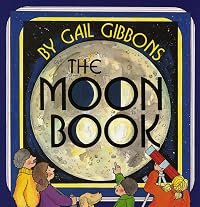
The Moon Book
by Gail Gibbons
On This Page
Description
Identifies the moon as our only natural satellite, describes its movement and phases, and discusses how we have observed and explored it over the years.Tags
Recommendations







Member Reviews
I would use this book to introduce the moon cycle to my students, and how it impacts the earth. The awesome thing about "The Moon Book" is that it has so many illustrations, and the text is super kid friendly. I would use this book in every type of classroom (bilingual, inclusive, ELL classroom, SPED, etc).
Gail Gibbons does excellent things for children's non-fiction. The Moon book covers a lot of areas related to the moon--legends, phases, tidal effect, eclipses, lunar geography, and exploration.--in brief, but simply and clearly. A great introduction to lunar study. Backmatter has even more: milestones, legends, and facts.
Nice, like all Gail Gibbons' books, but somehow inaccurate in its description of the geometry of eclipses. Very pleasant nonetheless.
This book is great for teaching science, especially solar science. Gail Gibbons does a great job packing this book with fun facts and colorful illustrations. The Moon Book covers virtually every aspect of the moon, from its phases to the fascinating legends that are still retold today. Also at the end of the book she includes a timeline, lunar milestones, and moon facts. There are so many lessons that a teacher can have with this book, but I think that this book would be best suited paired with a timeline lesson similar to what Gail has already done at the back of her book.
I've never been very interested in outer space before, but this informational book was able to catch my interest and make me want to learn more about it. Therefore, in my opinion, this book would be great for kids who want to learn more about space.
One reason I like this book is how many diagrams and graphics there are to represent what the text is saying. Usually in informational books, the text gets boring and makes you sleepy, but with this one, it holds your interest.
One reason I like this book is how many diagrams and graphics there are to represent what the text is saying. Usually in informational books, the text gets boring and makes you sleepy, but with this one, it holds your interest.
I liked this book for three reasons. One of the reasons why I liked this book was because of the illustrations. I liked how there were words on them to give the children a better understanding of what the book is talking about. Another reason I liked the illustrations was because of the colors that were used and how it showed the light and dark parts of the earth and moon. Also, I thought that the use of the illustrations showing the different phases of the moon was visually pleasing and I think children would understand it a lot. Another thing that I found was interesting was the plot. I'm twenty and I still thought this was interesting. I liked that it told us how the moon was formed and that it is basically just rock and debris from show more something that happened a really long time ago. Finally, I really liked the extra things that they added to this book. I thought adding a project, the moon milestones, legend, stories, and facts would draw the reader in and catch their attention a lot more than a regular book would. I thought the big idea of this book was to basically just have a better understanding of the moon and that it isn't just something that lights up our night sky. show less
I loved this book for many reasons. One reason is that it is bursting with new facts and information for children who may be interested in the moon or children who never knew they may be interested in the moon. Along with this the illustrations of the solar system were amazing. I feel this type of book would inspire a student to keep learning.
The big idea of the book was to inform and excite students about the moon, planets, stars, etc.
The big idea of the book was to inform and excite students about the moon, planets, stars, etc.
Members
- Recently Added By
Lists

Youth: Astronomy
42 works; 1 member
Author Information

167+ Works 57,996 Members
Gail Gibbons was born in 1944 in Oak Park, Illinois. She received a degree in graphic design from the University of Illinois. She got a job doing artwork for television shows in New York City. She was eventually offered a job creating art for a children's show, where some of the children asked her if she had ever considered doing a children's show more books. Her first book, Willy and His Wheel Wagon, was published in 1975. Since then she has written and illustrated more than 170 non-fiction books for children including Nature's Green Umbrella: Tropical Rain Forests. (Bowker Author Biography) show less
Awards and Honors
Common Knowledge
- Original publication date
- 1997
- Important places
- The Moon
- Dedication
- This book is dedicated to the memory of astronauts Roger Chaffee, Virgil "Gus" Grissom and Ed White, who perished in a fire during the launching of a test flight in 1967.
- First words
- As the sun sets at the end of each day, the sky becomes darker and darker.
- Last words
- (Click to show. Warning: May contain spoilers.)We are still learning about our closest neighbor... the moon.
- Original language
- English
Classifications
Statistics
- Members
- 2,039
- Popularity
- 10,230
- Reviews
- 36
- Rating
- (4.15)
- Languages
- English
- Media
- Paper, Audiobook, Ebook
- ISBNs
- 18
- ASINs
- 8