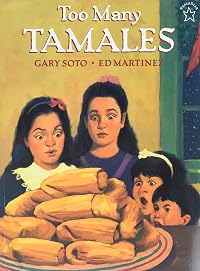
Too Many Tamales
by Gary Soto (Author), Ed Martinez (Illustrator)
On This Page
Description
Maria tries on her mother's wedding ring while helping make tamales for a Christmas family get-together. Panic ensues when hours later, she realizes the ring is missing.Tags
Recommendations




Member Reviews
The children's book Too Many Tamales, written by Gary Soto, displays the theme of responsibility and guilt through the main character Maria, as she struggles with the emotion of guilt after losing her mother's wedding ring while making tamales with her mother. However, as Maria faces her accident, she grows from an anxious child to someone who learns the importance of taking responsibility. Soto's use of symbolism can be displayed through the family tradition of making tamales and how losing the ring reflects how she fears disappointing her family. This story highlights that mistakes are a part of every child's life and that honesty is key to healthy relationships. Overall, I was able to connect to this book because it gave me a sense show more of nostalgia, thinking back to the winter months of making tamales with my own grandmother and sharing those traditions with my family. I feel that this book can offer children a look into a different culture and share the common feeling of being scared to face the consequences of our mistakes. show less
Delighted at the opportunity to help her mother make tamales for their Christmas celebration, Maria - dressed up in her mother's apron, and wearing (by special permission!) some lipstick and perfume - is tempted to try on her mother's diamond ring. Caught up in the joy of the holiday, and the pleasure of participating in "adult" things, Maria forgets all about the ring, until she realizes it is missing! Now she and her cousins must eat ALL of the tamales, in the hopes of finding it...
A charming holiday tale, full of family warmth and Christmas cheer, Too Many Tamales paints a portrait of a tradition which may be new to many young readers. There is no mention of church, Santa Claus, or gift-giving, but although tamale-making may be an show more unfamiliar custom to some, the gathering of an obviously loving family is sure to strike a chord. I enjoyed this Christmas story, with its culturally specific Latino themes, and universally relevant story - haven't we all taken something we weren't supposed to, as children? - and was delighted with the beautiful artwork. Ed Martinez really does a wonderful job capturing the humor of the story, with his wonderfully expressive faces. I'm so glad the Picture-Book Club to which I belong, chose this as one of our May selections, in honor of "Latino Books Month!" Highly recommended! show less
A charming holiday tale, full of family warmth and Christmas cheer, Too Many Tamales paints a portrait of a tradition which may be new to many young readers. There is no mention of church, Santa Claus, or gift-giving, but although tamale-making may be an show more unfamiliar custom to some, the gathering of an obviously loving family is sure to strike a chord. I enjoyed this Christmas story, with its culturally specific Latino themes, and universally relevant story - haven't we all taken something we weren't supposed to, as children? - and was delighted with the beautiful artwork. Ed Martinez really does a wonderful job capturing the humor of the story, with his wonderfully expressive faces. I'm so glad the Picture-Book Club to which I belong, chose this as one of our May selections, in honor of "Latino Books Month!" Highly recommended! show less
Too Many Tamales by Gary Soto follows Maria, a little girl helping her mother in the kitchen. She admired her mother's ring and decided it would be okay if she tried it on. After her mother left the room, she tries it on. She continues kneading the dough, not realizing it fell within the mixture. Later in the story she realizes where the ring went and tries her best to cover it up with her cousins. They attempt to eat all the tamales and she realizes her mom found it and places it back on her finger. This story shows how children should be honest about mistakes rather than creating big commotions over minor problems. In the story the children go through a lot of troubles, such as getting sick from eating all the tamales, as an attempt show more to cover up the problem. The illustration featured throughout the story show the clear panic and stress of the main character and her situation. This book reminded me of how many times growing up, I was always afraid of getting into trouble and as a result would keep things from others, eventually making small problems bigger. show less
This feels like a Christmas story in about the same way Die Hard does. It happens at Christmas, sure, but it could easily happen any time in the year when families (or corporate employees) gather: Thanksgiving, Fourth of July, a birthday party, etc.
In this nothing tale, a little girl tries on her mother's diamond ring and then loses track of it. She can only assume it has made its way into the tamale dough she was kneading, so she needs to search them.
My daughter did not connect with this book at two or twenty-four.
FOR REFERENCE:
Rated “Indifferent" in our old book database by Rod and Adelia.
In this nothing tale, a little girl tries on her mother's diamond ring and then loses track of it. She can only assume it has made its way into the tamale dough she was kneading, so she needs to search them.
My daughter did not connect with this book at two or twenty-four.
FOR REFERENCE:
Rated “Indifferent" in our old book database by Rod and Adelia.
This is one of my favorite classics that I read at least once during the Christmas season. This humorous story incorporates several aspects of the Hispanic culture, such as the food, holiday traditions, expectations and much more. Maria's fascination of admiration, prompted a possible accident that required her cousins to pitch in, in helping consume a number of tamales to find what was lost. In the end, Maria and her cousin all learn a lesson and their honesty leads to a great reward.
This is a wonderful Christmas picture book, with a slightly different emphasis than many other books on the subject. In this story, Maria is making tamales with her mother, a Christmas tradition very common among Hispanic families in the southwest (where I live). Her mother leaves the room for a moment, and Maria's eyes are drawn to the diamond ring her mother left on the counter. She can't resist, and tries the lovely jewelry on her own hand, admiring its shine; but when her mama returns, Maria forgets she is wearing the ring, and starts kneading the masa. The ring is pulled off by the dough, and Maria happily leaves the room to welcome her arriving family.
Maria enjoys playing with her cousins, but when something reminds her of the show more ring she dashes back to the kitchen, her three cousins in tow. After looking everywhere, to no success, Maria comes to the inevitable conclusion: the ring must have been cooked in a tamale! She enlists her cousins' help to eat through the tamales in search of the ring. At first, the job is enjoyable, but soon their bellies are full and they still haven't found the ring. After eating all the tamales, with still no ring in sight, the children believe it must be in someone's stomach. But when Maria is ready to confess to her mama, she finds a surprise - the ring is on her mom's finger. The adults laughingly console the children, and then the whole family makes new tamales together.
The story is sweet and funny, with a plucky heroine and a lovely tone of Christmas comfort and tender family memories. The text is well written, and the illustrations are warm and comic. I particularly like this book because it explores the Christmas traditions typical for Mexican American families, in an organic story that presents the customs in a natural setting, instead of noting them as peculiar or strange. I want to teach my children, and my self, an appreciation of diversity and cultures different from our own, and this book is a wonderful way to learn about other cultures while recognizing the similarities that bind us all together. Plus, it's just a fun story! This book deserves a lot more attention than it receives. show less
Maria enjoys playing with her cousins, but when something reminds her of the show more ring she dashes back to the kitchen, her three cousins in tow. After looking everywhere, to no success, Maria comes to the inevitable conclusion: the ring must have been cooked in a tamale! She enlists her cousins' help to eat through the tamales in search of the ring. At first, the job is enjoyable, but soon their bellies are full and they still haven't found the ring. After eating all the tamales, with still no ring in sight, the children believe it must be in someone's stomach. But when Maria is ready to confess to her mama, she finds a surprise - the ring is on her mom's finger. The adults laughingly console the children, and then the whole family makes new tamales together.
The story is sweet and funny, with a plucky heroine and a lovely tone of Christmas comfort and tender family memories. The text is well written, and the illustrations are warm and comic. I particularly like this book because it explores the Christmas traditions typical for Mexican American families, in an organic story that presents the customs in a natural setting, instead of noting them as peculiar or strange. I want to teach my children, and my self, an appreciation of diversity and cultures different from our own, and this book is a wonderful way to learn about other cultures while recognizing the similarities that bind us all together. Plus, it's just a fun story! This book deserves a lot more attention than it receives. show less
This story has staying power. It has humor and tension, and the resolution is satisfying. Illustrations fit the book well. I like the story because it is not self consciously a "teaching culture" story-- one where the story itself is sacrificed for the inclusion of cultural details. At the same time, the story itself gives ample room for discussions and cultural activities as time and interest allow.
Members
- Recently Added By
Lists

Children's picture books with kids of color
129 works; 15 members

75 Books for Literacy Block: Fall 2016
75 works; 2 members

75 Books for Fall Literacy Block - Dr. Reed
67 works; 2 members
Author Information

Gary Soto was born April 12, 1952, and raised in Fresno California. He graduated from Roosevelt High School and attended Fresno City College, graduating in 1974 with an English degree. His poems have appeared in many literary magazines, including The Nation, Plouqhshares, The Iowa Review, Ontario Review and Poetry, which has honored him with the show more Bess Hokin Prize and the Levinson Award and by featuring him in Poets in Person. He is one of the youngest poets to appear in The Norton Anthology of Modern Poetry. Soto has received the Discovery-The Nation Prize, the U.S. Award of the International Poetry Forum, The California Library Association's John and Patricia Beatty Award twice, a Recogniton of Merit from the Claremont Graduate School for Baseball in April, the Silver Medal from The Commonwealth Club of California, and the Tomás Rivera Prize, in addition to fellowships from the Guggenheim Foundation, the National Endowment for the Arts twice, and the California Arts Council. For ITVS, he produced the film The Pool Party, which received the 1993 Andrew Carnegie Medal. Soto wrote the libretto for an opera titled Nerd-landia for the The Los Angeles Opera. In 1999 he received the Literature Award from the Hispanic Heritage Foundation, the Author-Illustrator Civil Rights Award from the National Education Association, and the PEN Center West Book Award for Petty Crimes. He serves as Young People's Ambassador for the California Rural Legal Assistance and the United Farm Workers of America. Soto is the author of ten poetry collections for adults, with New and Selected Poems a 1995 finalist for both the Los Angeles Times Book Award and the National Book Award. His recollections Living Up the Street received a Before Columbus Foundation 1985 American Book Award. (Bowker Author Biography) show less

Some Editions
Awards and Honors
Awards
Work Relationships
Has the adaptation
Common Knowledge
- Canonical title
- Too Many Tamales
- Original title
- Too Many Tamales
- Original publication date
- 1993
- Dedication
- To Nancy Mellor - G.S.
To my best friend, my wife, Debbi - E.M. - First words
- Snow drifted through the streets and now that it was dusk, Christmas trees glittered in the windows.
- Last words
- (Click to show. Warning: May contain spoilers.)And when Maria put her hands back into the bowl of masa, the leftover tear was gone.
- Original language
- English
Classifications
Statistics
- Members
- 3,169
- Popularity
- 5,492
- Reviews
- 171
- Rating
- (4.09)
- Languages
- English, French, Spanish
- Media
- Paper, Audiobook, Ebook
- ISBNs
- 50
- UPCs
- 1
- ASINs
- 10