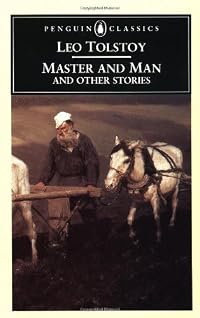
Master and man and other stories
by Leo Tolstoy
On This Page
Description
The ten stories collected in this volume demonstrate Tolstoy's artistic prowess displayed over five decades experimenting with prose styles and drawing on his own experiences with humour, realism and compassion. Inspired by his experiences in the army, 'The Two Hussars' contrasts a dashing father and his mean-spirited son. Illustrating Tolstoy's belief that art must serve a moral purpose, 'What Men Live By' portrays an angel sent to earth to learn three existential rules of life, and 'Two show more Old Men' shows a peasant abandoning his pilgrimage to the Holy Land in order to help his neighbours. And in the highly moving 'Master and Man', Tolstoy depicts a mercenary merchant travelling with his unprotesting servant through a blizzard to close a business deal - little realizing he may soon have to settle accounts with his maker. show lessTags
Recommendations













Member Reviews
A collection of three short stories (or novels?): "Father Sergius" follows a monk reaching for grace despite self-conscious pride in his virtues; "Master and Man" is about a lost landowner, his peasant, and the long, lethal winter night they spend in the countryside together; and "Hadji Murat" examines the many players at one point in Russia's long campaign to conquer the Caucasus.
"Father Sergius" and "Master and Man" are both overtly didactic (hubris and self-absorption are punished; mercy and tolerance are glorified; the transformative epiphany arrives right on cue) but enjoyable. "Hadji Murat" is a completely separate kettle of fish. According to Paul Foote's foreword, "Hadji Murat" is based on real events and remains anomalous among show more Tolstoy's late (didactic) works. Instead, Tolstoy viewed writing it as more of a guilty indulgence for himself than anything else. And "Hadji Murat" is really...good. It presents a kaleidoscope of the Russian/Chechen conflict by flitting effortlessly through the heads of a half-dozen participants, from the lowly Russian privates to Tsar Nicholas I. (And Tolstoy is pretty damning in his portrayal of the Russian elite -- there's the unmistakable impression that Nicholas I ran over Tolstoy's dog or something, because that sound you hear in the background of the story is an axe being ground). And Tolstoy goes to some lengths to parallel the cruelty of Nicholas with the inhumanity of his opposite number, the Chechen leader Shamil. But the center of the story is Hadji Murat, an opaque protagonist trying to navigate a safe course between the two insensate authorities contending for his country. The characters in "Hadji Murat" pointedly obsess about the religious and cultural distinctions that set them apart from their infidel opponents, but Tolstoy layers his POV-shifts to highlight their commonalities and shared humanity -- which, in "Hadji Murat," is less a plea for universal brotherhood and more a resigned portrait of how man is destined to fuck up man. show less
"Father Sergius" and "Master and Man" are both overtly didactic (hubris and self-absorption are punished; mercy and tolerance are glorified; the transformative epiphany arrives right on cue) but enjoyable. "Hadji Murat" is a completely separate kettle of fish. According to Paul Foote's foreword, "Hadji Murat" is based on real events and remains anomalous among show more Tolstoy's late (didactic) works. Instead, Tolstoy viewed writing it as more of a guilty indulgence for himself than anything else. And "Hadji Murat" is really...good. It presents a kaleidoscope of the Russian/Chechen conflict by flitting effortlessly through the heads of a half-dozen participants, from the lowly Russian privates to Tsar Nicholas I. (And Tolstoy is pretty damning in his portrayal of the Russian elite -- there's the unmistakable impression that Nicholas I ran over Tolstoy's dog or something, because that sound you hear in the background of the story is an axe being ground). And Tolstoy goes to some lengths to parallel the cruelty of Nicholas with the inhumanity of his opposite number, the Chechen leader Shamil. But the center of the story is Hadji Murat, an opaque protagonist trying to navigate a safe course between the two insensate authorities contending for his country. The characters in "Hadji Murat" pointedly obsess about the religious and cultural distinctions that set them apart from their infidel opponents, but Tolstoy layers his POV-shifts to highlight their commonalities and shared humanity -- which, in "Hadji Murat," is less a plea for universal brotherhood and more a resigned portrait of how man is destined to fuck up man. show less
Reading the tale, Master and Man, seems appropriate in the midst of winter. Tolstoy wrote this tale about a decade after The Death of Ivan Ilych and Winter cold is so important in the story that it becomes yet another character by the end of this sophisticated parable. Snow and biting winds gust from its pages. Its climactic event, the transferal of heat from one body to another, has a resonance that cannot be denied, but my question would be: can it be believed?
The story begins just following the attendance of a merchant, Vasily Andreich Brekhunov, at the winter festival of St. Nicholas. Brekhunov immediately turns his attention to an opportunity to become richer. On a dark afternoon, despite the threat of a storm, he sets out to show more secure the purchase of a wood at a bargain price. He takes his "kind, pleasant" servant Nikita with him, a man Brekhunov values but insensitively exploits. He pays him half what he should, and then "mostly not in money but in high-priced goods from [his] shop."
The main arc of the story is the passage from life to death, one of Tolstoy's frequent concerns (as was dramatized in Ivan Ilych). There are plenty of symbols in the narrative and the tension almost immediately begins as Brekhunov and Nikita leave the village of Kresti ("The Crosses"). The narrator describes the breaking of limits in this passage:
"As soon as they passed the last [building], they noticed at once that the wind was much stronger than they had thought. The road could hardly be seen...The fields were all in a whirl, and the limit where sky and earth met could not be seen."
Nikita drowses and they become lost, riding across bleak fields "with clumps of wormwood and straw sticking up from under the snow." They come to the village of Grishkino, receive directions and set off again. The snowstorm has intensified. Again Nikita drowses, again they get lost in "the slanting net of wind-driven snow". Night is falling. They travel in a circle.
They come again to Grishkino.
This time they seek shelter at a wealthy household of the Taras family in the village. The contrast created between the cold loneliness of the wilderness and the cozy warmth of human habitation is striking. Nikita, icicles melting from his beard, drinks "glass after glass" of tea and feels "warmer and warmer, pleasanter and pleasanter". They could safely stay with the Taras family but Brekhunov again insists they must resume their journey.
They get lost a third time, in darkness this time, and the horse Mukhorty is too tired to carry on. Nikita prepares for a night outdoors, with Brekhunov in the sleigh and himself in a straw-lined hollow. Brekhunov smokes and thinks about "the sole aim, meaning, joy, and pride of his life – of how much money he had made and might still make". But these thoughts fade into the "whistling of the wind, the fluttering and snapping of the kerchief in the shafts, and the lashing of the falling snow against the bast of the sleigh."
Over the next few pages Tolstoy tracks Brekhunov's shift from discomfort and irritation to panic. He decides to take Mukhorty and abandon Nikita – "'it's all the same if he dies. What kind of life has he got!'" – who is losing his toes to frostbite, and realizes he is probably going to die. "This thought did not seem especially unpleasant to him, because his whole life was not a continuous feast, but, on the contrary, a ceaseless servitude, which was beginning to weary him."
On a floundering Mukhorty, Brekhunov travels in smaller circles across a hostile, almost alien landscape, coming twice to a clump of wormwood – "growing on a boundary … desperately tossing about under the pressure of the wind" – that appears to mark the grim border of existence. He "sees he is perishing in the middle of this dreadful snowy waste" and realizes the horse has brought him back to the sleigh (and to the one man whom the horse loves). Then, amazingly, he scrapes the snow from Nikita and lies on top of him. In the morning Nikita is alive and Brekhunov is dead, frozen as if crucified, "his open mouth...packed with snow."
There is something strange about Brekhunov's sudden and unlikely transformation from exploiter to saviour, which Tolstoy outlines but does not precisely describe. Brekhunov's thought that "'Nikita's alive, which means I'm alive, too,'" does not comport with the unmistakably Christian symbolism of the story. There are many instances of the number three in the story, but the most insistently repeated symbol is that of the circle. This is a traditional symbol of the unity of life and death, the Chain of Being. In spite of this the moment of transformation seems at best coincidental and more likely forced. Does it represent a new form of interconnection for Brekhunov that did not exist previously, or is it a form of redemption or absolution for a life of greed and insensitivity?
"Master and Man" is a complicated tale. Do we really know these two characters who are identified primarily by a couple of essential characteristics? To paraphrase a popular song: "Is that all there is, my friend?" Nikita is kind and pleasant, but he's also a drunk who chopped up his wife's most treasured clothes. Brekhunov is odious but he sees himself as a "benefactor" (although this may merely be relative to his forebears who owned Russian "souls"). In the end these two along with the horse Mukhorty are trapped in a hostile world in a bitter and blinding snowstorm. The story only becomes a classic with the stroke of Tolstoy's pen whose clarity and simplicity of style is peerless. show less
The story begins just following the attendance of a merchant, Vasily Andreich Brekhunov, at the winter festival of St. Nicholas. Brekhunov immediately turns his attention to an opportunity to become richer. On a dark afternoon, despite the threat of a storm, he sets out to show more secure the purchase of a wood at a bargain price. He takes his "kind, pleasant" servant Nikita with him, a man Brekhunov values but insensitively exploits. He pays him half what he should, and then "mostly not in money but in high-priced goods from [his] shop."
The main arc of the story is the passage from life to death, one of Tolstoy's frequent concerns (as was dramatized in Ivan Ilych). There are plenty of symbols in the narrative and the tension almost immediately begins as Brekhunov and Nikita leave the village of Kresti ("The Crosses"). The narrator describes the breaking of limits in this passage:
"As soon as they passed the last [building], they noticed at once that the wind was much stronger than they had thought. The road could hardly be seen...The fields were all in a whirl, and the limit where sky and earth met could not be seen."
Nikita drowses and they become lost, riding across bleak fields "with clumps of wormwood and straw sticking up from under the snow." They come to the village of Grishkino, receive directions and set off again. The snowstorm has intensified. Again Nikita drowses, again they get lost in "the slanting net of wind-driven snow". Night is falling. They travel in a circle.
They come again to Grishkino.
This time they seek shelter at a wealthy household of the Taras family in the village. The contrast created between the cold loneliness of the wilderness and the cozy warmth of human habitation is striking. Nikita, icicles melting from his beard, drinks "glass after glass" of tea and feels "warmer and warmer, pleasanter and pleasanter". They could safely stay with the Taras family but Brekhunov again insists they must resume their journey.
They get lost a third time, in darkness this time, and the horse Mukhorty is too tired to carry on. Nikita prepares for a night outdoors, with Brekhunov in the sleigh and himself in a straw-lined hollow. Brekhunov smokes and thinks about "the sole aim, meaning, joy, and pride of his life – of how much money he had made and might still make". But these thoughts fade into the "whistling of the wind, the fluttering and snapping of the kerchief in the shafts, and the lashing of the falling snow against the bast of the sleigh."
Over the next few pages Tolstoy tracks Brekhunov's shift from discomfort and irritation to panic. He decides to take Mukhorty and abandon Nikita – "'it's all the same if he dies. What kind of life has he got!'" – who is losing his toes to frostbite, and realizes he is probably going to die. "This thought did not seem especially unpleasant to him, because his whole life was not a continuous feast, but, on the contrary, a ceaseless servitude, which was beginning to weary him."
On a floundering Mukhorty, Brekhunov travels in smaller circles across a hostile, almost alien landscape, coming twice to a clump of wormwood – "growing on a boundary … desperately tossing about under the pressure of the wind" – that appears to mark the grim border of existence. He "sees he is perishing in the middle of this dreadful snowy waste" and realizes the horse has brought him back to the sleigh (and to the one man whom the horse loves). Then, amazingly, he scrapes the snow from Nikita and lies on top of him. In the morning Nikita is alive and Brekhunov is dead, frozen as if crucified, "his open mouth...packed with snow."
There is something strange about Brekhunov's sudden and unlikely transformation from exploiter to saviour, which Tolstoy outlines but does not precisely describe. Brekhunov's thought that "'Nikita's alive, which means I'm alive, too,'" does not comport with the unmistakably Christian symbolism of the story. There are many instances of the number three in the story, but the most insistently repeated symbol is that of the circle. This is a traditional symbol of the unity of life and death, the Chain of Being. In spite of this the moment of transformation seems at best coincidental and more likely forced. Does it represent a new form of interconnection for Brekhunov that did not exist previously, or is it a form of redemption or absolution for a life of greed and insensitivity?
"Master and Man" is a complicated tale. Do we really know these two characters who are identified primarily by a couple of essential characteristics? To paraphrase a popular song: "Is that all there is, my friend?" Nikita is kind and pleasant, but he's also a drunk who chopped up his wife's most treasured clothes. Brekhunov is odious but he sees himself as a "benefactor" (although this may merely be relative to his forebears who owned Russian "souls"). In the end these two along with the horse Mukhorty are trapped in a hostile world in a bitter and blinding snowstorm. The story only becomes a classic with the stroke of Tolstoy's pen whose clarity and simplicity of style is peerless. show less
Ratings
Members
- Recently Added By
Lists

Russian Literature
184 works; 33 members

In Our Time books
4,934 works; 2 members
Author Information

2,482+ Works 129,160 Members
Count Lev Nikolayevich Tolstoy was born on September 9, 1828 in Russia. He is usually referred to as Leo Tolstoy. He was a Russian author who is regarded as one of the greatest authors of all time. Leo Tolstoy is best known for his novels War and Peace (1869) and Anna Karenina (1877). Tolstoy's fiction includes dozens of short stories and several show more novellas such as The Death of Ivan Ilyich, Family Happiness, and Hadji Murad. He also wrote plays and numerous philosophical essays. Tolstoy had a profound moral crisis and spiritual awakening in the 1870's which he outlined in his work, A Confession. His literal interpretation of the ethical teachings of Jesus, centering on the Sermon on the Mount, caused him to become a fervent Christian anarchist and pacifist. His ideas of nonviolent resistance which he shared in his works The Kingdom of God is Within You, had a profund impact on figures such as Mohandas Gandhi and Martin Luther King, Jr. On September 23, 1862 Tolstoy married Sophia Andreevna Behrs. She was the daughter of a court physician. They had 13 children, eight of whom survived childhood. Their early married life allowed Tolstoy much freedom to compose War and Peace and Anna Karenina with his wife acting as his secretary and proofreader. The Tolstoy family left Russia in the aftermath of the Russian Revolution and the subsequent establishment of the Soviet Union. Leo Tolstoy's relatives and descendants moved to Sweden, Germany, the United Kingdom, France and the United States. Tolstoy died of pneumonia at Astapovo train station, after a day's rail journey south on November 20, 1910 at the age of 82. (Bowker Author Biography) Count Leo Tolstoy was born in 1828 on the family estate of Yasnaya Polyana in the Tula province. He married in 1862 & was the father of 13 children. Tolstoy managed the estate of Yasnaya Polyana & ran its peasant schools, while writing his great novels, "War & Peace" (1869) & "Anna Karenina" (1877). He died in 1910. (Publisher Provided) show less
Some Editions
Series
Belongs to Publisher Series
Penguin Classics (L331)
Common Knowledge
Classifications
- Genres
- Fiction and Literature, General Fiction
- DDC/MDS
- 891.733 — Literature & rhetoric Asian Literature East Indo-European and Celtic literatures Russian and East Slavic languages Russian fiction 1800–1917
- LCC
- PG3366 .A13 .W55 — Language and Literature Slavic languages and literatures. Baltic languages. Albanian language Slavic. Baltic. Albanian Russian literature Individual authors and works 1800-1870 Tolstoi
- BISAC
Statistics
- Members
- 355
- Popularity
- 88,369
- Reviews
- 2
- Rating
- (4.10)
- Languages
- Danish, English
- Media
- Paper, Ebook
- ISBNs
- 20
- ASINs
- 4