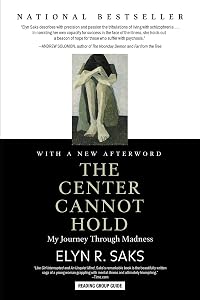
The Center Cannot Hold: My Journey through Madness
by Elyn R. Saks
On This Page
Description
Professor of psychiatry Elyn R. Saks writes about her struggle with schizophrenia in this unflinching account of her mental illness. In The Center Cannot Hold, Saks draws readers into a nightmare world of medications, a misguided health care system, and social stigmas. But she would not be defeated. With a strength and force of will that most can only imagine, Saks reclaimed her life and went on to achieve great success.Tags
Recommendations



































Member Recommendations


Member Reviews
I finished this book in tears of joy. I don't know if I can do justice to how much this book moved me as a person with schizoaffective disorder. I've read many books by people who have bipolar disorder and some by parents of people with schizophrenia but this was my first book written by someone who has schizophrenia. That sentence is a mess but I think you can gather the gist.
The fact that Elyn is hospitalized and so greatly affected by her schizophrenia, yet goes on to lead a richly successful and fulfilling life is inspiring. I am picking up the pieces of my life after it was shattered last summer. My goal is to put them back together again and Elyn gives me hope that it can happen. So far, being well enough to work eludes me. But I show more am determined that my years of getting a graduate degree and working in challenging positions will not go to waste. I am taking classes and volunteering as a start, and while it may be years before I work again full-time, I am not giving in, not giving up on my brain.
Thank you, Ms. Saks (if you ever read this), for putting yourself out there when stigma and shame are very real and threatening. You are an inspiration. show less
The fact that Elyn is hospitalized and so greatly affected by her schizophrenia, yet goes on to lead a richly successful and fulfilling life is inspiring. I am picking up the pieces of my life after it was shattered last summer. My goal is to put them back together again and Elyn gives me hope that it can happen. So far, being well enough to work eludes me. But I show more am determined that my years of getting a graduate degree and working in challenging positions will not go to waste. I am taking classes and volunteering as a start, and while it may be years before I work again full-time, I am not giving in, not giving up on my brain.
Thank you, Ms. Saks (if you ever read this), for putting yourself out there when stigma and shame are very real and threatening. You are an inspiration. show less
I thoroughly enjoyed this book. Elyn's recitation of her life and struggle is both pragmatic and incredulous. I found it to be a very straight forward read and one night, when I finally had time to really sit down and dig in I poured through over a hundred pages in what felt like minutes.
Portions of her story are significantly disturbing, including her parents' overreaction to her "drug abuse" and her subsequent "treatment" which sets her up for medication failure in the future, the blase way her concerns are at times brushed aside as just another sign of mental illness, and her treatment at the hands of several hospitals. These experiences should make us all take a deep, grim look at what we think is "right" for those who suffer from show more mental disorders.
Despite how disturbing it was, I also found it very refreshing. Elyn has found great success in her life in comparison to anyone, not just your average schizophrenic. She has a huge support web which really helps her through many tough times and stresses the importance of such people in everyone's lives. It's also notable that not once does she discuss the cost of these treatments, but for most people her good fortune wouldn't be possible due to the huge financial constraints your average middle class American now faces. She repeatedly thanks her own intelligence and hard work for getting her through but also credits her doctors who she often sees on a daily basis, without once seeming to worry about the cost.
That said, I do think there is a take away from Elyn's life, beyond "be able to afford excellent medical care." Elyn battles her disease, her prognosis, and her medication for a large portion of the book. She goes off her drugs multiple times. This isn't some internal flaw specific to her - getting your patients to stay on long term medication is difficult at best, and even harder when it carries a stigma in the form of admitting they have a mental illness. Elyn's epiphany that her medication is not a sign of failure, but rather more like insulin for diabetes or a crutch for a weak ankle, is a pivotal turning point and hopefully something more people will find helpful. Our disgust with mental illness and the treatment of mental illness has turned it into a damned if you will or damned if you won't affair, but the relief Elyn feels after accepting her disorder and her medication is great to see and hopefully will persuade others that they too are just fine taking the medications and accepting the therapy that they need.
All in all a great book which helps present what is actually going on in a schizophrenic's head and hopefully will convince more people to ignore negative stereotypes and help those in need wherever they can. show less
Portions of her story are significantly disturbing, including her parents' overreaction to her "drug abuse" and her subsequent "treatment" which sets her up for medication failure in the future, the blase way her concerns are at times brushed aside as just another sign of mental illness, and her treatment at the hands of several hospitals. These experiences should make us all take a deep, grim look at what we think is "right" for those who suffer from show more mental disorders.
Despite how disturbing it was, I also found it very refreshing. Elyn has found great success in her life in comparison to anyone, not just your average schizophrenic. She has a huge support web which really helps her through many tough times and stresses the importance of such people in everyone's lives. It's also notable that not once does she discuss the cost of these treatments, but for most people her good fortune wouldn't be possible due to the huge financial constraints your average middle class American now faces. She repeatedly thanks her own intelligence and hard work for getting her through but also credits her doctors who she often sees on a daily basis, without once seeming to worry about the cost.
That said, I do think there is a take away from Elyn's life, beyond "be able to afford excellent medical care." Elyn battles her disease, her prognosis, and her medication for a large portion of the book. She goes off her drugs multiple times. This isn't some internal flaw specific to her - getting your patients to stay on long term medication is difficult at best, and even harder when it carries a stigma in the form of admitting they have a mental illness. Elyn's epiphany that her medication is not a sign of failure, but rather more like insulin for diabetes or a crutch for a weak ankle, is a pivotal turning point and hopefully something more people will find helpful. Our disgust with mental illness and the treatment of mental illness has turned it into a damned if you will or damned if you won't affair, but the relief Elyn feels after accepting her disorder and her medication is great to see and hopefully will persuade others that they too are just fine taking the medications and accepting the therapy that they need.
All in all a great book which helps present what is actually going on in a schizophrenic's head and hopefully will convince more people to ignore negative stereotypes and help those in need wherever they can. show less
Elyn Saks is a distinguished law professor at USC, where she holds an endowed chair; she is a published author who has studied psychoanalysis; she is someone with a husband and many dear friends; and she is a schizophrenic. “The Center Cannot Hold,” her 2007 autobiography, traces her fall into madness, and her slow climb out. Just as Temple Grandin’s “Emergence” made it possible to begin to understand what it is really like to be autistic, and William Stryon’s “Darkness Visible” did the same for serious depression, “The Center Cannot Hold” provides a remarkable account of what it is like to experience psychosis—and what it is like to have the resilience to nonetheless create a successful, productive, happy life. show more
Even as a child, Saks had experiences that may have presaged her later illness, most notably when she came to believe that the houses she passed on her walk to school were sending her messages. However, she made her way through high school, graduated from college, and then moved to Oxford with a Marshall Scholarship before experiencing her first psychotic break. Over the next two decades, she struggled to control her illness. She obtained significant help from psychoanalysis, despite the common belief that the talking cure does little for schizophrenia. She also benefitting enormously from antipsychotic medicine, although she repeatedly tried to wean herself from drugs, both because she was afraid of their side effects and because they clearly represented the diagnosis she did not want to accept. Each time, her illness returned with a vengeance, and she had to return to the drugs, which she finally realized were saving her life.
Saks’ book takes its title from a quotation from Yeats: “Things fall apart, the centre cannot hold; mere anarchy is loosed upon the world.” It’s a fitting description of Saks’ psychotic breaks, which are essentially, periods of mental anarchy. As she describes it: “Place yourself in the middle of the room. Turn on the stereo, the television, the beeping video game, and then invite into the room several small children with ice cream cones. Crank up the volume on each piece of electrical equipment, then take away the children’s ice cream.
Even more harrowing than Saks’ psychoses, however, are the ways in which she’s treated during her psychotic episodes. In contrast to the humane, dignity-preserving treatment she receives at a British hospital while she’s at Oxford, what happens to her when she goes to the E.R. while at Yale Law School is horrifying. She’s immediately put into restraints, which make her even more agitated and scared, and is force-fed medicine without her consent. It’s the first of several such experiences, and it illustrates a particularly poignant problem for psychiatric patients: “The conundrum: Say what’s on your mind and there’ll be [negative] consequences; struggle to keep the delusions to yourself, and it’s likely you won’t get the help you need.”
Saks is determined to have a life despite her illness, and, she succeeds, against the odds. (She reports that only 20% of people with schizophrenia can be expected to live independently and to hold a job. ) As is probably always the case in any remarkable life, she is helped by remarkable people, including her beloved “Mrs. Jones,” her first psychoanalyst, with whom she develops an intense relationship, treating her almost as a mother figure; Steve Behnke, an extraordinarily close friend whom she meets in law school and on whom she relies on in many ways—she notes that to the current day, they speak almost daily; and her husband Will, who completes her journey to a full life when he accepts her for who she is and marries her.
Reading this book is both profoundly painful, and deeply uplifting. show less
Even as a child, Saks had experiences that may have presaged her later illness, most notably when she came to believe that the houses she passed on her walk to school were sending her messages. However, she made her way through high school, graduated from college, and then moved to Oxford with a Marshall Scholarship before experiencing her first psychotic break. Over the next two decades, she struggled to control her illness. She obtained significant help from psychoanalysis, despite the common belief that the talking cure does little for schizophrenia. She also benefitting enormously from antipsychotic medicine, although she repeatedly tried to wean herself from drugs, both because she was afraid of their side effects and because they clearly represented the diagnosis she did not want to accept. Each time, her illness returned with a vengeance, and she had to return to the drugs, which she finally realized were saving her life.
Saks’ book takes its title from a quotation from Yeats: “Things fall apart, the centre cannot hold; mere anarchy is loosed upon the world.” It’s a fitting description of Saks’ psychotic breaks, which are essentially, periods of mental anarchy. As she describes it: “Place yourself in the middle of the room. Turn on the stereo, the television, the beeping video game, and then invite into the room several small children with ice cream cones. Crank up the volume on each piece of electrical equipment, then take away the children’s ice cream.
Even more harrowing than Saks’ psychoses, however, are the ways in which she’s treated during her psychotic episodes. In contrast to the humane, dignity-preserving treatment she receives at a British hospital while she’s at Oxford, what happens to her when she goes to the E.R. while at Yale Law School is horrifying. She’s immediately put into restraints, which make her even more agitated and scared, and is force-fed medicine without her consent. It’s the first of several such experiences, and it illustrates a particularly poignant problem for psychiatric patients: “The conundrum: Say what’s on your mind and there’ll be [negative] consequences; struggle to keep the delusions to yourself, and it’s likely you won’t get the help you need.”
Saks is determined to have a life despite her illness, and, she succeeds, against the odds. (She reports that only 20% of people with schizophrenia can be expected to live independently and to hold a job. ) As is probably always the case in any remarkable life, she is helped by remarkable people, including her beloved “Mrs. Jones,” her first psychoanalyst, with whom she develops an intense relationship, treating her almost as a mother figure; Steve Behnke, an extraordinarily close friend whom she meets in law school and on whom she relies on in many ways—she notes that to the current day, they speak almost daily; and her husband Will, who completes her journey to a full life when he accepts her for who she is and marries her.
Reading this book is both profoundly painful, and deeply uplifting. show less
I never thought I'd read a book where a Freudian psychoanalyst is a hero. This book just blew me away - at every turn a frank and open story of mental illness from the person who experienced it. I did the audiobook equivalent of "couldn't put it down".
An amazing woman has written an eye-opening book!
No review is going to do justice to this incredible book by Elyn Saks, an academic dean, tenured law school and medical school professor, psychoanalysis student, and, not incidentally, a raving (at times of stress or change) schizophrenic. For readers who assume schizophrenics live out their lives, if we can really call their bare existences lives, shackled literally by physical restraints or zombie-d by antipsychotic drugs, always perched to incite violence against themselves or others, or slinking along building walls muttering about being god and killing people with their thoughts, this is a must-read book unlike any other in the field.
More amazing than the author's current positions show more in the academic and psychiatric world, the author has had "florid" schizophrenia starting when she was about 8 years old, although it didn't fully appear until she was studying at Oxford U. on a Marshall scholarship. She got her BA at Vanderbilt, graduating valedictorian, and after Oxford, got her law degree at Yale. This is no mediocre woman! Her vivid and precise descriptions of her hallucinations and psychotic breaks are like nothing I have ever read before. Her incredible ability to cover up "the voices" and disorganized thoughts to enable her to progress through life more successfully than most "normal" people, is unmatched, although change and stress will still make her rave like a maniac. It takes Ms. Saks almost 20 years of failures and forced hospital commitments to finally realize she needs to take medication for her entire life. But, unlike most people with schizophrenia one is likely to meet or read about, she was helped tremendously by psychoanalysis and talk therapy, treatments that have long been thought useless with such patients.
I have never before encountered such a book nor such a person as Elyn Saks. She leads an amazing and courageous life and has published numerous academic treatises about the forced institutionalization, restraint, and medication of the mentally ill. I know there is a lot more to come from this astonishing mind. show less
No review is going to do justice to this incredible book by Elyn Saks, an academic dean, tenured law school and medical school professor, psychoanalysis student, and, not incidentally, a raving (at times of stress or change) schizophrenic. For readers who assume schizophrenics live out their lives, if we can really call their bare existences lives, shackled literally by physical restraints or zombie-d by antipsychotic drugs, always perched to incite violence against themselves or others, or slinking along building walls muttering about being god and killing people with their thoughts, this is a must-read book unlike any other in the field.
More amazing than the author's current positions show more in the academic and psychiatric world, the author has had "florid" schizophrenia starting when she was about 8 years old, although it didn't fully appear until she was studying at Oxford U. on a Marshall scholarship. She got her BA at Vanderbilt, graduating valedictorian, and after Oxford, got her law degree at Yale. This is no mediocre woman! Her vivid and precise descriptions of her hallucinations and psychotic breaks are like nothing I have ever read before. Her incredible ability to cover up "the voices" and disorganized thoughts to enable her to progress through life more successfully than most "normal" people, is unmatched, although change and stress will still make her rave like a maniac. It takes Ms. Saks almost 20 years of failures and forced hospital commitments to finally realize she needs to take medication for her entire life. But, unlike most people with schizophrenia one is likely to meet or read about, she was helped tremendously by psychoanalysis and talk therapy, treatments that have long been thought useless with such patients.
I have never before encountered such a book nor such a person as Elyn Saks. She leads an amazing and courageous life and has published numerous academic treatises about the forced institutionalization, restraint, and medication of the mentally ill. I know there is a lot more to come from this astonishing mind. show less
This is an astonishing and illuminating memoir of a woman with great gifts who also happens to be schizophrenic. Saks describes the sensations involved very well, and does an excellent job of making it clear that people with mental illness, while not always able to manage, should not be treated like dangerous freaks but with compassion and understanding. She provides a telling comparison of care of the mentally ill in the UK and US because she was first hospitalized when she was on a Mellon fellowship at Oxford. There the doors weren’t locked, medication wasn’t forced, and the patients were treated with some dignity; in the US, in contrast, while a law student at Yale, she was placed in restraints for days at a time, forcibly show more medicated, and essentially taught that the best thing to do was to avoid letting anyone know what was going on inside her head - not the best way to deal with scary feelings.
The sensitive work of several psychoanalysts, the care of friends, and medication, combined with her own inner strength and intelligence, pulled her through some very difficult times. She is particularly informative about the emotional cost of having to take medication for the rest of one’s life - her discussion of why that’s so difficult really helps explain why going off meds is so persistently tempting for so many people.
One in five families in the US is affected by major mental illness. This book could be enormously helpful in understanding the issues because Saks does such a good job of explaining what schizophrenia feels like - and how other people’s reactions can help or hurt. It’s an engrossing, wonderfully written memoir besides. Highly recommended. show less
The sensitive work of several psychoanalysts, the care of friends, and medication, combined with her own inner strength and intelligence, pulled her through some very difficult times. She is particularly informative about the emotional cost of having to take medication for the rest of one’s life - her discussion of why that’s so difficult really helps explain why going off meds is so persistently tempting for so many people.
One in five families in the US is affected by major mental illness. This book could be enormously helpful in understanding the issues because Saks does such a good job of explaining what schizophrenia feels like - and how other people’s reactions can help or hurt. It’s an engrossing, wonderfully written memoir besides. Highly recommended. show less
I'd like to meet Elyn. My view of the world is in many ways different than hers but I think we could have an interesting conversation about it.
I am less comfortable with the concept of mental illness (Thomas Szasz The Myth of Mental Illness: Foundations of a Theory of Personal Conduct appears on my "currently reading" list) than she is. She talks a lot about her psychoanalysis but, though it appears that she is revealing everything, I suspect there's a lot in her analysis that she does not talk about. At least I hope there is since, were I here analyst, there are many topics I'd want to cover. I'll only mention one. Her relationship with her parents in the book is a little too rosy. Considering some of the stories she tells, with a show more positive spin of sorts, I believe they must have made her feel terribly alone and unseen, and I'm talking about the time >before
No, I'll mention a second. Her competitiveness and her retreat to unreality in response to even mild criticism (she is much more resilient under actual attack!) is a constant thread in her life and she never seems to analyze it (at least in the text of the book.)
My unreal fantasy (See? You don't need a diagnosis to have unreal fantasies.) is that I could help her recovery. Among other things, like her Mrs. Jones, I believe her persecutorial internal objects need to be reowned by her. She has a lot of rage with which she invests these imagined monsters and I'd like to know what it is about. I suspect it may be related to how she wasn't understood or seen growing up. She thinks that her parents were loving is sufficient, but to be loved but not seen isn't a trivial thing.
Still, her book is quite engaging and I'm glad she's out there fighting the good fight. show less
I am less comfortable with the concept of mental illness (Thomas Szasz The Myth of Mental Illness: Foundations of a Theory of Personal Conduct appears on my "currently reading" list) than she is. She talks a lot about her psychoanalysis but, though it appears that she is revealing everything, I suspect there's a lot in her analysis that she does not talk about. At least I hope there is since, were I here analyst, there are many topics I'd want to cover. I'll only mention one. Her relationship with her parents in the book is a little too rosy. Considering some of the stories she tells, with a show more positive spin of sorts, I believe they must have made her feel terribly alone and unseen, and I'm talking about the time >before
No, I'll mention a second. Her competitiveness and her retreat to unreality in response to even mild criticism (she is much more resilient under actual attack!) is a constant thread in her life and she never seems to analyze it (at least in the text of the book.)
My unreal fantasy (See? You don't need a diagnosis to have unreal fantasies.) is that I could help her recovery. Among other things, like her Mrs. Jones, I believe her persecutorial internal objects need to be reowned by her. She has a lot of rage with which she invests these imagined monsters and I'd like to know what it is about. I suspect it may be related to how she wasn't understood or seen growing up. She thinks that her parents were loving is sufficient, but to be loved but not seen isn't a trivial thing.
Still, her book is quite engaging and I'm glad she's out there fighting the good fight. show less
Members
- Recently Added By
Lists

Top Five Books of 2017
757 works; 230 members

Top Five Books of 2013
1,562 works; 715 members

thinking of reading in 2016
99 works; 1 member

Hachette Book Group
152 works; 6 members

Books Read in 2017
4,249 works; 129 members
Author Information

6 Works 1,313 Members
Some Editions
Awards and Honors
Common Knowledge
- Canonical title
- The Center Cannot Hold: My Journey through Madness
- Original publication date
- 2007
Classifications
- Genres
- Biography & Memoir, Nonfiction, General Nonfiction
- DDC/MDS
- 616.8980092 — Applied science & technology Medicine & health Diseases, Allergies, Skin Conditions Nervous Disorders: Autism, Anorexia, OCD Mental disorders: bi-polar/schizophrenia Schizophrenia
- LCC
- RC464 .S25 .A3 — Medicine Internal medicine Internal medicine Neurosciences. Biological psychiatry. Neuropsychiatry Psychiatry
- BISAC
Statistics
- Members
- 1,260
- Popularity
- 19,469
- Reviews
- 39
- Rating
- (4.16)
- Languages
- Dutch, English
- Media
- Paper, Audiobook, Ebook
- ISBNs
- 16
- ASINs
- 11