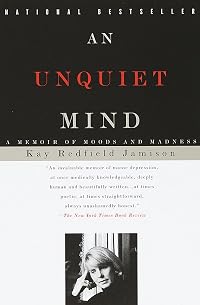
An Unquiet Mind: A Memoir of Moods and Madness
by Kay Redfield Jamison
On This Page
Description
"Dr. Jamison is one of the foremost authorities on manic-depressive (bipolar) illness; she has also experienced it firsthand. For even while she was pursuing her career in academic medicine, Jamison found herself succumbing to the same exhilarating highs and catastrophic depressions that afflicted many of her patients, as her disorder launched her into ruinous spending sprees, episodes of violence, and an attempted suicide. Here Jamison examines bipolar illness from the dual perspectives of show more the healer and the healed, revealing both its terrors and the cruel allure that at times prompted her to resist taking medication."--Provided by publisher. show lessTags
Recommendations




















Member Recommendations


grmb Bøkene omhandler kvinner som i voksen alder får en diagnose på en kronisk psykiatrisk lidelse som i stor grad innvirker på deres liv, sitt forhold til seg selv og andre. Begge bøkene gir et godt innenfra perspektiv på hvordan det kan oppleves å ikke ha kontroll på stemningsnivå og uro. Begge bøkene kan bidra til økt forståelse for hvordan lidelsene; henholdsvis ADHD og bipolar lidelse arter seg-og at mennesker med psykiatrisk lidelse har en diagnose-ikke er en diagnose. De er to kvinner som finner sine strategier å leve med sitt handicap-på godt og vondt.



Member Reviews
Years ago my mother took me to a series of talks at The U of Penn -- about depression and connected maladies. I heard Bill Styron talk about his terrifying bout with depression (about which he wrote in Darkness Visible) and also Kay Redfield Jamison whose book, An Unquiet Mind had just recently come out. Previous to this, Jamison, a clinical psychologist, had kept her own bipolar illness to herself and where necessary, friends and colleagues. (She prefers the term manic-depressive as more accurately descriptive.) The thumbnail takeaways are 1) If you are bipolar and lithium works for you, TAKE IT faithfully. 2) ALSO don't neglect to have a good therapist and psychiatrist who know your story 3) forgive yourself for the bad times and move show more on. 4) be open to loving and being loved. Jamison explores one of the key bipolar dilemmas--a terrifying number of those who have been diagnosed, who have had horrendous and repeated episodes of mania and depression, refuse to take lithium or quit, again and again once they feel better. The reasons are mainly cultural and she explores those. She also describes the allure and the terror of mania and the combined terror and utter tedium of depression, the former (the allure part) of which also made taking lithium regularly difficult to bear. We all know people who are bipolar, as it is surprisingly common, still kept hidden by individuals and families more afraid of the disruption of others knowing than of the private suffering, and so very very much the hidden cause behind many suicides and destroyed relationships. Jamison has devoted herself to bringing this topic into the open and to taking the cultural onus from being a sufferer down a few pegs. With time and experience too, she has been able to reduce her dose of lithium to one where her mind works more quickly, although she has had to work at staying on an even keel. (This took decades and dedication.)
Brava! ***** show less
Brava! ***** show less
'Which of my feelings are real? Which of me is me? The wild, impulsive, chaotic, energetic, and crazy one? Or the shy, withdrawn, desperate, suicidal, doomed, and tired one? Probably a bit of both, hopefully much that is neither.'
There is no way to make people not battling through it themselves understand how it actually feels to experience a mental illness. One can barely make them grasp it, maybe have them to get sympathy and a vague sense of grip; but telling of how it really feels, with all its subjectivity, is a nearly impossible feat, especially since such experiences will be different even between affected individuals. Yet, Kay Redfield Jamison manages to nearly achieve just that in exposing here all the fire of manic-depressive show more illness (she rejects the now widely used term 'bipolar'), 'a disease that both kills and gives life' -from its flying and intoxicating highs to its crushing and absolutely frightening lows, and the painful consequences coming with both.
There are a few books out there telling of first hand experiences of mental illnesses and depression. 'An Unquiet Mind', though, still stands out not least because the author is also a clinician specialist of the topic. Her ability to detach herself from what she is going through while battling her own demons is striking. The insights it provides her and, consequently, the readers are thus remarkable.
Indeed, it's the strange interplay between being a doctor and a patient, as well as the author's own human contradictions, that are here puzzling and touching. She not only tells of her wild dance with mania and depression (so bad she once tried to kill herself). She also opens up about the difficult issue of taking medication, the damages caused on relationships and, being genetic, the effect the disorder has had from her childhood (her dad was a likely sufferer too) to herself thinking of being a mother.
Here's an account which is as personal as it is insightful, but always moving and relevant. It can be grim. It can be funny. It can be hopeful. It is, above all, brave, emotional and, at the image of the illness it depicts, an intense read.
Highly recommended to anyone having an interest in manic-depressive/ bipolar disorder. show less
There is no way to make people not battling through it themselves understand how it actually feels to experience a mental illness. One can barely make them grasp it, maybe have them to get sympathy and a vague sense of grip; but telling of how it really feels, with all its subjectivity, is a nearly impossible feat, especially since such experiences will be different even between affected individuals. Yet, Kay Redfield Jamison manages to nearly achieve just that in exposing here all the fire of manic-depressive show more illness (she rejects the now widely used term 'bipolar'), 'a disease that both kills and gives life' -from its flying and intoxicating highs to its crushing and absolutely frightening lows, and the painful consequences coming with both.
There are a few books out there telling of first hand experiences of mental illnesses and depression. 'An Unquiet Mind', though, still stands out not least because the author is also a clinician specialist of the topic. Her ability to detach herself from what she is going through while battling her own demons is striking. The insights it provides her and, consequently, the readers are thus remarkable.
Indeed, it's the strange interplay between being a doctor and a patient, as well as the author's own human contradictions, that are here puzzling and touching. She not only tells of her wild dance with mania and depression (so bad she once tried to kill herself). She also opens up about the difficult issue of taking medication, the damages caused on relationships and, being genetic, the effect the disorder has had from her childhood (her dad was a likely sufferer too) to herself thinking of being a mother.
Here's an account which is as personal as it is insightful, but always moving and relevant. It can be grim. It can be funny. It can be hopeful. It is, above all, brave, emotional and, at the image of the illness it depicts, an intense read.
Highly recommended to anyone having an interest in manic-depressive/ bipolar disorder. show less
"I am tired of hiding, tired of misspent and knotted energies, tired of the hypocrisy, and tired of acting as though I have something to hide. One is what one is, and the dishonesty of hiding behind a degree, or a title, or any manner and collection of words, is still exactly that: dishonest."
Unmatched. Kay Redfield Jamison wrote this memoir in the 1990s, about her experiences with mental illness. She studies mood disorders at Johns Hopkins, and realized while studying Bipolar disorder that she herself had manic-depressive symptoms. The fact that she simultaneously has both an academic and a personal understanding of the condition allows her to articulate the experience in a way that is, as I said, unmatched.
Finding good representation show more of mental illness in any sense is frustratingly difficult. Lately I've been trying to find ways to articulate my own experiences, and I don't know how in the world I can copy what Dr. Jamison did in this book but I want to find out. This is not only an exemplary piece of writing, it is a beacon to any neuro-typical readers that want to see what it's like.
My experience, or the experience of anybody with any mental health problems, does not need to be exactly like Dr. Jamison's in order for this book to be meaningful. It's mere existence, let alone it's success, let alone it's actual content and style, is all so overwhelmingly excellent. To hear depression described as the feeling of being "dull, boring, inadequate, thick brained, unlit, unresponsive, chill skinned, bloodless, and sparrow drab" is energizing in it's honesty. Mental disorders, especially those of the depressive sort, are so inherently isolating. It takes an excellent writer to convey the feeling that those who struggle with these things are not alone.
The book also easily grapples with the complex struggles of medication, self-doubt, and maintaining healthy connections with other people. It explores the fears of hospitalization, and the reason why so many suicide attempts "fail", and why we consider these attempts "failures" (we shouldn't).
All in all, fantastic book.
"He taught me that the road from suicide to life is cold and colder and colder still, but- with steely effort, the grace of God, and an inevitable break in the weather- that I could make it."
I know the quotes are getting out of hand, but I'm going to close with pretty much the entire epilogue because it's very important:
"I have often asked myself whether, given the choice, I would choose to have manic-depressive illness. If [medicine] were not available to me, or didn't work for me, the answer would be a simple no- and it would be an answer laced with terror. But [it does, so]... I would choose to have it. It's complicated. Depression is awful beyond words or sounds or images; I would not go through an extended one again. It bleeds relationships.... there is nothing good to be said for it except that it gives you the experience of how it must be to be old, to be old and sick, to be dying...
Others imply that they know what it is like to be depressed because they have gone through a divorce, lost a job, or broken up with someone. But these experiences carry with them feelings. Depression, instead, is flat, hollow, and unendurable. It is also tiresome... So why would I want anything to do with this illness? Because I honestly believe that as a result of it I have felt more things, more deeply... worn death "as close as dungarees", appreciated it-and life- more...
Depressed, I have crawled on my hands and knees in order to get across a room and have done it for month after month. But, normal or manic, I have run faster, thought faster, and loved faster than most I know... The countless hypomanias, and mania itself, all have brought into my life a different level of sensing and feeling and thinking. Even when I have been most psychotic- delusional, hallucinating, frenzied- I have been aware of finding new corners in my mind and heart. Some of thee corners were incredible and beautiful and took my breath away and made me feel as though I could die right then and the images would sustain me. Some of them were grotesque and ugly and I never wanted to know they were there or to see them again. But, always, there were those new corners and- when feeling my normal self, beholden for that self to medicine and love- I cannot imagine becoming jaded to life, because I know of those limitless corners, with their limitless views." show less
Unmatched. Kay Redfield Jamison wrote this memoir in the 1990s, about her experiences with mental illness. She studies mood disorders at Johns Hopkins, and realized while studying Bipolar disorder that she herself had manic-depressive symptoms. The fact that she simultaneously has both an academic and a personal understanding of the condition allows her to articulate the experience in a way that is, as I said, unmatched.
Finding good representation show more of mental illness in any sense is frustratingly difficult. Lately I've been trying to find ways to articulate my own experiences, and I don't know how in the world I can copy what Dr. Jamison did in this book but I want to find out. This is not only an exemplary piece of writing, it is a beacon to any neuro-typical readers that want to see what it's like.
My experience, or the experience of anybody with any mental health problems, does not need to be exactly like Dr. Jamison's in order for this book to be meaningful. It's mere existence, let alone it's success, let alone it's actual content and style, is all so overwhelmingly excellent. To hear depression described as the feeling of being "dull, boring, inadequate, thick brained, unlit, unresponsive, chill skinned, bloodless, and sparrow drab" is energizing in it's honesty. Mental disorders, especially those of the depressive sort, are so inherently isolating. It takes an excellent writer to convey the feeling that those who struggle with these things are not alone.
The book also easily grapples with the complex struggles of medication, self-doubt, and maintaining healthy connections with other people. It explores the fears of hospitalization, and the reason why so many suicide attempts "fail", and why we consider these attempts "failures" (we shouldn't).
All in all, fantastic book.
"He taught me that the road from suicide to life is cold and colder and colder still, but- with steely effort, the grace of God, and an inevitable break in the weather- that I could make it."
I know the quotes are getting out of hand, but I'm going to close with pretty much the entire epilogue because it's very important:
"I have often asked myself whether, given the choice, I would choose to have manic-depressive illness. If [medicine] were not available to me, or didn't work for me, the answer would be a simple no- and it would be an answer laced with terror. But [it does, so]... I would choose to have it. It's complicated. Depression is awful beyond words or sounds or images; I would not go through an extended one again. It bleeds relationships.... there is nothing good to be said for it except that it gives you the experience of how it must be to be old, to be old and sick, to be dying...
Others imply that they know what it is like to be depressed because they have gone through a divorce, lost a job, or broken up with someone. But these experiences carry with them feelings. Depression, instead, is flat, hollow, and unendurable. It is also tiresome... So why would I want anything to do with this illness? Because I honestly believe that as a result of it I have felt more things, more deeply... worn death "as close as dungarees", appreciated it-and life- more...
Depressed, I have crawled on my hands and knees in order to get across a room and have done it for month after month. But, normal or manic, I have run faster, thought faster, and loved faster than most I know... The countless hypomanias, and mania itself, all have brought into my life a different level of sensing and feeling and thinking. Even when I have been most psychotic- delusional, hallucinating, frenzied- I have been aware of finding new corners in my mind and heart. Some of thee corners were incredible and beautiful and took my breath away and made me feel as though I could die right then and the images would sustain me. Some of them were grotesque and ugly and I never wanted to know they were there or to see them again. But, always, there were those new corners and- when feeling my normal self, beholden for that self to medicine and love- I cannot imagine becoming jaded to life, because I know of those limitless corners, with their limitless views." show less
As a memoir of a clinical researcher suffering from the very pathology she studies, "An Unquiet Mind" is candid, eloquent, and remarkably human in the way is addresses the reader face-on and quietly. That the author's personal journey runs concurrently with the changes in medical diagnoses, treatments, available medications, and in societal perceptions of mental illness makes "AUM" a chronicle as well of the dark spectre of a treatable disease being brought out of the closet into the light and seen for what it is. Jamison's account is at its best when she interweaves the threads of family and love, medical treatment, friendships, and personal struggles to make her point that a human mind is not a singular thing but the nexus of a show more working system and should be approached as such. Jamison also makes good use of literary references, musical allusions, and plain-old cultural literacy to centrally locate her story in a living, societal context.
There are a number of contra-indications, however, and the most salient to me is the now very dated nature of this work, published in 1995. Jamison, at the time of writing, was very much an advocate of pharmaceutical treatment of bipolar disorder, or any and all mental illness for that matter. In the nearly-thirty years since, over-prescription of SSRIs, opioids, and a pharmacopeia of other drugs...driven by an increasingly powerful Pharma Lobby...has created an entirely different landscape, a field of 'cures' far more destructive than the diseases and a Psychiatry based solely upon brain-altering drugs. Lithium worked for Jamison, and was apparently the workhorse from the early-1970s onward, but that was then and this is now. I wonder what a new edition of this book would look like, and what Jamison maintains this far into the 21st century. show less
There are a number of contra-indications, however, and the most salient to me is the now very dated nature of this work, published in 1995. Jamison, at the time of writing, was very much an advocate of pharmaceutical treatment of bipolar disorder, or any and all mental illness for that matter. In the nearly-thirty years since, over-prescription of SSRIs, opioids, and a pharmacopeia of other drugs...driven by an increasingly powerful Pharma Lobby...has created an entirely different landscape, a field of 'cures' far more destructive than the diseases and a Psychiatry based solely upon brain-altering drugs. Lithium worked for Jamison, and was apparently the workhorse from the early-1970s onward, but that was then and this is now. I wonder what a new edition of this book would look like, and what Jamison maintains this far into the 21st century. show less
An Unquiet Mind by Kay Redfield Jamison is an intimate look into the havoc that bipolar disorder can wreak. The book captures her journey with bipolar, from its emergence in her late teens to its effects on her accomplished career as a clinical psychologist and university professor.
The book contains rich descriptions, and is searingly honest. There’s no attempt to gloss over the messy and downright ugly bits of mental illness. The author is extremely insightful, and does an excellent job of capturing in words what mental illness feels like. She described the “particular kind of pain, elation, loneliness, and terror involved in this kind of madness… You are irritable, angry, frightened, uncontrollable, and totally enmeshed in the show more blackest caves of the mind.”
Many of the challenges Jamison has faced will sound very familiar to anyone living with a mood disorder. She is very open about her struggle to accept her diagnosis and the attached stigma. Even once she recognized that she was struggling with her mental health, fear and shame stopped her from seeking treatment. It took a long time for her to accept that she needed to remain on medication, and there were multiple occasions when she stopped her meds and then experienced a relapse of mania.
Several factors played into her reluctance to take medication, including a wish not to be brought down from the highs of mania. She thought of medications as something that “might be indicated for psychiatric patients, for those of weaker stock, but not for us.” She was placed on high doses of lithium, which caused considerable side effects including nausea and impaired coordination, and at times she ended up with toxic blood levels.
Her work as a psychologist impacted how she experienced and managed her illness and its treatment. When she first met with a psychiatrist, “the questions were familiar, I had asked them of others a hundred times, but I found it unnerving to have to answer them, unnerving not to know where it was all going, and unnerving not to realize how confusing it was to be a patient.”
When she was highly depressed, her psychiatrist tried to persuade her to go to hospital, but she refused. The idea terrified her and she didn’t want to have to “put up with all of the indignities and invasions of privacy that go into being on a psychiatric ward.” She also worried that if it became known she’d been hospitalized “my clinical work and privileges at best would be suspended; at worst, they would be revoked on a permanent basis.” This resonated strongly with me, as I have similar fears about the loss of my nursing license if I were to be hospitalized again.
As Jamison was recovering from a long period of suicidal depression, she began a romantic relationship with a man. He asked her to come to stay with him in London, and she states that although she was “still recovering… and my thoughts were so halting and my feelings so gray I could scarcely bear it I somehow knew that things would be made better by being with him. They were. Immeasurably.” Love helped her replace the awfulness of illness with beauty and vitality, which I found this interesting, as, in the past, love has made a big difference in my own recovery.
Jamison writes about the issue of language choices when it comes to mental illness. She prefers the term manic-depressive illness to bipolar disorder, as she finds it more accurate. She also questioned whether in the end destigmatization can possibly come from simple language changes, or whether it will instead come from things like public education and improvements in diagnosis and treatment.
Stigma within the health professions is discussed, including the example of one doctor who told her she shouldn’t have children due to her illness. Jamison warns that stigma may prevent clinicians with mental illness from seeking treatment because of concerns about their professional license or privileges. She has been careful to create a safety net of colleagues who are aware of her illness and who will step in to keep her from practice should her mental health start to deteriorate.
This reminds me of the safety net I had in place several years ago when I was getting outpatient ECT. I knew from past experience that ECT adversely affected my memory and I was often unaware of the full extent of this impairment, so I had spoken to each of the physicians I worked with and asked them to let me know if I was slipping in my management of our shared patients so that I would know if I needed to take time off.
I found the conclusion of the book very powerful. The author stated that, as a result of her illness:
I have felt more things, more deeply; had more experiences, more intensely; loved more, and been more loved; laughed more often for having cried more often; appreciated more the springs, for all the winters; worn death ‘as close as dungarees’, appreciated it—and life—more; seen the finest and the most terrible in people, and slowly learned the values of caring, loyalty, and seeing things through.
It’s a good reminder to all of us that as dark as mental illness can be, it doesn’t entirely shut out the light. I would definitely recommend An Unquiet Mind.
https://mentalhealthathome.org/2018/08/01/book-review-an-unquiet-mind/ show less
The book contains rich descriptions, and is searingly honest. There’s no attempt to gloss over the messy and downright ugly bits of mental illness. The author is extremely insightful, and does an excellent job of capturing in words what mental illness feels like. She described the “particular kind of pain, elation, loneliness, and terror involved in this kind of madness… You are irritable, angry, frightened, uncontrollable, and totally enmeshed in the show more blackest caves of the mind.”
Many of the challenges Jamison has faced will sound very familiar to anyone living with a mood disorder. She is very open about her struggle to accept her diagnosis and the attached stigma. Even once she recognized that she was struggling with her mental health, fear and shame stopped her from seeking treatment. It took a long time for her to accept that she needed to remain on medication, and there were multiple occasions when she stopped her meds and then experienced a relapse of mania.
Several factors played into her reluctance to take medication, including a wish not to be brought down from the highs of mania. She thought of medications as something that “might be indicated for psychiatric patients, for those of weaker stock, but not for us.” She was placed on high doses of lithium, which caused considerable side effects including nausea and impaired coordination, and at times she ended up with toxic blood levels.
Her work as a psychologist impacted how she experienced and managed her illness and its treatment. When she first met with a psychiatrist, “the questions were familiar, I had asked them of others a hundred times, but I found it unnerving to have to answer them, unnerving not to know where it was all going, and unnerving not to realize how confusing it was to be a patient.”
When she was highly depressed, her psychiatrist tried to persuade her to go to hospital, but she refused. The idea terrified her and she didn’t want to have to “put up with all of the indignities and invasions of privacy that go into being on a psychiatric ward.” She also worried that if it became known she’d been hospitalized “my clinical work and privileges at best would be suspended; at worst, they would be revoked on a permanent basis.” This resonated strongly with me, as I have similar fears about the loss of my nursing license if I were to be hospitalized again.
As Jamison was recovering from a long period of suicidal depression, she began a romantic relationship with a man. He asked her to come to stay with him in London, and she states that although she was “still recovering… and my thoughts were so halting and my feelings so gray I could scarcely bear it I somehow knew that things would be made better by being with him. They were. Immeasurably.” Love helped her replace the awfulness of illness with beauty and vitality, which I found this interesting, as, in the past, love has made a big difference in my own recovery.
Jamison writes about the issue of language choices when it comes to mental illness. She prefers the term manic-depressive illness to bipolar disorder, as she finds it more accurate. She also questioned whether in the end destigmatization can possibly come from simple language changes, or whether it will instead come from things like public education and improvements in diagnosis and treatment.
Stigma within the health professions is discussed, including the example of one doctor who told her she shouldn’t have children due to her illness. Jamison warns that stigma may prevent clinicians with mental illness from seeking treatment because of concerns about their professional license or privileges. She has been careful to create a safety net of colleagues who are aware of her illness and who will step in to keep her from practice should her mental health start to deteriorate.
This reminds me of the safety net I had in place several years ago when I was getting outpatient ECT. I knew from past experience that ECT adversely affected my memory and I was often unaware of the full extent of this impairment, so I had spoken to each of the physicians I worked with and asked them to let me know if I was slipping in my management of our shared patients so that I would know if I needed to take time off.
I found the conclusion of the book very powerful. The author stated that, as a result of her illness:
I have felt more things, more deeply; had more experiences, more intensely; loved more, and been more loved; laughed more often for having cried more often; appreciated more the springs, for all the winters; worn death ‘as close as dungarees’, appreciated it—and life—more; seen the finest and the most terrible in people, and slowly learned the values of caring, loyalty, and seeing things through.
It’s a good reminder to all of us that as dark as mental illness can be, it doesn’t entirely shut out the light. I would definitely recommend An Unquiet Mind.
https://mentalhealthathome.org/2018/08/01/book-review-an-unquiet-mind/ show less
As someone with bipolar disorder (or manic depressive disorder, if you prefer), I know this kind of subject matter well. Reading the author's unfolding story had me doing a lot of "yep, been there and done that" but also a lot of "wow, I'm glad that didn't happen to me" and "huh, I wonder why THIS didn't happen to her even though it happened to me so many times".
I expected all of that. People with bipolar disorder stop at a lot of the same way stations but travel between them in a huge array of styles.
What I didn't expect was for this book to be so triggering for me, primarily in the explanation of how hard it is to stay on medication. While reading those parts, I found myself longing for the person that *I* was without medication. This show more is a struggle that it seems like nobody really escapes (at least nobody that I've known), and the fact that I felt it so keenly while reading this book makes me suspect that the author does a good job of conveying how hard it can be to stay medicated - even when you know intellectually that it's saving your life.
Would somebody 'normal' find this as good of a read as I did? No clue... but I'm probably as close to 'normal' as I'll ever get and I liked it. :) show less
I expected all of that. People with bipolar disorder stop at a lot of the same way stations but travel between them in a huge array of styles.
What I didn't expect was for this book to be so triggering for me, primarily in the explanation of how hard it is to stay on medication. While reading those parts, I found myself longing for the person that *I* was without medication. This show more is a struggle that it seems like nobody really escapes (at least nobody that I've known), and the fact that I felt it so keenly while reading this book makes me suspect that the author does a good job of conveying how hard it can be to stay medicated - even when you know intellectually that it's saving your life.
Would somebody 'normal' find this as good of a read as I did? No clue... but I'm probably as close to 'normal' as I'll ever get and I liked it. :) show less
I read this book to better understand the complexities of mania and depression and to learn more about it from the perspective of not only someone with the disease, but from someone who is also a professional and academic in the field. Perhaps what I find most compelling about this book is the openness through which she discusses the topics of bipolar, mental illness, and suicide. These topics are still considered socially taboo, and she does a great job of bringing to light why they’re so important to talk about (with friends and family, as well as in academia).
However, I unfortunately think her case is truly extraordinary. I was surprised by how supportive virtually everyone she encountered was of her and of her illness. Then again, show more she was surrounded by incredibly well-informed individuals (and some of the best researchers and practitioners in the field). Not everyone with bipolar has a such a strong support system or has the luxury of being surrounded by people who know and understand the disease, which is also part of the problem. Further, it doesn’t even begin to describe to the socioeconomic problems faced by lower or middle-class individuals who have the disease. It can be hard for people with this disease to hold a job (or even get a job), which can seriously limit their access to healthcare. People less fortunate than her often end up institutionalized in one form or another, and lack access to healthcare and other resources they need to function.
I think this book does a great job of explaining the highs and lows of bipolar and how it truly affects all aspects of life. It answers many of the ongoing questions friends and family of people with bipolar have: how and why bipolar is a disease and should be treated as such, how even the most intelligent people can become suicidal, and why people with bipolar so often stop and then resume taking medication (and the often-horrible side effects of such medication). Overall, it’s a very insightful book that gives interesting, thought-provoking insights into bipolar illness. show less
However, I unfortunately think her case is truly extraordinary. I was surprised by how supportive virtually everyone she encountered was of her and of her illness. Then again, show more she was surrounded by incredibly well-informed individuals (and some of the best researchers and practitioners in the field). Not everyone with bipolar has a such a strong support system or has the luxury of being surrounded by people who know and understand the disease, which is also part of the problem. Further, it doesn’t even begin to describe to the socioeconomic problems faced by lower or middle-class individuals who have the disease. It can be hard for people with this disease to hold a job (or even get a job), which can seriously limit their access to healthcare. People less fortunate than her often end up institutionalized in one form or another, and lack access to healthcare and other resources they need to function.
I think this book does a great job of explaining the highs and lows of bipolar and how it truly affects all aspects of life. It answers many of the ongoing questions friends and family of people with bipolar have: how and why bipolar is a disease and should be treated as such, how even the most intelligent people can become suicidal, and why people with bipolar so often stop and then resume taking medication (and the often-horrible side effects of such medication). Overall, it’s a very insightful book that gives interesting, thought-provoking insights into bipolar illness. show less
Members
- Recently Added By
Lists

Books Read in 2016
4,666 works; 199 members

Female Author
1,235 works; 65 members

Penguin Random House
458 works; 4 members

Best Self Help Books
87 works; 18 members
Author Information

18+ Works 8,294 Members
Clinical psychologist Kay Redfield Jamison was born on June 22, 1946. She received a B.A., M.A., and Ph.D. from the University of California, Los Angeles. She is considered one of the foremost experts on bipolar disorder, which she has had since her early adulthood. She is Professor of Psychiatry at the Johns Hopkins University School of Medicine show more and a Honorary Professor of English at the University of St. Andrews in Scotland. She is the author of numerous books including An Unquiet Mind: A Memoir of Moods and Madness; Night Falls Fast: Understanding Suicide; and Touched with Fire: Manic-Depressive Illness and the Artistic Temperament. (Bowker Author Biography) show less
Awards and Honors
Distinctions
Common Knowledge
- Canonical title
- An Unquiet Mind: A Memoir of Moods and Madness
- Original publication date
- 1995
- People/Characters
- Kay Redfield Jamison
- Important places
- University of California, Los Angeles, California, USA
- Epigraph
- I doubt sometimes whether
a quiet & unagitated life
would have suited me—yet I
sometimes long for it.
—Byron - Dedication
- For my mother,
Dell Temple Jamison
Who gave me life not
once, but countless times - First words
- Prologue
When it's two o'clock in the morning, and you're manic, even the UCLA Medical Center has a certain appeal.
I was standing with my head back, one pigtail caught between my teeth, listening to the jet overhead. - Quotations
- "Moods are such an essential part of the substance of life, of one's notion of oneself, that even psychotic extremes in mood and behavior can somehow be seen as temporary, even understandable, reactions to what life has dealt... (show all)."
"It took me far too long to realize that lost years and relationships cannot be recovered, that damage done to oneself and others cannot always be put right again, and that freedom from the control imposed by medication loses... (show all) its meaning when the only alternatives are death and insanity."
"If we got rid of all the manic-depressives on the medical school faculty, not only would we have a much smaller faculty, it would also be a far more boring one." (chairman of the Department of Psychiatry at Johns Hopkins Ho... (show all)spital) - Last words
- (Click to show. Warning: May contain spoilers.)Epilogue
But, always, there were those new corners and—when feeling my normal self, beholden for that self to medicine and love—I cannot imagine becoming jaded to life, because I know of those limitless corners, with their limitless views.
(Click to show. Warning: May contain spoilers.)It is, at the end of the day, the individual moments of restlessness, of bleakness, of strong persuasions and maddened enthusiasms, that inform one's life, change the nature and direction of one's work, and give final meaning and color to one's loves and friendships. - Blurbers
- Sacks, Oliver; Safire, William; Watson, James D.; Gardner, Howard; Conroy, Pat; Self, Will
- Original language*
- Engels
*Some information comes from Common Knowledge in other languages. Click "Edit" for more information.
Classifications
- Genres
- Biography & Memoir, General Nonfiction, Nonfiction
- DDC/MDS
- 616.8950092 — Applied science & technology Medicine & health Diseases, Allergies, Skin Conditions Nervous Disorders: Autism, Anorexia, OCD Mental disorders: bi-polar/schizophrenia Bipolar
- LCC
- RC516 .J363 — Medicine Internal medicine Internal medicine Neurosciences. Biological psychiatry. Neuropsychiatry Psychiatry Psychopathology Psychoses
- BISAC
Statistics
- Members
- 4,604
- Popularity
- 3,151
- Reviews
- 69
- Rating
- (3.93)
- Languages
- 13 — Arabic, Chinese, Danish, Dutch, English, Finnish, French, German, Italian, Norwegian (Bokmål), Portuguese, Spanish, Turkish
- Media
- Paper, Audiobook, Ebook
- ISBNs
- 36
- UPCs
- 1
- ASINs
- 25