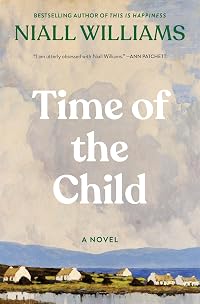
On This Page
Description
Doctor Jack Troy was born and raised in Faha, but his responsibilities for the sick and his care for the dying mean he has always been set apart from the town. His eldest daughter, Ronnie, has grown up in her father's shadow, and remains there, having missed one chance at love - and passed up another offer of marriage from an unsuitable man. But in the Advent season of 1962, as the town readies itself for Christmas, Ronnie and Doctor Troy's lives are turned upside down when a baby is left in show more their care. As the winter passes, father and daughter's lives, the understanding of their family, and their role in their community are changed forever. Set over the course of one December in the same village as Williams' beloved This Is Happiness, Time of the Child is a tender return to Faha for readers who know its charms, and a heartwarming welcome to new readers entering for the very first time. show lessTags
Recommendations






Member Reviews
In a Nutshell: A companion novel to "This is Happiness" (TIH). Same setting and era, different key characters. Even more slow-paced and meandering than the earlier novel. The writing is just as stunning, but the narration didn't work as well for me this time around. Still, a good option for prose lovers.
~~~~~~~~~~~~~~~~~~~~~~~
Plot Preview:
This book is not exactly a sequel. While the events of this novel are set four years after the end of TIH, the plot is independent enough to work as a standalone story. There is a little recap provided wherever the reader needs a reference of what happened in the earlier novel. However, for a few characters who make a reappearance in this story, their background is available in detail only in the first book. As such, if you are a stickler for detail, you might like to begin with TIH before venturing into this story.
This time, I was even better prepared for the unstructured narration as I already had first-hand experience of the author’s writing style while reading TIH. But unlike that novel, which was presented in the form of a septuagenarian’s first-person reminiscences about his teen years in Faha, this book is written in a more generic third-person POV, which shifts across multiple characters and even multiple timelines. As such, I found it tougher to forgive the meandering narration this time around. With no firm narrator, there was no justification as to why the story had to take such a serpentine and disjointed journey to the finish line.
Another issue is that, while the book regularly informs us that “a child was found” on a particular night, the actual appearance of the child in the main plot happens only after the one-third mark. So the hundred-or-so pages of build-up can get a bit tedious, all the more as the book keeps reciting disparate incidents from “the day it happened”, but the day seems never-ending!
Those are my only two complaints, but both are relatively major ones.
I liked the three main characters of this book: Dr. Troy, Ronnie, and their teen neighbour Jack. Each of them carries some or the other pain from their pasts, which doesn’t allow them to immerse fully in the happiness of the present. Ronnie was especially amazing, and I love that a male author could create such a compelling and relatable female character and even provide her arc the perfect ending.
Just as in TIH, the characters of this book feel utterly real, like people we might even know in actual life. That grounded approach helps us stay invested in the “plot” even when there’s so little of it. For a character-driven book, such compelling characters are a must. Yet again, Faha the place is as good as a character, with its belief system being the instigator of several events.
The plot is just as wafer-thin as in TIH, but as I said, I was better prepared for it this time around. While the arrival of electricity was the driving force in the first book, the appearance of the child is the key catalyst in this one. The idea of someone stepping in to take care of an abandoned child might lead you to certain assumptions about how the plot will go. But most of these guesses would be inapplicable to this story. I was pleasantly surprised by how the author chose to drive that particular arc ahead.
The writing is just as pleasing and soul-satisfying. The metaphors, the descriptions, the vocabulary, the thought-provoking one-liners – all a literary treat. I think the first book fared a little better in this regard because of its narrator being the source of much wisdom, but this book also has plenty to reflect upon.
All in all, this book is a treat for the prose lover, and a test of the patience for the plot lover. If you are all about the journey and don’t care where you are going as long as you are moving, this novel ought to be a delight.
Recommended but not to all. This book is for literary fiction lovers who like character-driven, prose-rich, plot-less storytelling. If possible, try to read ‘This is Happiness’ prior to this book, though they are both standalones.
3.5 stars, rounding up because the writing and Ronnie deserve it.
My thanks to Bloomsbury Publishing Plc (UK & ANZ) for providing the DRC of “Time of the Child” via NetGalley. This review is voluntary and contains my honest opinion about the book.
~~~~~~~~~~~~~~~~~~~~~~~
Connect with me through:
|| My Blog || The StoryGraph || Instagram || Facebook || show less
~~~~~~~~~~~~~~~~~~~~~~~
Plot Preview:
1962. Faha, four years after the events of "This is Happiness". Doctor Jack Troy is still in Faha, but of his three daughters, only his eldest, Ronnie, still stays with him and helps him with his duties. As Advent begins, a teenaged boy from their neighbourhood turns up at their doorstep with a baby in his arms. With no idea about who abandoned the baby, the Troys have to accept responsibility for theshow more
little charge, with Ronnie doing so gladly. But the good doctor knows that there needs to be one immediate change in their life if Ronnie wants to care for the baby. She must get married!
The story comes to us in the third-person perspective of several characters.
This book is not exactly a sequel. While the events of this novel are set four years after the end of TIH, the plot is independent enough to work as a standalone story. There is a little recap provided wherever the reader needs a reference of what happened in the earlier novel. However, for a few characters who make a reappearance in this story, their background is available in detail only in the first book. As such, if you are a stickler for detail, you might like to begin with TIH before venturing into this story.
This time, I was even better prepared for the unstructured narration as I already had first-hand experience of the author’s writing style while reading TIH. But unlike that novel, which was presented in the form of a septuagenarian’s first-person reminiscences about his teen years in Faha, this book is written in a more generic third-person POV, which shifts across multiple characters and even multiple timelines. As such, I found it tougher to forgive the meandering narration this time around. With no firm narrator, there was no justification as to why the story had to take such a serpentine and disjointed journey to the finish line.
Another issue is that, while the book regularly informs us that “a child was found” on a particular night, the actual appearance of the child in the main plot happens only after the one-third mark. So the hundred-or-so pages of build-up can get a bit tedious, all the more as the book keeps reciting disparate incidents from “the day it happened”, but the day seems never-ending!
Those are my only two complaints, but both are relatively major ones.
I liked the three main characters of this book: Dr. Troy, Ronnie, and their teen neighbour Jack. Each of them carries some or the other pain from their pasts, which doesn’t allow them to immerse fully in the happiness of the present. Ronnie was especially amazing, and I love that a male author could create such a compelling and relatable female character and even provide her arc the perfect ending.
Just as in TIH, the characters of this book feel utterly real, like people we might even know in actual life. That grounded approach helps us stay invested in the “plot” even when there’s so little of it. For a character-driven book, such compelling characters are a must. Yet again, Faha the place is as good as a character, with its belief system being the instigator of several events.
The plot is just as wafer-thin as in TIH, but as I said, I was better prepared for it this time around. While the arrival of electricity was the driving force in the first book, the appearance of the child is the key catalyst in this one. The idea of someone stepping in to take care of an abandoned child might lead you to certain assumptions about how the plot will go. But most of these guesses would be inapplicable to this story. I was pleasantly surprised by how the author chose to drive that particular arc ahead.
The writing is just as pleasing and soul-satisfying. The metaphors, the descriptions, the vocabulary, the thought-provoking one-liners – all a literary treat. I think the first book fared a little better in this regard because of its narrator being the source of much wisdom, but this book also has plenty to reflect upon.
All in all, this book is a treat for the prose lover, and a test of the patience for the plot lover. If you are all about the journey and don’t care where you are going as long as you are moving, this novel ought to be a delight.
Recommended but not to all. This book is for literary fiction lovers who like character-driven, prose-rich, plot-less storytelling. If possible, try to read ‘This is Happiness’ prior to this book, though they are both standalones.
3.5 stars, rounding up because the writing and Ronnie deserve it.
My thanks to Bloomsbury Publishing Plc (UK & ANZ) for providing the DRC of “Time of the Child” via NetGalley. This review is voluntary and contains my honest opinion about the book.
~~~~~~~~~~~~~~~~~~~~~~~
Connect with me through:
|| My Blog || The StoryGraph || Instagram || Facebook || show less
On the monthly fair day, a boy waiting to bring his da home from the pub, finds an infant abandoned behind the church. He brings it to Dr. Troy. The baby lives and then the question becomes, what will be done with it? Running parallel to this story is that of the failing priest of the village, Father Tom, who is succumbing to dementia. Perhaps too, running between these book ends of life are Dr. Troy and his daughter Ronnie, one at the end of mid-life and the other on the edge of determining her future as an adult. The baby is the catalyst for everyone.
I marvelled over how easily Williams can shift point of view, but then I though, that is because the characters in the village of Faha (Clare, Ireland) are facets of the real character show more which is Faha itself, a small village, on the cusp of change, but not changed yet. Along with profound moments there is also, as ever with Williams, plenty of humour to soften the blows of reality.
There are novels in which the story is merely an excuse for the prose, and novels where the story is all, supported by workmanlike prose. Williams offers both! *****
Country doctor's all-purpose diagnosis: It'll either get worse, get better, or it will stay the same."
A quote: "Living in a parish that had the character of the bottom of a pocket, with only one way out, meant that everyone knew who was where and doing what without being told . . ."(201) show less
I marvelled over how easily Williams can shift point of view, but then I though, that is because the characters in the village of Faha (Clare, Ireland) are facets of the real character show more which is Faha itself, a small village, on the cusp of change, but not changed yet. Along with profound moments there is also, as ever with Williams, plenty of humour to soften the blows of reality.
There are novels in which the story is merely an excuse for the prose, and novels where the story is all, supported by workmanlike prose. Williams offers both! *****
Country doctor's all-purpose diagnosis: It'll either get worse, get better, or it will stay the same."
A quote: "Living in a parish that had the character of the bottom of a pocket, with only one way out, meant that everyone knew who was where and doing what without being told . . ."(201) show less
Written in Williams' marvelous style of textured layers of the lives of ordinary people in a small Irish village, this story of an abandoned infant who changes the lives of Dr. Jack Troy, his daughter Ronnie, and the entire village is charming without being sappy. Niall Williams has a way of draping his sentences in language that describe the subtle depth of people and place. It is placed in Faha where his earlier novel "This is Happiness" was also featured. Both are highly recommended.
Set in Faha, Ireland in the weeks leading up to Christmas 1962, the story begins when an infant is found abandoned. Doctor Troy and his daughter Ronnie, take the child in, and try to keep it a secret from the town.
What a wonderful novel of love and family and understanding and forgiveness. Williams populates Faha with a variety of characters from an elderly priest who is clearly descending into dementia, to the young boy who finds the child, and the various people that make up a community – tradesmen, farmers, shopkeepers, the ladies of the church, school children, and the new young priest who is finding his way. In this very Catholic community, there are expectations and rules of conduct. The doctor is a trusted person who has never show more steered them wrong before, so his and Ronnie’s behavior and secrecy of late is concerning to all.
I had not read anything by Williams before, but this will NOT be the last book by him that I read. He’s a marvelous storyteller, and he writes with vivid descriptions and intelligent character development.
I particularly loved this scene of the Christmas Eve service:
The main pews were filling by procession, families coming in at the pace at which people look at each other when they’re in their best clothes. Hats that only came out for Christmas, the red felt one, the blue one with nominal ostrich feather, the green with seven plastic cherries, and the brimless pillbox or what passed for that in Faha, sat atop women’s heads in milliner’s homage to the saviour of the world, the half-can of hairspray securing the foundations. Those scrubbed children who, by age or convenience, had the dispensation to stay up, moved up the aisle with a nun’s reverence and mimicked the manners of adults in the theatre of a midnight birth.” show less
What a wonderful novel of love and family and understanding and forgiveness. Williams populates Faha with a variety of characters from an elderly priest who is clearly descending into dementia, to the young boy who finds the child, and the various people that make up a community – tradesmen, farmers, shopkeepers, the ladies of the church, school children, and the new young priest who is finding his way. In this very Catholic community, there are expectations and rules of conduct. The doctor is a trusted person who has never show more steered them wrong before, so his and Ronnie’s behavior and secrecy of late is concerning to all.
I had not read anything by Williams before, but this will NOT be the last book by him that I read. He’s a marvelous storyteller, and he writes with vivid descriptions and intelligent character development.
I particularly loved this scene of the Christmas Eve service:
The main pews were filling by procession, families coming in at the pace at which people look at each other when they’re in their best clothes. Hats that only came out for Christmas, the red felt one, the blue one with nominal ostrich feather, the green with seven plastic cherries, and the brimless pillbox or what passed for that in Faha, sat atop women’s heads in milliner’s homage to the saviour of the world, the half-can of hairspray securing the foundations. Those scrubbed children who, by age or convenience, had the dispensation to stay up, moved up the aisle with a nun’s reverence and mimicked the manners of adults in the theatre of a midnight birth.” show less
Stunning on characterization--of people, place and time---but less so on story. Nothing moves fast in the Irish village of Faha, where rain is nearly constant, and a blue sky makes villagers lift their eyes in wonder. It's 1962, Christmas is coming, and local traditions are playing out. At the annual Christmas Fair, a young boy finds a baby behind the church, and believes it to be dead. With the help of two batchelor brothers he carries the child off to the home of Dr. Troy who revives her and then swears everyone involved to "Say nothing to anyone". From there, we watch as the doctor's daughter falls in love with the little one, and he himself schemes--ineptly and ill-advisedly, but always with love-- to avoid turning wee Noelle over show more to the authorities. Once immersed in the language and locale, it doesn't matter much to this reader that not a lot actually happens here. I enjoyed the read, but it did lack something I can't quite put my finger on, and left me mildly dissatisfied after I had loved This is Happiness by the same author. show less
This lovely book by Niall Williams is set in the fictional small town of Faha in Ireland in 1962. Jack Troy shares a home with his eldest daughter, Ronnie, who is unmarried at 29 and takes care of their home and helps with Jack's medical practice by ushering patients into his office in the lower part of their home. Due to the small size of the community, everyone is very interested and invested in all that happens in the lives of their fellow citizens. Like his father before him, Jack is entrusted with the care of his patients and their families. His father's words of wisdom resonate throughout the novel.
When a baby is discovered one cold night in a field, she is brought to the doctor. The assumption that she was dead is soon discovered show more by Jack to be wrong, and she is placed in the willing and able hands of Ronnie. Everyone involved is sworn to secrecy for fear that the baby, Noelle, will have to be placed with social services. Jack is thrilled at how happy the baby has made Ronnie; however, secrets are not easily kept in Faha so Noelle's fate hangs in the balance.
There are many stories of Faha's inhabitants in this book. Faha itself becomes a character with its annual Christmas fair. The fact that the baby was found at the beginning of Christmas is especially meaningful as everyone comes together to welcome the wonder of this child at the Christmas Eve mass. show less
When a baby is discovered one cold night in a field, she is brought to the doctor. The assumption that she was dead is soon discovered show more by Jack to be wrong, and she is placed in the willing and able hands of Ronnie. Everyone involved is sworn to secrecy for fear that the baby, Noelle, will have to be placed with social services. Jack is thrilled at how happy the baby has made Ronnie; however, secrets are not easily kept in Faha so Noelle's fate hangs in the balance.
There are many stories of Faha's inhabitants in this book. Faha itself becomes a character with its annual Christmas fair. The fact that the baby was found at the beginning of Christmas is especially meaningful as everyone comes together to welcome the wonder of this child at the Christmas Eve mass. show less
Niall Williams has a style all his own. His prose reads like a storytale meandering from one thought to the next within the same sentence. Once I became accustomed to the rhythm of his narrative, I was all in. I have discovered that I enjoy the stories of the common person, told with reflection and insight so that the reader might enjoy the discovery of wisdom. This story takes place leading up to the 1962 Christmas holiday in a fictional Irish village. Williams treats us to the daily happenings in this small village on the coast in the south of Ireland. He uses an omniscient point of view to comment on the thoughts and actions of his flawed and loveable characters. Including folklore, religious doctrine and scientific research, show more Williams examines the health and well-being of the villagers as they face the challenges of changing societal norms. show less
Members
- Recently Added By
Lists

Top Five Books of 2024
795 works; 264 members

Books Read in 2024
4,727 works; 128 members
Top Five Books of 2025
954 works; 303 members
Author Information

21+ Works 4,775 Members
Author and playwright Niall Williams was born in Dublin in 1958. He received a Master's degree in Modern American Literature from University College Dublin, where he also studied English and French literature. In 1980, he moved to New York and worked as a copywriter for Avon Books. In 1985, he moved back to Ireland to become a full-time writer. show more His first four books were co-written with his wife and deal with their life together in Kiltumper, Ireland. On his own, he has written three plays and five novels. His first novel, Four Letters of Love, became an international bestseller. (Bowker Author Biography) show less
Some Editions
Awards and Honors
Awards
Distinctions
The Guardian Book of the Day (2024-12-19)
Series

Common Knowledge
- Original publication date
- 2024-10-24
- Important places
- Faha, County Cork, Ireland
- Epigraph
- There will be a fair tomorrow in County Clare.
Traditional Irish Song
I felt like a soul being prayed for.
Seamus Heaney - First words
- This is what happened in Faha over the Christmas of 1962, in what became known in the parish as the time of the child.
Classifications
Statistics
- Members
- 500
- Popularity
- 60,420
- Reviews
- 32
- Rating
- (4.28)
- Languages
- English
- Media
- Paper, Audiobook, Ebook
- ISBNs
- 12
- ASINs
- 4