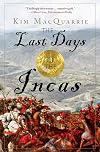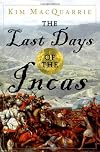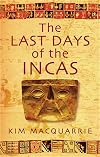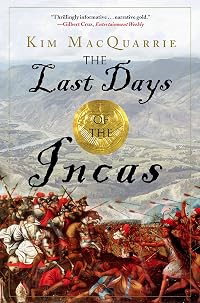
The Last Days of the Incas
by Kim MacQuarrie 
On This Page
Description
In 1532, the fifty-four-year-old Spanish conquistador Francisco Pizarro led a force of 167 men, including his four brothers, to the shores of Peru. Unbeknownst to the Spaniards, the Inca rulers of Peru had just fought a bloody civil war in which the emperor Atahualpa had defeated his brother Huascar. Pizarro and his men soon clashed with Atahualpa and a huge force of Inca warriors at the Battle of Cajamarca. Despite being outnumbered by more than two hundred to one, the Spaniards show more prevailed-due largely to their horses, their steel armor and swords, and their tactic of surprise. They captured and imprisoned Atahualpa. Although the Inca emperor paid an enormous ransom in gold, the Spaniards executed him anyway. The following year, the Spaniards seized the Inca capital of Cuzco, completing their conquest of the largest native empire the New World has ever known. Peru was now a Spanish colony, and the conquistadors were wealthy beyond their wildest dreams. But the Incas did not submit willingly. A young Inca emperor, the brother of Atahualpa, soon led a massive rebellion against the Spaniards, inflicting heavy casualties and nearly wiping out the conquerors. Eventually, however, Pizarro and his men forced the emperor to abandon the Andes and flee to the Amazon. There, he established a hidden capital, called Vilcabamba. Although the Incas fought a deadly, thirty-six-year-long guerrilla war, the Spanish ultimately captured the last Inca emperor and vanquished the native resistance. Kim MacQuarrie lived in Peru for five years and became fascinated by the Incas and the history of the Spanish conquest. Drawing on both native and Spanish chronicles, he vividly describes the dramatic story of the conquest, with all its savagery and suspense. MacQuarrie also relates the story of the modern search for Vilcabamba, of how Machu Picchu was discovered, and of how a trio of colorful American explorers only recently discovered the lost Inca capital of Vilcabamba, which had been hidden in the Amazon for centuries.This authoritative, exciting history is among the most powerful and important accounts of the culture of the South American Indians and the Spanish Conquest. show lessTags
Recommendations











Member Recommendations

JGolomb A terrific narrative history of the conquest of the Incas.
Member Reviews
A popular topic of discussion in European intellectual circles over the last couple of centuries has been the so-called Black Legend. Largely formulated in northern Protestant Europe, the Black Legend holds the the golden age of the Spanish Empire was a nightmare of brutality, repression, fanaticism and exploitation, and that the Spanish, both in Europe and in their American colonies, gloried in unspeakable acts in the name of God and the Spanish king. Not surprisingly, this belief was particularly strong in Britain and the Netherlands, two countries who had plenty of history with the Spanish. Equally unsurprisingly, the Spanish strongly reject the Black Legend, to the extent that some scholars now refer to a White Legend, a show more Spanish-sponsored revisionism which goes to the other extreme and portrays the Spanish as, if not exactly enlightened colonizers, as certainly much more humane than they have been portrayed. I’m not versed enough in Spanish colonial history to offer an educated opinion one way or another on the validity or otherwise of the Black Legend, however, after reading this book, I am quite comfortable saying that on the basis of Spanish activities in Peru, the Black Legend seems much more likely than the White. You will seldom find a more horrifying account of greed, brutality, venality and treachery than the history of Francisco Pizzaro’s conquest of the Inca Empire. There is really no saving grace for Spain here. In the space of four decades, a few thousand Spaniards wiped out a great and cultured civilization, murdered uncountable numbers of its inhabitants and subjected the rest to slavery, all in the name of God, Gold and Glory. The noble side of the story is the heroic resistance the Inca, using spears and swords against horses, muskets, armour and cannon, put up for those forty years. This is an extremely well-written account of horrors beyond imagining, an ugly and brutal story that is nonetheless enthralling. It is topped and tailed by an exciting account of the discovery of the lost Inca cities of Macchu Picchu and Vilcabamba and the eccentric characters who believed enough in the legends to go out and find them. I guess we wait now for Spanish revisionism of this story. I can’t see how it can be done, but it will be some job of restoration if it is achieved show less
Spanish conquistador Francisco Pizarro was the illegitimate son of a very poor woman who became the ruler of Peru by conquering the Incas. The Incas put up a good fight, and won many battles. But their territory continued to shrink as the Incas sought a place to live in the mountains. This book tells their story from the Spanish arrival and the death of the last Inca emperor. The book feels comprehensive but interesting. My only complaint is the author editorializing too much: he states as fact the Incas were benevolent rulers and theirs was a utopia. I think that goes too far. Just because the Spanish were so wrong in everything they did in colonizing the Americas, that doesn’t mean the opposite (in essence a perfect society) is true show more of the colonized peoples. Setting that aside, it’s an excellent history of the end of the Incas and Peru sounds so beautiful and bountiful. show less
A fascinating and very detailed account of the Spanish conquest of Peru. Very informative account of the despicable and barbaric behavior of the Spanish invaders who pillaged and raped their way through the Inca empire.
Irrespective of sentiments and political correctness (PC Brigade alert), Pizzaro's conquest of the Incas-while nefarious-also holds perpetual lessons for us in the form of leadership contrasts between both the Conquistadores and the Incan Royalty. And these contrasts form a crucial backdrop to MacQuarrie's narration of the rise and fall of the Incan Empire. Intertwined alongside are the fates of the Pizzaro clan and the turns in their fortunes. This is an epic tour de force rendition of a tragic history which reverberates as viscerally today as it did when the events mentioned transpired.
Mr. MacQuarrie has written a more colourful update to John Hemming's book on the destruction of the Empire of the Four Quarters. The tone is somewhat more sensation, the information is sketchier in some areas, but as in the case of the identification of the "Lost City" of Vilcabamba, the coverage is more fine grained. The book benefits from the research and archaeology done since Hemming's day, and there is more information about the actual function and probable history of Machu Picchu. If you have read this book as well as the earlier book by Hemming, you will be well equipped for going deeper into the Inca culture, and that of the Spanish Empire as a whole.
This was a well researched and well written account of the Spanish conquest of the Inca nation. I was naturally appalled, if not surprised, at the way the Spanish treated the natives. That said, it is equally important to remember the atrocities committed by the Incas in the name of religion. They were not the nicest people either. Last Days of the Incas was a page turner from the first encounter between Francisco Pizarro and the Inca to the final showdown between the warring Spanish over who would have control of the new colonies. Then, in an epilogue, MacQuarrie jumps forward to 1911 and gives a general overview of the modern explorers who discovered the ruins of the Inca cities, including Machu Picchu. At this point, things got a show more little weird for me. The material was still interesting, just in terms of knowing the timeline of when and how some of these amazing ruins were discovered, but I think the ins and outs of the competition to publish first and the personal lives of some of the explorers might well be a different book. Highly recommended, but beware. If you didn't already have Peru on your bucket list, you will after you read this book. show less
I wish there was more information available about the Incas pre-Pizarro, but there really isn't; what there is is here, along with a detailed and engrossing account of the Spanish conquest of the Incas. Excellent stuff and a gripping story.
Members
- Recently Added By
Lists

In Our Time books
4,934 works; 2 members
Author Information

10 Works 840 Members
Kim MacQuarrie is a writer, a four-time Emmy-winning documentary filmmaker, and an anthropologist. He is the author of four books on Peru, including The Last Days of the Incas. which Entertainment Weekly called "Thrillingly informative narrative gold."
Kim MacQuarrie is a LibraryThing Author, an author who lists their personal library on LibraryThing.
Awards and Honors
Common Knowledge
- Original title
- The last days of the Incas
- Original publication date
- 2007, Simon & Schuster, USA
- People/Characters
- Francisco Pizarro; Atahualpa; Manco Capac
- Important places
- Cuzco, Peru; Peru; Andes Mountains; Inca Empire
- Important events
- Spanish Conquest of Peru; Incan Civilization; Pre-Columbian Era
- Original language*
- English
*Some information comes from Common Knowledge in other languages. Click "Edit" for more information.
Classifications
Statistics
- Members
- 713
- Popularity
- 40,048
- Reviews
- 26
- Rating
- (4.03)
- Languages
- Czech, English, Polish, Spanish
- Media
- Paper, Audiobook, Ebook
- ISBNs
- 21
- ASINs
- 7