
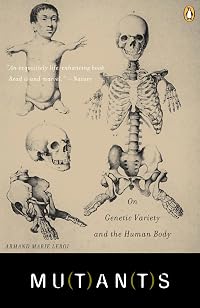
Mutants: On Genetic Variety and the Human Body
by Armand Marie Leroi
On This Page
Description
History. Science. Nonfiction. HTML:Visit Armand Marie Leroi on the web: http://armandleroi.com/index.html Stepping effortlessly from myth to cutting-edge science, Mutants gives a brilliant narrative account of our genetic code and the captivating people whose bodies have revealed it—a French convent girl who found herself changing sex at puberty; children who, echoing Homer’s Cyclops, are born with a single eye in the middle of their foreheads; a village of long-lived Croatian dwarves; show more one family, whose bodies were entirely covered with hair, was kept at the Burmese royal court for four generations and gave Darwin one of his keenest insights into heredity. This elegant, humane, and engaging book “captures what we know of the development of what makes us human” (Nature).. show less
Tags
Recommendations


















Member Reviews
Disclaimer: this book was published in 2003, so of course there are portions out of date (the chapter on gender for example) But otherwise this was a fascinating tour through the world of biology and genetics!
The author makes a valid point throughout that "mutant" genes should neither be gawked at nor ignored. And they don't just "happen." Nearly all of the conditions mentioned are caused by a mutation in a protein. But these mutations could be a result of nutritional deficiency, chemical poison, environmental hazard, etc. For example, the (now banned) use of Thalidomide for morning sickness! Some mutations can be traced back hundreds of years because of a unique physical trait. The author also discusses the darker treatment of those show more who were considered "monsters" or "freaks." Courts and princes collected them, naturalists catalogued them and theologians turned them into religious propaganda. It was thought that a pregnant woman could cause deformity in her child if she looked at an "unsightly" thing. At Auschwitz, Elizabeth Ovitz and her family (among many others) were tortured under Mengele, who was never tried for his crimes!
Among those mentioned are Ritta and Christina Parodi, Harry Eastlack (who's skeleton I saw at the Mutter Museum!), Clara and Altagracia Rodriguez, and more famous names like Charles Byrne, Eng and Chang, Joseph Boruwlaski and Henri de Toulouse-Lautrec. I learned about Kartagener's Syndrome, the "sonic hedgehog mutation" (it's true!), Cleppie Bells, BMPs, Hoxd13, cyclopia, osteopetrosis, the noggin molecule, sirenomelia and Robert's Syndrome just to name a few. And explaining these mutations in layman's terms is no easy feat. It's not perfect, as the study of the human body is never ending, but I gained an incredible amount of new information and starting points for more! show less
The author makes a valid point throughout that "mutant" genes should neither be gawked at nor ignored. And they don't just "happen." Nearly all of the conditions mentioned are caused by a mutation in a protein. But these mutations could be a result of nutritional deficiency, chemical poison, environmental hazard, etc. For example, the (now banned) use of Thalidomide for morning sickness! Some mutations can be traced back hundreds of years because of a unique physical trait. The author also discusses the darker treatment of those show more who were considered "monsters" or "freaks." Courts and princes collected them, naturalists catalogued them and theologians turned them into religious propaganda. It was thought that a pregnant woman could cause deformity in her child if she looked at an "unsightly" thing. At Auschwitz, Elizabeth Ovitz and her family (among many others) were tortured under Mengele, who was never tried for his crimes!
Among those mentioned are Ritta and Christina Parodi, Harry Eastlack (who's skeleton I saw at the Mutter Museum!), Clara and Altagracia Rodriguez, and more famous names like Charles Byrne, Eng and Chang, Joseph Boruwlaski and Henri de Toulouse-Lautrec. I learned about Kartagener's Syndrome, the "sonic hedgehog mutation" (it's true!), Cleppie Bells, BMPs, Hoxd13, cyclopia, osteopetrosis, the noggin molecule, sirenomelia and Robert's Syndrome just to name a few. And explaining these mutations in layman's terms is no easy feat. It's not perfect, as the study of the human body is never ending, but I gained an incredible amount of new information and starting points for more! show less
Very good, if a little creepy. Author Armand Marie Leroi treats the subject of human body variation (we’re talking things like conjoined twins, not eye color) with a mixture of compassion and intellectual curiosity that would make me happy to deal with him if I had two heads. Both of us, in fact.
Conjoined twins (“Siamese twins” in less politically correct times) result from fusion of embryonic disks very early in development. The details are fascinating: 77% of conjoined twins are both female; it’s possible, although rare, to have conjoined twins that are not monozygotic (i.e., not “identical”), demonstrating that at least some of the time they are the result of embryo fusion rather than splitting. In 50% of cases, one twin show more is “inverted” (the internal organs are reversed left-right). This last observation leads Leroi to discuss Kartagener’s syndrome – organ inversion in single births (about 1:8500). People with Kartagener’s syndrome generally have a poor sense of smell, and men born with it are sterile. What these things have in common is defective cilia; and it turns out that there’s a small group of mesodermal cells in the very early embryo that have cilia and provide a very weak current in the amniotic fluid. The current allows the developing embryo to distinguish left from right, and if the cilia are nonfunctional it goes wrong half the time.
Leroi continues with a discussion of homeobox genes and their role in setting up bilateral symmetry in the body. I was surprised to discover that about 10% of people have an extra rib – odds are that someone here does. The extra can come in a variety of ways; a cervical vertebra can get the wrong signal and develop ribs it isn’t supposed to (I know someone with that; she had to have them removed as they were causing “thoracic outlet syndrome", a sort of carpal tunnel of the shoulders). I also know somebody with extra ribs because he’s go an entire extra back vertebra, not discovered until he tried to join the National Guard. The discussion of homeobox genes helped me see what Martin Lockley was getting a when he talked about them as the reason for the small forelimbs of Tyrannosaurus rex in a book reviewed earlier; I still don’t agree with him but it makes a little more sense now.
Then there are various limb defects - polydactyly, “cleppies” with claw-like hands, phocomelia, and so on. Interestingly, people with defective limbs tend to have defective genitalia as well, and Leroi notes that the folk-wisdom correlation between foot size and penis size is actually true (although weak).
The chapter on bone variations has some unpleasant illustrations: the skeleton of the unfortunate Harry Eastlake, who suffered from a condition that caused continuous and random bone growth, and a family of Transylvanian Jews with pseudoachondroplasia who ended up surviving Auschwitz because they were favorites of Joseph Mengele. Growth conditions – pygmies, giants, castrati, and Proteus (Elephant Man) syndrome are caused by various changes in genes that make growth factor hormones. Castrati were tall because they lacked estrogen (usually thought of as a female hormone but in fact produced in small quantities by men); apparently the presence of estrogen is necessary to halt growth at adulthood, and thus castrati never stop growing - they have the “bone age” of teenagers all their lives. (Sounds like a good handle for an Aaron Elkins mystery). Interestingly, there are several perfectly masculine men known with the same condition; rather than lacking estrogen, they lack estrogen receptors. Height has profound cultural associations; at the time the book was published (2003), the taller of two US presidential candidates had won election 40 out of 43 times; women of all cultures surveyed preferred mates at last two inches taller than they are, and in the academic world full professors at US universities average ¾ inches taller than assistant professors. There are, of course, ethical implications for the use of human growth hormone that are mentioned but not extensively discussed.
The chapter on gender variation complements the Joan Roughgarden work (Evolution’s Rainbow) I reviewed a while back. Leroi discusses paradoxical “sex-reversed” men and women - XX men and XY women. Although the genes for genital development are on the X chromosome, there’s a small region (SRY, Sex-determining Region) on the Y chromosome that actually triggers male genitalia. Once in a great while this region gets translocated on to an X chromosome, leading to someone that’s genetically male but chromosomally female. Similar, if the region’s defective, an XY person remains female. Interestingly, the chromosomal layout in birds and reptiles is reversed; it’s males that have two identical sex chromosomes and females that have different ones (called W and Z). This suggests some time in mammalian ancestry a “reversed sex” translocation like this became the normal condition instead of a genetic defect.
The chapter on skin variants discusses albinism, piebaldism, and whole-body hairiness. Leroi makes an interesting note on redheads; they lack a eumelanin receptor. This takes him down the path of considering whether redheads are exhibiting a simple genetic polymorphism or a mutation (and a possible deleterious one at that). There is no single “redhead gene”; instead there are about 30 different variants of the MC1R gene that codes for phaeomelanin rather than eumelanin. Thus any given variant of MC1R is vanishingly rare, and Leroi concludes it’s a mutation rather than a polymorphism (albeit one that’s often pleasant to look at).
The final chapter, appropriately, is about the genetics of aging. The iron rule of natural selection dictates that deleterious mutations that don't take effect until after reproductive years will not be selected against, with Huntington’s disease (and now likely Alzheimer’s disease) as the classic examples. Leroi extends this to the entire aging process; our lives end because of accumulation of mutations that are not subject to selection.
Very interesting and recommended. There’s an extensive bibliography and, as mentioned, abundant if slightly creepy illustrations. One nit to pick; it would have been nice if Leroi had shown some illustrations of the areas in a developing embryo affected by some of the mutations discussed, especially things like defective neural tube development. show less
Conjoined twins (“Siamese twins” in less politically correct times) result from fusion of embryonic disks very early in development. The details are fascinating: 77% of conjoined twins are both female; it’s possible, although rare, to have conjoined twins that are not monozygotic (i.e., not “identical”), demonstrating that at least some of the time they are the result of embryo fusion rather than splitting. In 50% of cases, one twin show more is “inverted” (the internal organs are reversed left-right). This last observation leads Leroi to discuss Kartagener’s syndrome – organ inversion in single births (about 1:8500). People with Kartagener’s syndrome generally have a poor sense of smell, and men born with it are sterile. What these things have in common is defective cilia; and it turns out that there’s a small group of mesodermal cells in the very early embryo that have cilia and provide a very weak current in the amniotic fluid. The current allows the developing embryo to distinguish left from right, and if the cilia are nonfunctional it goes wrong half the time.
Leroi continues with a discussion of homeobox genes and their role in setting up bilateral symmetry in the body. I was surprised to discover that about 10% of people have an extra rib – odds are that someone here does. The extra can come in a variety of ways; a cervical vertebra can get the wrong signal and develop ribs it isn’t supposed to (I know someone with that; she had to have them removed as they were causing “thoracic outlet syndrome", a sort of carpal tunnel of the shoulders). I also know somebody with extra ribs because he’s go an entire extra back vertebra, not discovered until he tried to join the National Guard. The discussion of homeobox genes helped me see what Martin Lockley was getting a when he talked about them as the reason for the small forelimbs of Tyrannosaurus rex in a book reviewed earlier; I still don’t agree with him but it makes a little more sense now.
Then there are various limb defects - polydactyly, “cleppies” with claw-like hands, phocomelia, and so on. Interestingly, people with defective limbs tend to have defective genitalia as well, and Leroi notes that the folk-wisdom correlation between foot size and penis size is actually true (although weak).
The chapter on bone variations has some unpleasant illustrations: the skeleton of the unfortunate Harry Eastlake, who suffered from a condition that caused continuous and random bone growth, and a family of Transylvanian Jews with pseudoachondroplasia who ended up surviving Auschwitz because they were favorites of Joseph Mengele. Growth conditions – pygmies, giants, castrati, and Proteus (Elephant Man) syndrome are caused by various changes in genes that make growth factor hormones. Castrati were tall because they lacked estrogen (usually thought of as a female hormone but in fact produced in small quantities by men); apparently the presence of estrogen is necessary to halt growth at adulthood, and thus castrati never stop growing - they have the “bone age” of teenagers all their lives. (Sounds like a good handle for an Aaron Elkins mystery). Interestingly, there are several perfectly masculine men known with the same condition; rather than lacking estrogen, they lack estrogen receptors. Height has profound cultural associations; at the time the book was published (2003), the taller of two US presidential candidates had won election 40 out of 43 times; women of all cultures surveyed preferred mates at last two inches taller than they are, and in the academic world full professors at US universities average ¾ inches taller than assistant professors. There are, of course, ethical implications for the use of human growth hormone that are mentioned but not extensively discussed.
The chapter on gender variation complements the Joan Roughgarden work (Evolution’s Rainbow) I reviewed a while back. Leroi discusses paradoxical “sex-reversed” men and women - XX men and XY women. Although the genes for genital development are on the X chromosome, there’s a small region (SRY, Sex-determining Region) on the Y chromosome that actually triggers male genitalia. Once in a great while this region gets translocated on to an X chromosome, leading to someone that’s genetically male but chromosomally female. Similar, if the region’s defective, an XY person remains female. Interestingly, the chromosomal layout in birds and reptiles is reversed; it’s males that have two identical sex chromosomes and females that have different ones (called W and Z). This suggests some time in mammalian ancestry a “reversed sex” translocation like this became the normal condition instead of a genetic defect.
The chapter on skin variants discusses albinism, piebaldism, and whole-body hairiness. Leroi makes an interesting note on redheads; they lack a eumelanin receptor. This takes him down the path of considering whether redheads are exhibiting a simple genetic polymorphism or a mutation (and a possible deleterious one at that). There is no single “redhead gene”; instead there are about 30 different variants of the MC1R gene that codes for phaeomelanin rather than eumelanin. Thus any given variant of MC1R is vanishingly rare, and Leroi concludes it’s a mutation rather than a polymorphism (albeit one that’s often pleasant to look at).
The final chapter, appropriately, is about the genetics of aging. The iron rule of natural selection dictates that deleterious mutations that don't take effect until after reproductive years will not be selected against, with Huntington’s disease (and now likely Alzheimer’s disease) as the classic examples. Leroi extends this to the entire aging process; our lives end because of accumulation of mutations that are not subject to selection.
Very interesting and recommended. There’s an extensive bibliography and, as mentioned, abundant if slightly creepy illustrations. One nit to pick; it would have been nice if Leroi had shown some illustrations of the areas in a developing embryo affected by some of the mutations discussed, especially things like defective neural tube development. show less
So I really liked this book, it's my first candidate for favorite book I read in 2013. Written extremely well, this COULD have been a sensationalist book, full of hermaphrodites, "wolf-boys," and (emphasis on the quotes) "freaks." It isn't, though, it's a serious discussion about why these things happen, with easy-to-understand explanations of the science behind it, and humanizing descriptions of how the people behind the "freak" labels live with their differences. Powerful, fascinating, riveting stuff.
Best for: People with a strong science background but who maybe stopped studying it after high school or early college, so still get most of the basics but want some more specifics.
In a nutshell: Exploration of the causes of different genetic mutations in humans.
Line that sticks with me: N/A
Why I chose it: I was in a science and technology bookstore and the topic caught my interest.
Review: What causes our genes to act up? Why are some twins conjoined? Why do some people grow to be three feet tall, while others are much taller? Why are some covered in hair? This book seeks to explain, as the subheading suggests, “genetic variety and the human body.”
On paper, this book should have been great for me. It’s non-fiction and it involves show more medical issues. It has interesting illustrations. But I found parts of it to be a challenge to read, and it’s mostly because it’s over my head. The book has what appears to be accurate information, and author Leroi has obviously done a ton of research into the topic. But it feels more like a well-written text for a 200-level college course than a book that someone who hasn’t taken biology in well over 20 years can easy absorb.
That said, there were parts that were quite fascinating. I found the vignettes of individuals who had the particular genetic profiles being discussed in a given chapter to be interesting. Nearly all are about people from centuries past (I don’t recall any contemporary ones), I suppose perhaps to avoid creating some challenges for people who are still alive.
I’m still unsure about the title. I think I associate the word with the X-men now, or with something negative, when in reality the genetic differences Leroi discusses are often value neutral. Leroi has the challenge of walking the line between sensationalizing the lives of people who were often, in the past, treated poorly and providing information about what, at a cellular level, brings these genetic difference about. To that end, I think both the title and the cover miss the mark a bit.
If the book sounds interesting but you’re hesitant because you think it might be too full of jargon for you, I suggest skipping the chapter on Limbs. I think that was the wordiest for me, and the least interesting. It’s also where I almost gave up, but I’m glad that I pushed through to finish it. show less
In a nutshell: Exploration of the causes of different genetic mutations in humans.
Line that sticks with me: N/A
Why I chose it: I was in a science and technology bookstore and the topic caught my interest.
Review: What causes our genes to act up? Why are some twins conjoined? Why do some people grow to be three feet tall, while others are much taller? Why are some covered in hair? This book seeks to explain, as the subheading suggests, “genetic variety and the human body.”
On paper, this book should have been great for me. It’s non-fiction and it involves show more medical issues. It has interesting illustrations. But I found parts of it to be a challenge to read, and it’s mostly because it’s over my head. The book has what appears to be accurate information, and author Leroi has obviously done a ton of research into the topic. But it feels more like a well-written text for a 200-level college course than a book that someone who hasn’t taken biology in well over 20 years can easy absorb.
That said, there were parts that were quite fascinating. I found the vignettes of individuals who had the particular genetic profiles being discussed in a given chapter to be interesting. Nearly all are about people from centuries past (I don’t recall any contemporary ones), I suppose perhaps to avoid creating some challenges for people who are still alive.
I’m still unsure about the title. I think I associate the word with the X-men now, or with something negative, when in reality the genetic differences Leroi discusses are often value neutral. Leroi has the challenge of walking the line between sensationalizing the lives of people who were often, in the past, treated poorly and providing information about what, at a cellular level, brings these genetic difference about. To that end, I think both the title and the cover miss the mark a bit.
If the book sounds interesting but you’re hesitant because you think it might be too full of jargon for you, I suggest skipping the chapter on Limbs. I think that was the wordiest for me, and the least interesting. It’s also where I almost gave up, but I’m glad that I pushed through to finish it. show less
Mutants is a lay-science book about genetics and embryology; from genetic mutation -- all that can go wrong (or just different) -- Leroi draws inferences about general reproductive processes. Though difficult at times, the book is extremely engaging, informative, and thought-provoking. It deals with issues as common as growth and ageing and as weighty as cloning and genetic engineering. While some of the laboratory experiments described (e.g., the genetic manipulation of mice) disturbed me, I can't deny that the findings are fascinating.
If you have hang-ups about the fact that you’re a little short, balding, got flabby arms, varicose veins or teeth like some ghost town saloon piano, you need this book. Boy, I’ll never complain about my body again. Never!
Leroi has done a great job of taking a very complex subject and making it understandable… well of making it easy enough to follow… for the general public. The premise is this: we are all fearfully and wonderfully made. It’s just that some of us are made in a way that induces a little more fear and wonder.
Starting with the formation of embryos (which really blows me away) and progressing through our anatomy until two final chapters dealing respectively with ageing and death, we are taken on a grand tour of the show more variety of our physiology. On the way, we are introduced to some truly amazing characters from the familiar James Merrick with his Proteus Syndrome to them less well-known but equally startling Maphoon with her Hypertrichosis Lanuginosa.
Hypertrichosis Lanuginosa, you say, what on earth’s that? Well, she was just covered in hair, just covered. And, yes, even the paperback edition I read has plenty of illustrations to satisfy your macabre curiosity.
Sure, some of the genetic analysis is a little beyond me. What am I saying, it’s waaaaay beyond me. But the way Leroi writes it doesn’t matter. You appreciate what he’s communicating, that you are in the presence of someone who knows exactly what he’s talking about and that if you just hang in there through the next bit of explanation of what proteins turn on what enzymes at what cell layers, there’ll be another fascinating morsel just beyond the next turn of the page.
One such morsel occurred on page 236 when it talked about the Eastern Highlands of Papua New Guinea. Now I don’t know about you but I feel all tingly when someone in a book I’m reading mentions the very place I’m reading the book in. I LOVE it when this happens! And what, I eagerly wanted to know, was weird in PNG… well, weirder than some of the things I’ve already encountered which have blown my mind.
It turns out that down the bush track from me here are a group called the Sambia that have a high rate of hermaphrodites living among them: girls who become men. This is based on a 1991 paper by Imperato-McGinley et al. and what’s more, the Sambia have some of the most arduous male initiation rites I’ve ever read about (and I’ve read more than a few).
The chapter on death fascinated me. Why? Because I never realised until now that geneticists simply don’t have an explanation for it. How bizarre, I thought, that the only thing we can guarantee with any certainty after birth is a complete mystery to us still. Incredible!
This is a very readable and fascinating account of what can happen to a human body. It made me even more thankful for the healthy, fully-functioning one that I’ve been given, made me even more dependent on God’s mercy in light of the inevitable genetic mutations I must have inherited from my foreparents and gave me increased admiration and compassion for those who live fruitful lives despite inheriting a less than complete set of DNA. show less
Leroi has done a great job of taking a very complex subject and making it understandable… well of making it easy enough to follow… for the general public. The premise is this: we are all fearfully and wonderfully made. It’s just that some of us are made in a way that induces a little more fear and wonder.
Starting with the formation of embryos (which really blows me away) and progressing through our anatomy until two final chapters dealing respectively with ageing and death, we are taken on a grand tour of the show more variety of our physiology. On the way, we are introduced to some truly amazing characters from the familiar James Merrick with his Proteus Syndrome to them less well-known but equally startling Maphoon with her Hypertrichosis Lanuginosa.
Hypertrichosis Lanuginosa, you say, what on earth’s that? Well, she was just covered in hair, just covered. And, yes, even the paperback edition I read has plenty of illustrations to satisfy your macabre curiosity.
Sure, some of the genetic analysis is a little beyond me. What am I saying, it’s waaaaay beyond me. But the way Leroi writes it doesn’t matter. You appreciate what he’s communicating, that you are in the presence of someone who knows exactly what he’s talking about and that if you just hang in there through the next bit of explanation of what proteins turn on what enzymes at what cell layers, there’ll be another fascinating morsel just beyond the next turn of the page.
One such morsel occurred on page 236 when it talked about the Eastern Highlands of Papua New Guinea. Now I don’t know about you but I feel all tingly when someone in a book I’m reading mentions the very place I’m reading the book in. I LOVE it when this happens! And what, I eagerly wanted to know, was weird in PNG… well, weirder than some of the things I’ve already encountered which have blown my mind.
It turns out that down the bush track from me here are a group called the Sambia that have a high rate of hermaphrodites living among them: girls who become men. This is based on a 1991 paper by Imperato-McGinley et al. and what’s more, the Sambia have some of the most arduous male initiation rites I’ve ever read about (and I’ve read more than a few).
The chapter on death fascinated me. Why? Because I never realised until now that geneticists simply don’t have an explanation for it. How bizarre, I thought, that the only thing we can guarantee with any certainty after birth is a complete mystery to us still. Incredible!
This is a very readable and fascinating account of what can happen to a human body. It made me even more thankful for the healthy, fully-functioning one that I’ve been given, made me even more dependent on God’s mercy in light of the inevitable genetic mutations I must have inherited from my foreparents and gave me increased admiration and compassion for those who live fruitful lives despite inheriting a less than complete set of DNA. show less
As the author states, mutations (errors during the copying process of DNA) are the Rosetta stone of the genetic code. Indeed, understanding these errors is to better understand how the genome works.
He therefore leads us here through a whole panel of such mutations, fascinating, rare or not, from cyclopia to cretinism, phocomelia, albinism, osteogenesis or, again, nanism and gigantism so as to try and explain, within the constraints of our knowledge, what exactly went wrong. Beyond the bizarre of more or less serious medical cases, he tells the myths and legends born out of such conditions and, recalls the controversies they fuelled during past centuries.
Besides, far from being a cold medical report or, a vulgar piece of voyeurism he is show more also deeply touching, as he warmly depicts the lives of the people with such genetic disorders. We're not walking in a freak show! Remarkable personal stories serves a serious scientific work, where genetics embraces embryology.
An interesting read. show less
He therefore leads us here through a whole panel of such mutations, fascinating, rare or not, from cyclopia to cretinism, phocomelia, albinism, osteogenesis or, again, nanism and gigantism so as to try and explain, within the constraints of our knowledge, what exactly went wrong. Beyond the bizarre of more or less serious medical cases, he tells the myths and legends born out of such conditions and, recalls the controversies they fuelled during past centuries.
Besides, far from being a cold medical report or, a vulgar piece of voyeurism he is show more also deeply touching, as he warmly depicts the lives of the people with such genetic disorders. We're not walking in a freak show! Remarkable personal stories serves a serious scientific work, where genetics embraces embryology.
An interesting read. show less
Members
- Recently Added By
Lists

Top Five Books of 2013
1,562 works; 721 members

Non-Fiction Worth Reading
1,015 works; 261 members
Author Information

3+ Works 1,329 Members
Armand Marie Leroi is Reader in Evolutionary Developmental Biology at Imperial College London.
Awards and Honors
Awards
Notable Lists
Common Knowledge
- Alternate titles
- Mutants
- Original publication date
- 2003
- People/Characters
- Lucca Landucci; William Harvey; Ritta Parodi; Christina Parodi; Hilda Proscholdt; Geoffroy Saint-Hilaire (show all 34); Edwin Chadwick; Margaret McLaughlin; Margaret Wilson; Hermann Unthan; Harry Eastlack; Josef Mengele; Elizabeth Ovitz; Alexandre Jost; Victor Twitty; Henri de Toulouse-Lautrec; William Vrolick; Józef Boruwłaski (as Joseph Boruwlaski); Alessandro Moreschi; Sun Yaoting; Herculine Adelaide "Abel" Barbin; Genevieve; Andreas Vesalius; Carl Linnaeus; Georges-Louis Leclerc, Comte de Buffon; Marie "Germain" Gerard; Rita Hoefling; Petrus Gonsalvus; Giovanni Mani; Thibaut; Chair-Allah; James Merrick; Marie Sabina; Arrigo Gonsalvus
- Important places
- Ravenna, Emilia-Romagna, Italy; Auschwitz concentration camp, Oświęcim, Lesser Poland, Poland; Oświęcim, Lesser Poland, Poland
- Epigraph
- My mind is bent to tell of bodies changed to other forms. - Ovid, Metamorphoses
- First words
- This book is about the making of the human body. (Prologue)
It was March 1512, and a Florentine apothecary named Lucca Landucci was writing up his diary. - Last words
- (Click to show. Warning: May contain spoilers.)Beauty, Stendhal says, is only the promise of happiness. Perhaps. But is is equally the recollection of sorrow.
- Blurbers
- Ridley, Matt; Fortey, Richard
Classifications
- Genres
- Science & Nature, Nonfiction, General Nonfiction, History
- DDC/MDS
- 616.043 — Applied science & technology Medicine & health Diseases, Allergies, Skin Conditions Pathology; Diseases; Treatment Genetic and hereditary diseases Genetic Abnormalities
- LCC
- QM691 .L47 — Science Human anatomy Human anatomy Human embryology
- BISAC
Statistics
- Members
- 1,021
- Popularity
- 25,357
- Reviews
- 21
- Rating
- (4.10)
- Languages
- 5 — Dutch, English, German, Portuguese, Spanish
- Media
- Paper, Audiobook, Ebook
- ISBNs
- 15
- ASINs
- 5