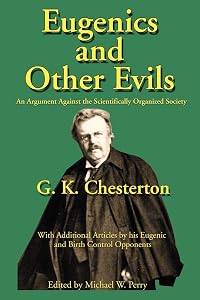
Eugenics and Other Evils : An Argument Against the Scientifically Organized State
by G. K. Chesterton
On This Page
Description
When the concept of eugenics—the practice of selecting for desirable traits in the larger population by encouraging gifted and/or attractive people to breed—began to take hold in the early twentieth century, British thinker and writer G.K. Chesterton took a stance contrary to that of many intellectuals of the period and denounced it as evil in this bold, engaging series of essays..
Tags
Recommendations

















Member Reviews
A fantastic work, rivaling even Orthodoxy with its razor sharp insight, wit and prescience. Chesterton was an early opponent to eugenics at a time when it was very fashionable. With a clarity that is as tragic as it is brilliant, Chesterton foretold what was to come. There are many things that can be said about the Holocaust, but one thing that cannot be said is that we were not warned.In addition to dealing with the Eugenists, Chesterton also speaks on economics and freedom. Building on the foundation that Hilaire Belloc began with The Servile State, Chesteron comments on the deficiencies and absurdities of both Capitalism and Socialism, offering Property (Distributism) as the sane and humane alternative.The timelessness of this book show more is truly remarkable. Even though overt eugenics has fallen into disfavor, it is tragically apparent that the same goals and mindset are thriving in the abortion industry. Indeed, abortion and artificial contraception has largely succeeded in fulfilling the wildest dreams of the Eugenists... and Chesterton cries out from heaven warning us, once again, of what is to come. show less
Ratings
Members
- Recently Added By
Lists

Books Read in 2021
5,361 works; 114 members
Author Information

798+ Works 60,047 Members
Gilbert Keith Chesterton was born in London, England, in 1874. He began his education at St Paul's School, and later went on to study art at the Slade School, and literature at University College in London. Chesterton wrote a great deal of poetry, as well as works of social and literary criticism. Among his most notable books are The Man Who Was show more Thursday, a metaphysical thriller, and The Everlasting Man, a history of humankind's spiritual progress. After Chesterton converted to Catholicism in 1922, he wrote mainly on religious topics. Chesterton is most known for creating the famous priest-detective character Father Brown, who first appeared in "The Innocence of Father Brown." Chesterton died in 1936 at the age of 62. (Bowker Author Biography) show less
Some Editions
Series
Belongs to Publisher Series
Work Relationships
Common Knowledge
- Canonical title*
- Eugenetica e altri malanni: ragionamenti contro l'organizzazione scientifica della società
- Original title
- Eugenics and Other Evils
- Original publication date
- 1922
- First words
- The wisest thing in the world is to cry out before you are hurt.
- Last words
- (Click to show. Warning: May contain spoilers.)And if they do not believe now, neither would they believe though one rose from the dead; though all the millions who died to destroy Prussianism stood up and testified against it.
- Original language
- English
*Some information comes from Common Knowledge in other languages. Click "Edit" for more information.
Classifications
- Genres
- Nonfiction, General Nonfiction, Religion & Spirituality
- DDC/MDS
- 363.92 — Society, government, & culture Social problems and social services Public Safety - Police, Crime Investigation Population problems Eugenics
- LCC
- HQ755 .C48 — Social sciences The family. Marriage, Women and Sexuality The Family. Marriage. Women The family. Marriage. Home Parents. Parenthood
- BISAC
Statistics
- Members
- 321
- Popularity
- 99,493
- Reviews
- 1
- Rating
- (3.84)
- Languages
- 5 — English, German, Italian, Portuguese, Spanish
- Media
- Paper, Audiobook, Ebook
- ISBNs
- 58
- ASINs
- 18