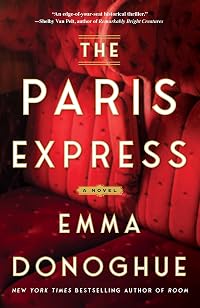
The Paris Express
by Emma Donoghue
On This Page
Description
Based on an 1895 disaster that went down in history when it was captured in a series of surreal, extraordinary photographs, The Paris Express is a propulsive novel set on a train packed with a fascinating cast of characters who hail from as close as Brittany and as far as Russia, Ireland, Algeria, Pennsylvania, and Cambodia. Members of parliament hurry back to Paris to vote; a medical student suspects a girl may be dying; a secretary tries to convince her boss of the potential of moving show more pictures; two of the train's crew build a life away from their wives; a young anarchist makes a terrifying plan, and much more. show lessTags
Recommendations












Member Reviews
In 1895, the Paris Express steams toward the capital, full of people of all classes, colors, and ages. There's a pregnant woman, a little boy, an American artist, a scientist, a self-appointed social worker, the company employees...and a bomber. When an unplanned stop due to a rich, entitled man and his wife sets them behind schedule, they try to make up the time on the final leg to Montparnasse. Tension comes from the reader's knowledge of the impending crash (the novel is based on a true historical event, and many of the characters are based on real people), the interplay between the travelers, and the suspense about the bomber. Taut, propulsive, and compelling.
Quotes
This modern notion of needing to go away on holiday for one's health show more is an invention of the railway companies, in her view... (Blonska, 16)
Better prepare and prevent than repair and repent. (Leon, 23)
That's the paradox of trains, he supposes; they show you what you'd never have seen otherwise, but only for a tantalising second. (Henry Tanner, 29)
A railway carriage is as intimate as a dinner party, but one with no host and guests assembled at random. (Marcella de Heredia, 45)
This train is a moving image of the unfairness of the long con of life. (Mado Pelletier, 81)
Each minute feels large and vivid, illuminated by spotlight but rocketing past, impossible to catch. (Mado, 85)
Any woman who works with men learns ways to avoid disagreeing head-on. (Alice Guy, 98)
She can't help herself; impossible to take a holiday from being concerned about people. (Blonska, 142)
She liked to drink in the atmosphere of burning zeal flavored with rage. (Blonska, 144)
How little we know about the strangers we sit beside. (Henry, 152)
It seems life, in any form, is too sweet to surrender. (Blonska, 188)
"When you can't avert disaster, perhaps it's better not to see it coming." (Marcelle to Henry, 226)
The agony of this suspense. How to carry on minute by minute when you don't know how long you've got. (Blonska, 231) show less
Quotes
This modern notion of needing to go away on holiday for one's health show more is an invention of the railway companies, in her view... (Blonska, 16)
Better prepare and prevent than repair and repent. (Leon, 23)
That's the paradox of trains, he supposes; they show you what you'd never have seen otherwise, but only for a tantalising second. (Henry Tanner, 29)
A railway carriage is as intimate as a dinner party, but one with no host and guests assembled at random. (Marcella de Heredia, 45)
This train is a moving image of the unfairness of the long con of life. (Mado Pelletier, 81)
Each minute feels large and vivid, illuminated by spotlight but rocketing past, impossible to catch. (Mado, 85)
Any woman who works with men learns ways to avoid disagreeing head-on. (Alice Guy, 98)
She can't help herself; impossible to take a holiday from being concerned about people. (Blonska, 142)
She liked to drink in the atmosphere of burning zeal flavored with rage. (Blonska, 144)
How little we know about the strangers we sit beside. (Henry, 152)
It seems life, in any form, is too sweet to surrender. (Blonska, 188)
"When you can't avert disaster, perhaps it's better not to see it coming." (Marcelle to Henry, 226)
The agony of this suspense. How to carry on minute by minute when you don't know how long you've got. (Blonska, 231) show less
France in the Belle Epoque, a time of an explosion in industrial advancements and in art and culture, of rising poverty and squalor. A train leaves the coast in the morning and will be in Paris by mid-afternoon. Engine 721 has made this run many times and her engineers are experienced and motivated to keep the rigorous timetable. The Paris Express fills with people eager to reach their destination for as many reasons as there are passengers on board. But the reader knows from the beginning that this journey will end in a disaster, although how or what the consequences are is yet unknown. As people climb on board, to either the wooden benches of third class, the simple decorations of second, the lush upolstery of first or even the luxury show more of a private car, they bring their preoccupations, their curiosity about their fellow passengers and their own histories with them. The novel is composed of multiple voices.
Emma Donoghue uses a large cast of characters and moves between them rapidly, echoing the movement of the express as it travels along the rails. As the world around them rapidly changes, some passengers wish for a return to simpler times, others are eager to prove themselves, and some are ready to push back against the forces that keep the poor in place. A young American artist is interested in a young woman, but will he find the courage to strike up a conversation? A young boy is on his first solo train trip, and while he is only traveling a few stations, he is anxious to not make a mistake. An old Russian woman notices that all is not as it should be with the young woman seated next to her, and an Irish writer contemplates the Parisienne seated across from him, in her fancy feathered hat and tiny monkey.
I enjoyed the constantly changing viewpoints of this novel and the tension of knowing things will go badly at the end, but not knowing what that will mean. There's no main character, although maybe the train herself fits that role well enough, and with tightly constrained time period, Donoghue paces this novel very like the express train she is writing about, there really isn't a slow point in the novel. show less
Emma Donoghue uses a large cast of characters and moves between them rapidly, echoing the movement of the express as it travels along the rails. As the world around them rapidly changes, some passengers wish for a return to simpler times, others are eager to prove themselves, and some are ready to push back against the forces that keep the poor in place. A young American artist is interested in a young woman, but will he find the courage to strike up a conversation? A young boy is on his first solo train trip, and while he is only traveling a few stations, he is anxious to not make a mistake. An old Russian woman notices that all is not as it should be with the young woman seated next to her, and an Irish writer contemplates the Parisienne seated across from him, in her fancy feathered hat and tiny monkey.
I enjoyed the constantly changing viewpoints of this novel and the tension of knowing things will go badly at the end, but not knowing what that will mean. There's no main character, although maybe the train herself fits that role well enough, and with tightly constrained time period, Donoghue paces this novel very like the express train she is writing about, there really isn't a slow point in the novel. show less
Widely admired author Emma Donoghue manages to capture some version of fin de siècle zeitgeist while also spinning a suspenseful action narrative in The Paris Express. She sets her scene in an actual 1895 out-of-control express train that crashes into the Montparnasse station, and assembles within it a cast of historical figures, (some of whom were actually passengers on the wreck). This clever device gathers together key figures who represent the coming train wreck that is the 20th Century. It’s a bravura performance; I recommend it for its intelligence, its respect for its readers, and not least for its breathless pacing.
A national railway express leaves Granville on the Normandy coast bound for Paris, and its passengers include a show more handful of deputies, or representatives, of the Orne Department of France. The author also calls “all aboard” to scientists, prominent engineers and captains of industry, and literary and artistic lights of the period, and a very angry young anarchist with a bomb. Donoghue names and clearly identifies these souls in the novel. The author mounts an elaborate, nail-biting race against death, in a highly diverting, and very well-organized novel.
And the interaction of these disparate characters, along with the threat to everyone’s life, along with the speed of the action, all make for a very rewarding, heart-quickening experience. This mélange represents for me, the headlong speed and power of wrenching change the world will suffer as the 19th Century swings along into the 20th. For on this train is a French automotive pioneer and industrialist Émile Lavassor; Irish dramatist John Millington Synge; Max Jacob, the French poet and painter; Henry Tanner, the African American painter; and Marcelle Lapicque, a neurophysiologist who lived until 1960. This is not an exhaustive list, but it illustrates the grand scope of Donoghue’s story, which brings all these characters into play. The momentum, the dreadnaught, irresistible forces in play, would wreck any static edifice in its way, be it Montparnasse station or any settled, backward-looking lassitude. I was quite out of breath at the end of this book.
The author shows a steely discipline as she yolks her wildly divergent elements into a cohesive, yet breakneck, story. It’s very well done.
https://bassoprofundo1.blogspot.com/2025/04/the-paris-express-by-emma-donoghue.h... show less
A national railway express leaves Granville on the Normandy coast bound for Paris, and its passengers include a show more handful of deputies, or representatives, of the Orne Department of France. The author also calls “all aboard” to scientists, prominent engineers and captains of industry, and literary and artistic lights of the period, and a very angry young anarchist with a bomb. Donoghue names and clearly identifies these souls in the novel. The author mounts an elaborate, nail-biting race against death, in a highly diverting, and very well-organized novel.
And the interaction of these disparate characters, along with the threat to everyone’s life, along with the speed of the action, all make for a very rewarding, heart-quickening experience. This mélange represents for me, the headlong speed and power of wrenching change the world will suffer as the 19th Century swings along into the 20th. For on this train is a French automotive pioneer and industrialist Émile Lavassor; Irish dramatist John Millington Synge; Max Jacob, the French poet and painter; Henry Tanner, the African American painter; and Marcelle Lapicque, a neurophysiologist who lived until 1960. This is not an exhaustive list, but it illustrates the grand scope of Donoghue’s story, which brings all these characters into play. The momentum, the dreadnaught, irresistible forces in play, would wreck any static edifice in its way, be it Montparnasse station or any settled, backward-looking lassitude. I was quite out of breath at the end of this book.
The author shows a steely discipline as she yolks her wildly divergent elements into a cohesive, yet breakneck, story. It’s very well done.
https://bassoprofundo1.blogspot.com/2025/04/the-paris-express-by-emma-donoghue.h... show less
Those who complain that the book has too many characters have missed the point. The book is an excuse to depict a wide range of characters who were or might have bee in that train rolling towards doom on that particular day. The character studies are very well done. Repeat entrances of characters are skilfully done, with reminders to help the reader remember who this is. The suspense is skilfully built up. I have just one major complaint. None of the characters feels French.
This book was on the shortlist for the Giller Prize in 2025 but was not the eventual winner. I haven't read the winner yet so I can't say how this compares but it was certainly a compelling read.
The book takes place in the course of a train journey from the coast of Normandy to Paris. We meet various passengers as well as the four railway employees on the train. Donoghue has blended real people known to be on the train with real people living in France at the time who might have been on the express. At the back of the book she has extensive notes about all the characters. One of the people she imagines to be on board is a young female anarchist, Madeleine Pelletier, who is carrying a homemade bomb in a lunch pail. She is in the third show more class coach but it is next to one of the first class coaches and she hopes that the explosion in her coach will extend to the next coach. When she learns that three deputies to the institution that governs France will be on board, she plans to detonate the bomb to target them. Of course, she will also die in the explosion but she is willing to make that sacrifice. In the end, she does not carry out her plan but the train does suffer an accident right in the Montmartre station. Miraculously, no-one on the train was killed but a woman selling newspapers in the station was crushed when the engine came down on her.
The Giller citation said, in part, about the book: "As intricately crafted as a station master’s pocket watch, The Paris Express gains momentum and depth with each chapter, propelling us towards an inevitable, and deeply moving, conclusion. " Donoghue shows all her mastery with words and characters in this short but powerful novel. show less
The book takes place in the course of a train journey from the coast of Normandy to Paris. We meet various passengers as well as the four railway employees on the train. Donoghue has blended real people known to be on the train with real people living in France at the time who might have been on the express. At the back of the book she has extensive notes about all the characters. One of the people she imagines to be on board is a young female anarchist, Madeleine Pelletier, who is carrying a homemade bomb in a lunch pail. She is in the third show more class coach but it is next to one of the first class coaches and she hopes that the explosion in her coach will extend to the next coach. When she learns that three deputies to the institution that governs France will be on board, she plans to detonate the bomb to target them. Of course, she will also die in the explosion but she is willing to make that sacrifice. In the end, she does not carry out her plan but the train does suffer an accident right in the Montmartre station. Miraculously, no-one on the train was killed but a woman selling newspapers in the station was crushed when the engine came down on her.
The Giller citation said, in part, about the book: "As intricately crafted as a station master’s pocket watch, The Paris Express gains momentum and depth with each chapter, propelling us towards an inevitable, and deeply moving, conclusion. " Donoghue shows all her mastery with words and characters in this short but powerful novel. show less
This might have been a swifter, more engaging read had I realised from the start that the 'Paris Express' of the title was the train which crashed through the station wall in Montparnasse, 1895. I've seen the famous photograph numerous times and disappeared down a Google rabbit hole learning about the circumstances, but I didn't read the blurb and the author spent most of the narrative focusing on a woman with a homemade bomb in a bucket. When the penny finally dropped, and the train was powering into Paris, my interest was lost, unfortunately.
Why? Too many characters, some real with fictionalised lives (I'm sure the family of the man who goes seeking rough trade in the toilets were delighted), some altogether fictional, but none very show more likeable or even fully fleshed out. The tone of the writing seemed rather moralistic in places too, especially when describing Mado's quest to blow the whole train to pieces as some sort of political protest (she might be 'poor and raging' but her plan is neither right nor righteous, just vain and selfish). As Blonska, the old Russian woman tells her, 'Slogans and songs, marches and riots, never yet stopped a child crying.' I was sort of hoping she would drop her bucket and end the story quicker by the halfway mark!
Fair play to the author for leading me down a different plot path, but I would have preferred just to read about the crash, thanks. show less
Why? Too many characters, some real with fictionalised lives (I'm sure the family of the man who goes seeking rough trade in the toilets were delighted), some altogether fictional, but none very show more likeable or even fully fleshed out. The tone of the writing seemed rather moralistic in places too, especially when describing Mado's quest to blow the whole train to pieces as some sort of political protest (she might be 'poor and raging' but her plan is neither right nor righteous, just vain and selfish). As Blonska, the old Russian woman tells her, 'Slogans and songs, marches and riots, never yet stopped a child crying.' I was sort of hoping she would drop her bucket and end the story quicker by the halfway mark!
Fair play to the author for leading me down a different plot path, but I would have preferred just to read about the crash, thanks. show less
I love Emma Donahue's writing, and when I saw that this was her latest, I just had to read it. The book is entirely based on a true event and is full of the actual people from this train disaster of 1895. Ms. Donahue has taken these real-life characters and constructed a total life for each of them and these people and their lives are revealed to us as we read through the book. This is as fine an example of a character narrative that I have ever read. Each of the characters comes alive in the telling of their stories. Even though we know that the train is going to crash, we just keep reading to see the how, when and why, and to get to know the astounding characters better. The train trip itself is only about 5 or 6 hours in length, but show more so much life happens and is revealed in that time. Well worth a read for historical fiction and non-fiction lovers. show less
Members
- Recently Added By
Lists

Netgalley Reads
468 works; 3 members

Books Read in 2025
4,128 works; 98 members

LoanStars | Adult List: March 2025
10 works; 1 member

Globe and Mail | Canadian Fiction: March 22, 2025
10 works; 1 member

Globe and Mail | Canadian Fiction: March 29, 2025
10 works; 1 member

Globe and Mail | Canadian Fiction: April 5, 2025
10 works; 1 member

Globe and Mail | Canadian Fiction: April 12, 2025
10 works; 1 member

Globe and Mail | Canadian Fiction: April 19, 2025
10 works; 1 member
Globe and Mail | Canadian Fiction: April 26, 2025
10 works; 1 member

Globe and Mail | Canadian Fiction: May 3, 2025
10 works; 1 member

Read & Relax Collection
4 works; 1 member

Globe and Mail | Canadian Fiction: October 25, 2025
10 works; 1 member
Globe and Mail | Canadian Fiction: November 1, 2025
10 works; 1 member

Globe and Mail | Canadian Fiction: November 22, 2025
10 works; 1 member
Globe and Mail | Canadian Fiction: November 29, 2025
10 works; 1 member
Globe and Mail | Canadian Fiction: December 20, 2025
10 works; 1 member
Author Information

42+ Works 34,726 Members
Emma Donoghue was born on October 24, 1969 in Dublin, Ireland. She received her BA degree from the University College Dublin and PhD in English from University of Cambridge. Her first novel was Stir. Her next novel was Hood which won the 1997 American Library Association's Gay, Lesbian and Bisexual Book Award for Literature. Her novel Slammerkin show more was a finalist in the 2001 Irish Times Irish Literature Prize for Fiction. The Sealed Letter, published in 2008, is a work of historical fiction. This work was the joint winner of the 2009 Lambda Literary Award for Lesbian Fiction. She continued writing several award winning novels including Room which was shortlisted for the Man Booker Prize in September 2010. Some of her other works include Astray, Three and a Half Deaths, and Frog Music. (Bowker Author Biography) show less
Awards and Honors
Awards
Distinctions
Common Knowledge
- Canonical title
- The Paris Express
- Original publication date
- 2025-03-18
- People/Characters
- Anne Madeleine “Mado” Pellitier; Maurice Marland; Jean Le Goff; Guillaume Pellerin; Victor Garnier; Elise Blonska (show all 17); Léon Mariette; Henry Ossawa Tanner; John Synge; Annah Lamor; Marcelle de Heredia; Alice Guy-Blaché (Alice Guy); Monsieur Gaumont; Cécile Langlois; Albert Christophle; Louise Sarazin-Levassor; Jeanne Sarazin-Levassor
- Important places
- Granville, France; Vire, France; Flers, France; Briouze, France; Surdon, France; Dreux, France (show all 7); Montparnasse, Paris, France
- Important events
- Montparnasse Train Disaster (1895)
- Epigraph
- The occasional disaster,
What does it matter?
Let‘s take necessary evils in our stride—
Every great invention costs a few lives!
AUGUSTE-MARSEILLE BARTHÉLEMY,
“STEAM” (1845)
There isn't a train I wouldn't take,
No matter where it's going.
EDNA ST. VINCENT MILLAY,
“TRAVEL” (1921)
And here is a mill and there is a river;
Each a glimpse and gone forever!
ROBERT LOUIS STEVENSON
“FROM A RAILWAY CARRIAGE” (1885)
The most salient characteristic of life in this latter
portion of the nineteenth century is speed.
W. R. GREG,
“LIFE AT HIGH PRESSURE “ (1875)
The arteries of iron
run through and renew
every part of the body
of this land, bearing life.
PIERRE LACHAMBEAUDIE,
“STEAM” (1846)
I don't know where you're fleeing to,
You don't know where I'm going,
You I could have loved,
And didn't you know it.
CHARLES BAUDELAIRE,
“TO A PASSERBY” (1860)
To save time is to lengthen life.
REMINGTON TYPEWRITER
MOTTO (C. 1902)
We anticipate the future as if it were too slow in coming,
as if to hurry it up, or we recall the past as if to halt its
rapid flight. We are so foolish that we wander in times
that are not ours, without thinking of... (show all) the only one that is.
BLAISE PASCAL,
PENSÉES (1670)
Watch the curves, the fills, and tunnels,
Never falter, never quail,
Keep your hand upon the throttle,
And your eye upon the rail.
MASON ELLIS ABBEY,
“LIFE'S RAILWAY TO HEAVEN” (1890)
The ticking of the clock sounds
like mice nibbling at time.
ALPHONSE ALLAIS,
THE BLACK CAT (1890)
Tarde venientibus ossa.
(The late are left nothing but bones.)
LATIN SAYING
Those who kiss too much
will miss the train.
FRENCH PROVERB
They didn't last long. That”s how it is—
The loveliest days are the shortest.
HENRI MURGER,
SCENES OF BOHEMIAN LIFE (1851)
Every body perseveres in its state of rest, or of uniform
motion in a right line, unless it is compelled to
change that state by forces impressed thereon.
ISAAC NEWTON,
PRINCIPIA (1687)
All that happened in
the space of a second.
MONTPARNASSE STATIONMASTER,
“A SHATTERED STATION,”
GIL BLAS (October 24, 1895) - Dedication
- This book is for my beloved belle-mère,
Claude Gillard,
translator and best of readers - First words
- Half past eight in the morning, on the twenty-second of October, 1895, in Granville, on the Normandy coast.
- Quotations
- “They make this concession to their passengers' weakness, but like sin, it must be paid for sooner or later.
“Take your seats, mesdames, messieurs, the Paris Express is about to depart.”
How little we know about the strangers we sit beside.
“I dread to think that what made me speak up was my longing to be right. The thrill of knowing—as if I'm the only one in the world with the solution to the puzzle.
“… When you can't avert disaster, perhaps it's better not to see it coming."
All of us in this carriage, maybe all of us on this train, our stories end today. - Last words
- (Click to show. Warning: May contain spoilers.)He takes the shot.
- Blurbers
- Van Pelt, Shelby; O'Neill, Heather; Winn, Alice
- Original language
- English Canada
Classifications
Statistics
- Members
- 519
- Popularity
- 57,986
- Reviews
- 33
- Rating
- (3.60)
- Languages
- English
- Media
- Paper, Audiobook, Ebook
- ISBNs
- 22
- ASINs
- 4