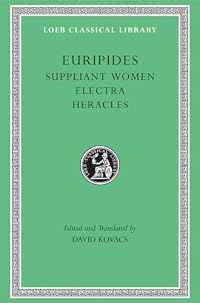
3 Plays: Electra / Heracles / Suppliant Women
by Euripides
On This Page
Description
Euripides (c. 485-406 BCE) has been prized in every age for his emotional and intellectual drama. Eighteen of his ninety or so plays survive complete, including Medea, Hippolytus, and Bacchae, one of the great masterpieces of the tragic genre. Fragments of his lost plays also survive.Tags
Recommendations








Member Reviews
The Suppliants (also known as The Suppliant Women, Ancient Greek: Ἱκέτιδες, Hiketides), first performed in 423 BC, is an ancient Greek play by Euripides.
After Oedipus leaves Thebes, his sons fight for control of it. Polyneices lays siege to Thebes against his brother Eteocles. Polyneices has married the daughter of Adrastus, King of Argos. And so Polyneices has on his side the Argive army, leaders of which help form the Seven Against Thebes. The invaders lose the battle, and Polyneices and Eteocles both die. Creon takes power in Thebes and decrees the invaders are not to be buried. The mothers of the dead seek someone to help reverse this, so their sons can be buried.
In Greek mythology, Electra (Greek: Ἠλέκτρα, show more Ēlektra) was the daughter of King Agamemnon and Queen Clytemnestra,[citation needed] and thus princess of Argos. She and her brother Orestes plotted revenge against their mother Clytemnestra and stepfather Aegisthus for the murder of their father, Agamemnon.
Electra is the main character in two Greek tragedies, Electra by Sophocles and Electra by Euripides, and has inspired other works. In psychology, the Electra complex is also named after her.
Euripides' Electra (Ancient Greek: Ἠλέκτρα, Ēlektra) was a play probably written in the mid 410s BC, likely after 413 BC. It is unclear whether it was first produced before or after Sophocles' version of the Electra story.
Years before, near the start of the Trojan War, the Greek general Agamemnon sacrificed his daughter Iphigeneia in order to appease the goddess Artemis and allow the Greek army to set sail for Troy. His wife Clytemnestra never forgave him, and when he returned from the war ten years later, she and her lover Aegisthus murdered Agamemnon.
A first-rate version of the play exists in a film by Michael Cacoyannis, starring Irene Papas, based on Euripides, it was available on Netflix.
Cf. http://www.imdb.com/title/tt0055950/
Herakles (Ancient Greek: Ἡρακλῆς μαινόμενος, Hēraklēs Mainomenos, also known as Hercules Furens) is an Athenian tragedy by Euripides that was first performed c. 416 BCE. While Herakles is in the underworld obtaining Cerberus for one of his labours, his father Amphitryon, wife Megara, and children are sentenced to death in Thebes by Lycus. Herakles arrives in time to save them, though the goddesses Iris and Madness (personified) cause him to kill his wife and children in a frenzy. It is the second of two surviving tragedies by Euripides where the family of Herakles are suppliants (the first being Herakles' Children). It was first performed at the City Dionysia festival. show less
After Oedipus leaves Thebes, his sons fight for control of it. Polyneices lays siege to Thebes against his brother Eteocles. Polyneices has married the daughter of Adrastus, King of Argos. And so Polyneices has on his side the Argive army, leaders of which help form the Seven Against Thebes. The invaders lose the battle, and Polyneices and Eteocles both die. Creon takes power in Thebes and decrees the invaders are not to be buried. The mothers of the dead seek someone to help reverse this, so their sons can be buried.
In Greek mythology, Electra (Greek: Ἠλέκτρα, show more Ēlektra) was the daughter of King Agamemnon and Queen Clytemnestra,[citation needed] and thus princess of Argos. She and her brother Orestes plotted revenge against their mother Clytemnestra and stepfather Aegisthus for the murder of their father, Agamemnon.
Electra is the main character in two Greek tragedies, Electra by Sophocles and Electra by Euripides, and has inspired other works. In psychology, the Electra complex is also named after her.
Euripides' Electra (Ancient Greek: Ἠλέκτρα, Ēlektra) was a play probably written in the mid 410s BC, likely after 413 BC. It is unclear whether it was first produced before or after Sophocles' version of the Electra story.
Years before, near the start of the Trojan War, the Greek general Agamemnon sacrificed his daughter Iphigeneia in order to appease the goddess Artemis and allow the Greek army to set sail for Troy. His wife Clytemnestra never forgave him, and when he returned from the war ten years later, she and her lover Aegisthus murdered Agamemnon.
A first-rate version of the play exists in a film by Michael Cacoyannis, starring Irene Papas, based on Euripides, it was available on Netflix.
Cf. http://www.imdb.com/title/tt0055950/
Herakles (Ancient Greek: Ἡρακλῆς μαινόμενος, Hēraklēs Mainomenos, also known as Hercules Furens) is an Athenian tragedy by Euripides that was first performed c. 416 BCE. While Herakles is in the underworld obtaining Cerberus for one of his labours, his father Amphitryon, wife Megara, and children are sentenced to death in Thebes by Lycus. Herakles arrives in time to save them, though the goddesses Iris and Madness (personified) cause him to kill his wife and children in a frenzy. It is the second of two surviving tragedies by Euripides where the family of Herakles are suppliants (the first being Herakles' Children). It was first performed at the City Dionysia festival. show less
Apparently there are many editions in the LCL, so this is what is in my Euripides Vol III dated 1962:
The Bacchanals
The Children of Hercules
The Phoenician Maidens
Suppliants
The Bacchanals
The Children of Hercules
The Phoenician Maidens
Suppliants
Ratings
Members
- Recently Added By
Author Information

1,338+ Works 34,027 Members
Euripides was born in Attica, Greece probably in 480 B.C. He was the youngest of the three principal fifth-century tragic poets. In his youth he cultivated gymnastic pursuits and studied philosophy and rhetoric. Soon after he received recognition for a play that he had written, Euripides left Athens for the court of Archelaus, king of Macedonia. show more Fragments of about fifty-five plays survive. Among his best-known plays are Alcestis, Medea and Philoctetes, Electra, Iphigenia in Tauris, The Trojan Women, and Iphigenia in Aulis Iphigenia. He died in Athens in 406 B.C. (Bowker Author Biography) show less
Series
Belongs to Publisher Series
Common Knowledge
Classifications
- Genre
- Fiction and Literature
- DDC/MDS
- 882.01 — Literature & rhetoric Classical & modern Greek literatures Classical Greek dramatic poetry and drama standard subdivisions; collections; history, description, critical appraisal; Specific periods Ancient period to ca. 499
- LCC
- PA3975 .A2 — Language and Literature Greek language and literature. Latin language and literature Greek literature Individual authors Euripedes
- BISAC
Statistics
- Members
- 79
- Popularity
- 400,142
- Reviews
- 2
- Rating
- (3.40)
- Languages
- English, Greek (Ancient)
- Media
- Paper, Ebook
- ISBNs
- 2