Performance Anxiety
by Betsy Burke
On This Page
Description
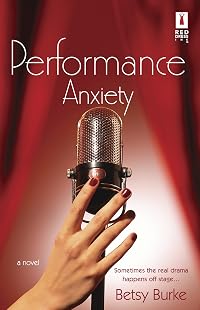
Miranda Lyme, mezzo-soprano, is in love with the infamous--and, okay, technically married--conductor-composer Kurt Hancock. So what if he lives in London, and she...doesn't. Their secret rendezvous are more than enough--for now. Besides, Miranda's life is full and frenetic: four part-time jobs, plus singing in the opera chorus, voice lessons with Madame Klein and looking for her long-lost father. Who's got time for a full-time beau?Miranda craves the good life and is certain that's what show more she'll have once Kurt officially ends his marriage and she rises to stardom. But there are glitches. Like the fact that Kurt is still technically faithful to his wife and he insists that Miranda keep their relationship a secret. He promises it won't be like this forever. Yeah, sure.... The truth, when it finally arrives, is so shocking that it causes Miranda to lose her voice.
But the show must go on. Will it be a night to remember--or one to utterly forget? show less
Tags
Recommendations


Member Reviews
This is a story about Miranda Lyme, a mid-20s woman who works hard to be a professional opera singer. She's arranged her whole life around achieving this goal, working several part-time jobs to pay for singing lessons and making sure she's never bogged down with too many possessions not to be able to accept a gig in another city at the drop of a hat. She gets side-tracked with a man, a star singer that all the chorus girls dream of (though it's worth noting that Miranda herself mentions she did not initially find herself attracted to this man). But that's a detour that leads to nowhere but heartbreak and laryngitis. Ultimately, unable to sing, Miranda finds that her passion for opera is broader than she realized and is inspired to show more compose and produce her own opera. The happy ending occurs once the opera is successfully performed and Miranda gets together with a guy whose been a presence in her life throughout the span of the novel.
This is actually a quite lovely plot and my lack of admiration for the book does not stem from the general structure of the story. There's something about the writing style that didn't do it for me, and that I suspect doesn't really do it for the chick lit genre. Though this story is told in the first person, it seems like the author does not take advantage of any of the opportunities this offers, notably getting inside the head of the first-person narrator. Instead, it seems like the author has been told "show, don't tell" -- i.e. show your readers Miranda is sad, don't tell them -- so that the author might write "I cried" but not "I had not felt so lost and lonely since being a teenager. I broke down in tears. I know it's a girlie thing to do and I really would have rather not cried in front of this near stranger but my emotions had taken the best of me and I could no longer hold it together."
Not only in the first person narrator not revealing about her inner thoughts and feelings, she also seems to be looking back on the events she is describing from a distance, far off in the future. It seems plausible that this might be the author's own memoir (or based somewhat on events that happened to her in her 20s) but, whatever the case, she doesn't get back in the moment to describe what is going on with her character. This makes her come off too detached for my liking. The main character uses the "I" form and I expect that she will share her innermost thoughts with me in real time. Instead she comes at me from a detached distance and only describes her actions, not her thoughts and feelings.
Bottom line: not the voice of chick lit, not the voice I was hoping for, and, in my opinion, not the appropriate voice to tell the story in an engaging manner. show less
This is actually a quite lovely plot and my lack of admiration for the book does not stem from the general structure of the story. There's something about the writing style that didn't do it for me, and that I suspect doesn't really do it for the chick lit genre. Though this story is told in the first person, it seems like the author does not take advantage of any of the opportunities this offers, notably getting inside the head of the first-person narrator. Instead, it seems like the author has been told "show, don't tell" -- i.e. show your readers Miranda is sad, don't tell them -- so that the author might write "I cried" but not "I had not felt so lost and lonely since being a teenager. I broke down in tears. I know it's a girlie thing to do and I really would have rather not cried in front of this near stranger but my emotions had taken the best of me and I could no longer hold it together."
Not only in the first person narrator not revealing about her inner thoughts and feelings, she also seems to be looking back on the events she is describing from a distance, far off in the future. It seems plausible that this might be the author's own memoir (or based somewhat on events that happened to her in her 20s) but, whatever the case, she doesn't get back in the moment to describe what is going on with her character. This makes her come off too detached for my liking. The main character uses the "I" form and I expect that she will share her innermost thoughts with me in real time. Instead she comes at me from a detached distance and only describes her actions, not her thoughts and feelings.
Bottom line: not the voice of chick lit, not the voice I was hoping for, and, in my opinion, not the appropriate voice to tell the story in an engaging manner. show less
Ratings
Members
- Recently Added By
Author Information
8 Works 161 Members
Common Knowledge
- Canonical title
- Performance Anxiety
- Original publication date
- 2004-11-01
- People/Characters
- Miranda Lyme; Kurt Hancock
- Dedication
- For Sara and Salva and music-makers everywhere.
- First words
- The collision was all my fault.
- Last words
- (Click to show. Warning: May contain spoilers.)There was the rich scent of the earthly-sweet grass we had lain on all afternoon, the smell of pine bark and needles from the trees surrounding us, the clicking of cicadas, and there was another sound---a rising, wild, free, singing, animal sound that would have made even Matilde envious, and it was coming from me.
Classifications
Statistics
- Members
- 39
- Popularity
- 749,436
- Reviews
- 1
- Rating
- (1.75)
- Languages
- English
- Media
- Paper, Ebook
- ISBNs
- 5
- ASINs
- 1