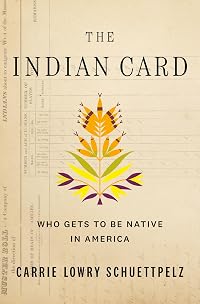
The Indian Card: Who Gets to Be Native in America
by Carrie Lowry Schuettpelz
On This Page
Description
"A groundbreaking and deeply personal exploration of Tribal enrollment, and what it means to be Native American in the United States "Candid, unflinching....Her thorough excavation of the painful history that gave rise to rigid enrollment policies is a courageous gift to our understanding of contemporary Native life." --The Whiting Foundation Jury. Who is Indian enough? To be Native American is to live in a world of contradictions. At the same time that the number of people in the U.S. who show more claim Native identity has exploded--increasing 85 percent in just ten years--the number of people formally enrolled in Tribes has not. While the federal government recognizes Tribal sovereignty, being a member of a Tribe requires navigating blood quantum laws and rolls that the federal government created with the intention of wiping out Native people altogether. Over two million Native people are tribally enrolled, yet there are Native people who will never be. Native people who, for a variety of reasons ranging from displacement to disconnection, cannot be card-carrying members of their Tribe. In The Indian Card, Carrie Lowry Schuettpelz grapples with these contradictions. Through in-depth interviews, she shares the stories of people caught in the mire of identity-formation, trying to define themselves outside of bureaucratic processes. With archival research, she pieces together the history of blood quantum and tribal rolls and federal government intrusion on Native identity-making. Reckoning with her own identity--the story of her enrollment and the enrollment of her children--she investigates the cultural, racial, and political dynamics of today's Tribal identity policing. With this intimate perspective of the ongoing fight for Native sovereignty, The Indian Card sheds light on what it looks like to find a deeper sense of belonging"-- show lessTags
Recommendations




Member Reviews
Schuettpelz (Lumbee) examines her own sense of identity through the lens of Native American history from first contact with Europeans (the Lumbee people may be descended from a mixture of Native peoples and the white colonists of Roanoke), through eras of (broken) treaties, (forced) assimilation (including the Indian boarding schools), termination, and Tribal self-governance.
She looks at data and lists, including the U.S. Census and the Dawes rolls, and looks at how each Tribe determines eligibility for enrollment, and how that process is sometimes exclusionary. She questions the idea of blood quantum - which isn't used for any other population, and in fact is the opposite of how the race of people with Black heritage is determined. show more
She interviews friends, acquaintances, and colleagues from different Tribes about their family history and their experience and their feeling of belonging (or not), and how various pieces of legislation have had a real effect on people's lives for centuries, right up through today.
An important and thoughtful book, with enough history to provide context and enough people's stories to foster connection and understanding.
Quotes/notes
[Indians in the U.S.], uniquely, have been forced into a corner of needing to constantly prove our identities to ourselves and others... (4)
I suppose that's what assimilation is all about: in the process of removing Native people from their communities, of surrounding them with non-Natives and making their customs feel foreign, the policies and f*ckery unleashed upon Native people by the U.S. government have also made them feel supremely disconnected. (14)
Blood quantum is an awkward calculation that makes identity seem like math. (24)
[Censuses are institutions "rooted in imperialism."] Indeed, many historians have observed that colonization and counting went hand in hand....Data collection...deeply shaped the way colonizers both viewed and exerted power over colonized populations - and part of that included the idea of racial categories. (63)
I begin to think about historical data - particularly lists of Native people - through the lens of justice. (75)
Treaties took advantage...of the fact that most Tribes did not operate inside the same system of land commodification that settlers did....Annuity payments...became something Tribes depended on. (82)
By the 1850s, the United States had embarked on a different kind of removal policy, one that involved not removing the Indians from the land but...removing the land from the Indians. In this way, the U.S. government dramatically shrank the size of land that Tribes controlled. (109)
Those federal decisions - even those made over a hundred years ago - continue to have real consequences today. (110)
Certificate of Degree of Indian Blood (CDIB) (174)
...nowhere else does the federal government quantify people like this. (176)
Native identity "is not so much who you claim; it's who claims you" -Jimmy Beason (Osage) (194)
What we know from the historical record is that European contact was the start of a long journey for Indian people that included, but was not limited to, disease, enslavement, warfare, and the imposition of rules that didn't make sense. (198)
[Compare the "one drop" rule for Blackness, when white people wanted to enslave Black bodies, to the blood quantum for Native people, when white people wanted to minimize the land and other benefits Native people were entitled to] (201)
I fear that, particularly with increased rates of urbanity and intermarriage, blood quantum will become a tool of extinction. (215) show less
She looks at data and lists, including the U.S. Census and the Dawes rolls, and looks at how each Tribe determines eligibility for enrollment, and how that process is sometimes exclusionary. She questions the idea of blood quantum - which isn't used for any other population, and in fact is the opposite of how the race of people with Black heritage is determined. show more
She interviews friends, acquaintances, and colleagues from different Tribes about their family history and their experience and their feeling of belonging (or not), and how various pieces of legislation have had a real effect on people's lives for centuries, right up through today.
An important and thoughtful book, with enough history to provide context and enough people's stories to foster connection and understanding.
Quotes/notes
[Indians in the U.S.], uniquely, have been forced into a corner of needing to constantly prove our identities to ourselves and others... (4)
I suppose that's what assimilation is all about: in the process of removing Native people from their communities, of surrounding them with non-Natives and making their customs feel foreign, the policies and f*ckery unleashed upon Native people by the U.S. government have also made them feel supremely disconnected. (14)
Blood quantum is an awkward calculation that makes identity seem like math. (24)
[Censuses are institutions "rooted in imperialism."] Indeed, many historians have observed that colonization and counting went hand in hand....Data collection...deeply shaped the way colonizers both viewed and exerted power over colonized populations - and part of that included the idea of racial categories. (63)
I begin to think about historical data - particularly lists of Native people - through the lens of justice. (75)
Treaties took advantage...of the fact that most Tribes did not operate inside the same system of land commodification that settlers did....Annuity payments...became something Tribes depended on. (82)
By the 1850s, the United States had embarked on a different kind of removal policy, one that involved not removing the Indians from the land but...removing the land from the Indians. In this way, the U.S. government dramatically shrank the size of land that Tribes controlled. (109)
Those federal decisions - even those made over a hundred years ago - continue to have real consequences today. (110)
Certificate of Degree of Indian Blood (CDIB) (174)
...nowhere else does the federal government quantify people like this. (176)
Native identity "is not so much who you claim; it's who claims you" -Jimmy Beason (Osage) (194)
What we know from the historical record is that European contact was the start of a long journey for Indian people that included, but was not limited to, disease, enslavement, warfare, and the imposition of rules that didn't make sense. (198)
[Compare the "one drop" rule for Blackness, when white people wanted to enslave Black bodies, to the blood quantum for Native people, when white people wanted to minimize the land and other benefits Native people were entitled to] (201)
I fear that, particularly with increased rates of urbanity and intermarriage, blood quantum will become a tool of extinction. (215) show less
Personal narrative interwoven with the history of identifying Natives—how the US whipsawed from trying to destroy tribes to protecting them, but only if they’d somehow survived the earlier devastation while retaining traditions, governance, a compact enough territory, and a tribal identification system. Not all tribes use a blood quantum definition to identify members, but those who do tend to face resource demands that force difficult decisions. Children of parents from two different tribes may lack the blood quantum necessary to allow them to be enrolled members of either, even though pan-Indian movements have made such relationships more common. And the history on which blood quantum determinations are made is corrupt: the show more censuses the author examines assign racial classifications apparently arbitrarily and changeably; one ancestor she discusses was given three different labels in three different decennial censuses. One key metric, the Dawes list, included full siblings whose claims to Indianness were treated differently. (The unsurprising constraint on arbitrariness: people who looked white were often allowed to claim Indianness, but people who looked Black were often not.) But the book is not about alternatives—there may not be good ones—it is rather about sitting in the contradictions of using descent to manage identity in the context of Native life. show less
Lowry Schuettpelz combines personal insight and Native experiences from interviewees with unwashed US history and governmental policy toward Native communities to discuss the complexity of Native Identity, injustices forced upon Natives, and erasure of Native peoples and culture. With a distinct and captivating voice, her writing walks the line between academia and memoir, altogether providing a rich exploration of what it means to be Native in America. Please pick up this important book.
Author Carrie Lowry Schuettpetz examines quantitative and qualitative data, federal laws, and other information sources in her quest to trace the history of Native American identity in the United States. In contrast to the simplistic “one-drop” standard used to relegate millions of people to second-class “Black” status, the U.S. Government’s “blood quantum” system deliberately undercounts Native Americans in order to deny them federal benefits and a sense of tribal identity. Many tribal governments have adopted their own arbitrary and confusing membership rules as well. As a result, modern “urban Indians” with tangled genealogies, like Schuettpetz herself, often feel as though they are “not Native enough.”
This is a show more harrowing narrative, filled with many examples of governmental callousness and injustice. I recommend this book to readers who are interested in issues of identity and belonging. show less
This is a show more harrowing narrative, filled with many examples of governmental callousness and injustice. I recommend this book to readers who are interested in issues of identity and belonging. show less
4.5 stars, this is a thoughtful, if incomplete, look at what it takes to be considered Native American to different tribes within the US, as well as among individuals both inside and outside of Native communities. It is also a decent history of the atrocities perpetrated against Native Americans since this land was colonized.
Ratings
Members
- Recently Added By
Lists

Indigenous Peoples: Nonfiction & Fiction
50 works; 1 member
Author Information
1 Work 100 Members
Classifications
Statistics
- Members
- 101
- Popularity
- 323,636
- Reviews
- 5
- Rating
- (4.12)
- Languages
- English
- Media
- Paper, Ebook
- ISBNs
- 4
- ASINs
- 1