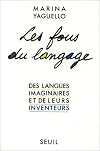
Lunatic Lovers of Language: Imaginary Languages and Their Inventors
by Marina Yaguello
On This Page
Description
This study examines the creation of imaginary languages as a way of exploring the relationship between words and their users at different periods in history.Tags
Recommendations













Member Recommendations
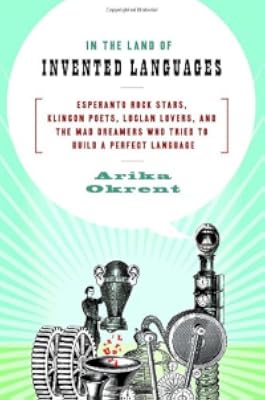
In the Land of Invented Languages: Esperanto Rock Stars, Klingon Poets, Loglan Lovers, and the Mad Dreamers Who Tried to Build A Perfect Language by Arika Okrent
prosfilaes A much better study; more complete, more even in its coverage, and much more even-handed in its tone.
Member Reviews
I picked up Lunatic Lovers of Language: Imaginary Languages and their Inventors at the used bookstore because it was there and it's one of the few books about constructed languages in general. The problem is, it annoys the hell out of me; I'm not sure I can more than skim the book. Let's start with the title; is anyone particularly draw to a title about their interests in the form of Lunatic Lovers of Foo: Imaginary Foos and their Inventors? Say a book about RPGs: Lunatic Lovers of Games: Imaginary Games and their Inventors. And no, constructed languages are no more imaginary than RPGs are.
Or let's talk about the section titled "In Defense of Natural Languages". Given that those constructed languages are outnumbered speaker-wise 6,000 show more to one (and I regard that as a rather conservative estimate) and aren't exactly vibrant contenders, defending natural languages seems pointless, even cruel. Near the end, it says "It should be noted, however, that Zamenhof would have wanted a language that was fixed once and for all." In a narrow sense, this is false; Zamenhof had no problems with the natural growth of the language. In a broader sense, outside often-violent Eastern European politics, who really wants to see their language broken into mutually incomprehensible dialects? Anyone really a fan of Indian English taking a left turn somewhere and becoming a barrier to the communications between India and the other English speaking nations? For at least seven hundred years after the last shovelful of earth was laid on Latin's grave, it still was the major language of communication in Europe, because trying to communicate with a dozen major languages and a continuum of unstandardized dialects is a major pain. And what is a section promoting anything doing in a study anyway?
(I think part of her discussion of Esperanto's dialects is based off the list in the appendix of a couple dozen spinoff languages; while interesting and possibly even useful, many of them were minor changes--any fluent Esperantist could read reformed Esperanto without help--and many of the others can't claim even one person who speaks it fluently.)
To add injury to insult, flipping through the book isn't showing me valuable stuff. She rambles about Marr, a Stalinist linguist who seems to have the same sort of useful, viable ideas as Lysenko did in biology, and also a section about speaking in tongues. There's lots about searches for the language of Adam and Eve, but when it comes down to it, there's precious little about invented languages--you remember the whole word "inventors" in the title? There's about sixty pages in an appendix of primary materials; that list of Esperanto's descendants, a number of vocabulary comparisons, quotes from various philosophical language texts or fiction, etc. Biased towards the random weird stuff she writes about in the body, but still interesting. Of course, she manages to throw in eye-rolling stuff here, too; a list of words from Volapük, Esperanto, Ido and IALA Interlingua, labeled the development from Volapük to Interlingua via Esperanto and Ido. Except that there's little evidence that Esperanto took anything from Volapük except a warning about what not to do, and Interlingua is a regularized Latin with the vocabulary chosen by algorithm, again developed with at best a glance at its predecessors. There's three different strains here; for the computer programmers in my audience, think of something comparing Fortran to Python, via C and C++.
Ugh; on one hand, I feel it's a vital part of my book collection, and on the other I want to throw it out the window and watch it get run over a couple times. show less
Or let's talk about the section titled "In Defense of Natural Languages". Given that those constructed languages are outnumbered speaker-wise 6,000 show more to one (and I regard that as a rather conservative estimate) and aren't exactly vibrant contenders, defending natural languages seems pointless, even cruel. Near the end, it says "It should be noted, however, that Zamenhof would have wanted a language that was fixed once and for all." In a narrow sense, this is false; Zamenhof had no problems with the natural growth of the language. In a broader sense, outside often-violent Eastern European politics, who really wants to see their language broken into mutually incomprehensible dialects? Anyone really a fan of Indian English taking a left turn somewhere and becoming a barrier to the communications between India and the other English speaking nations? For at least seven hundred years after the last shovelful of earth was laid on Latin's grave, it still was the major language of communication in Europe, because trying to communicate with a dozen major languages and a continuum of unstandardized dialects is a major pain. And what is a section promoting anything doing in a study anyway?
(I think part of her discussion of Esperanto's dialects is based off the list in the appendix of a couple dozen spinoff languages; while interesting and possibly even useful, many of them were minor changes--any fluent Esperantist could read reformed Esperanto without help--and many of the others can't claim even one person who speaks it fluently.)
To add injury to insult, flipping through the book isn't showing me valuable stuff. She rambles about Marr, a Stalinist linguist who seems to have the same sort of useful, viable ideas as Lysenko did in biology, and also a section about speaking in tongues. There's lots about searches for the language of Adam and Eve, but when it comes down to it, there's precious little about invented languages--you remember the whole word "inventors" in the title? There's about sixty pages in an appendix of primary materials; that list of Esperanto's descendants, a number of vocabulary comparisons, quotes from various philosophical language texts or fiction, etc. Biased towards the random weird stuff she writes about in the body, but still interesting. Of course, she manages to throw in eye-rolling stuff here, too; a list of words from Volapük, Esperanto, Ido and IALA Interlingua, labeled the development from Volapük to Interlingua via Esperanto and Ido. Except that there's little evidence that Esperanto took anything from Volapük except a warning about what not to do, and Interlingua is a regularized Latin with the vocabulary chosen by algorithm, again developed with at best a glance at its predecessors. There's three different strains here; for the computer programmers in my audience, think of something comparing Fortran to Python, via C and C++.
Ugh; on one hand, I feel it's a vital part of my book collection, and on the other I want to throw it out the window and watch it get run over a couple times. show less
Ratings
Members
- Recently Added By
Author Information

19+ Works 280 Members
Classifications
- Genres
- Nonfiction, General Nonfiction
- DDC/MDS
- 499.99 — Language Other languages Non-Austronesian languages of Oceania, Austronesian languages, miscellaneous languages Miscellaneous languages Artificial languages
- LCC
- P120 .I53 .Y313 — Language and Literature Philology. Linguistics Language. Linguistic theory. Comparative grammar
Statistics
- Members
- 31
- Popularity
- 905,278
- Reviews
- 1
- Rating
- (3.50)
- Languages
- English, French
- Media
- Paper
- ISBNs
- 3