On This Page
Description
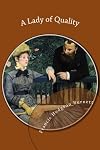
In Frances Hodgson Burnett's compelling historical novel A Lady of Quality, a girl named Clorinda is born and raised in a horrible environment. Motherless, resented, and brought up as a boy by her drunken lout of a father, the odds are stacked against her. Can Clorinda rise above the circumstances of her birth and childhood and find true happiness?.
Tags
Recommendations





















Member Reviews
Now, this isn't as good as Burnett's Through One Administration, but that's kind of a tall order. As Through One Administration was, though, it's a complete change of tack. Burnett's first three novels were Lancashire-set stories about the lower classes (kind of), while Through One Administration was about the political culture of Washington, D.C., during the Rutherford years. A Lady of Quality takes us back to England in the late 17th/early 18th century, chronicling a young woman named Clorinda. Clorinda is the third daughter of an English lord and the woman he used horribly, but unlike her older sisters, who are weak, she's strong, argumentative, and aggressive. She wins over her father and is raised as a boy-- until she show more hits sixteen or so and decides that she's going to be a woman. But she's not just any woman, she's the best dang woman who ever was. Having essentially been a "boy" for much of her life, Clorinda seems to have realized that gender is performance, and so she gives the best performances possible. She's a magnificent creation, one of those characters who is the best at everything, but it never bothers you that this is so because Burnett shows you why.
I'm going to get into spoiler territory, because what makes this novel truly interesting is a surprise. So don't read the rest of this if you intend to ever read A Lady of Quality (likely, I know). Just take me on trust that it's worth your time (mostly). So here it is: Clorinda flirts with one man, but marries another, who dies after only a couple years. When she's about to remarry, the first man comes back, threatening to reveal their "secret marriage" to the world. (I am pretty sure they just had sex, but whatever.) In a fit of rage, Clordina grabs a horsewhip from a table (she's just been riding) and beats him to death with it. Woah. There is no way in heck that I saw that coming; I was anticipating one of those Victorian "I've got to get the proof of our romance back from him" plots like in Wives and Daughters. What's more, she gets away with it. The last third of the book is about how wonderful her second marriage is. I certainly did not see that coming.
It's a great idea, and incredibly daring for an era in which so many people judged novels by their "moral" content, and the lengths to which Clorinda (and Burnett) goes to rationalize the murder as appropriate are interesting in and of themselves. Unfortunately, a third of a novel being about how happy someone is is dull reading. I don't object to Clorinda getting away with it-- and I love her cool, detached appraisal of what she has to do to cover it up when her rage has burnt itself out, not to mention the fact that she has visitors over while sitting on the couch the body is hidden under-- but it would have been more interesting for her to have to struggle to get away it a little bit more. I was fully expecting someone to turn up with an inkling of what transpired, and Clorinda to have to overcome him somehow, but that never happened. It just went on and on and on and on about how great everything was. So, there's a good, powerful idea at the center of A Lady of Quality, but I think it's hard to argue that Burnett doesn't explore its possibilities as well as she might. show less
I'm going to get into spoiler territory, because what makes this novel truly interesting is a surprise. So don't read the rest of this if you intend to ever read A Lady of Quality (likely, I know). Just take me on trust that it's worth your time (mostly). So here it is: Clorinda flirts with one man, but marries another, who dies after only a couple years. When she's about to remarry, the first man comes back, threatening to reveal their "secret marriage" to the world. (I am pretty sure they just had sex, but whatever.) In a fit of rage, Clordina grabs a horsewhip from a table (she's just been riding) and beats him to death with it. Woah. There is no way in heck that I saw that coming; I was anticipating one of those Victorian "I've got to get the proof of our romance back from him" plots like in Wives and Daughters. What's more, she gets away with it. The last third of the book is about how wonderful her second marriage is. I certainly did not see that coming.
It's a great idea, and incredibly daring for an era in which so many people judged novels by their "moral" content, and the lengths to which Clorinda (and Burnett) goes to rationalize the murder as appropriate are interesting in and of themselves. Unfortunately, a third of a novel being about how happy someone is is dull reading. I don't object to Clorinda getting away with it-- and I love her cool, detached appraisal of what she has to do to cover it up when her rage has burnt itself out, not to mention the fact that she has visitors over while sitting on the couch the body is hidden under-- but it would have been more interesting for her to have to struggle to get away it a little bit more. I was fully expecting someone to turn up with an inkling of what transpired, and Clorinda to have to overcome him somehow, but that never happened. It just went on and on and on and on about how great everything was. So, there's a good, powerful idea at the center of A Lady of Quality, but I think it's hard to argue that Burnett doesn't explore its possibilities as well as she might. show less
A melodramatic, wholly unbelievable and highly unrealistic view of a willful, stubborn, and high spirited woman’s rise to power in early eighteenth century England. Raised by a drunken lout of a father, Clorinda rides wild horses and carouses to keep up with even the most degenerate of his fellows. When she comes of age, she decides to become a proper lady. I loved Clorinda, for who could not—I have never read another heroine of so wild of spirit yet such aself-controlled manner. I especially love that she’s far more likely to break into a violent fury than burst into tears.
A larger-than-life heroine, drama, romance, villainy, dark secrets -- if all you've read of Burnett is The Secret Garden and A Little Princess, this book will make your head spin. This is one of my favorites of her books; it's not the best constructed, and yes, it's over-the-top in places, but that's what makes it so much fun to read.
There's a reason why some great writers produce books that are almost unknown. This one - a novel for adults - is a far remove from the author's delightful children's classics 'Secret Garden' or 'Little Lord Fauntleroy'. It features an eminently dislikeable heroine, Clorinda, whose mother died giving birth to her. Her father is appalling, her childhood a caricature of depravity, and her sudden about-turn into being a society lady very difficult to swallow.
I don't mind a slight excess of emotion, description or moralising in books of this era, but this one went on for pages, sometimes, without adding to the plot at all. I kept reading because I was interested in Clorinda's sister Anne, and because some of the plot developments caught my show more interest - but towards the end I skimmed several pages in order to finish it more quickly.
I don't think I'll be reading this again, and really wouldn't recommend it - but if you're now intrigued, make sure to get the free ebook edition. show less
I don't mind a slight excess of emotion, description or moralising in books of this era, but this one went on for pages, sometimes, without adding to the plot at all. I kept reading because I was interested in Clorinda's sister Anne, and because some of the plot developments caught my show more interest - but towards the end I skimmed several pages in order to finish it more quickly.
I don't think I'll be reading this again, and really wouldn't recommend it - but if you're now intrigued, make sure to get the free ebook edition. show less
Having loved "the Shuttle" so much last year, I was really looking forward to reading another of Burnett's adult novels. However this story of tomboy Clorinda and her saintly sister Anne was a bit of a disappointment. I felt the characters were poorly drawn, the plot tended towards the improbable and the moral ending jarred with me. Still a good read for fans of 19th century literature but definitely not one of the better ones.
The companion novel to His Grace of Osmonde, which I read/listened to last year. I don't think this really sheds much light on the oddness of that novel, some of the same ground is gone over but Clorinda's miraculous transformation from willfull tomboy to gracious lady seems as much of a mystery as before. At least the mystery of Sir JohnOxon is cleared up but the last few chapters get mired in what seems a very High Victorian piety that I think would have been out of place in the Restoration. I think I will leave Mrs. Burnett for the time being and get back to some of my own books.
Funny how her heroines run to such extremes -- the last one so good as to drive one to wretchedness, this one so bad -- just an interesting thing.
Members
- Recently Added By
Published Reviews
ThingScore 100
This is the first sentence of the review quoted under the ad for this book in the 1897 edition of His Grace of Osmonde: 'The plot is excellent, and an unflagging interest is maintained from the first page to the very last.'
added by JalenV
Lists

Publisher's Weekly Bestsellers Part I - 1895-1939
399 works; 8 members
Author Information

358+ Works 77,204 Members
Frances Hodgson Burnett wrote for children and adults, publishing both plays and novels. She was born in Manchester, England, on November 24, 1849. Her father, who owned a furniture store, died when she was only four years old. Her mother struggled to keep the family business running while trying to raise five children. Finally, because of the show more failing Manchester economy, the family sold the store and immigrated to the United States. In 1865 they settled just outside of Knoxville, Tennessee. Hoping to offset her family's continuing financial troubles, Burnett began to submit her stories to women's magazines. She was immediately successful. In the late 1860s her stories were published in nearly every popular American magazine. Burnett helped to support her family with income from the sale of her stories, even saving enough to finance a trip back to England, where she stayed for over a year. In 1879, Burnett published her first stories for children; two of her most popular are A Little Princess and The Secret Garden. In contrast to an extremely successful career, Burnett's personal life held many challenges. Her son Lionel was diagnosed with tuberculosis at age 15, from which he never recovered. His death inspired several stories about dead or dying children. Burnett lived her later years on Long Island, New York. She died in 1924. (Bowker Author Biography) show less
Some Editions
Awards and Honors
Distinctions
Series

Common Knowledge
- Canonical title*
- Una nobile donna
- Original title
- A Lady of Quality
- Original publication date
- 1896
- People/Characters*
- Clorinda Wildairs; Anne Wildairs; Jeoffry Wildairs; Margery Wimpole; Sir John Oxon; Lord Dunstanwolde (show all 7); Duca di Osmonde
- Important places*
- Inghilterra, Regno Unito; Regno Unito
- Related movies
- A Lady of Quality (1913 | tt0003048) a Famous Players production (1913 | IMDb); A Lady of Quality (1924 | tt0015050) a Universal Super-Jewel production (1924 | IMDb)
- Epigraph
- Where Nature just to Man from his first hour, he need not ask for mercy; then 'tis for us--the toys of Nature--to be both just and merciful, for so only can the wrongs she does be undone.
- First words
- The Twenty-fourth Day of November in the Year 1685
On a wintry morning at the close of 1685, the sun shining faint and red through a light fog, there was a great noise of baying dogs, loud voices, and trampling of hors... (show all)es in the court-yard at Wildairs Hall. - Last words
- (Click to show. Warning: May contain spoilers.)"Here sleeps by her husband the purest and noblest lady God e'er loved, yet the high and gentle deeds of her chaste, sweet life sleep not, but live and grow, and so will do so as long as earth is earth."
- Original language*
- Inglese
- Disambiguation notice
- Not to be confused with Lady of Quality by Georgette Heyer.
*Some information comes from Common Knowledge in other languages. Click "Edit" for more information.
Classifications
- Genres
- Fiction and Literature, General Fiction
- DDC/MDS
- 813.48 — Literature & rhetoric American literature in English American fiction in English Later 19th Century 1861-1900 Burnett, Frances Hodgson 1849–1924
- LCC
- PZ3 .B934 — Language and Literature Fiction and juvenile belles lettres Fiction and juvenile belles lettres Fiction in English
- BISAC
Statistics
- Members
- 169
- Popularity
- 194,529
- Reviews
- 8
- Rating
- (3.10)
- Languages
- English, Italian
- Media
- Paper, Audiobook, Ebook
- ISBNs
- 66
- UPCs
- 1
- ASINs
- 13