On This Page
Description
Recreates the events which led to the defeat of the French in North America, focusing on the Battle of Quebec.Tags
Recommendations









Member Reviews
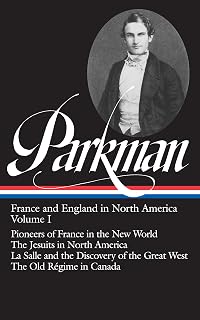
I didn't read this cover to cover--focused on the sections having to do with Fort Ticonderoga, but also read the chapter introducing Montcalm, and also the one on the Siege of Quebec. The writing was beautiful--it was written in 1884, and the language is just wonderful. Even though 1884 is more than 100 years after the French and Indian War, there are still so many close connections between Francis Parkman (author) and the events of the war: he speaks to descendants of the people involved, gets quotes from people who heard stories from people involved, etc. The appendices include the legend of Duncan Campbell, whose murdered cousin appeared to him as a ghost and told him he'd die at Ticonderoga. His troops--who knew about the ghost's show more warning--tried to keep from him that they were approaching the fort--but eventually it comes out, and of course, he does die there. The appendices also have the French texts of the letters Montcalm wrote his wife--so intimate! Francis Parkman didn't think much of the Indians, so we have lots of downputting remarks about savages, which is pretty depressing, but even there, sometimes you can see through the prejudice to discover interesting things (like the amount of time taken putting on war paint). Anyway, I loved the book. show less
I didn't read this cover to cover--focused on the sections having to do with Fort Ticonderoga, but also read the chapter introducing Montcalm, and also the one on the Siege of Quebec. The writing was beautiful--it was written in 1884, and the language is just wonderful. Even though 1884 is more than 100 years after the French and Indian War, there are still so many close connections between Francis Parkman (author) and the events of the war: he speaks to descendants of the people involved, gets quotes from people who heard stories from people involved, etc. The appendices include the legend of Duncan Campbell, whose murdered cousin appeared to him as a ghost and told him he'd die at Ticonderoga. His troops--who knew about the ghost's show more warning--tried to keep from him that they were approaching the fort--but eventually it comes out, and of course, he does die there. The appendices also have the French texts of the letters Montcalm wrote his wife--so intimate! Francis Parkman didn't think much of the Indians, so we have lots of downputting remarks about savages, which is pretty depressing, but even there, sometimes you can see through the prejudice to discover interesting things (like the amount of time taken putting on war paint). Anyway, I loved the book. show less
Montcalm and Wolfe was published in 1880, midway between the French and Indian War and today. Parkman conveys an immediacy of the events with a strong, clear narrative. There are heroes (Montcalm and Wolfe, Rogers Rangers and Pitt) and villains (the corrupt civil administration of Canada, particularly Vaudreuil and Bigot, and Pitt’s rival Newcastle) and “Indians” are portrayed as merciless savages. Although Parkman’s approach to history is dated, this is a book well worth reading.
I was struck by the portrait of Pitt, a strong war leader, seen as a war monger by his opponents. He sounds a lot like Churchill who almost certainly would have read this book as a young man. Parkman writes about “the gathering storm” around Pitt show more and I wonder whether this was the inspiration for the title of Churchill’s first volume of his WWII history.
The French and Indian War was part of the first true World War (Seven Years War) and set the stage for the American Revolution which followed less than a generation later. The removal of France as a force in North America made the colonies much less dependent upon England for military protection. The colonies learned the importance of military co-operation and developed the leaders (e.g., Washington) of the Revolution. England “won” the French and Indian War but the seeds were sown for American independence. show less
I was struck by the portrait of Pitt, a strong war leader, seen as a war monger by his opponents. He sounds a lot like Churchill who almost certainly would have read this book as a young man. Parkman writes about “the gathering storm” around Pitt show more and I wonder whether this was the inspiration for the title of Churchill’s first volume of his WWII history.
The French and Indian War was part of the first true World War (Seven Years War) and set the stage for the American Revolution which followed less than a generation later. The removal of France as a force in North America made the colonies much less dependent upon England for military protection. The colonies learned the importance of military co-operation and developed the leaders (e.g., Washington) of the Revolution. England “won” the French and Indian War but the seeds were sown for American independence. show less
I approached this book with some trepidation, given that it had been written in the 1880s. Boy, was I wrong -- Montcalm & Wolfe is one of those timeless treasures. It is extremely well-written, not dry at all, and the lessons imparted in the course of the story are still valid today. Parkman is the recognized authority on pre-Revolution America, and he describes the wild North America of the 18th century with true verve. I highly recommend this book to any student of American history.
A lively, but out of date account of the fall of Quebec and Montreal. Published originally in 1884.
Ratings
Members
- Recently Added By
Lists

Neustadt & May's List
21 works; 1 member

Trinity College Booklist (1951): Class Four, History
120 works; 2 members
Author Information

70+ Works 5,843 Members
Early in his youth, this Boston-born historian was infected with what he called (in language offensive to today's readers) "Injuns on the brain." For the rest of his life, he dedicated himself to writing what he had called at the age of 18 "a history of the American forest." In 1846, following the completion of his studies at Harvard College, he show more set out in company with a cousin on an expedition from St. Louis over the Oregon Trail to Fort Laramie, Wyoming, a journey that brought him into close contact with the Lakota Indians. Back in Boston, he turned the journal that he had kept on the trail into a series of sketches that were published in the Knickerbocker Magazine and afterwards as a book, The California and Oregon Trail, Being Sketches of Prairie and Rocky Mountain Life (1849), now better known by the abbreviated title of a later revised edition, The Oregon Trail. By this time, Parkman had well underway the historical work that would occupy him during the rest of his life, an account of the French and English in North America, the first installment of which was his History of the Conspiracy of Pontiac and the War of the North American Tribes against the English Colonies, published in 1851. (Bowker Author Biography) show less
Some Editions
Series

Work Relationships
Is contained in
Contains
Is abridged in
Common Knowledge
- Canonical title
- Montcalm and Wolfe
- Original publication date
- 1884
- People/Characters
- General James Wolfe; Louis-Joseph de Montcalm-Gozon (General Montcalm); William Pitt the Elder; Robert Dinwiddie, Governor of Virginia; William Johnson (1st Baronet, 1715? to 1774); Jeffrey Amherst (show all 15); Edward Braddock; John Forbes; Robert Rogers; William Shirley; George Washington; John Winslow; Conrad Weiser (1696 to 1760); Francois Bigot; Louis Joseph Le Loutre
- Important places
- New France; Louisbourg, New France; Pittsburgh, Pennsylvania, USA; Québec, Canada; Oswego, New York, USA; Detroit, Michigan, USA (show all 8); Halifax, Nova Scotia, Canada; Louisbourg, Nova Scotia, Canada
- Important events
- French and Indian War (1754 | 1763); Seven Years' War
- Dedication
- To Harvard College, the alma mater under whose influence the purpose of writing it was conceived, This Book is affectionately inscribed.
- First words
- The latter half of the reign of George II. was one of the most prosaic periods in English history.
- Last words
- (Click to show. Warning: May contain spoilers.)She [the United States] has tamed the savage continent, peopled the solitude, gathered wealth untold, waxed potent, imposing, redoubtable; and now it remains for her to prove, if she can, that the rule of the masses is consistent with the highest growth of the individual; that democracy can give the world a civilization as mature and pregnant, ideas as energetic and vitalizing, and types of manhood as lofty and strong, as any of the systems which it boasts to supplant.
- Original language
- English US
Classifications
- Genres
- History, Nonfiction, General Nonfiction, Biography & Memoir
- DDC/MDS
- 973.2 — History & geography History of North America United States Colonial period (1607-1775)
- LCC
- E199 .P255 — History of the United States United States Colonial history (1607-1775) By period 1689-1775 French and Indian War, 1755-1763
- BISAC
Statistics
- Members
- 429
- Popularity
- 72,141
- Reviews
- 5
- Rating
- (4.18)
- Languages
- English
- Media
- Paper, Ebook
- ISBNs
- 27
- ASINs
- 23