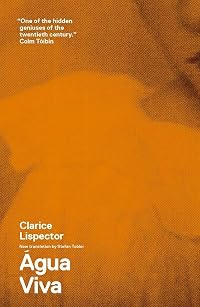
Água Viva
by Clarice Lispector
On This Page
Description
A monologue about an unnamed female protagonist's awareness of self-realization.Tags
Recommendations








Member Recommendations
Member Reviews
By publishing het work in the Modern Classics series and putting on a pedestal with Kafka and Joyce, you might think the work of Clarice Lispector belongs to the distant past of the early Twentieth Century, but she is actually fairly contemporaneous. Agua viva was first published in 1973.
It is a wildly poetic work that is throbbing with life. Some readers will consider this type of text poetry. Although the initial images suggest the text consists of a narrative in which a painter is trying to express their medium through words, at later stages of the book this transposition of words is also explored through the other senses. The texts is music, the text is fragrance, music is touch (vibration) soaked up the fingers, not the ears.
The show more fluidic state of the narrator moves on to find identity in nature, man as animal, animal as man, and while the narrator strives for life, the contemplation of death is as much part of the story. Whence is all this energy directed? Up. Freedom. As birth is the wrestling free from the sack of fluid, cutting the umbilical cord, to become free. Freedom, living and love is it. show less
It is a wildly poetic work that is throbbing with life. Some readers will consider this type of text poetry. Although the initial images suggest the text consists of a narrative in which a painter is trying to express their medium through words, at later stages of the book this transposition of words is also explored through the other senses. The texts is music, the text is fragrance, music is touch (vibration) soaked up the fingers, not the ears.
The show more fluidic state of the narrator moves on to find identity in nature, man as animal, animal as man, and while the narrator strives for life, the contemplation of death is as much part of the story. Whence is all this energy directed? Up. Freedom. As birth is the wrestling free from the sack of fluid, cutting the umbilical cord, to become free. Freedom, living and love is it. show less
Lispector's novel is, well a novel may not be the right word, a collection of philosophical musings or the distillation of a landscape of thought might be a better way to put it. Either way it is an excellent read that engages a deep and idiosyncratic specificity that blossoms outward to the universal. Her authorship is arresting and befuddling in the best way possible. I can't wait to come back to Água Viva.
Clarice crea sobre el acto de crear y reflexiona sobre reflexionar mientras vive para vivir. En medio te clava unas angustias y ansiedades que para qué te cuento.
"It's with such intense joy."
So begins The Stream of Life by Clarice Lispector. Full stop. One rereads that sentence and, yes, that is exactly what it says. The whole opening paragraph helps but little:
"It's with such intense joy. It's such an Hallelujah. "Hallelujah" I shout, an hallelujah that fuses with the darkest human howl of the pain of separation but is a shout of diabolical happiness. Because nobody holds me back anymore. I still have the ability to reason -- I've studied mathematics, which is the madness of reason -- but now I want plasma, I want to feed directly from the placenta. I'm a little frightened, still afraid to give myself over since the next instant is the unknown. Do I make the coming instant? Or does it make show more itself? We make it together with our breathing. And with the ease of a bullfighter in the ring."
What is her purpose (among many to come)?
"Let me tell you . . I'm trying to capture the fourth dimension of the now-instant, which is so fleeting it now longer is because it has already become a new now-instant, whch also is no longer. Each thing has an instant in which it is. I want to take posession of the thing's is."
And her declaration (again among many to come)?
"When you come to read me you'll ask why I don't stick to painting and exhibiting my pictures, since my writing is coarse and orderless. It's that just now I feel the need for words -- and what I write is new to me because my true word has remained untouched until now. The word is my fourth dimension."
And, there, after having finished reading the book, one can go back and realize that, in those exuberant early paragraphs are many of the main subthemes of the book: joy; darkness; pain; separation; happiness; freedom; birth; fear; surrender; the unknown; the instant; the future; the is.
One strives to keep up with the urgency of this conversational monologue, to understand as well as one can, what the author herself, in very direct and personal terms, is trying to tell you the reader. It is a feeling of involvement that is difficult to shake. One tries as hard as one can to unravel her meaning -- until finally, much later in the book, one finally realizes that "you" is a different person with whom the narrator has suffered broken love. And that this is a work of fiction out of which it may be difficult to separate the autobiographical.
Upon first reading these paragraphs I was unavoidably reminded of a now-famous sentence created long ago by Noam Chomsky (in his linguist days, in 1957):
"Colorless green ideas sleep furiously."
His intent was to exhibit a syntactically correct, perfectly clear, declarative English sentence that nevertheless was meaningless -- unless of course one chose to view it figuratively or poetically. For our purpose here and now, it offers a good point of reference for describing Lispector's artfully written prose.
First of all, Chomsky's sentence had correct syntax; Lispector definitely and deliberately writes with broken and fractured syntax.
Second, Chomsky's sentence is clearly about ideas; it is often not clear exactly what Lispector's sentences and fragments are alluding to, at least in the ordinary senses of their words.
Third, though unrelated to Chomsky, her style is non-linear and has been referred to as stream of consciousness -- although consciousness of "what" is less than clear, and we'll return to that.
Fourth, the author of the Introduction to The Stream of Life herself opens with the question: "Is the text readable?" and soon advises the reader that "there is no story."
As a result, it is fair to say that The Streeam of Life is certainly the most difficult book I have encountered in my reading to date, because of its departure from usual narrative in all respects of syntax, content, linearity and plot.
But all that is about what the book isn't. What about what the book is -- to use Lispector's favorite word -- and why read it?
First of all, I was mesmerized by it.
I had the feeling throughout that if I but read the next sentence, or the next paragaraph, or some sentences or paragraphs later to come, then the opaqueness and inscrutability of what I was reading would be clarified for me. And in a sense they were. My lingering impression of the book is that it is cast as an urgent and effusive outpouring of thoughts and feelings regarding creativity and life, which have been gained by the artistic narrator during moments of keen introspection and near-ecstatic insight. And that, by the end, she attains a degree of repose in being satisfied that, even though her testimony may end, she has had her say, and her thoughts will go on. In a very real sense, in the real world, they have.
The book was acclaimed as a masterpiece immediately when it was published (in 1989) and the back cover tells us that the New York Times Book review called the book "luxuriant and fascinating" while the San Fransico Review of Books concluded that "Lispector is without a doubt one of the most thought provoking Latin American writers of this century."
Yes, and yes.
But the road to those realizations is not an easy one. And I might take issue with "luxuriant." Stark and forceful are more often what come to my mind. And verbal. One might wish for more developed lyrical phrasings that conveyed ecstatic images to correspond with and illuminate the thoughts being presented. But the narrator's decision to forego painting and pursue the word was a fateful one. So one reads too seldom the vivid imagery of:
"My state is that of a garden with running water" (p10)
or
"Then I live the blue dawn which arrives with its gullet full of little birds" (p12)
or
"In the burning of a dry tree I twist in the flames" (p15)
or
"Like a dead woman I walk the fields in the tall grass, stalks of green light". (p18)
or
"Death erases the traces of seafoam on the sand" (p21)
or
"Once I gazed deeply into a black panther's eyes. We were both transmuted". (p66)
This is not a stream of consciousness of events and people and places amenable to images; it deals with intellectual concepts and emotions and thoughts, so one instead reads words, and declarations, and metaphors, and oxymorons:
"The secret harmony of disharmony" (p6)
and
"I force myself into the nudity of a skeleton free of humors" (p8)
and
"I am afraid of myself because I know how to paint horror" (p9)
and
"Because of the rhythm's paroxysm, I shall cross over -- cross over to the other side of life" (p12)
and
"I don't want to be me anymore" (p14)
and
"I achieve the achievable but I live the unachievable" (p56)
and
"I don't know what I am writing about: I'm obscure even to myself". (p16)
And of course, as usual, I can't find the two most colorful images that stand out in my memory. But perhaps if you read the book you will find your own images and thoughts. I can at best tell you what the book is like; I can hardly claim that it finally cohered for me or that I understood it.
Perhaps reading The Stream of Life is like staring deeply into the eyes of Clarice. She would have appreciated that. show less
So begins The Stream of Life by Clarice Lispector. Full stop. One rereads that sentence and, yes, that is exactly what it says. The whole opening paragraph helps but little:
"It's with such intense joy. It's such an Hallelujah. "Hallelujah" I shout, an hallelujah that fuses with the darkest human howl of the pain of separation but is a shout of diabolical happiness. Because nobody holds me back anymore. I still have the ability to reason -- I've studied mathematics, which is the madness of reason -- but now I want plasma, I want to feed directly from the placenta. I'm a little frightened, still afraid to give myself over since the next instant is the unknown. Do I make the coming instant? Or does it make show more itself? We make it together with our breathing. And with the ease of a bullfighter in the ring."
What is her purpose (among many to come)?
"Let me tell you . . I'm trying to capture the fourth dimension of the now-instant, which is so fleeting it now longer is because it has already become a new now-instant, whch also is no longer. Each thing has an instant in which it is. I want to take posession of the thing's is."
And her declaration (again among many to come)?
"When you come to read me you'll ask why I don't stick to painting and exhibiting my pictures, since my writing is coarse and orderless. It's that just now I feel the need for words -- and what I write is new to me because my true word has remained untouched until now. The word is my fourth dimension."
And, there, after having finished reading the book, one can go back and realize that, in those exuberant early paragraphs are many of the main subthemes of the book: joy; darkness; pain; separation; happiness; freedom; birth; fear; surrender; the unknown; the instant; the future; the is.
One strives to keep up with the urgency of this conversational monologue, to understand as well as one can, what the author herself, in very direct and personal terms, is trying to tell you the reader. It is a feeling of involvement that is difficult to shake. One tries as hard as one can to unravel her meaning -- until finally, much later in the book, one finally realizes that "you" is a different person with whom the narrator has suffered broken love. And that this is a work of fiction out of which it may be difficult to separate the autobiographical.
Upon first reading these paragraphs I was unavoidably reminded of a now-famous sentence created long ago by Noam Chomsky (in his linguist days, in 1957):
"Colorless green ideas sleep furiously."
His intent was to exhibit a syntactically correct, perfectly clear, declarative English sentence that nevertheless was meaningless -- unless of course one chose to view it figuratively or poetically. For our purpose here and now, it offers a good point of reference for describing Lispector's artfully written prose.
First of all, Chomsky's sentence had correct syntax; Lispector definitely and deliberately writes with broken and fractured syntax.
Second, Chomsky's sentence is clearly about ideas; it is often not clear exactly what Lispector's sentences and fragments are alluding to, at least in the ordinary senses of their words.
Third, though unrelated to Chomsky, her style is non-linear and has been referred to as stream of consciousness -- although consciousness of "what" is less than clear, and we'll return to that.
Fourth, the author of the Introduction to The Stream of Life herself opens with the question: "Is the text readable?" and soon advises the reader that "there is no story."
As a result, it is fair to say that The Streeam of Life is certainly the most difficult book I have encountered in my reading to date, because of its departure from usual narrative in all respects of syntax, content, linearity and plot.
But all that is about what the book isn't. What about what the book is -- to use Lispector's favorite word -- and why read it?
First of all, I was mesmerized by it.
I had the feeling throughout that if I but read the next sentence, or the next paragaraph, or some sentences or paragraphs later to come, then the opaqueness and inscrutability of what I was reading would be clarified for me. And in a sense they were. My lingering impression of the book is that it is cast as an urgent and effusive outpouring of thoughts and feelings regarding creativity and life, which have been gained by the artistic narrator during moments of keen introspection and near-ecstatic insight. And that, by the end, she attains a degree of repose in being satisfied that, even though her testimony may end, she has had her say, and her thoughts will go on. In a very real sense, in the real world, they have.
The book was acclaimed as a masterpiece immediately when it was published (in 1989) and the back cover tells us that the New York Times Book review called the book "luxuriant and fascinating" while the San Fransico Review of Books concluded that "Lispector is without a doubt one of the most thought provoking Latin American writers of this century."
Yes, and yes.
But the road to those realizations is not an easy one. And I might take issue with "luxuriant." Stark and forceful are more often what come to my mind. And verbal. One might wish for more developed lyrical phrasings that conveyed ecstatic images to correspond with and illuminate the thoughts being presented. But the narrator's decision to forego painting and pursue the word was a fateful one. So one reads too seldom the vivid imagery of:
"My state is that of a garden with running water" (p10)
or
"Then I live the blue dawn which arrives with its gullet full of little birds" (p12)
or
"In the burning of a dry tree I twist in the flames" (p15)
or
"Like a dead woman I walk the fields in the tall grass, stalks of green light". (p18)
or
"Death erases the traces of seafoam on the sand" (p21)
or
"Once I gazed deeply into a black panther's eyes. We were both transmuted". (p66)
This is not a stream of consciousness of events and people and places amenable to images; it deals with intellectual concepts and emotions and thoughts, so one instead reads words, and declarations, and metaphors, and oxymorons:
"The secret harmony of disharmony" (p6)
and
"I force myself into the nudity of a skeleton free of humors" (p8)
and
"I am afraid of myself because I know how to paint horror" (p9)
and
"Because of the rhythm's paroxysm, I shall cross over -- cross over to the other side of life" (p12)
and
"I don't want to be me anymore" (p14)
and
"I achieve the achievable but I live the unachievable" (p56)
and
"I don't know what I am writing about: I'm obscure even to myself". (p16)
And of course, as usual, I can't find the two most colorful images that stand out in my memory. But perhaps if you read the book you will find your own images and thoughts. I can at best tell you what the book is like; I can hardly claim that it finally cohered for me or that I understood it.
Perhaps reading The Stream of Life is like staring deeply into the eyes of Clarice. She would have appreciated that. show less
A fascinating attempt to write a philosophical 'novel,' and one which should appeal to readers of the Camuses and Satres as well as those searching for new forms! I say attempt, because I'm pretty sure this is a failed attempt! Lispector's translators all bemoan the difficulty of getting her idiosyncratic Portugese into English, and I have to think, from the two novels I've read, that nobody's succeeded, because this (and The Passion) both sound like over-awed teenagers who've just realised they're allowed to use their brains, but don't really have the skills with words needed to, you know, get their brains out into the public!
Lispector was clearly very intelligent; her thought in here is much better than the older existentialist-novel show more types, and would probably repay close study! But I just can't read books in which every sentence seems like it should have Spanish-style exclamation points before and after! Is this just because I'm so hemmed into the Anglophone tradition that I've lost touch with my inner excitable child?! Perhaps! But I'm too old to really care! If I want to read musings on the nature of time and memory, I'll stick to Proust, Woolf and, in a pinch, Bergson! And even Henri's a little too over the top for me! So Lispector probably never stood a chance! show less
Lispector was clearly very intelligent; her thought in here is much better than the older existentialist-novel show more types, and would probably repay close study! But I just can't read books in which every sentence seems like it should have Spanish-style exclamation points before and after! Is this just because I'm so hemmed into the Anglophone tradition that I've lost touch with my inner excitable child?! Perhaps! But I'm too old to really care! If I want to read musings on the nature of time and memory, I'll stick to Proust, Woolf and, in a pinch, Bergson! And even Henri's a little too over the top for me! So Lispector probably never stood a chance! show less
A seemingly random, stream of consciousness series of reflections on time, memory, God, her creative processes, grace, art, and various other topics. Sometimes a single, lapidary epigram, sometimes an incoherent paragraph. Probably not a good choice for a first Lispector book.
Wow. I've been working on this since July. Lispector is trying to capture with words what you can do with painting. Good luck. She just can't keep up the ecstatic soul cracking for any sustained length and it sort of devolves into what I was afraid PKD's Exegesis was going to be. There are some great life affirming poetic nuggets in here, and pagan gods pop in a time or two, but far too often she just come off as bored. And I'm reading it in translation. I want to say more positive things but if it took me this long to finish?
I have a story about this book.
I have a story about this book.
Members
- Recently Added By
Lists

Experimental Literature
141 works; 19 members

Latin American Literature
50 works; 11 members

Cult Classics
30 works; 1 member
Author Information

151+ Works 12,887 Members
Clarice Lispector was born in the Ukraine and was taken to Brazil as a young child. She was a law student, editor, translator, and newswriter, who traveled widely, spending eight years in the United States. "Family Ties" (1960) is a collection of short stories revealing Lispector's existentialist view of life and demonstrating that even family show more ties and social relationships are temporary. Although tied to each other and to the outside world, the characters are finally totally alone and separate. Lispector received praise from American critics for "The Apple in the Dark" (1967), a novel about a guilt-ridden man's search for the ultimate knowledge (Eve's apple), which he believes will bring him hope. Lispector's books are being translated into various languages in Europe, especially in France, where the critic Helene Cixous is one of her great admirers and a promoter of her works. (Bowker Author Biography) show less
Some Editions
Awards and Honors
Awards
Series
Belongs to Publisher Series
Common Knowledge
- Canonical title
- Água Viva
- Original title
- Água Viva
- Alternate titles
- The Stream of Life
- Original publication date
- 1973
- Publisher's editor*
- Prumo
- Original language
- Portuguese
*Some information comes from Common Knowledge in other languages. Click "Edit" for more information.
Classifications
- Genres
- Fiction and Literature, General Fiction
- DDC/MDS
- 869.3 — Literature & rhetoric Spanish Literature Literatures of Portuguese and Galician languages Portuguese fiction
- LCC
- PQ9697 .L585 .A7813 — Language and Literature French, Italian, Spanish and Portuguese literatures Portuguese literature Provincial, local, colonial, etc. Brazil
- BISAC
Statistics
- Members
- 1,081
- Popularity
- 23,680
- Reviews
- 20
- Rating
- (3.95)
- Languages
- 10 — Danish, English, Finnish, French, Italian, Latin, Portuguese, Spanish, Swedish, Turkish
- Media
- Paper, Ebook
- ISBNs
- 31
- ASINs
- 9