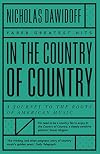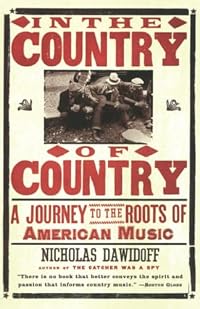
In the Country of Country: A Journey to the Roots of American Music
by Nicholas Dawidoff
On This Page
Description
In a series of indelible portraits of country music stars, Dawidoff reveals, among others, Jimmie Rodgers, the "father of Country"; Johnny Cash, the "Man in Black"; and Patsy Cline, a lonely figure striding out bravely in a man's world. In the Country of Country is a passionate and expansive account of a quintessentially American art form and the performers that made country music what it is today. nbsp; Both deeply personal and endlessly evocative,nbsp; In the Country of Country pays show more tribute to the music that sprang from places like Maces Springs, Virginia, home of the Carter Family, and Bakersfield, California, where Buck Owens held sway. Bestselling author Nicholas Dawidoff takes readers to the back roads and country hollows that were home to Chet Atkins, Doc Watson, Emmylou Harris, and many more. show lessTags
Recommendations












Member Reviews
A strong, conventional ramble through the history of country music. I've always been more into classic rock, but in the last couple of years I've stumbled across a number of great young country musicians (most notably Colter Wall, Charley Crockett, Tyler Childers, Nick Shoulders and Sierra Ferrell) and felt like I didn't know enough about the well they were drawing from. With the notable exception of Johnny Cash, and the occasional Hank Williams song or other country standard covered by a rock band, I didn't know much about country music.
Nicholas Dawidoff's 1997 book In the Country of Country was a useful remedy to this. While of course there is no substitute to listening to the music directly, this book did provide a useful orientation show more to the genre, particularly the early pioneers like Jimmie Rodgers and the Carter Family. I learned about the integration of yodelling into country music, the importance of the Grand Ole Opry, and the differences between bluegrass and country (the former is defined by its restrictions (pg. 86); it's what Bill Monroe called "hillbilly jazz" (pg. 109)). Dawidoff wrote when many of these country giants were still alive, and it's a mark very much in favour of his book that he's able to pick the brains of Cash, Monroe, Charlie Louvin and Rose Maddox (among others) directly.
The book does have its disadvantages. Starting out, as the subtitle puts it, as 'a journey to the roots of American music', In the Country of Country soon develops tunnel vision. Initially, as we learn about Jimmie Rodgers, the Carter Family and Bill Monroe, we get a real sense of how this genre was built, but it all becomes a bit isolated. It's like blues and folk music don't exist here, though in reality the cross-pollination was considerable, and Dawidoff's brief interaction with Bob Dylan reminds us that there's plenty of hinterland here which he hasn't even touched. The second half of the book loses its dynamism, focusing on more contemporary artists in a way that becomes a bit more paint-by-numbers and magazine-profile-like. These later chapters are often colourless, end abruptly, and don't really contribute to our 'journey to the roots of American music'.
That said, In the Country of Country covers many of the relevant bases, and if it can't be said to be an essential book, or even an essential introduction, it's certainly a solid approach. While it's always better to hear a song than read a description of it, this book does communicate some of the real flavour of the genre. Dawidoff addresses, though rarely directly, the central tension in the country-loving community: the battle over authenticity and purity; the earthy, rough music of various regions versus the safe, homogenised 'hat acts' of Nashville. He notes how the music began as "a means of solidarity for people who felt marginalized by American society" but which has since become commodified (pg. 19). We come to realise that the obsession with 'purity' is less to do with gatekeeping and more about a desire to preserve the music's emotional maturity against the assault of tight jeans and songs about pick-up trucks. In the course of his rich but middle-of-the-road journey, Dawidoff reminds us of country's appeal: "This is not music for swinging teens. It's raw stuff for grown-up people who aren't getting any younger and know something about disappointment" (pg. 212). show less
Nicholas Dawidoff's 1997 book In the Country of Country was a useful remedy to this. While of course there is no substitute to listening to the music directly, this book did provide a useful orientation show more to the genre, particularly the early pioneers like Jimmie Rodgers and the Carter Family. I learned about the integration of yodelling into country music, the importance of the Grand Ole Opry, and the differences between bluegrass and country (the former is defined by its restrictions (pg. 86); it's what Bill Monroe called "hillbilly jazz" (pg. 109)). Dawidoff wrote when many of these country giants were still alive, and it's a mark very much in favour of his book that he's able to pick the brains of Cash, Monroe, Charlie Louvin and Rose Maddox (among others) directly.
The book does have its disadvantages. Starting out, as the subtitle puts it, as 'a journey to the roots of American music', In the Country of Country soon develops tunnel vision. Initially, as we learn about Jimmie Rodgers, the Carter Family and Bill Monroe, we get a real sense of how this genre was built, but it all becomes a bit isolated. It's like blues and folk music don't exist here, though in reality the cross-pollination was considerable, and Dawidoff's brief interaction with Bob Dylan reminds us that there's plenty of hinterland here which he hasn't even touched. The second half of the book loses its dynamism, focusing on more contemporary artists in a way that becomes a bit more paint-by-numbers and magazine-profile-like. These later chapters are often colourless, end abruptly, and don't really contribute to our 'journey to the roots of American music'.
That said, In the Country of Country covers many of the relevant bases, and if it can't be said to be an essential book, or even an essential introduction, it's certainly a solid approach. While it's always better to hear a song than read a description of it, this book does communicate some of the real flavour of the genre. Dawidoff addresses, though rarely directly, the central tension in the country-loving community: the battle over authenticity and purity; the earthy, rough music of various regions versus the safe, homogenised 'hat acts' of Nashville. He notes how the music began as "a means of solidarity for people who felt marginalized by American society" but which has since become commodified (pg. 19). We come to realise that the obsession with 'purity' is less to do with gatekeeping and more about a desire to preserve the music's emotional maturity against the assault of tight jeans and songs about pick-up trucks. In the course of his rich but middle-of-the-road journey, Dawidoff reminds us of country's appeal: "This is not music for swinging teens. It's raw stuff for grown-up people who aren't getting any younger and know something about disappointment" (pg. 212). show less
Great set of essays about country music and the people who make it. Kind of quirky, in that some people, like Steve Earle, are mentioned but not profiled. But an excellent tour of past and present giants in the genre.
Please remember two stars on Goodreads is an "ok" rating. That's what I felt (or rather didn't feel) about this book. It is ok....
Ratings
Members
- Recently Added By
Author Information

9+ Works 1,555 Members
Nicholas Dawidoff is the author of four previous critically acclaimed books, including the best-selling The Catcher Was a Spy and The Crowd Sounds Happy. He has been a Guggenheim Fellow, a Civitella Ranieri Fellow, a Berlin Prize Fellow of the American Academy, and an Anschutz Distinguished Fellow at Princeton University, and is now a Branford show more Fellow at Yale University. A Pulitzer Prize finalist (for The Fly Swatter), Dawidoff is a contributor to The New Yorker, the New York Times Magazine, and Rolling Stone. He lives in New Haven, Connecticut, with his family. show less
Classifications
- Genres
- Music, Nonfiction, General Nonfiction, History, Biography & Memoir
- DDC/MDS
- 781.642 — Arts & recreation Music General principles and musical forms Traditions of music Western popular music {equally instrumental and vocal} Country and Bluegrass
- LCC
- ML3524 .D39 — Music Literature on music Literature on music History and criticism Popular music
- BISAC
Statistics
- Members
- 178
- Popularity
- 183,300
- Reviews
- 3
- Rating
- (3.93)
- Languages
- English, French
- Media
- Paper, Ebook
- ISBNs
- 7
- ASINs
- 1