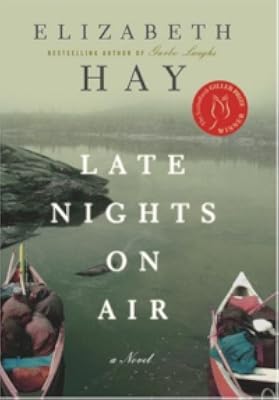
Late Nights on Air
by Elizabeth Hay
On This Page
Description
It’s 1975 when beautiful Dido Paris arrives at the radio station in Yellowknife, a frontier town in the Canadian north. She disarms hard-bitten broadcaster Harry Boyd and electrifies the station, setting into motion rivalries both professional and sexual. As the drama at the station unfolds, a proposed gas pipeline threatens to rip open the land and inspires many people to find their voices for the first time. This is the moment before television conquers the north’s attention, when the show more fate of the Arctic hangs in the balance. After the snow melts, members of the radio station take a long canoe trip into the Barrens, a mysterious landscape of lingering ice and infinite light that exposes them to all the dangers of the ever-changing air. Spare, witty, and dynamically charged, this compelling tale embodies the power of a place and of the human voice to generate love and haunt the memory.. show less
Tags
Recommendations






















Member Reviews
Set in Yellowknife, Northwest Territories, Canada, during the mid-1970s, the novel is focused initially on three people associated with the local radio station: novice Gwen Symon, interim station manager Harry Boyd, and alluring host Dido Paris. The narrative follows their interactions, along with other radio employees and local townsfolk. The storyline builds toward a pivotal canoe trip that several characters undertake into the Barrens, following the route of a real explorer, John Hornby.
The historical backdrop includes the 1975 Berger Inquiry into a proposed Mackenzie Valley Pipeline, which addresses conflicts between newcomers and indigenous peoples. The radio station setting allows Hay to examine how we present ourselves to the show more world. The characters' relationships with their own voices - Gwen's initial uncertainty, Harry's professional polish, Dido's seductive control - become vehicles for exploring authenticity.
Hay's lyrical prose captures the landscape's stark beauty. The tone is melancholy. It is slow-paced with an emphasis on atmosphere and introspection rather than external action. It speaks to fundamental questions about belonging, environmental responsibility, and the human need for both connection and solitude. show less
The historical backdrop includes the 1975 Berger Inquiry into a proposed Mackenzie Valley Pipeline, which addresses conflicts between newcomers and indigenous peoples. The radio station setting allows Hay to examine how we present ourselves to the show more world. The characters' relationships with their own voices - Gwen's initial uncertainty, Harry's professional polish, Dido's seductive control - become vehicles for exploring authenticity.
Hay's lyrical prose captures the landscape's stark beauty. The tone is melancholy. It is slow-paced with an emphasis on atmosphere and introspection rather than external action. It speaks to fundamental questions about belonging, environmental responsibility, and the human need for both connection and solitude. show less
I liked this book and I think the most identifiable theme that engendered that liking was the idea of the arbitrary nature of our life's directions. People live long or they die young; they stay in one place, or they travel long distances; they have one good relationship, or none, or many. Which out of these possibilities will actually occur is decided by coincidence or in brief moments in time, or by 'luck', or by someone else's arbitrary action.
I also liked the northwest Canadian setting of this story - so much beyond my experience (I live in Australia) that I just enjoyed exploring this (physical) world with Elizabeth Hay as my leader and guide. I reckon she is a great observer of the natural world as well as a fine writer. Perhaps I show more would have liked the book even more there had been more focus on one character, but maybe not....perhaps this superficiality helps to reinforce the essential nature of the book's message. show less
I also liked the northwest Canadian setting of this story - so much beyond my experience (I live in Australia) that I just enjoyed exploring this (physical) world with Elizabeth Hay as my leader and guide. I reckon she is a great observer of the natural world as well as a fine writer. Perhaps I show more would have liked the book even more there had been more focus on one character, but maybe not....perhaps this superficiality helps to reinforce the essential nature of the book's message. show less
Last year, I read Alone in the Classroom and fell in love with Elizabeth Hay's writing. The book itself wasn't great; forward momentum just disappeared in the second half, but the writing was lovely; clear and precise, with ordinary turns of speech mixed with astonishing metaphors. So I was all set for an enjoyable few evenings with her Giller Prize winner, Late Nights on Air.
"I heard Abe Lamont talking about how to shape an interview and write for radio. It's not so different, is it? One thought in each sentence. Not too many adjectives. Simplicity. Intimacy. Directness. That's what I'm after, too."
Late Nights on Air is written in that same clear style, which here reflects the setting of the book; the clear, thin northern air, without show more unnecessary decoration, but full of the magnificence of the breadth of the country. It concerns a group of co-workers, almost all recent transplants, at a radio station in Yellowknife in the Northwest Territories in the mid-1970s. Beginning when Dido Paris is hired by the station, the story follows the various broadcasters as they adjust to life in the north and as a judge conducts hearings on whether or not an gas pipeline should be built. Inspired by a radio play dramatizing the fate of John Hornby's final expedition to the Barrens, four of them set off on a canoe trip across the tundra. The story is intensely character driven, from Gwen, the uncertain neophyte, to Dido, the charismatic and volatile focus of many, to Harry, the jaded, but wise station manager, [Late Nights on Air] is all about how living north of the 60th parallel changes them and how their relationships changed or didn't change over time.
I inhabited this book while I read it. I have a fascination for the northern wilderness and the canoe trip that forms the backbone of the book was beautifully described. Yellowknife was almost a character in the book, with so much based on the unique culture of the Canadian north. show less
"I heard Abe Lamont talking about how to shape an interview and write for radio. It's not so different, is it? One thought in each sentence. Not too many adjectives. Simplicity. Intimacy. Directness. That's what I'm after, too."
Late Nights on Air is written in that same clear style, which here reflects the setting of the book; the clear, thin northern air, without show more unnecessary decoration, but full of the magnificence of the breadth of the country. It concerns a group of co-workers, almost all recent transplants, at a radio station in Yellowknife in the Northwest Territories in the mid-1970s. Beginning when Dido Paris is hired by the station, the story follows the various broadcasters as they adjust to life in the north and as a judge conducts hearings on whether or not an gas pipeline should be built. Inspired by a radio play dramatizing the fate of John Hornby's final expedition to the Barrens, four of them set off on a canoe trip across the tundra. The story is intensely character driven, from Gwen, the uncertain neophyte, to Dido, the charismatic and volatile focus of many, to Harry, the jaded, but wise station manager, [Late Nights on Air] is all about how living north of the 60th parallel changes them and how their relationships changed or didn't change over time.
I inhabited this book while I read it. I have a fascination for the northern wilderness and the canoe trip that forms the backbone of the book was beautifully described. Yellowknife was almost a character in the book, with so much based on the unique culture of the Canadian north. show less
Where to even begin? Elizabeth Hay's eloquence and utter humanity has nearly struck me dumb. I loved this book, LATE NIGHTS ON AIR, so much that I didn't want it to end.
Canadian writers have fascinated me for years, maybe because I'm always so amazed that many great and well-known authors in Canada are all but UNknown here in the U.S. I remember discovering the funny and oh-so-human SMITH novels of Paul St Pierre many years ago. And of course there is always Farley Mowat, who is pretty well-known down here in the 48, probably mostly for his memoir, NEVER CRY WOLF. But his other two memoirs, BORN NAKED and AND NO BIRDS SANG are equally good, and they are all but invisible here in this country.
And there is Linden MacIntyre, the show more award-winning CBC journalist, with his Cape Breton novel trilogy and his lovely memoir of that region, CAUSEWAY. I simply can't understand how those books have not caught on here.
But now here is Elizabeth Hay, who has obviously been around for quite a while now and won some prestigious literary awards, and I am just now discovering her. Or thought I was, until I remembered I had read A STUDENT OF WEATHER some years back, a book I found, sadly, in a remainder bin. (Where I often find some of the very best books.)
LATE NIGHTS ON AIR is a literary gem, written from an omniscient point-of-view with love and care for its several main characters, who have all been turned and polished so that all of their facets and flaws are revealed under the light of careful and appreciative reading. And I did appreciate these fictional folks, make no mistake, all of whom worked at a small Northern Services radio station in Yellowknife, Northwest Territory, an historical settlement on the shore of Great Slave Lake.
First there is Harry, a embittered veteran of radio who peaked early, tried TV and failed, and is now, in his mid-forties, back where he started twenty years before.
The story unfolds in the mid-70s and begins with Harry hearing a voice on his own radio station, a late night radio voice that he hasn't heard before. The voice belongs to Dido Paris, a new hire, a beautiful young woman with a past and indeterminate sexual preferences, who leaves her lasting mark on Harry, as well as on all the other people whose lives she touches.
There is Eleanor Dew, the station's receptionist, who has her own unusual story which includes a brief unconsummated marriage. And Ralph, the station's book reviewer and nature photographer. And Eddie, a Vietnam vet and the station technician, and Harry's rival for Dido's affections.
But the novel's central character is Gwen, young and - mostly - innocent, still groping for her proper place in life, looking for a start in radio. Under Harry's guidance and Eleanor's friendship she gradually grows from a frightened young broadcaster into a confident and inventive late night radio personality with her own persona, 'Stella Round.'
Also key to the novel's forward impetus is the story of the Canadian explorer of the Barrens, John Hornby. Harry, Eleanor, Gwen and Ralph are all so fascinated by this man's legend and tragic end that they embark on a summer canoe trip retracing Hornby's last journey. (Both Hornby's trip and the retracing of it by this novel's characters made me remember Jon Krakauer's bestseller, INTO THE WILD.) And there is also the subtheme of an ongoing study by a federally appointed judge of the effects a planned pipeline would have on the fragile arctic ecosystem.
LATE NIGHTS ON AIR makes use of both of the most common themes in fiction: 'a new person comes to town' and 'someone goes on a journey.' And they are used and interwoven in a masterful manner. The book is filled with wonderful details that evoked so many memories and associations. The mention of Miles Davis' seminal album, KIND OF BLUE, made me remember my own introduction to that jazz masterpiece, at a remote army base in northern Turkey. The book's very title, and its theme, evoked memories of another more obscure but favorite album, Katy Moffatt's MIDNIGHT RADIO. And the description of the travelers' encounter with a massive herd of migrating caribou brought to mind Mowat's own similar experience in NEVER CRY WOLF.
There is nothing forced or contrived in LATE NIGHTS ON AIR. It has elements of tragedy, humor, and pathos. But what shines through the strongest is its utter humanity. As I said earlier, I wanted the story to go on and on. But its ending, while certainly not a happily-ever-after conventional sort of ending, is richly, deeply, and profoundly satisfying. I loved this book and recommend it highly. show less
Canadian writers have fascinated me for years, maybe because I'm always so amazed that many great and well-known authors in Canada are all but UNknown here in the U.S. I remember discovering the funny and oh-so-human SMITH novels of Paul St Pierre many years ago. And of course there is always Farley Mowat, who is pretty well-known down here in the 48, probably mostly for his memoir, NEVER CRY WOLF. But his other two memoirs, BORN NAKED and AND NO BIRDS SANG are equally good, and they are all but invisible here in this country.
And there is Linden MacIntyre, the show more award-winning CBC journalist, with his Cape Breton novel trilogy and his lovely memoir of that region, CAUSEWAY. I simply can't understand how those books have not caught on here.
But now here is Elizabeth Hay, who has obviously been around for quite a while now and won some prestigious literary awards, and I am just now discovering her. Or thought I was, until I remembered I had read A STUDENT OF WEATHER some years back, a book I found, sadly, in a remainder bin. (Where I often find some of the very best books.)
LATE NIGHTS ON AIR is a literary gem, written from an omniscient point-of-view with love and care for its several main characters, who have all been turned and polished so that all of their facets and flaws are revealed under the light of careful and appreciative reading. And I did appreciate these fictional folks, make no mistake, all of whom worked at a small Northern Services radio station in Yellowknife, Northwest Territory, an historical settlement on the shore of Great Slave Lake.
First there is Harry, a embittered veteran of radio who peaked early, tried TV and failed, and is now, in his mid-forties, back where he started twenty years before.
The story unfolds in the mid-70s and begins with Harry hearing a voice on his own radio station, a late night radio voice that he hasn't heard before. The voice belongs to Dido Paris, a new hire, a beautiful young woman with a past and indeterminate sexual preferences, who leaves her lasting mark on Harry, as well as on all the other people whose lives she touches.
There is Eleanor Dew, the station's receptionist, who has her own unusual story which includes a brief unconsummated marriage. And Ralph, the station's book reviewer and nature photographer. And Eddie, a Vietnam vet and the station technician, and Harry's rival for Dido's affections.
But the novel's central character is Gwen, young and - mostly - innocent, still groping for her proper place in life, looking for a start in radio. Under Harry's guidance and Eleanor's friendship she gradually grows from a frightened young broadcaster into a confident and inventive late night radio personality with her own persona, 'Stella Round.'
Also key to the novel's forward impetus is the story of the Canadian explorer of the Barrens, John Hornby. Harry, Eleanor, Gwen and Ralph are all so fascinated by this man's legend and tragic end that they embark on a summer canoe trip retracing Hornby's last journey. (Both Hornby's trip and the retracing of it by this novel's characters made me remember Jon Krakauer's bestseller, INTO THE WILD.) And there is also the subtheme of an ongoing study by a federally appointed judge of the effects a planned pipeline would have on the fragile arctic ecosystem.
LATE NIGHTS ON AIR makes use of both of the most common themes in fiction: 'a new person comes to town' and 'someone goes on a journey.' And they are used and interwoven in a masterful manner. The book is filled with wonderful details that evoked so many memories and associations. The mention of Miles Davis' seminal album, KIND OF BLUE, made me remember my own introduction to that jazz masterpiece, at a remote army base in northern Turkey. The book's very title, and its theme, evoked memories of another more obscure but favorite album, Katy Moffatt's MIDNIGHT RADIO. And the description of the travelers' encounter with a massive herd of migrating caribou brought to mind Mowat's own similar experience in NEVER CRY WOLF.
There is nothing forced or contrived in LATE NIGHTS ON AIR. It has elements of tragedy, humor, and pathos. But what shines through the strongest is its utter humanity. As I said earlier, I wanted the story to go on and on. But its ending, while certainly not a happily-ever-after conventional sort of ending, is richly, deeply, and profoundly satisfying. I loved this book and recommend it highly. show less
There is something inherently intimate about radio. I am not talking about “shock jock” or talk radio where the sole purpose of the program is to brooch a controversial topic and get callers lighting up the switchboard to voice their opinions. I am talking about the late night deejays… the Venus Flytraps of the world with their silky voices, their sympathetic ears. Hay draws on her early work history as a Northwest Territories-based radio broadcaster for the CBC to weave an eloquently powerful Canadian novel. Hay stated during an interview that the starting point of this book for her was that real voices have fictional faces, that we make up what we think should be associated with the voice we hear. Hay’s makes use of this show more ‘disconnect’ to present a 1970's circa northern world at a cross roads, with sub-themes of a television station coming to encroach on radio country and a proposed gas pipeline that may threaten the wildlife habitat and native communities of the region. Hay’s characters are a motley crew. A straggling collection of humanity that, for reasons conscious or unconscious, have individually migrated to this remote hinterland. For this group, the radio station representing an outpost: a rest stop from their former lives before before heading on to their future.
Essentially, this is a love story, or maybe a series of love triangles as the characters bob and weave through the motions of infatuation, seduction, smothering love and abandonment. In Hay’s deft, sympathetic hands, the reader experiences the poignancy of unrequited love and the unforgiving nature and striking beauty of the Yellowknife and the Barrens. Through her writing, one can feel Hay’s compassion for the human spirit – sadness, longing, tenderness – as well as a strong love and respect for the raw power and isolation of the far north.
A richly poignant and deeply satisfying read. A well-deserved winner of the 2007 Giller Prize, IMO, and one of my favorite reads so far this year. show less
Essentially, this is a love story, or maybe a series of love triangles as the characters bob and weave through the motions of infatuation, seduction, smothering love and abandonment. In Hay’s deft, sympathetic hands, the reader experiences the poignancy of unrequited love and the unforgiving nature and striking beauty of the Yellowknife and the Barrens. Through her writing, one can feel Hay’s compassion for the human spirit – sadness, longing, tenderness – as well as a strong love and respect for the raw power and isolation of the far north.
A richly poignant and deeply satisfying read. A well-deserved winner of the 2007 Giller Prize, IMO, and one of my favorite reads so far this year. show less
Late Nights on Air was the Giller Prize winner for 2007 - and deservedly so.
Elizabeth Hay creates a group of characters who work at the radio station in Yellowknife in 1975. They all come from elsewhere - the misfits, the loners, the romantics, the people running away from life. The employees at the station fit into one or more of those categories. Harry, the station manager, has returned to radio after a disastrous attempt at television. Dido, the station’s most popular newsreader, fled her marriage after an ill-conceived affair with her father-in-law, only to find herself caught between the affections of Harry and Eddy, the station’s 'bad boy' engineer. Ralph has deep feelings for Eleanor, another refugee from a bad marriage. Gwen show more turns up in Yellowknife drawn north by childhood memories of a radio program about northern explorer John Hornby. (side note - read more about Hornsby - his expeditions sound fascinating). She dreams of a career in radio, only to find herself paralyzed by shyness and assigned to late night radio where her stammering won't be an issue.
Harry, Gwen, Eleanor and Ralph embark on a 6 weeks-long life-changing canoeing trip to retrace Hornsby's fatal expedition. The beauty of the North, the scenery, the quiet, the seduction, the underlying danger becomes a compelling fifth character on this trip.
Their lives are played out against the backdrop of Justice Thomas Berger's commission on the proposed building of the MacKenzie pipeline through the Yukon. Berger spent three years truly listening to all, going from native village to village, compiled 40,000 pages of testimony, and recommended “no pipeline now, and no pipeline across northern Yukon ever.”
Are you listening, Justin Trudeau!!??
Elizabeth Hay has written a wonderful book, peopled by characters that will stay with me. show less
Elizabeth Hay creates a group of characters who work at the radio station in Yellowknife in 1975. They all come from elsewhere - the misfits, the loners, the romantics, the people running away from life. The employees at the station fit into one or more of those categories. Harry, the station manager, has returned to radio after a disastrous attempt at television. Dido, the station’s most popular newsreader, fled her marriage after an ill-conceived affair with her father-in-law, only to find herself caught between the affections of Harry and Eddy, the station’s 'bad boy' engineer. Ralph has deep feelings for Eleanor, another refugee from a bad marriage. Gwen show more turns up in Yellowknife drawn north by childhood memories of a radio program about northern explorer John Hornby. (side note - read more about Hornsby - his expeditions sound fascinating). She dreams of a career in radio, only to find herself paralyzed by shyness and assigned to late night radio where her stammering won't be an issue.
Harry, Gwen, Eleanor and Ralph embark on a 6 weeks-long life-changing canoeing trip to retrace Hornsby's fatal expedition. The beauty of the North, the scenery, the quiet, the seduction, the underlying danger becomes a compelling fifth character on this trip.
Their lives are played out against the backdrop of Justice Thomas Berger's commission on the proposed building of the MacKenzie pipeline through the Yukon. Berger spent three years truly listening to all, going from native village to village, compiled 40,000 pages of testimony, and recommended “no pipeline now, and no pipeline across northern Yukon ever.”
Are you listening, Justin Trudeau!!??
Elizabeth Hay has written a wonderful book, peopled by characters that will stay with me. show less
The first half of the book sets down the foundation of flawed characters who slowly woo you into the landscape of the North, its isolation, yet the closeness and intimacy of their township, and the realism and authenticity of their unique, yet easily recognizable personalities. They are rich and substantial, lacking stereotype. And their relationships with one another reveal their longings, their failings, and their complexities---especially in the forms of love.
The latter half of the novel becomes an expedition into the Barrens of Yellowknife, a lovely, yet detailed and intelligent view of a land rarely visited or seen by man. It weaves Canada’s historical pioneering heroes while documenting the northern wilderness. At the same time, show more the characters themselves experience the glory of its vastness, abundance, and beauty, while resisting and overcoming its treachery and harshness. It is a story about journeying, crossing boundaries, and surviving. Not only in the extreme climates of the northern wilderness, but also of the extreme climates of relationship and love. The characters who you come to care for are intelligent, witty, passionate, humbling, and resilient.
It’s a beautiful and beautifully written novel. show less
The latter half of the novel becomes an expedition into the Barrens of Yellowknife, a lovely, yet detailed and intelligent view of a land rarely visited or seen by man. It weaves Canada’s historical pioneering heroes while documenting the northern wilderness. At the same time, show more the characters themselves experience the glory of its vastness, abundance, and beauty, while resisting and overcoming its treachery and harshness. It is a story about journeying, crossing boundaries, and surviving. Not only in the extreme climates of the northern wilderness, but also of the extreme climates of relationship and love. The characters who you come to care for are intelligent, witty, passionate, humbling, and resilient.
It’s a beautiful and beautifully written novel. show less
Members
- Recently Added By
Published Reviews
ThingScore 75
This book will no doubt be remembered as Hay’s “Yellowknife novel” or even her “radio novel” – it follows the lives of a handful of people running a northern CBC station in the 1970s. The characters’ various hang-ups are magnified and elevated by the lonely vastness....That city crops up in many of Hay’s works, through explorations of Canadian history and through what she calls show more a north-south/hot-cold fixation. But this novel is the first time she explores the territory deeply, as much as she explores the medium of radio deeply. “What actually was on my mind more than Yellowknife was the whole dilemma of shyness,” she says. “For some strange reason, shy people are frequently drawn to radio as a workplace...That effort has culminated in Late Nights on Air, with its adventure, entanglements, and suspense. But the book also has plenty of emotional insight show less
added by vancouverdeb
Lists

The Best of Canadian Literature
235 works; 33 members
CBC Books - Canada's 100 (+ bonus 10): Which have you read?
110 works; 23 members

Recommend the 20 best books you've read in the last five years
2,168 works; 608 members

Female Author
1,234 works; 65 members

Giller Prize Winners
32 works; 6 members

Swinging Seventies
255 works; 18 members

Books Read in 2024
4,727 works; 125 members
Author Information

12+ Works 2,518 Members
Elizabeth Hay was born in Owen Sound, Ontario on October 22, 1951. She attended Victoria College, University of Toronto. She worked for Canadian Broadcasting Corporation radio for ten years as a host, interviewer, and documentary maker. She has written several books including Small Change, A Student of Weather, Garbo Laughs, and The Only Snow in show more Havana. She won the 2007 Scotiabank Giller Prize for Late Nights on Air. In 2002, she received the Marian Engel Award for her body of work, which includes novels, short fiction, and creative non-fiction. (Bowker Author Biography) show less
Awards and Honors
Awards
Common Knowledge
- Canonical title
- Late Nights on Air
- Original publication date
- 2007-09-18
- People/Characters*
- Harry Boyd; Eleanor Dew; Dido Paris; Ralph Cody; Gwen Symon; Eddy Fitzgerald (show all 24); Lorna Dargabble (Lorna Palliser); Lorna Palliser (Lorna Dargabble); Daniel Moir; Danny Moir; Jim Murphy; Andrew McNab; Bill Thwaite; George Tupper; Thomas Berger; Louise Corrie; Abe Lamont; Evelyn Boyd; Teresa Dolorosa Lafferty; Bud Knapp; Ee-zay; Doug Palliser; Irving Dargabble; David
- Important places
- Yellowknife, Northwest Territories, Canada; Canada; Canada's North
- Dedication
- In memory of David Turney 1952 - 1988
- First words
- Harry was in his little house on the edge of Back Bay when at half past twelve her voice came over the radio for the first time.
- Quotations
- Harry confessed he had no sense of direction. He told Eleanor about he infamous night in Toronto when he went to play poker at a buddy's house for the umpteenth time, but walked into another house entirely, on a different blo... (show all)ck. "I was hanging up my coat when the owner came out of the kitchen. I figured he had to be the new player. So I said, 'Where's the booze?'"
She thought how changeable and infinitely various the air is, and how she was being paid to cram it to the gills with talk, to bury it under endless information, and she couldn't do it any more.
Lying on the ground, being reshaped, was like lying awake beside a new husband - Last words
- (Click to show. Warning: May contain spoilers.)How the earth could hold any more water they didn't know.
(Click to show. Warning: May contain spoilers.)How earth could hold any more water, they didn't know.
*Some information comes from Common Knowledge in other languages. Click "Edit" for more information.
Classifications
Statistics
- Members
- 1,109
- Popularity
- 23,005
- Reviews
- 67
- Rating
- (3.64)
- Languages
- Dutch, English, Estonian, German
- Media
- Paper, Audiobook, Ebook
- ISBNs
- 25
- ASINs
- 7