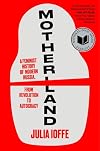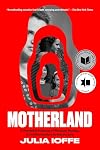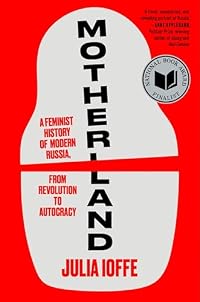
Motherland: A Feminist History of Modern Russia, from Revolution to Autocracy
by Julia Ioffe
On This Page
Description
"Acclaimed journalist Julia Ioffe tells the story of modern Russia through the history of its women, from revolution to utopia to autocracy. In 1990, seven-year-old Julia Ioffe and her family fled the Soviet Union. Nearly twenty years later, Ioffe returned to Moscow -- only to discover just how much Russian society had changed while she had been living in America. The Soviet women she had known growing up -- doctors, engineers, scientists -- seemed to have been replaced by women desperate to show more marry rich and become stay-at-home moms. How had Russia gone from portraying itself as the vanguard of world feminism to becoming a bastion of conservative Christian values? In Motherland, Ioffe turns modern Russian history on its head, telling it exclusively through the stories of its women. From her own physician great-grandmothers to Lenin's lover, a feminist revolutionary; from the hundreds of thousands of Soviet girls who fought in World War II to the millions of single mothers who rebuilt and repopulated a devastated country; from the members of Pussy Riot to Yulia Navalnaya, the wife of opposition leader Alexey Navalny, Ioffe chronicles one of the most audacious social experiments in history and documents how it failed the very women it was meant to liberate -- and how that failure paved the way for the revanche of Vladimir Putin. Part memoir, part journalistic exploration, part history, Motherland paints a portrait of modern Russia through the women who shaped it. With deep emotion, Ioffe reveals what it means to live through the cataclysms of revolution, war, idealism, and heartbreak -- and how the story of Russia today is inextricably tied to the sacrifices of its women" -- show lessTags
Recommendations




















Member Reviews
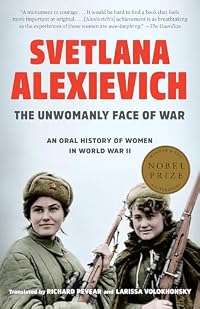
A blend of exceptional reporting and personal pain and passion. This reminded me, in tone, of Louisa Lim's wonderful Hong Kong book, Indelible City, and the work of Svetlana Alexievich, whose oral histories The Unwomanly Face of War and Secondhand Time changed my understanding of Russia and prompted my interest in this book. (Alexievich's other books are on my TBR, and I will get to those in time -- she is a brilliant and engaging historian. This also made me face that I need to read The Gulag Archipelago. I purchased Volume 1 last week, and it comes in at 660 pages so I don't hold out much hope I will also get to Volume 2, which comes in at a tight 770/).
Ioffe, who spent her early years in Russia and moved to Maryland in the later part show more of elementary school, reveals a Soviet and post-Soviet Russia that I have never seen. Women, elevated in the time of Lenin, then forced to handle all household responsibilities and work as much as the men (for less pay) have now found themselves reduced to status as babymakers and sexual savants. The government, running out of men to fight in Ukraine, has let women know they have a patriotic duty to birth babies, and the government will pay them to do so. JD Vance and Putin must be chatting. Ioffee tells this story through the experiences of many women, including her grandmothers and great grandmothers, prominent women in the country, the spouses and daughters of leaders, and others. The story is gripping and terrifying since many of the things we read about here are happening in the US now. Early stages, but still. One example: Putin energized his base by moving against gender nonconformity, and made Gay and Trans people equivalent to ISIS militants in the eyes of the law, all terrorists.
This is not to be missed for readers intersted in narrative history. I can't wait to dive deeper into the subject. show less
Ioffe, who spent her early years in Russia and moved to Maryland in the later part show more of elementary school, reveals a Soviet and post-Soviet Russia that I have never seen. Women, elevated in the time of Lenin, then forced to handle all household responsibilities and work as much as the men (for less pay) have now found themselves reduced to status as babymakers and sexual savants. The government, running out of men to fight in Ukraine, has let women know they have a patriotic duty to birth babies, and the government will pay them to do so. JD Vance and Putin must be chatting. Ioffee tells this story through the experiences of many women, including her grandmothers and great grandmothers, prominent women in the country, the spouses and daughters of leaders, and others. The story is gripping and terrifying since many of the things we read about here are happening in the US now. Early stages, but still. One example: Putin energized his base by moving against gender nonconformity, and made Gay and Trans people equivalent to ISIS militants in the eyes of the law, all terrorists.
This is not to be missed for readers intersted in narrative history. I can't wait to dive deeper into the subject. show less
A blend of memoir, family stories, and reportage, which tracks the experiences of some women in Russia from the 1910s through to the present day.
I hesitate to use the term "feminist history" to describe this—despite the phrase appearing in the book's subtitle—not because I question Julia Ioffe's personal convictions or commitment to feminism, but because of the book's fundamental issues with analytical framing/structure and because Ioffe seems to think that writing about the actions of some (feminist) women is in itself "feminist history." Nope. Equally, what Ioffe means by "Russian" needs examination. She discusses somewhat her own family's identity and how their Russianness was/is often questioned because of their Jewishness, but show more there's little grappling here with how/why her other case studies tend to default to middle-to-upper-class, urban, (culturally) Christian, ethnic Russian women from western Russia. She also says in passing some stuff about race/class in the U.S. that I side-eyed with vigour.
These and some other methodological caveats aside, Ioffe certainly can write vividly. The parts where she details the experiences of her mother, grandmothers, and great-grandmothers are some of the most compelling of the book. Equally, she highlights some ordinary women's stories, their horrifying experiences, with a clarity and power that meant I had to put the book down for stretches—Margarita Gracheva is a powerhouse of a woman. show less
I hesitate to use the term "feminist history" to describe this—despite the phrase appearing in the book's subtitle—not because I question Julia Ioffe's personal convictions or commitment to feminism, but because of the book's fundamental issues with analytical framing/structure and because Ioffe seems to think that writing about the actions of some (feminist) women is in itself "feminist history." Nope. Equally, what Ioffe means by "Russian" needs examination. She discusses somewhat her own family's identity and how their Russianness was/is often questioned because of their Jewishness, but show more there's little grappling here with how/why her other case studies tend to default to middle-to-upper-class, urban, (culturally) Christian, ethnic Russian women from western Russia. She also says in passing some stuff about race/class in the U.S. that I side-eyed with vigour.
These and some other methodological caveats aside, Ioffe certainly can write vividly. The parts where she details the experiences of her mother, grandmothers, and great-grandmothers are some of the most compelling of the book. Equally, she highlights some ordinary women's stories, their horrifying experiences, with a clarity and power that meant I had to put the book down for stretches—Margarita Gracheva is a powerhouse of a woman. show less
An impressive and compelling survey of Russian history that gets more personal as the author's life begins to overlap the public figures. As much a work of sociology as history, Ioffe brings a psychological approach to the evolution of Russian gender roles and character. If you enjoyed Revolutions' history of the Soviet revolution, this would be a great next stop.
I learned so much from this book about Russian history, sociology and the unique role of women from the time of the Russian Revolution till today. Ioffe is uniquely qualified as four generations of her family lived there and experienced the high hopes of women had for inclusion after Lenin took over until now under Putin as they are relegated to being baby machines in a patriarchal society. I loved this book which was rightly considered for a National Book Award.
nonfiction - "a feminist history of modern Russia" (distinctly different from Western ideas of feminism) and a review of powerful/underappreciated women in Russian history from the Bolsheviks of the 1910s thru the various upheavals into current day, and how various government policies have impacted the lives of Russia's women and girls, along with a little family history from Russian-born American journalist.
Took a bit of settling into this one, as my knowledge of Russian history has been embarrassingly wanting, but it turned out to be a fascinating read.
Took a bit of settling into this one, as my knowledge of Russian history has been embarrassingly wanting, but it turned out to be a fascinating read.
Ratings
Members
- Recently Added By
Lists

To Read
133 works; 1 member
Author Information

2+ Works 141 Members
Awards and Honors
Awards
Distinctions
Common Knowledge
Classifications
- Genres
- Sexuality and Gender Studies, History, Nonfiction, General Nonfiction, Biography & Memoir
- DDC/MDS
- 947.0082 — History & geography History of Europe Russia and neighboring east European countries Russian & Slavic History by Period Russia
- LCC
- HQ1662 .I64 — Social sciences The family. Marriage, Women and Sexuality The Family. Marriage. Women Women. Feminism
- BISAC
Statistics
- Members
- 140
- Popularity
- 232,655
- Reviews
- 5
- Rating
- (4.30)
- Languages
- English
- Media
- Paper, Ebook
- ISBNs
- 9
- ASINs
- 2