On This Page
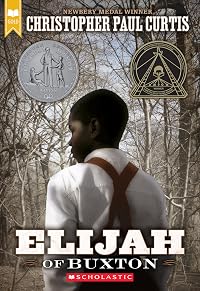
Description
In 1859, eleven-year-old Elijah Freeman, the first free-born child in Buxton, Canada, which is a haven for slaves fleeing the American south, uses his wits and skills to try to bring to justice the lying preacher who has stolen money that was to be used to buy a family's freedom.Tags
Recommendations






Member Reviews
What an awesome book this is! Christopher Paul Curtis has a knack for capturing the in-between innocence mixed with growing understanding of the 11-13 age range. In many children's books, the things that the child characters imagine are always worse than reality, but Curtis's characters don't have this comfort. They have the joys and laughter of childhood, but their challenges are serious, not contrived by adults to educate, but actual and real.
Curtis also gives his characters ample time and opportunity to make mistakes, reflect, and grow, which I love.
Another slam-dunk selection from the Build Your Library booklist, Level 5.
Curtis also gives his characters ample time and opportunity to make mistakes, reflect, and grow, which I love.
Another slam-dunk selection from the Build Your Library booklist, Level 5.
Elijah Freeman was the first child born free in Canada. His other claim to fame was that, as an infant, he had thrown up on Frederick Douglass while the famous orator was visiting the settlement of former slaves in Buxton, Ontario. Buxton is right across the river from Detroit. It’s 1859 and eleven-year-old Elijah sometimes finds it hard to understand how some words or ways of talking will make his elders fly into an unexpected rage. It’s because he’s never known slavery. He can see the physical scars that it’s left on many of the adults, but he can’t see the emotional ones, until an unplanned trip to Michigan gives him a frightening first-hand view.
Curtis’s always strong sense of humor and his ability to accurately see and show more report from a child’s point of view makes Elijah of Buxton by turns laugh-out-loud funny and icily frightening, with a bright bit of Hope at the end of the tale. show less
Curtis’s always strong sense of humor and his ability to accurately see and show more report from a child’s point of view makes Elijah of Buxton by turns laugh-out-loud funny and icily frightening, with a bright bit of Hope at the end of the tale. show less
I really enjoyed this one. What an interesting and different perspective on slavery. What Elijah's parents have told him about former slaves is insightful, sensitive, and seems very realistic. In the children's playing slavers and abolitionists (and Elijah's revelation about it), CPC even addresses the tendency to soften slavery in depictions for children. The last few chapters are truly haunting, and yet I wouldn't hesitate to have a 9 or 10 year old read this book. CPC has struck just the right balance of acknowledging and showing the horrors, but without making it too overwhelming for his audience.
One of my favorite narrative tricks is when an author uses a very limited first person viewpoint and is still able to let the reader know show more more than the narrator. It's one of the things I love about [b: Walk Two Moons|53496|Walk Two Moons|Sharon Creech|http://images.gr-assets.com/books/1389035862s/53496.jpg|1237212] (among others), and CPC does it so very well here.
I will definitely be recommending this one to the sixth graders, who study both civil rights and sustainability. I will be very interested to hear their responses to it. show less
One of my favorite narrative tricks is when an author uses a very limited first person viewpoint and is still able to let the reader know show more more than the narrator. It's one of the things I love about [b: Walk Two Moons|53496|Walk Two Moons|Sharon Creech|http://images.gr-assets.com/books/1389035862s/53496.jpg|1237212] (among others), and CPC does it so very well here.
I will definitely be recommending this one to the sixth graders, who study both civil rights and sustainability. I will be very interested to hear their responses to it. show less
It's 1860 and Elijah is the first free-born child in the settlement of Buxton in Canada and as such you would think he'd get a little respect, but instead everyone tells him how fragile he is and boy do they love to tell the story of how he threw up on Mr. Frederick Douglass even though Elijah was just a baby when it happened. Elijah enjoys his life - he has a best friend, Cooter, to get in trouble with, he gets to go rock fishing on his favorite mule, Old Flapjack, and he gets to work with Mr. Leroy helping to clear a neighbor's land. Now that he's almost 12, Elijah thinks it's about time people realize he's pretty much grown up even if some things are still pretty confusing. For one thing, his Ma tells him he "has to respect what show more growned folks say" one minute and the next she's telling him "not to believe some of the things growned folks tell" you. How's a boy to know which things are which? As the year goes on and Elijah learns more about the world outside of Buxton - especially about slavery, he starts to see that being grown up is much more complicated than he thought. show less
Confession: I've never read any Christopher Paul Curtis before! Not even Bud, Not Buddy! So I decided it was time to finally rectify that, and I'm glad I did. This book was funny and charming, with an incredibly likable narrator. That said, it didn't shy away from sensitively portraying the real horrors of slavery and the toll that it takes on the human spirit, building up to a heartbreaking but uplifting conclusion.
I also loved the setting -- a 19th century freed slaves colony in Canada -- which was new to me and well-portrayed.
I also loved the setting -- a 19th century freed slaves colony in Canada -- which was new to me and well-portrayed.
This book is so breathtakingly beautiful that I'm at a loss to adequately write a review that would provide justice.
Christopher Paul Curtis is fast becoming one of my favorite authors. A three-time Newbery award winner, his works shine like a bright beacon of hope for any aspiring writer. A 13-year assembly line worker in Flint Michigan, Curtis became a fledgling writer during breaks in the factory. With the encouragement of his wife, he took a year away from his job and spent his days in libraries writing and researching the background for his stories while learning how to submit his work to publishing companies.
Never returning to the factory, he became a highly successful writer. His books Bud, Not Buddy, The Watsons Go To Birmingham show more and Elijah of Buxton are filled with incredibly likable characters you would love to meet. When reading his stories, the characters seem to jump off the pages and become vibrantly alive.
Elijah of Buxton is set in pre Civil War 1860. Buxton Ontario provides the setting for the marvelous character of Elijah Freeman whose claim to fame is that he is the first child born free in the settlement.
Buxton, Ontario was indeed an actual community in the Canadian wilderness founded by Rev. William King, a white man from Philadelphia, PA who was severely critical of slavery and empowered to put his feelings into actions.
In all his books, Curtis deftly weaves historical fact with fictional characters. This marvelous book is packed full of humor, wit and seriousness. Without over bearing preaching and proselytizing, Curtis paints a vivid portrait of the joy of freedom and the brutality of slavery.
According to his mother, Elijah is a "fra-gile" child, quickly prone to tears and emotion. When The Right Rev. Zephariah W. Connerly III leaves Buxton with the money that Elijah's adult friend Mr. Leroy saved in order to purchase his family from slavery, Elijah's fragility is augmented with a keen sense of indignation and courage.
Traveling with Mr. Leroy to America in search of the crooked scoundrel, Elijah witnesses the brutality of slavery and learns first hand the extreme horror his parents fled.
In the end, Elijah keeps his wonderful fragility and learns that his sensitivity provides the strength needed when facing adversity.
If you read one of my recommendations this year, please let it be this book!
This is a powerful symphony of hope and a testimony to the power of the human soul striving to be alive and free!
HIGHLY RECOMMENDED show less
Christopher Paul Curtis is fast becoming one of my favorite authors. A three-time Newbery award winner, his works shine like a bright beacon of hope for any aspiring writer. A 13-year assembly line worker in Flint Michigan, Curtis became a fledgling writer during breaks in the factory. With the encouragement of his wife, he took a year away from his job and spent his days in libraries writing and researching the background for his stories while learning how to submit his work to publishing companies.
Never returning to the factory, he became a highly successful writer. His books Bud, Not Buddy, The Watsons Go To Birmingham show more and Elijah of Buxton are filled with incredibly likable characters you would love to meet. When reading his stories, the characters seem to jump off the pages and become vibrantly alive.
Elijah of Buxton is set in pre Civil War 1860. Buxton Ontario provides the setting for the marvelous character of Elijah Freeman whose claim to fame is that he is the first child born free in the settlement.
Buxton, Ontario was indeed an actual community in the Canadian wilderness founded by Rev. William King, a white man from Philadelphia, PA who was severely critical of slavery and empowered to put his feelings into actions.
In all his books, Curtis deftly weaves historical fact with fictional characters. This marvelous book is packed full of humor, wit and seriousness. Without over bearing preaching and proselytizing, Curtis paints a vivid portrait of the joy of freedom and the brutality of slavery.
According to his mother, Elijah is a "fra-gile" child, quickly prone to tears and emotion. When The Right Rev. Zephariah W. Connerly III leaves Buxton with the money that Elijah's adult friend Mr. Leroy saved in order to purchase his family from slavery, Elijah's fragility is augmented with a keen sense of indignation and courage.
Traveling with Mr. Leroy to America in search of the crooked scoundrel, Elijah witnesses the brutality of slavery and learns first hand the extreme horror his parents fled.
In the end, Elijah keeps his wonderful fragility and learns that his sensitivity provides the strength needed when facing adversity.
If you read one of my recommendations this year, please let it be this book!
This is a powerful symphony of hope and a testimony to the power of the human soul striving to be alive and free!
HIGHLY RECOMMENDED show less
Elijah is a freeborn child living in the Canadian settlement of Buxton, made up entirely of freedmen and women and their children. He has always known a relatively comfortable life with no more serious worries than whether his teacher would tell his parents he wasn’t doing very well in Latin. That changes when a flashy “preacher” steals money that Elijah’s friend Mr. Leroy was saving to buy his family out of captivity—and Mr. Leroy needs Elijah’s help to go after him. In Michigan, Elijah comes face-to-face with the horrors that his parents and the other grownups in Buxton knew and will learn both what he can do—and what he can’t.
The novel starts out simply enough, but once the Preacher steals Mr. Leroy’s money, the show more narrative takes on a pretty dark tone for a children’s novel, with references to beatings (to death), recapture of escaped slaves, families torn asunder, and suicide as a desirable alternative. The ending can’t, and doesn’t, make it all right, but Elijah does have the safety of his Canadian home and loving parents to return to. show less
The novel starts out simply enough, but once the Preacher steals Mr. Leroy’s money, the show more narrative takes on a pretty dark tone for a children’s novel, with references to beatings (to death), recapture of escaped slaves, families torn asunder, and suicide as a desirable alternative. The ending can’t, and doesn’t, make it all right, but Elijah does have the safety of his Canadian home and loving parents to return to. show less
Members
- Recently Added By
Published Reviews
Elijah Freeman, 11, has two claims to fame. He was the first child "born free" to former slaves in Buxton, a (real) haven established in 1849 in Canada by an American abolitionist. The rest of his celebrity, Elijah reports in his folksy vernacular, stems from a "tragical" event. When Frederick Douglass, the "famousest, smartest man who ever escaped from slavery," visited Buxton, he held baby show more Elijah aloft, declaring him a "shining bacon of light and hope," tossing him up and down until the jostled baby threw up-on Douglass. The arresting historical setting and physical comedy signal classic Curtis (Bud, Not Buddy), but while Elijah's boyish voice represents the Newbery Medalist at his finest, the story unspools at so leisurely a pace that kids might easily lose interest. Readers meet Buxton's citizens, people who have known great cruelty and yet are uncommonly polite and welcoming to strangers. Humor abounds: Elijah's best friend puzzles over the phrase "familiarity breeds contempt" and decides it's about sexual reproduction. There's a rapscallion of a villain in the Right Reverend Deacon Doctor Zephariah Connerly the Third, a smart-talking preacher no one trusts, and, after 200 pages, a riveting plot: Zephariah makes off with a fortune meant to buy a family of slaves their freedom. Curtis brings the story full-circle, demonstrating how Elijah the "fra-gile" child has become sturdy, capable of stealing across the border in pursuit of the crooked preacher, and strong enough to withstand a confrontation with the horrors of slavery. The powerful ending is violent and unsettling, yet also manages to be uplifting. Ages 9-12. (Oct.)
Copyright 2007 Reed Business Information show less
Copyright 2007 Reed Business Information show less
added by sriches
Krista Johansen (Resource Links, December 2007 (Vol. 13, No. 2))
It may surprise some to discover that Christopher Paul Curtis, who has both a Newbery Honor and a Newbery Medal to his credit, has actually lived in Canada for a quarter of a century. In Elijah of Buxton he sets a story in Canada West (soon to become Ontario) just before the time of the American Civil War. Elijah Freeman is the show more child of former slaves, the first baby born in the settlement of Buxton. He is a quick-witted, resourceful, and imaginative boy with strong reactions to what he sees going on around him and a wry, self-depreciating way of presenting himself. The book is a first-person narrative, and Elijah seems to be telling the story not long after it happened. He is no adult looking back on his past but still a young boy getting events clear in his mind. Curtis can be a very funny writer and some of the more subtle comedy in the story (and some of the more sombre moments too) arise from Elijah's failure to fully understand adults. Some of these may be lost on younger children, no more experienced than Elijah, on a first reading, but they benefit older readers. Through various episodes in Elijah's daily round of school, chores, fishing, and family life, the first part of the story introduces Elijah's character and his relationships with people like Mr. Leroy, who is saving money to buy his family's freedom, and the untrustworthy, self-proclaimed Preacher. It also depicts everyday life in Buxton and conveys the history and principles of this idealistic, successful settlement of people who had escaped slavery. Elijah's pranks and adventures and the stories of loss and courage his elders tell all weave a background full of interest for the story to come. The second part of the book is about Elijah's journey across the border into Michigan, accompanying Mr. Leroy, without his parents' knowledge. They are tracking down the Preacher, who has fled with money entrusted to him to free Mr. Leroy's family. Mr. Leroy suffers a heart attack and dies. Elijah continues his hunt alone, but finds instead four men, a woman, and a baby who had escaped slavery only to be recaptured almost within sight of the border. They are chained up naked in a barn. The Preacher's body is there as well; he has been killed and Mr. Leroy's money is long gone. Elijah is horrified by the reality of slavery seen firsthand - at first he did not even realize the people were human, but thought them ghosts or demons. He tries to get some free Africans in the neighbourhood to help him rescue them, but they refuse, fearing for their own safety. He returns to take a baby back to Buxton with him, saving at least that one life. The story is one of tragedy: the baby's parents and the other captives are likely to die, because although they cannot escape their chains, Mrs. Chloe has the Preacher's revolver, given to her by Elijah; Mr. Leroy's family is still enslaved, not even knowing their husband and father has died trying to save them. It is also one of hope and small, enduring victories, as Elijah brings the baby, Hope Too-mah-ee-nee, safely to Buxton. Elijah of Buxton is an excellent story, funny, suspenseful, and horrifying. The historical background is brought to life with great attention to detail and accuracy, while Elijah's role as a narrator examining himself and his world allows the unfamiliar to be explained in a natural and unobtrusive way. Elijah is a very realistic eleven-year-old who goes from being an ordinary boy dealing with everyday problems to a person facing a situation in which even an adult would have found himself helpless to do more. Though he calls himself fragile for his overwhelming emotional reactions to events, Elijah's courage, resilience and determination make him a hero. Elijah of Buxton will quite deservedly find a place in every elementary and middle-school library. In the classroom, it could be used in units studying this period in Canada's history, in examining the history of slavery and the Underground Railroad in North American, and as a portrayal of mid-nineteenth-century life in general. show less
It may surprise some to discover that Christopher Paul Curtis, who has both a Newbery Honor and a Newbery Medal to his credit, has actually lived in Canada for a quarter of a century. In Elijah of Buxton he sets a story in Canada West (soon to become Ontario) just before the time of the American Civil War. Elijah Freeman is the show more child of former slaves, the first baby born in the settlement of Buxton. He is a quick-witted, resourceful, and imaginative boy with strong reactions to what he sees going on around him and a wry, self-depreciating way of presenting himself. The book is a first-person narrative, and Elijah seems to be telling the story not long after it happened. He is no adult looking back on his past but still a young boy getting events clear in his mind. Curtis can be a very funny writer and some of the more subtle comedy in the story (and some of the more sombre moments too) arise from Elijah's failure to fully understand adults. Some of these may be lost on younger children, no more experienced than Elijah, on a first reading, but they benefit older readers. Through various episodes in Elijah's daily round of school, chores, fishing, and family life, the first part of the story introduces Elijah's character and his relationships with people like Mr. Leroy, who is saving money to buy his family's freedom, and the untrustworthy, self-proclaimed Preacher. It also depicts everyday life in Buxton and conveys the history and principles of this idealistic, successful settlement of people who had escaped slavery. Elijah's pranks and adventures and the stories of loss and courage his elders tell all weave a background full of interest for the story to come. The second part of the book is about Elijah's journey across the border into Michigan, accompanying Mr. Leroy, without his parents' knowledge. They are tracking down the Preacher, who has fled with money entrusted to him to free Mr. Leroy's family. Mr. Leroy suffers a heart attack and dies. Elijah continues his hunt alone, but finds instead four men, a woman, and a baby who had escaped slavery only to be recaptured almost within sight of the border. They are chained up naked in a barn. The Preacher's body is there as well; he has been killed and Mr. Leroy's money is long gone. Elijah is horrified by the reality of slavery seen firsthand - at first he did not even realize the people were human, but thought them ghosts or demons. He tries to get some free Africans in the neighbourhood to help him rescue them, but they refuse, fearing for their own safety. He returns to take a baby back to Buxton with him, saving at least that one life. The story is one of tragedy: the baby's parents and the other captives are likely to die, because although they cannot escape their chains, Mrs. Chloe has the Preacher's revolver, given to her by Elijah; Mr. Leroy's family is still enslaved, not even knowing their husband and father has died trying to save them. It is also one of hope and small, enduring victories, as Elijah brings the baby, Hope Too-mah-ee-nee, safely to Buxton. Elijah of Buxton is an excellent story, funny, suspenseful, and horrifying. The historical background is brought to life with great attention to detail and accuracy, while Elijah's role as a narrator examining himself and his world allows the unfamiliar to be explained in a natural and unobtrusive way. Elijah is a very realistic eleven-year-old who goes from being an ordinary boy dealing with everyday problems to a person facing a situation in which even an adult would have found himself helpless to do more. Though he calls himself fragile for his overwhelming emotional reactions to events, Elijah's courage, resilience and determination make him a hero. Elijah of Buxton will quite deservedly find a place in every elementary and middle-school library. In the classroom, it could be used in units studying this period in Canada's history, in examining the history of slavery and the Underground Railroad in North American, and as a portrayal of mid-nineteenth-century life in general. show less
added by kthomp25
Eleven-year-old Elijah Freeman is known for two things: being the first child born free in Buxton, Canada, and throwing up on the great Frederick Douglass. It's 1859, in Buxton, a settlement for slaves making it to freedom in Canada, a setting so thoroughly evoked, with characters so real, that readers will live the story, not just read it. This is not a zip-ahead-and-see-what-happens-next show more novel. It's for settling into and savoring the rich, masterful storytelling, for getting to know Elijah, Cooter and the Preacher, for laughing at stories of hoop snakes, toady-frogs and fish-head chunking and crying when Leroy finally gets money to buy back his wife and children, but has the money stolen. Then Elijah journeys to America and risks his life to do what's right. This is Curtis's best novel yet, and no doubt many readers, young and old, will finish and say, "This is one of the best books I have ever read." (author's note) (Fiction. 9+) show less
added by sriches
Lists

Best Newbery Honor Books
241 works; 31 members

Canada
42 works; 3 members

Sonlight Books
1,487 works; 25 members

Newbery Honor Books By year - II - 1981-2035
143 works; 4 members

Youth: BLM
265 works; 1 member

Most Popular Books Tagged Canada
34 works; 1 member

Books Read in 2015
3,299 works; 129 members

Historical Fiction Books
99 works; 5 members
1800s: America
23 works; 4 members
CBC's 100 Young Adult Books
100 works; 4 members

Struggle for Freedom
69 works; 4 members

Canadian Historical Fiction 🇨🇦
157 works; 8 members

Books Read in 2022
5,166 works; 112 members

EGBERTINA's List of Newbery books that I hated or found unnecessary
58 works; 3 members

Build Your Library Level 5
27 works; 1 member
Author Information

18+ Works 29,430 Members
Newbery Medal-winning children's book author Christopher Paul Curtis was born in Flint, Michigan on May 10, 1953 and graduated from The University of Michigan. While there he won the Avery and Jules Hopwood Prizes for poetry and a draft of one of his early books. Curtis spent thirteen years on an assembly line hanging car doors. His story The show more Watsons Go to Birmingham-1963 received a Newbery Honor and a Coretta Scott King Honor, and Bud, Not Buddy became the first novel to win both of these awards. Elijah of Buxton received the 2008 Scott O'Dell Historical Fiction Award, the Coretta Scott King Award, and a Newbery Honor. Curtis also won the 2009 Anne V. Zarrow Award for Young Readers' Literature. (Bowker Author Biography) show less
Some Editions
Awards and Honors
Awards
Distinctions
Notable Lists
Series

Work Relationships
Is contained in
Has as a student's study guide
Common Knowledge
- Canonical title
- Elijah of Buxton
- Original title
- Elijah of Buxton
- Original publication date
- 2007
- People/Characters
- Elijah Freeman; Mr. Leroy; Cooter Bixby; Right Reverend Deacon Doctor Zephariah Connerly the Third
- Important places
- Buxton, Ontario, Canada; Chatham-Kent, Ontario, Canada
- Important events
- Underground Railroad
- Dedication
- To the original twenty-one former-slave settlers of the Elgin Settlement and Buxton Mission of Raleigh: Eliza, Amelia, Mollie, Sarah, Isaiah Phares, Harriet, Solomon, Jacob King, Talbert King, Peter King, Fanny, Ben Phares, R... (show all)obin Phares, Stephen Phares, Emeline Phares, and Isaac and Catherine Riley and their four children. And to the Reverend William King and his love of justice.
- First words
- It was Sunday after church and all my chores were done.
- Last words
- (Click to show. Warning: May contain spoilers.)And Hope slept the whole way.
Classifications
- Genres
- Kids, Children's Books, Fiction and Literature
- DDC/MDS
- 813.54 — Literature & rhetoric American literature in English American fiction in English 1900-1999 1945-1999
- LCC
- PZ7 .C94137 .E — Language and Literature Fiction and juvenile belles lettres Fiction and juvenile belles lettres Juvenile belles lettres
- BISAC
Statistics
- Members
- 4,419
- Popularity
- 3,362
- Reviews
- 117
- Rating
- (4.12)
- Languages
- Chinese, Dutch, English, Spanish
- Media
- Paper, Audiobook, Ebook
- ISBNs
- 31
- ASINs
- 15