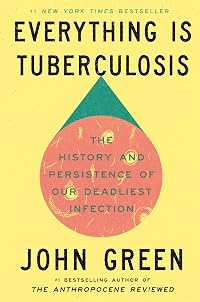
Everything Is Tuberculosis: The History and Persistence of Our Deadliest Infection
by John Green 
On This Page
Description
"Tuberculosis has been entwined with humanity for millennia. Once romanticized as a malady of poets, today tuberculosis is seen as a disease of poverty that walks the trails of injustice and inequity we blazed for it. In 2019, author John Green met Henry Reider, a young tuberculosis patient at Lakka Government Hospital in Sierra Leone. John became fast friends with Henry, a boy with spindly legs and a big, goofy smile. In the years since that first visit to Lakka, Green has become a vocal show more advocate for increased access to treatment and wider awareness of the healthcare inequities that allow this curable, preventable infectious disease to also be the deadliest, killing over a million people every year. In Everything is Tuberculosis, John tells Henry's story, woven through with the scientific and social histories of how tuberculosis has shaped our world--and how our choices will shape the future of tuberculosis"-- show lessTags
Recommendations























Member Recommendations

Member Reviews
For those of us lucky enough to live in rich countries with decent healthcare it's easy to think of tuberculosis as something quaint and old-fashioned, bringing to mind languishing 19th century poets or Doc Holliday quietly coughing blood into a handkerchief. But not only has tuberculosis killed a truly staggering number of people throughout human history, it continues to kill frankly unfathomable numbers today... even though, with modern medicine, it is entirely curable. Not easily curable. But curable.
I was fascinated and horrified to learn these particular statistics, but, I admit, I spent much of the early parts of this book feeling as if, interesting as it might be, it was skimming a little too lightly over its subject and not show more going into nearly as much depth as I'd been hoping for. Eventually, though, I realized that's because it wasn't quite the book I had expected it to be. It's not a medical history of TB at all. It is, to some extent, a cultural history of the disease. But it's not even primarily that. What it's really about is the story of TB as the story of inequality, of the vicious cycles with which poverty and disease reinforce each other, and of a world that could put its efforts and resources towards addressing these problems and has chosen not to. All of which is extremely depressing, although John Green does find space for hope and optimism, as well as centering his narrative around the story of one particular TB patient from Sierra Leone whose story, despite years of struggle, stigma, and hardship, did have a happy ending.
I will say that I eventually did reach a point where I felt like Green was mostly just making the same points over and over again in slightly different ways, which sort of makes me feel like this might be one of those non-fiction books that might have been slightly more suited to life as a long article instead. But then, I imagine far fewer people would have read it in that case, and its message is one that deserves to reach as wide an audience as it can get. show less
I was fascinated and horrified to learn these particular statistics, but, I admit, I spent much of the early parts of this book feeling as if, interesting as it might be, it was skimming a little too lightly over its subject and not show more going into nearly as much depth as I'd been hoping for. Eventually, though, I realized that's because it wasn't quite the book I had expected it to be. It's not a medical history of TB at all. It is, to some extent, a cultural history of the disease. But it's not even primarily that. What it's really about is the story of TB as the story of inequality, of the vicious cycles with which poverty and disease reinforce each other, and of a world that could put its efforts and resources towards addressing these problems and has chosen not to. All of which is extremely depressing, although John Green does find space for hope and optimism, as well as centering his narrative around the story of one particular TB patient from Sierra Leone whose story, despite years of struggle, stigma, and hardship, did have a happy ending.
I will say that I eventually did reach a point where I felt like Green was mostly just making the same points over and over again in slightly different ways, which sort of makes me feel like this might be one of those non-fiction books that might have been slightly more suited to life as a long article instead. But then, I imagine far fewer people would have read it in that case, and its message is one that deserves to reach as wide an audience as it can get. show less
John Green delves into the history of tuberculosis and how this single disease shaped so much of our world and continues to be one of the leading causes of death globally. Framing this history of tuberculosis, is the story of Henry a teenaged tuberculosis patient that Green met while on a trip to Sierra Leone in 2019.
John Green is an excellent writer and he turns his tremendous talents here to exploring the history and present of a disease that has devastated so many lives. His decision to use Henry's story as a frame for delving into the realities of tuberculosis puts a human and relatable face on the realities of fighting this disease in the twenty-first century. In between Henry's story, Green explores the science of tuberculosis, show more its cultural impacts, and the ongoing fight to eliminate this curable disease that still kills millions every year. A powerful read that I strongly recommend. show less
John Green is an excellent writer and he turns his tremendous talents here to exploring the history and present of a disease that has devastated so many lives. His decision to use Henry's story as a frame for delving into the realities of tuberculosis puts a human and relatable face on the realities of fighting this disease in the twenty-first century. In between Henry's story, Green explores the science of tuberculosis, show more its cultural impacts, and the ongoing fight to eliminate this curable disease that still kills millions every year. A powerful read that I strongly recommend. show less
I am so enjoying John Green's shift into nonfiction. This is a short history of tuberculosis, both socially and medically, as well as a discussion of the state of TB treatment today. In short: if you live in a poor country, you're quite likely to contract it and your prognosis isn't great. AND it absolutely does not have to be this way. The cure exists. It just (mostly) isn't accessible in most of the places the disease is rampant. Green gives a truly excellent account of the state of things and points out where things are going wrong without being preachy. The interlaced small biography of a young man living with TB Green met in Sierra Leone is also well-done and affecting. Recommended, and the audio is wonderful.
John Green might be best known for his novels, including the highly successful The Fault in Our Stars, published in 2012. Green is also a very popular YouTuber on his own and in collaboration with his brother Hank. For the past few years he has used his public profile to become a global health advocate, specifically concerning tuberculosis, a disease that still kills over a million people every year. As Green puts it in Everything is Tuberculosis, “the cure is where the disease is not, and the disease is where the cure is not.”
This book is both a history of a devastating disease and a view of the present-day through the story of Henry, a young tuberculosis patient in Sierra Leone. Green exposes the inequities in the global show more healthcare system that often prevent those with the greatest need from receiving care. In 2023, Green personally spearheaded a campaign against Johnson & Johnson to allow manufacture of generic versions of their tuberculosis drug, reducing the cost of treatment so dramatically that it could finally be made available to poor countries and communities.
I learned a great deal from this book. The world needs more people like John Green to fight for those who cannot. show less
This book is both a history of a devastating disease and a view of the present-day through the story of Henry, a young tuberculosis patient in Sierra Leone. Green exposes the inequities in the global show more healthcare system that often prevent those with the greatest need from receiving care. In 2023, Green personally spearheaded a campaign against Johnson & Johnson to allow manufacture of generic versions of their tuberculosis drug, reducing the cost of treatment so dramatically that it could finally be made available to poor countries and communities.
I learned a great deal from this book. The world needs more people like John Green to fight for those who cannot. show less
If you’ve seen John Green talk about his book or about his friend Henry Reider, you’ll know what to expect from Everything Is Tuberculosis. In his earnest, thoughtful, and compassionate way, he presents the history of tuberculosis, its sociocultural impacts, and the toll it takes on human lives, all grounded in the story of his friend Henry, whom he met in Sierra Leone at a hospital for patients with tuberculosis. It is also, in a way, about how we think about public health in terms of cost-benefit analysis rather than in terms of human suffering, about how problems become “out of sight, out of mind” until they resurge to bite us in the ass. This book is also a sad and timely testament to how cruel and short-sighted the current show more administration’s hacking away at U.S. aid for international health programs is. show less
I think I held most of the stereotypes that people typically have about tuberculosis—not least the paradoxical pairing of “it’s not really an issue anymore” alongside “there really isn’t a cure.” Obviously, I’m now disabused of both notions. But what’s much more powerful is Green’s indictment of our broad (societal/national/international) approach to this awful disease. He sums it up very clearly, just a few pages in: “We know how to live in a world without tuberculosis. But we choose not to live in that world.”
He returns to that essential point several more times in the book, driving it deep while also, I think, leaning toward an acknowledgement that this isn’t even just about TB. We routinely abandon those show more who fall victim to all manner of inescapable maladies, and not just physical ones. “Why,” Greene asks, “must we treat what are obviously systemic problems as failures of individual morality?” He’s 100% on point, and so his proposed remedy also lands firmly in place: We must fight “for better systems that understand human health not primarily as a market, but primarily as a shared priority for our species. . . . We must address the root cause of tuberculosis, which is injustice.”
It’s well put, and worth reading. show less
He returns to that essential point several more times in the book, driving it deep while also, I think, leaning toward an acknowledgement that this isn’t even just about TB. We routinely abandon those show more who fall victim to all manner of inescapable maladies, and not just physical ones. “Why,” Greene asks, “must we treat what are obviously systemic problems as failures of individual morality?” He’s 100% on point, and so his proposed remedy also lands firmly in place: We must fight “for better systems that understand human health not primarily as a market, but primarily as a shared priority for our species. . . . We must address the root cause of tuberculosis, which is injustice.”
It’s well put, and worth reading. show less
I'm so glad I read this book. Hopefully, many more people will read it and decide it is time to do something about this disease.
John Green went to Sierra Leone in 2019. While there he visited Lakka Hospital where he met a young man named Henry. They struck up a conversation since Green has a son named Henry. He thought this Henry was about the same age as his son, nine years old at the time, but, in fact, this Henry was 17. He was so small and thin due to the tuberculosis that had resisted treatment for years and also because of the poverty that his family endured. After meeting Henry Green started reading everything he could about TB. And he couldn't forget Henry. That's what led to writing this book. Far from being a disease of the show more past, TB continues to rage in poorer countries and kill 1,300,000 people each year. Yet TB can be treated successfully now that we have antibiotics; we just don't get those treatments to the places where they are needed. Green makes the case that it is far cheaper in the long run to address the needs of everyone with TB than letting it continue to infect more and more people. There is already a problem with drug resistance to many of the current antibiotics. It is possible that sometime the TB bacilli will become superbug resistant and spread around the world. Of course, Green also makes the case that treating the disease without treating the underlying poverty where it thrives is doing too little.
With the current person in the White House cutting back research funding and refusing to donate to world development, I feel like it could be a long time before TB is eradicated. show less
John Green went to Sierra Leone in 2019. While there he visited Lakka Hospital where he met a young man named Henry. They struck up a conversation since Green has a son named Henry. He thought this Henry was about the same age as his son, nine years old at the time, but, in fact, this Henry was 17. He was so small and thin due to the tuberculosis that had resisted treatment for years and also because of the poverty that his family endured. After meeting Henry Green started reading everything he could about TB. And he couldn't forget Henry. That's what led to writing this book. Far from being a disease of the show more past, TB continues to rage in poorer countries and kill 1,300,000 people each year. Yet TB can be treated successfully now that we have antibiotics; we just don't get those treatments to the places where they are needed. Green makes the case that it is far cheaper in the long run to address the needs of everyone with TB than letting it continue to infect more and more people. There is already a problem with drug resistance to many of the current antibiotics. It is possible that sometime the TB bacilli will become superbug resistant and spread around the world. Of course, Green also makes the case that treating the disease without treating the underlying poverty where it thrives is doing too little.
With the current person in the White House cutting back research funding and refusing to donate to world development, I feel like it could be a long time before TB is eradicated. show less
Members
- Recently Added By
Lists

Phi Beta Kappa reading list
260 works; 8 members

Science: Health & Medical
100 works; 1 member

public health, illness, dying
11 works; 1 member

Books Read in 2025
4,091 works; 97 members

Penguin Random House
458 works; 4 members

Top Five Books of 2025
954 works; 303 members

ClubRead 2026 Category Challenge NON FICTION Reads Suggestions
12 works; 1 member

Governerds Insider
32 works; 1 member

World
18 works; 1 member

Books Read in 2026
1,950 works; 66 members
Author Information

John Green was born in Indianapolis, Indiana on August 24, 1977. He graduated from Kenyon College in 2000 with a double major in English and religious studies. Before becoming a writer, he was a publishing assistant and production editor for Booklist, which is a book review journal. His first novel, Looking for Alaska, was published in 2005 and show more won the Michael L. Printz Award for excellence in Young Adult literature in 2006. His other works include An Abundance of Katherines, a 2007 Michael L. Printz Award Honor Book; Paper Towns, which won the 2009 Edgar Award for Best Young Adult Novel and the 2010 Corine Literature Prize; and The Fault in Our Stars, which was a New York Times Best Seller. He is also the co-author, with David Levithan, of Will Grayson, Will Grayson. Two of John Green's titles, The Fault in Our Stars and Paper Towns, have been made into major motion pictures. His title, An Abundance of Katherines, made the New York Times Best Seller List. Paper Towns made The New Zealand Best Seller List 2015. (Bowker Author Biography) show less
John Green is a LibraryThing Author, an author who lists their personal library on LibraryThing.
Some Editions
Awards and Honors
Awards
Distinctions
Notable Lists
Common Knowledge
- Canonical title
- Everything Is Tuberculosis: The History and Persistence of Our Deadliest Infection
- Original publication date
- 2025-03-18
- People/Characters
- John Green; Henry Reider; Isatu Reider (mother of Henry Reider); Sarah Urist Green; James Watt; John B. Stetson (hatmaker) (show all 27); Nedjelko Cabrinovic; Trifko Grabez; Gavrilo Princip; Franz Ferdinand, Archduke of Austria; Favor Reider (sister of Henry Reider); Henry Reider's father; John Keats; Sukanta Bhattacharya; Masaoka Shiki; Henry Peach Robinson; Eliza Poe (mother of Edgar Allan Poe); Edgar Allan Poe; Robert Koch (doctor); Arthur Conan Doyle; C. Gale Perkins; Alan Hart (doctor); Girum Tefera (doctor); Phumeza Tisile; Carole Mitnick (doctor); Stokes Goodrich; Shreya Tripathi
- Important places
- Sierra Leone; Lakka, Sierra Leone; Freetown, Sierra Leone
- Dedication
- This book is dedicated to Shreya Tripathi, Henry Reider, and TB Fighters everywhere
- First words
- Around the turn of the nineteenth century, the Scottish tinkerer and chemist James Watt began working on a new project. [Introduction]
When I first visited Lakka Government Hospital a few years back, I did not really want to be there. [Chapter 1] - Last words
- (Click to show. Warning: May contain spoilers.)We must also be the cure. [Chapter 23]
(Click to show. Warning: May contain spoilers.)That is why we must work together to end tuberculosis and all other diseases of injustice. [Postscript] - Original language
- English
Classifications
Statistics
- Members
- 2,240
- Popularity
- 8,991
- Reviews
- 78
- Rating
- (4.24)
- Languages
- English
- Media
- Paper, Audiobook, Ebook
- ISBNs
- 13
- ASINs
- 6