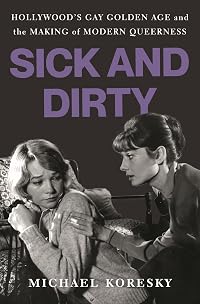
Sick and Dirty: Hollywood’s Gay Golden Age and the Making of Modern Queerness
by Michael Koresky
On This Page
Description
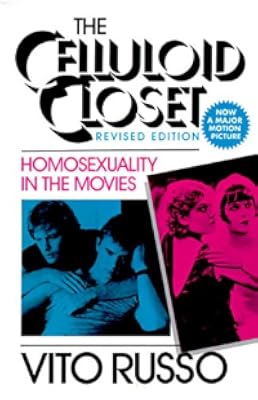
"A blazingly original history celebrating the persistence of queerness onscreen, behind the camera, and between the lines during the dark days of the Hollywood Production Code. From the 1930s to the 1960s, the Motion Picture Production Code severely restricted what Hollywood cinema could depict. This included "any inference" of the lives of homosexuals. In a landmark 1981 book, gay activist Vito Russo famously condemned Hollywood's censorship regime, lambasting many midcentury films as the show more bigoted products of a "celluloid closet." But there is more to these movies than meets the eye. In this insightful, wildly entertaining book, cinema historian Michael Koresky finds new meaning in "problematic" classics of the Code era like Hitchcock's Rope, Minnelli's Tea and Sympathy, and-bookending the period and anchoring Koresky's narrative-William Wyler's two adaptations of The Children's Hour, Lillian Hellman's provocative hit play about a pair of schoolteachers accused of lesbianism. Lifting up the underappreciated queer filmmakers, writers, and actors of the era, Koresky finds artists who are long overdue for reevaluation. Through his brilliant inquiry, Sick and Dirty reveals the "bad seeds" of queer cinema to be surprisingly, even gleefully subversive, reminding us, in an age of book bans and gag laws, that nothing makes queerness speak louder than its opponents' bids to silence it."--Publisher. show lessTags
Recommendations









Member Reviews
Sick and Dirty by Michael Koresky delves into several films from "classic Hollywood" that skirted the production code of the time. Bracketed between two versions of the same play, both by the same director but 26 years apart, key films are analyzed both as texts and for the people who wrote them.
If you want good film analysis backed by solid research, you will enjoy each chapter in this book. Unlike some previous, and quite good, books about queerness in classic Hollywood, this expands from simply being about homosexuality as homosexuality to the broader feelings of exclusion and being silenced that people beyond the queer community can relate to. That is part of the reason these films speak to so many people from all walks of life. Our show more basic humanity and how we can often abuse people out of ignorance and fear.
Koresky also points out that sometimes, maybe most of the time, leaving things unsaid, only partially seen, and hinted at can make the moviegoing experience more enjoyable. It allows us to read ourselves into the story more easily since we have fewer absolutes about each character and situation.
For film history buffs more generally, you will find a lot of excellent background material on the writers, directors, and actors involved in these productions. The writing is excellent and makes transitions between someone's personal life and what we see on screen flow naturally. As readers we don't have to completely change gears when he shifts focus, he walks us easily to the next point.
Reviewed from a copy made available by the publisher via NetGalley. show less
If you want good film analysis backed by solid research, you will enjoy each chapter in this book. Unlike some previous, and quite good, books about queerness in classic Hollywood, this expands from simply being about homosexuality as homosexuality to the broader feelings of exclusion and being silenced that people beyond the queer community can relate to. That is part of the reason these films speak to so many people from all walks of life. Our show more basic humanity and how we can often abuse people out of ignorance and fear.
Koresky also points out that sometimes, maybe most of the time, leaving things unsaid, only partially seen, and hinted at can make the moviegoing experience more enjoyable. It allows us to read ourselves into the story more easily since we have fewer absolutes about each character and situation.
For film history buffs more generally, you will find a lot of excellent background material on the writers, directors, and actors involved in these productions. The writing is excellent and makes transitions between someone's personal life and what we see on screen flow naturally. As readers we don't have to completely change gears when he shifts focus, he walks us easily to the next point.
Reviewed from a copy made available by the publisher via NetGalley. show less
This is an interesting survey of Code-era queer movies, which of course means Code-era queer coded movies. And it's a fascinating look at how artists maneuver around obstacles to get their vision made, as well as what happens when they can't quite manage that. I enjoyed it, I learned things, and I didn't find it depressing, so it's basically a huge win in the history of queer cinema department.
A wonderful book, but very much misrepresented by its subtitle and accompanying PR babble. We are revisiting four movies, extensively, and appropriately, while pretending to explore the entire history of post-Code "queerness" through 1961.
If the publisher had not inflated one's expectations of the book, one would be more than happy with Koresky's explorations of these iconic films.
If the publisher had not inflated one's expectations of the book, one would be more than happy with Koresky's explorations of these iconic films.
Ratings
Members
- Recently Added By
Lists

Sexuality & Gender
160 works; 3 members

Check Library
177 works; 1 member

Queer History - Specialized
37 works; 1 member
Author Information

4+ Works 95 Members
Awards and Honors
Distinctions
Common Knowledge
- Dedication
- To Terence Davies, whose private dreams
became cinematic revelations. - First words
- It begins at the end, with a death.
In fall of 2021, I taught a course called Queerness in American Cinema in the Undergraduate Film and Television department at NYU's Tisch School of Arts. It was the end of October, h... (show all)alfway through the semester, and for that week's screening I had selected 1961's The Children's House to watch in its entirety with the class. -Prologue: Tell Us How You Really Feel
Lillian Hellman immediately despised Los Angeles. Upon her arrival in 1930, she found the sprawl of the city unwelcoming, the drab color palette uninviting, the sense of community nonexistent. Hellman had been hitting the pav... (show all)ement in New ork as a wannabe short story writer and had few published works to her name Such career struggles hadn't loosened the metropolis's fairy-tale-like grip on Hellman, however, and she hesitated looking for work out west as so many others, including her husband, had begun to do. -Chapter 1, The Original Sin
Classifications
- Genres
- Sexuality and Gender Studies, Nonfiction, History, LGBTQ+, Literature Studies and Criticism
- DDC/MDS
- 791.43653 — Arts & recreation Recreation, sports, and performing arts Public performances Motion pictures, radio, television, podcasting Motion pictures Special aspects of films; film adaptations, film genres {class specific films in 791.437} Films dealing with humanity Human characteristics and activities
- LCC
- PN1995.9 .H55 .K67 — Language and Literature Literature (General) Literature (General) Drama Motion pictures
- BISAC
Statistics
- Members
- 61
- Popularity
- 508,233
- Reviews
- 3
- Rating
- (3.88)
- Languages
- English
- Media
- Paper, Ebook
- ISBNs
- 1
- ASINs
- 1