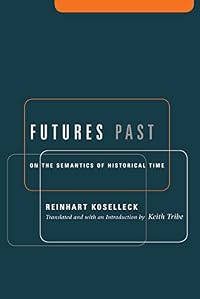
Futures Past: On the Semantics of Historical Time
by Reinhart Koselleck
On This Page
Description
With a new, interpretive introduction by the translator, this revised edition of Koselleck's most acclaimed work is once again available in English. Koselleck explores the concept of historical time by posing the question: What kind of experience is opened up by the emergence of modernity? Koselleck explores the concept of historical time by posing the question: what kind of experience is opened up by the emergence of modernity?Tags
Recommendations










































Member Reviews
I have a few more books to go in my temporary reading program on time and temporality, but I'm pretty sure this book will be the highlight of the series I've plowed through. Like most works by German history theorist Reinhart Koselleck, this is a collection of essays, published at different times, and therefore to some degree heterogeneous. The common denominator is the importance of temporality and of concepts, which themselves also evolve over time.
The first and last articles in particular are groundbreaking in this respect. In them Koselleck comprehensively outlines his view about the relationship between the space of experience and the horizon of expectation, the first focusing on what has passed, the other on what is to come. show more According to Koselleck this relationship has fundamentally changed with the breakthrough of modernity, in the period 1750-1850. Where past, present and future up to that point were more or less mixed, the space of experience in modernity was dissociated from and subordinated to the present and especially the future, in function of the concept of 'progress'.
I know, all of that remains fairly abstract, so this is by no means an easy read. There’s some repetition due to the different publication dates of the articles, but through them one can see that Koselleck formulated his theses more precisely, made them more concrete and put them in a broader context. This is history theory at the highest level! My rating is not the full 5 stars, because there are also some slightly lesser contributions, and also contributions that move at such a high philosophical level that they were less useful for me.
For a more elaborate review: see my History-account on Goodreads: https://www.goodreads.com/review/show/2449430878 show less
The first and last articles in particular are groundbreaking in this respect. In them Koselleck comprehensively outlines his view about the relationship between the space of experience and the horizon of expectation, the first focusing on what has passed, the other on what is to come. show more According to Koselleck this relationship has fundamentally changed with the breakthrough of modernity, in the period 1750-1850. Where past, present and future up to that point were more or less mixed, the space of experience in modernity was dissociated from and subordinated to the present and especially the future, in function of the concept of 'progress'.
I know, all of that remains fairly abstract, so this is by no means an easy read. There’s some repetition due to the different publication dates of the articles, but through them one can see that Koselleck formulated his theses more precisely, made them more concrete and put them in a broader context. This is history theory at the highest level! My rating is not the full 5 stars, because there are also some slightly lesser contributions, and also contributions that move at such a high philosophical level that they were less useful for me.
For a more elaborate review: see my History-account on Goodreads: https://www.goodreads.com/review/show/2449430878 show less
100 KOS 1
Ratings
Members
- Recently Added By
Author Information

40+ Works 763 Members
Awards and Honors
Notable Lists
Series
Belongs to Publisher Series
Common Knowledge
- Canonical title
- Futures Past: On the Semantics of Historical Time
- Original title
- Vergangene Zukunft : zur Semantik geschichtlicher Zeiten
- Original publication date
- 1979
Classifications
Statistics
- Members
- 235
- Popularity
- 137,982
- Reviews
- 2
- Rating
- (3.88)
- Languages
- 9 — English, French, German, Hungarian, Italian, Portuguese, Slovenian, Spanish, Swedish
- Media
- Paper, Ebook
- ISBNs
- 17
- ASINs
- 1