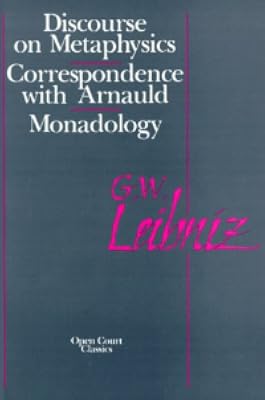
Discourse on Metaphysics
by Gottfried Wilhelm Leibniz
On This Page
Description
"I flatter myself that I have learned something by following in the tracks of Plato and others, and have reached, in one way at least, the serene temples erected by the teachings of the wise. These temples are built on a foundation of general truths which do not depend on facts and yet, as I see it, form the key to the knowledge which passes judgment on facts...I have always striven to uncover the truth that lies buried under and dispersed among the various philosophical schools, and to show more bring it into harmony with itself." show lessTags
Recommendations


























Member Reviews
A good snapshot of the trend toward constructing tighter logic; however, heavily set toward proofs of God and his truths without a strong premise. More than anything, Leibniz shows a strong understanding of a wide subject matter, including philosophy, history, science, mathematics, and religion. He is a more practical philosopher than some of his contemporaries and gives a fair treatment of free will. He downplays Descartes in two places, once regarding the physics of velocity vs. momentum, and again in the matter of "efficient causes." In the latter, he argues that Descartes method was weaker because he never would have discovered the truth without Snell having done so first.
Le Discours de métaphysique, écrit en 1686 (mais qui ne sera publié qu'en 1846), marque un tournant dans le système de Leibniz, car il y présente enfin une métaphysique structurée de façon autonome. Le point de départ de son système est le concept d’un Dieu parfait, omniscient et infiniment bon, économe de ses moyens mais prodigue de ses effets. A partir de là, Leibniz établit la réalité de la substance (il est donc substantialiste) et décrit les sources possibles de notre connaissance (c'est-à-dire qu’il met en place une gnoséologie). Son cheminement ressemble à un cercle : il consiste à partir de Dieu pour rejoindre le monde physique, pour se diriger ensuite vers les esprits et enfin retourner à Dieu de show more nouveau. Sa méthode consiste donc à déployer (Deleuze dirait à déplier) les attributs de Dieu pour découvrir le monde dans sa nature profonde. Dans ce cercle, on retrouve toutes les intuitions fondamentales de sa philosophie : des monades en passant par un Dieu-nexus qui les connecte toutes ensemble, jusqu’à une théodicée visant à déresponsabiliser Dieu du mal, Leibniz réunit ici tous les éléments de la philosophie systématique la plus rigoureuse de l’époque moderne. show less
Dec 15, 2010French
Librería 6. Estante 5
Dec 18, 2019Spanish
Ratings
Members
- Recently Added By
Lists

How to Read a Book's Recommended Reading List
309 works; 10 members
Author Information

416+ Works 4,931 Members
Gottfried Wilhelm Leibniz, one of the last real polymaths, was born in Leipzig. Educated there and at the Universities at Jena and Altdorf, he then served as a diplomat for the Elector of Mainz and was sent to Paris, where he lived for a few years and came into contact with leading scientists, philosophers, and theologians. During a trip to show more England, he was elected to the Royal Society; he made a visit to Holland to meet Spinoza. Back in Germany he became librarian to the Duke of Brunswick, whose library was the largest in Europe outside the Vatican. From there he became involved in government affairs in Hanover and later settled in Berlin at the court of Queen Sophie Charlotte of Prussia. Leibniz was involved in the diplomatic negotiations that led to the Hanoverian succession to the English throne. From his university days he showed an interest in mathematics, logic, physics, law, linguistics, and history, as well as theology and practical political affairs. He discovered calculus independently of Newton and had a protracted squabble about which of them should be given credit for the achievement. The developer of much of what is now modern logic, he discovered some important physical laws and offered a physical theory that is close to some twentieth-century conceptions. Leibniz was interested in developing a universal language and tried to master the elements of all languages. Leibniz corresponded widely with scholars all over Europe and with some Jesuit missionaries in China. His philosophy was largely worked out in answer to those of other thinkers, such as Locke, Malebranche, Bayle, and Arnauld. Although he published comparatively little during his lifetime, Leibniz left an enormous mass of unpublished papers, drafts of works, and notes on topics of interest. His library, which has been preserved, contains annotations, analyses, and often refutations of works he read. The project of publishing all of his writings, undertaken in the 1920s by the Prussian Academy, was delayed by World War II but was resumed thereafter. It is not likely that the project will be completed in the twentieth century. (Bowker Author Biography) show less
Series
Belongs to Publisher Series
Work Relationships
Is contained in
3 Volumes of Modern Library: The English Philosophers From Bacon to Mill, The European Philosophers From Descartes to Nietzche, The Basic Writings of Sigmund Freud by A. A. Brill (indirect)
The Rationalists: Descartes: Discourse on Method & Meditations; Spinoza: Ethics; Leibniz: Monadology & Discourse on Metaphysics by René Descartes (indirect)
Common Knowledge
- First words
- METAPHYSICS -- I. Concerning the divine perfection and that God does everything in the most desirable way. -- The conception of God which is the most common and the most full of meaning is expressed well enough in the words: ... (show all)God is an absolutely perfect being. The implications, however, of these words fail to receive sufficient consideration. For instance, there are many different kinds of perfection, all of which God possesses, and each one of them pertains to him in the highest degree.
Classifications
Statistics
- Members
- 243
- Popularity
- 134,321
- Reviews
- 3
- Rating
- (3.95)
- Languages
- 8 — Dutch, English, French, German, Italian, Latin, Portuguese, Spanish
- Media
- Paper, Audiobook, Ebook
- ISBNs
- 23
- ASINs
- 9