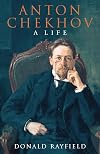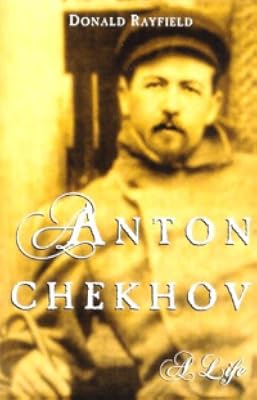
Anton Chekhov: A Life
by Donald Rayfield
On This Page
Description
"Anton Chekhov's life was short, intense, and dominated by battles - both with his dependents and with the tuberculosis that was to kill him at age forty-four. He was one of the greatest playwrights and short-story writers ever born, but he was torn between medicine and literature, as he was between family and friends, between a longing for solitude and a need for company. When he was a child, his family life was at times made a hell by a monstrous father, a possessive sister, and delinquent show more elder brothers; his own adult life was tortuously balanced between the affections of a series of mistresses and a marriage to an actress that was not as idyllic as it has traditionally been painted." "Donald Rayfield's biography strips the whitewash from the image of Chekhov and shows us what lay behind his restrained, ironic facade. The result does not denigrate him but shows him in the full heroism of his brief, prodigiously creative life. Rayfield has spent more than three years combing the Chekhov archives all over Russia (Chekhov was a restless traveler for the whole of his life, going from Siberia to the Cote d'Azur) and has uncovered thousands of documents and letters from Chekhov's lovers, friends, and family, most of them never published before, which cumulatively tell of a life far more entangled and turbulent than we ever previously suspected. The many cuts made in Soviet and foreign editions of Chekhov's and his wife's letters have been restored; what once was hidden is now revealed."--Jacket. show lessTags
Recommendations















Member Reviews
I'm sure there are amusing names for hyper-inclusive biographies, I mean, right down to toilet paper usage (not kidding) - let us just call it the "laundry list bio". Much new information was released in the last few decades, letters etc. of Chekhov's that had been considered too racy by the Soviet state. And racy plenty of it is. Chekhov, rather like Shakespeare, arose from a class only two generations away from serfdom into precarious middle-class (shopkeeping). The parents worked tirelessly and devotedly (which includes beatings, scoldings and whatever else deemed necessary) to encourage the five boys to study hard and make something of themselves. This did not exclude occasionally abandoning them while they went elsewhere to try and show more make money. (The one sister, Masha, did receive slightly less harsh treatment although she was expected to do her share in the household.) The father, Pavel, was a religious fanatic and the boys grew up memorizing vast tracts of bible and music, reciting and singing the orthodox litany. Rayfield is so intent on laying out the new information that he does not linger over interpretation -- but many have seen that the Chekhovian story structure is musical, theme, development, return to deepened theme (at the simplest) and likely it is from this early influence. Rayfield mentions this here and there, but no deeper looks. As the boys grow up it becomes apparent that Kolia, the painter, is a genius but unstable and that Anton is the most stable and the most intelligent of the lot. Oldest brother Aleksandr is a math/science whiz but also vulnerable to substance abuse. They are all very randy and crude in ways that separate them entirely from, say, Tolstoy and the aristocratic classes. In fact there is something Elizabethan all around in a reaching after everything life could offer, as if knowing it couldn't last long. Russia at the turn of the century had, perhaps, more in common with earlier times than staid and repressed Western Europe. (About to explode into violence, yes.) In a biography of this magnitude I can hardly summarize but I will say that many things surprised me -- among them how careless Chekhov's family were with him, given that he became the de facto head of the family, a famous and admired man, the breadwinner. They were also amazingly restless always hopping on trains to Moscow, Petersburg, back to the dacha in the country, later to Yalta, now and then into Europe . . . and as Chekhov grew more ill these jaunts didn't cease. The weather in Russia is truly appalling most of the year and he found himself stuck in terrible circumstances waiting for trains -- no doubt these speeded on his death. The contradictions are endless. Chekhov knew how important he was: he never let Masha marry (she was not sure she wanted to and he played on it so she would stay head of domestic affairs for him). Everyone knew he was ill and that he should be kept warm and well fed, and yet Masha would go off, or later his wife Olga, and the house would go cold and the food would revert to potatoes and indigestible fatty stews he couldn't stomach . . . His mother was rather hopeless at caring for him too. Dogs were adored then cruelly abandoned. There were interludes, a few years at the dacha Melikhovo where they played at being estate owners and enjoyed themselves but it all proved to be incredibly hard work. I'm rambling -- Rayfield does provide the information for the knowledgeable Chekhovian to draw the parallels between what went on in his family life, love life, and travels and what he put into his works. An exhausting and exhaustive read but worth it for any Chekhovian admirer, which I am. The writing is never anything but solid, clear and so a degree above pedestrian, but Rayfield was trying to get in every scrap of information and he succeeds. ****1/2 show less
I listened to this book on tape (from Audible) and parts of it were hard going. Either the narrator or the writing has a flat, relentless quality to it, hard to tell which The book grew on me though. By the end I thought the tone was actually appropriate to the tragic, relentless aspects of Checkov's life: his brutal childhood, his almost comically dysfunctional family (if it weren't so tragic), the waste of his tremendous talent through disease. Some of the reviewers below mention they felt the author did not like his subject. I didn't feel that. What I thought the book was excellent at was showing the obstacles both large and small that Checkov overcame to become the great writer he was. Amazing to me was how contolled Russian society show more was, even before the Revolution and also how very many women pursued Checkov around the country. He seemed to have been irresistible. show less
Ratings
Members
- Recently Added By
Lists

In Our Time books
4,934 works; 2 members
Author Information

20+ Works 582 Members
Donald Rayfield is Emeritus Professor of Russia and Georgian in the Department of Russia, Queen Mary University of London. He has published the standard history of Georgia's literature and is editor-in-chief of the immense Comprehensive Georgian-English Dictionary. His Stalin and His Hangmen (2004) has been translated into nine languages. With 28 show more illustrations and 6 maps show less
Awards and Honors
Notable Lists
Common Knowledge
- Canonical title
- Anton Chekhov: A Life
- Original publication date
- 1997
- People/Characters
- Anton Chekhov; Leo Tolstoy; Maxim Gorky; Olga Knipper
- Important places
- Moscow, Russia; Siberia, Russia; Baden-Württemberg, Germany; Badenweiler, Baden-Württemberg, Germany; Yalta, Crimea, Ukraine
- Dedication
- For Alia, Galia, Maia and Tolia
Classifications
- Genres
- Biography & Memoir, Literature Studies and Criticism, Fiction and Literature
- DDC/MDS
- 891.72 — Literature & rhetoric Literatures of other languages East Indo-European and Celtic literatures Russian and East Slavic languages Russian drama
- LCC
- PG3458 .R35 — Language and Literature Slavic languages and literatures. Baltic languages. Albanian language Slavic. Baltic. Albanian Russian literature Individual authors and works 1870-1917 Chekhov
- BISAC
Statistics
- Members
- 143
- Popularity
- 227,465
- Reviews
- 2
- Rating
- (4.21)
- Languages
- English, Russian, Spanish
- Media
- Paper, Audiobook, Ebook
- ISBNs
- 12
- ASINs
- 2