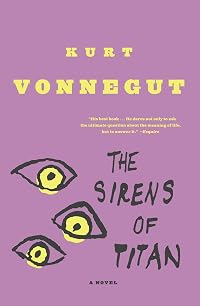
The Sirens of Titan
by Kurt Vonnegut
On This Page
Description
Malachi Constant, "the richest man in America," gives up his indulgent lifestyle to follow an urgent calling to probe the depths of space. He participates in a Martian invasion of Earth, mates with the wife of an astronaut adrift on the tides of time, and follows the lure of the "Sirens of Titan."Tags
Recommendations



























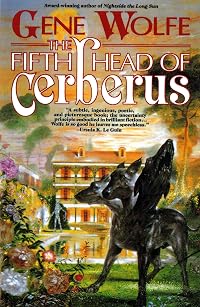

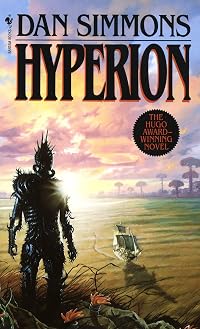

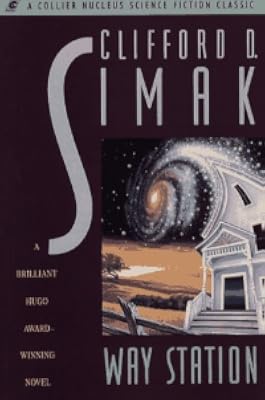



Member Recommendations

wvlibrarydude Is there meaning to the universe, or one big joke of coincidences.
47
Member Reviews
Spoilers
This is one that will stay with me for a while. I loved the detail in the creation of Rufoord's new religion. I almost wondered at times if I was instead reading "The Winston Niles Rumfoord Pocket HIstory of Mars". But it wasn't until I reached the end, until the reveal of the Tralfamadorian influence on Earth, that I realized the full impact of the story. For me, it changed the whole perspective of the narrative, and wonderfully so. Throughout the book, Vonnegut in his matter-of-fact tone simultaneously challenges and embraces the ideas of free will, fate, and purpose. I think if there is a moral to the story, it would be what Constant said of Beatrice at the very end- "It took us that long to realize that a purpose of human show more life, no matter who is controlling it, is to love whoever is around to be loved." And I'll be comforted in the future by the thought that I am a victim of a series of accidents, as are we all. show less
This is one that will stay with me for a while. I loved the detail in the creation of Rufoord's new religion. I almost wondered at times if I was instead reading "The Winston Niles Rumfoord Pocket HIstory of Mars". But it wasn't until I reached the end, until the reveal of the Tralfamadorian influence on Earth, that I realized the full impact of the story. For me, it changed the whole perspective of the narrative, and wonderfully so. Throughout the book, Vonnegut in his matter-of-fact tone simultaneously challenges and embraces the ideas of free will, fate, and purpose. I think if there is a moral to the story, it would be what Constant said of Beatrice at the very end- "It took us that long to realize that a purpose of human show more life, no matter who is controlling it, is to love whoever is around to be loved." And I'll be comforted in the future by the thought that I am a victim of a series of accidents, as are we all. show less
Rating: 3.5* of five
The Publisher Says: The Sirens of Titan is an outrageous romp through space, time, and morality. The richest, most depraved man on Earth, Malachi Constant, is offered a chance to take a space journey to distant worlds with a beautiful woman at his side. Of course there’ s a catch to the invitation–and a prophetic vision about the purpose of human life that only Vonnegut has the courage to tell.
My Review: I read this book when I was a teenager in the 1970s. I missed a lot of assumptions, like the one where it's okay for a man to discuss his own wife "being bred" by another man; the one where black people all speak in dialect, obviating the need to mention their skin color; the one about homosexual sex being show more offensive; I'm at a loss, as a 695-month-old reader with literally thousands more books under my expansive mental belt, how this 1950s prejudice whipped past my allegedly enlightened 1970s sensibilities.
Two stars off.
The Tralfamadorian Salo, tangerine-colored mechanical man whose millions of years of lightspeed travel get interrupted by an unexpected landing on the balmy, verdant shores of Titan, also gets the stink-eye from my increasingly myopic baby greens. Winston Niles Rumfoord, the chrono-synclastically infundibulated spacetime sprinter, becomes his buddy? Salo spends inordinate amounts of energy, for a Tralfamadorian, setting WNR (a note to come on these initials) up and making his life on Titan extraordinarily pleasant. That has more than a faint whiff of colonial privilege, Salo being the first inhabitant of Titan though not native to it, who expends all his energies to improve the lot of an ungrateful, entitled newcomer.
Another star off.
Malachi Constant, reasonably dim, phenomenally lucky, is summoned to Rumfoord's famous reappearance after he's been chrono-synclastically infundibulated (seriously, if you're ever in a foul humor or just draggy, say or better yet type, "chrono-synclastic infundibulum." Your smile muscles will automatically activate and your crow's-feet will dance) in order to converse with the great man, though why he's so great really isn't much discussed. And what happens? Constant is turned into an unlucky pauper and press-ganged to Mars to fight a fake war with real casualties designed to unite the people of earth. In service of this goal, Malachi Constant has his identity stripped from him, mechanical thought-control devices implanted in him, and he's specifically made subject to a black man's total control to symbolize his utter dehumanization.
More racism, fewer stars. What are we down to, one? I'll snatch that one back for black-man-as-nature-gawd-of-Mercury, Boaz using his natural rhythm (urp) to feed the harmoniums off his superiorly rhythmic pulse in preference to Unk/Malachi's more, what? bland? attenuated?, white man's pulse.
No stars for you, Vonnegut. Zip. Zero. Rien. Nada.
So whence cometh the three-and-a-half stars above? The Church of God the Utterly Indifferent. The mass religion of billions who know with the simple certainty of faith that God couldn't pick you out in a police line-up and couldn't possibly care less about you, your prayers, your troubles, and your existence or non-existence. You don't matter to God.
That is the single best take-away from reading this book. The assurance with which Vonnegut adduces the non-existence of God's interest in humanity is worth all three and a half stars I've rated the book. This isn't the reason I suspect people want to read a novel. It isn't my first thought on picking up a novel. But it damn sure makes for a great end! Though I have to say the ending of this novel, as opposed to its end in the sense of purpose, is...it's...on the bland side. Things rather stop than end. After a long, long time passes, the show rings down the curtain and you don't have to go home but you can't stay here.
I remembered this novel as a Big Deal, a game-changer for me, and so it might have been in my teens. I think encountering a created world in which the Indifference of the Divine was simply accepted as fact, and the attitude towards the accumulation of money was sneeringly superior to those who merely grub after gold in the mud resonated strongly with my noblesse oblige sense of wealth as responsibility not opportunity.
Another entry in the "re-read at your own risk" files. I might have liked it better left un-re-read. show less
The Publisher Says: The Sirens of Titan is an outrageous romp through space, time, and morality. The richest, most depraved man on Earth, Malachi Constant, is offered a chance to take a space journey to distant worlds with a beautiful woman at his side. Of course there’ s a catch to the invitation–and a prophetic vision about the purpose of human life that only Vonnegut has the courage to tell.
My Review: I read this book when I was a teenager in the 1970s. I missed a lot of assumptions, like the one where it's okay for a man to discuss his own wife "being bred" by another man; the one where black people all speak in dialect, obviating the need to mention their skin color; the one about homosexual sex being show more offensive; I'm at a loss, as a 695-month-old reader with literally thousands more books under my expansive mental belt, how this 1950s prejudice whipped past my allegedly enlightened 1970s sensibilities.
Two stars off.
The Tralfamadorian Salo, tangerine-colored mechanical man whose millions of years of lightspeed travel get interrupted by an unexpected landing on the balmy, verdant shores of Titan, also gets the stink-eye from my increasingly myopic baby greens. Winston Niles Rumfoord, the chrono-synclastically infundibulated spacetime sprinter, becomes his buddy? Salo spends inordinate amounts of energy, for a Tralfamadorian, setting WNR (a note to come on these initials) up and making his life on Titan extraordinarily pleasant. That has more than a faint whiff of colonial privilege, Salo being the first inhabitant of Titan though not native to it, who expends all his energies to improve the lot of an ungrateful, entitled newcomer.
Another star off.
Malachi Constant, reasonably dim, phenomenally lucky, is summoned to Rumfoord's famous reappearance after he's been chrono-synclastically infundibulated (seriously, if you're ever in a foul humor or just draggy, say or better yet type, "chrono-synclastic infundibulum." Your smile muscles will automatically activate and your crow's-feet will dance) in order to converse with the great man, though why he's so great really isn't much discussed. And what happens? Constant is turned into an unlucky pauper and press-ganged to Mars to fight a fake war with real casualties designed to unite the people of earth. In service of this goal, Malachi Constant has his identity stripped from him, mechanical thought-control devices implanted in him, and he's specifically made subject to a black man's total control to symbolize his utter dehumanization.
More racism, fewer stars. What are we down to, one? I'll snatch that one back for black-man-as-nature-gawd-of-Mercury, Boaz using his natural rhythm (urp) to feed the harmoniums off his superiorly rhythmic pulse in preference to Unk/Malachi's more, what? bland? attenuated?, white man's pulse.
No stars for you, Vonnegut. Zip. Zero. Rien. Nada.
So whence cometh the three-and-a-half stars above? The Church of God the Utterly Indifferent. The mass religion of billions who know with the simple certainty of faith that God couldn't pick you out in a police line-up and couldn't possibly care less about you, your prayers, your troubles, and your existence or non-existence. You don't matter to God.
That is the single best take-away from reading this book. The assurance with which Vonnegut adduces the non-existence of God's interest in humanity is worth all three and a half stars I've rated the book. This isn't the reason I suspect people want to read a novel. It isn't my first thought on picking up a novel. But it damn sure makes for a great end! Though I have to say the ending of this novel, as opposed to its end in the sense of purpose, is...it's...on the bland side. Things rather stop than end. After a long, long time passes, the show rings down the curtain and you don't have to go home but you can't stay here.
I remembered this novel as a Big Deal, a game-changer for me, and so it might have been in my teens. I think encountering a created world in which the Indifference of the Divine was simply accepted as fact, and the attitude towards the accumulation of money was sneeringly superior to those who merely grub after gold in the mud resonated strongly with my noblesse oblige sense of wealth as responsibility not opportunity.
Another entry in the "re-read at your own risk" files. I might have liked it better left un-re-read. show less
An impressive book for 1959, and for a debut. Vonnegut uses science fiction to satirize the wealthy, the military, religion, and mankind’s role in the universe, and manages to tell an entertaining tale on top of it. While fantastical, it’s brilliantly creative. There is a chrono-synclastic infundibula which spreads one of the characters and his dog out across space in a wave, such that they appear on Earth when its orbit regularly intersects it. There are translucent, diamond-shaped creatures in deep caves of Mercury with only one sense, touch, that cooperate with one another. There are creatures on the planet Tralfamadore who can’t find any purpose to existence and wage war against each other, ultimately turning the job over to show more machines ala the Terminator.
The satire of the ultra-wealthy, who believe they are that way because of their consummate business skill or because “someone up there likes me,” implying a God who actually pays attention to our little lives and favors them, is not only effective but well ahead of its time, and highly relevant today. We see overpaid CEO’s who don’t understand how much sheer luck played a role in their success. We see the immorality of their excesses, war profiteering, and the “philanthropy” of buying art and lending it out to museums in reality being PR and good investments. We see the creation of shell corporations that are “a marvelous engine for doing violence to the spirit of thousands of laws without actually running afoul of so much as a city ordinance.” We see generational wealth maintained via marrying within the set, even if it means with cousins. It’s just remarkable stuff, and one can only imagine what Vonnegut would think of the elite today.
Relative to the military, in some of his best and most chilling writing, Vonnegut describes a Martian army controlled by antenna implants into the brain and regular memory scrubbing, so that they strictly follow orders, even if it means cold-blooded killing. A military commander wears the uniform of an elite tactical group which caught his fancy, “regardless of how much hell anybody else had to go through for the privilege.” The Earthling military response is out of all proportion to the danger, with thermonuclear devices rendering the moon “unfit for human occupation for at least ten million years.”
As for religion and the delusion that there is a God looking down upon us, the story alludes to how this is weaponized, and how one of the characters creates a new church, that of the “God of the Utterly Indifferent” to combat this. Vonnegut writes: “No longer can a fool like Malachi Constant point to a ridiculous accident of good luck and say, ‘Somebody up there like me.’ And no longer can a tyrant say, ‘God wants this or that to happen, and anybody who doesn’t help this or that to happen is against God.’ O Lord Most High, what a glorious weapon is Thy Apathy, for we have unsheathed it, have thrust and slashed mightily with it, and the claptrap that has so often enslaved us or driven us into the madhouse lies slain!”
As for mankind, the story plays with meaninglessness in a vast universe and free will (or lack thereof) in fanciful ways. It also alludes to our violence, creatively captured in a statue of Neanderthals roasting a human foot on a crude spit, and one of a scientist with an erection for having discovered atomic power – there being little that is pure or cooperative about the species. Bonus points for the protagonist wanting to be let down in Indianapolis near the end because it was “the first place in the United States of America where a white man was hanged for the murder of an Indian,” referring to the Fall Creek Massacre of 1824 and subsequent hanging of three of the perpetrators the following year.
Great stuff here, full of meaning, but written in a light, engaging way. One to seek out. show less
The satire of the ultra-wealthy, who believe they are that way because of their consummate business skill or because “someone up there likes me,” implying a God who actually pays attention to our little lives and favors them, is not only effective but well ahead of its time, and highly relevant today. We see overpaid CEO’s who don’t understand how much sheer luck played a role in their success. We see the immorality of their excesses, war profiteering, and the “philanthropy” of buying art and lending it out to museums in reality being PR and good investments. We see the creation of shell corporations that are “a marvelous engine for doing violence to the spirit of thousands of laws without actually running afoul of so much as a city ordinance.” We see generational wealth maintained via marrying within the set, even if it means with cousins. It’s just remarkable stuff, and one can only imagine what Vonnegut would think of the elite today.
Relative to the military, in some of his best and most chilling writing, Vonnegut describes a Martian army controlled by antenna implants into the brain and regular memory scrubbing, so that they strictly follow orders, even if it means cold-blooded killing. A military commander wears the uniform of an elite tactical group which caught his fancy, “regardless of how much hell anybody else had to go through for the privilege.” The Earthling military response is out of all proportion to the danger, with thermonuclear devices rendering the moon “unfit for human occupation for at least ten million years.”
As for religion and the delusion that there is a God looking down upon us, the story alludes to how this is weaponized, and how one of the characters creates a new church, that of the “God of the Utterly Indifferent” to combat this. Vonnegut writes: “No longer can a fool like Malachi Constant point to a ridiculous accident of good luck and say, ‘Somebody up there like me.’ And no longer can a tyrant say, ‘God wants this or that to happen, and anybody who doesn’t help this or that to happen is against God.’ O Lord Most High, what a glorious weapon is Thy Apathy, for we have unsheathed it, have thrust and slashed mightily with it, and the claptrap that has so often enslaved us or driven us into the madhouse lies slain!”
As for mankind, the story plays with meaninglessness in a vast universe and free will (or lack thereof) in fanciful ways. It also alludes to our violence, creatively captured in a statue of Neanderthals roasting a human foot on a crude spit, and one of a scientist with an erection for having discovered atomic power – there being little that is pure or cooperative about the species. Bonus points for the protagonist wanting to be let down in Indianapolis near the end because it was “the first place in the United States of America where a white man was hanged for the murder of an Indian,” referring to the Fall Creek Massacre of 1824 and subsequent hanging of three of the perpetrators the following year.
Great stuff here, full of meaning, but written in a light, engaging way. One to seek out. show less
Did I like this book? I certainly appreciated this book. But Vonnegut is clearly annoyed by humanity and its search for meaning in our individual lives. In The Sirens of Titan Vonnegut depicts the human condition as having no meaning and that everything that happens is an accident and not of our own design. Individual human experience is simply collateral damage as a result of someone else’s plans or desires. And this makes sense coming from someone who experienced that calamity of the Dresden firebombing during WWII. But as a result, there are no likeable characters in this novel; none of them have redeeming qualities. There is no hero in this story. So does this say something about myself as a reader who wants to have their stories show more make sense to have purpose? Does this say something about my own life that desires some sort of sensical narrative and meaning? From that point of view, making me, the reader, ask these questions about my own life, this is a work of literature. But interesting that I didn’t “like” the experience of reading it. I much preferred Slaughterhouse Five. Maybe existentialist philosophy doesn’t make for very good fiction?
I like this rating system by ashleytylerjohn of LibraryThing (https://www.librarything.com/profile/ashleytylerjohn) that I have also adopted:
(Note: 5 stars = rare and amazing, 4 = quite good book, 3 = a decent read, 2 = disappointing, 1 = awful, just awful.) show less
I like this rating system by ashleytylerjohn of LibraryThing (https://www.librarything.com/profile/ashleytylerjohn) that I have also adopted:
(Note: 5 stars = rare and amazing, 4 = quite good book, 3 = a decent read, 2 = disappointing, 1 = awful, just awful.) show less
5/5
During the summer before my junior year in high-school, my upcoming English class gave everyone an assignment to read one book. It didn't matter what book it was, our teacher just wanted us to read literally anything, presumably so that we didn't show up to class having let our reading skills stagnate for 3 months. The prior year, I had read Slaughter House 5, and really enjoyed it, so I decided why not try another one of Kurt Vonnegut Jr's novels. The Sirens of Titan was what I chose.
I simply can't describe to you how captivated I was. I had simply never read anything like it. When I dried to describe it to my class a month later, everything was so vivid in my head, but I had a hard to putting it all in to words. I think they may show more have got the wrong idea about it. Looking back on it now, I think this book was very formative on my tastes as a reader, but also my outlook on life.
The Sirens of Titans revolves around Malachi Constant, the wealthiest person on earth, whose destiny is foretold by Winston Rumfoord, a man who purposefully flew into an anomaly in space that then spreads his existence over the solar system. Malachi is sent to Mars to participate in a sham and forced invasion of Earth, has his intelligence tested in the caves of Mercury, returns to Earth as the prodigal son, only to be exiled yet again by the new religion of earth that handicaps everyone equally. He is sent to Titan with Rumfoord's former wife Beatrice, whom he had a child with, to help an alien robot complete his own destiny. It's ridiculous, adventurous, and funny. It reminds me a lot of The Stars My Destination by Alfred Bester, both in terms of its unrelenting pacing, and the density of its fantastic ideas.
Vonnegut has his own distinct flavor of prose, which is on display here, though perhaps not at it's highest strength. I personally love the style, love how seemingly effortless it is to read without sacrificing depth of meaning, but I can understand that it's not for everyone. I think Vonnegut provides a great palate cleanser when you become tired of reading the same old thing, simply because he's so different from anyone else. There's a sarcastic, ironic, and dark style of humor to this novel that I also enjoyed immensely.
Vonnegut obsesses over destiny, and the absence of free-will. Nearly every single character in the Sirens of Titan can not control their own fate, no matter how they try to deviate from it with their actions. Vonnegut postulates that in this indifferent universe where there is no higher meaning, that what is most important is finding a place where you can be of use, accepting it, and loving those that can be loved around you. Boaz, Malachi's companion on Mars and Mercury, thought he had some higher purpose in leading the Martian army, but discovered his foolishness and found a place where he can love and be loved in the caves of Mercury. He accepted this position, no matter how small it is perceived to be, and found happiness. In contrast, Rumfoord runs away from the solar system when he discovers that he too had a destiny outside of his own control.
I think frequently about how small we are in the indifferent cosmos, and how in spite of that we can all find our little corner of purpose. I think this book must've at least played a part in forming that thought process. I don't know if it's necessarily a perfect book, but it's important to me personally, I think that it's a wild ride regardless of your personal connection to it. show less
During the summer before my junior year in high-school, my upcoming English class gave everyone an assignment to read one book. It didn't matter what book it was, our teacher just wanted us to read literally anything, presumably so that we didn't show up to class having let our reading skills stagnate for 3 months. The prior year, I had read Slaughter House 5, and really enjoyed it, so I decided why not try another one of Kurt Vonnegut Jr's novels. The Sirens of Titan was what I chose.
I simply can't describe to you how captivated I was. I had simply never read anything like it. When I dried to describe it to my class a month later, everything was so vivid in my head, but I had a hard to putting it all in to words. I think they may show more have got the wrong idea about it. Looking back on it now, I think this book was very formative on my tastes as a reader, but also my outlook on life.
The Sirens of Titans revolves around Malachi Constant, the wealthiest person on earth, whose destiny is foretold by Winston Rumfoord, a man who purposefully flew into an anomaly in space that then spreads his existence over the solar system. Malachi is sent to Mars to participate in a sham and forced invasion of Earth, has his intelligence tested in the caves of Mercury, returns to Earth as the prodigal son, only to be exiled yet again by the new religion of earth that handicaps everyone equally. He is sent to Titan with Rumfoord's former wife Beatrice, whom he had a child with, to help an alien robot complete his own destiny. It's ridiculous, adventurous, and funny. It reminds me a lot of The Stars My Destination by Alfred Bester, both in terms of its unrelenting pacing, and the density of its fantastic ideas.
Vonnegut has his own distinct flavor of prose, which is on display here, though perhaps not at it's highest strength. I personally love the style, love how seemingly effortless it is to read without sacrificing depth of meaning, but I can understand that it's not for everyone. I think Vonnegut provides a great palate cleanser when you become tired of reading the same old thing, simply because he's so different from anyone else. There's a sarcastic, ironic, and dark style of humor to this novel that I also enjoyed immensely.
Vonnegut obsesses over destiny, and the absence of free-will. Nearly every single character in the Sirens of Titan can not control their own fate, no matter how they try to deviate from it with their actions. Vonnegut postulates that in this indifferent universe where there is no higher meaning, that what is most important is finding a place where you can be of use, accepting it, and loving those that can be loved around you. Boaz, Malachi's companion on Mars and Mercury, thought he had some higher purpose in leading the Martian army, but discovered his foolishness and found a place where he can love and be loved in the caves of Mercury. He accepted this position, no matter how small it is perceived to be, and found happiness. In contrast, Rumfoord runs away from the solar system when he discovers that he too had a destiny outside of his own control.
I think frequently about how small we are in the indifferent cosmos, and how in spite of that we can all find our little corner of purpose. I think this book must've at least played a part in forming that thought process. I don't know if it's necessarily a perfect book, but it's important to me personally, I think that it's a wild ride regardless of your personal connection to it. show less
Kurt Vonnegut's second and most sci-fi novel, which follows the life of the richest man on Earth, Malachi Constant. Things take a turn for Malachi when he loses all his money and ends up embarking on a galactic adventure that takes him to Mars, Saturn, and Titan… clearly, a lot goes on! It is so packed with ideas that could each be their own novel (some ideas would be expanded upon in future Vonnegut works ie. equality handicaps in Harrison Bergeron, Tralfamadorians in Slaughterhouse-Five). But it's fun reading the fast-paced plot flying all over the galaxy. Stylistically this is a huge jump from "Player Piano" and it is the first novel where the classic Vonnegut voice is recognizable.
This book makes fun of the way that we think show more humanity is so elevated and important. Human progress is completely belittled by making the goal mankind be progressing towards to be delivering a repair part for a Tralfamadorian's stranded spaceship. Talk about glory! Instead of being the only intelligent life form in the galaxy, we are just messenger boys. It also makes fun of the idea that a higher power is looking out for us ("somebody up there likes me!") and actively shaping our destiny. The premise of the religion that Ruumford creates to unite the world is that we should stop expecting things from God because he does not care about the billions of people on Earth. It's an interesting way of acknowledging a higher power, but also granting agency and independence back to the people. To be alive is to be a victim of a series of accidents.
Malachi Constant is anything but constant and undergoes a LOT of change. At the beginning he is this super unlikeable billionaire playboy, who rapes his future wife on a spaceship. But on Mars he becomes the completely unrecognizable solider, Unk, who keeps getting his memory wiped. One of my favourite parts of the novel is when Malachi reads the letter he wrote to himself, because he finally becomes a sympathetic character with a family and a best friend (who he tragically doesn't remember strangling to death). He ends up evolving into this weary old guy who begins accepting, not fighting, his fate.
The most redemptive and powerful force in this novel seems to be friendship. Even if we are victims of a series of accidents, having someone to share your experiences with is what keeps life from feeling too meaningless. There's Unk and Stony, Ruumford and Kazak, Bea and Chrono (or Chrono and the birds!), and the tragic Salo/Ruumford friendship. Salo is a loveable little Tralfamadorian who bonds with Ruumford on Titan and it's the saddest part of the book when Ruumford questions his loyalty. Salo destroys himself in the process of trying to honour his friendship, as his human emotions totally contradict his machine-like constitution. Friendship seems to be able to change us for the better, aw!
Vonnegut novels may be cynical, but with messages like that they are never too bleak. Sure he makes fun of Earthling and our silly beliefs, but his humanism clearly shines through.
P.S. I want pet Harmonium. I think Boaz got the happiest ending getting to chill with the harmoniums and putting on classical 'concerts' for them… adorable! show less
This book makes fun of the way that we think show more humanity is so elevated and important. Human progress is completely belittled by making the goal mankind be
Malachi Constant is anything but constant and undergoes a LOT of change. At the beginning he is this super unlikeable billionaire playboy, who rapes his future wife on a spaceship. But on Mars he becomes the completely unrecognizable solider, Unk, who keeps getting his memory wiped. One of my favourite parts of the novel is when Malachi reads the letter he wrote to himself, because he finally becomes a sympathetic character with a family and a best friend
The most redemptive and powerful force in this novel seems to be friendship. Even if we are victims of a series of accidents, having someone to share your experiences with is what keeps life from feeling too meaningless. There's Unk and Stony, Ruumford and Kazak, Bea and Chrono (or Chrono and the birds!), and the tragic Salo/Ruumford friendship. Salo is a loveable little Tralfamadorian who bonds with Ruumford on Titan and it's the saddest part of the book when Ruumford questions his loyalty.
Vonnegut novels may be cynical, but with messages like that they are never too bleak. Sure he makes fun of Earthling and our silly beliefs, but his humanism clearly shines through.
P.S. I want pet Harmonium. I think Boaz got the happiest ending getting to chill with the harmoniums and putting on classical 'concerts' for them… adorable! show less
With an author like Vonnegut, it’s a bit daunting to know where to start. You could choose the most popular book, or the first book he published (which is often the same) or the one that won awards. I did none of those things and in some ways I wish I had. Reading The Sirens of Titan broke my heart and has altered my relationship with another author, this one a favorite. Douglas Adams.
For 30 years...since I was a teenager, I have loved The Hitchhikers Guide series. Maybe not all of them equally, but they are a touchstone for me. Books that made me think on the ridiculousness of humanity. Our fixation with our own importance. Our backward approach to many ideas, situations and occurrences. The pure silliness he injects into the most show more serious thing. The wordplay. The funny names of things. All of it so engaging and enlightening that I thought it original. Alas, it isn’t.
Most of it originated with Vonnegut and this book. So much so that I stopped reading it for itself and read it looking for parallels to Hitchhikers. There were many. It made it very difficult to read for the story itself. To wit -
Salo’s ship is powered by UWTB, the Universal Will to Become. This reminds me of the Infinite Improbability Drive. Or an SEP field. There’s even a song about it like the one sung about the Sirius Cybernetics Corporation’s teleportation device.
Pan-Galactic Space Service. They probably drink Pan-Galactic Gargle Blasters.
The Imperial Commandos reminded me of the Robots of Krikkit.
The seemingly willful, but emotional nature of the Martian vehicles is just like the computer on The Heart of Gold and the Happy Vertical People Transporters who need therapy because they can see into the future.
The meaning of Stonehenge in Trafalmadorian, when viewed from above, is: “Replacement part being rushed with all possible speed.” So like the sign that used to read Share and Enjoy, the motto of the Complaints Division of the Sirius Cybernetics Corporation, that sank into the ground and now reads in the local dialect “Go Stick Your Head in a Pig.” Well, maybe not such a great parallel, but if you count the artificially constructed earth, the Magratheans and Slartibartfast...well, you get the idea.
Then there’s Rumfoord himself who struck me as a combination of Zaphod and the man in the shack who secretly rules the Universe. Rumfoord had a dog, the man who rules the Universe a cat.
There are more, but I won’t bore you with all of them. You get the drift.
Stylistically, Vonnegut doesn’t go over the top with language or down ratholes of tangents the way Adams does, so the story is much tighter. Also, I like the spare, no the pared-down way Vonnegut delivers the story. There isn’t a whole lot of inside information about every minute and every facet of what happened to a person from situation A to situation B. Sometimes there isn’t a need and Vonnegut catapults you right into what matters. He does not digress. Even when it seems he does, it isn’t. What he’s telling you is important. And damn he could write. Well, duh, right, but here are some highlights -
“He was an anarchist, though he never got into any trouble about it, except with his wife.” p. 68
“It was a marvelous engine for doing violence to the spirit of thousands of laws without actually running afoul of so much as a city ordinance.” p. 75
“The only thing anybody could think of to do with them was to housebreak them, teach them basic vocabulary of a thousand words, and give them jobs in military or industrial public relations.” p. 127
“The ball is no more lively than a ten-gallon hat filled with rain water.” p. 138
I also think that Vonnegut was more disturbed by capitalism and religion than Adams was and with good reason. His experiences in Dresden during WWII were horrendous and that obviously shaped his world view. Including his opinion of the military and its mindless obedience.
Like Adams does in later years, Vonnegut fleshes out his universe with legends and stories of other planets. I especially liked the one about Tralfamadore and why they were all machines and that organic life had crushed itself out, the machines themselves delivering the coup de grace. It’s absolutely lovely and clever. In it I see the origins of Deep Thought, the Ultimate Question, 42, the Golgafrinchans and Krikkit. Mad genius.
I especially thought his idea of equality brought on by this religion based on God the Indifferent was genius. So human to pervert the natural and try to control the uncontrollable. The handicapping! OMG. I think he explores this idea much further in another book, but this was absolutely wonderful. How silly we are.
“No one could then reproach you for taking advantage of the random ways of luck.” Oh how Malachi Constant would have cried.
Up to this point in writing this review, I’d had a lot of negative emotion about this book, but strangely now I’ve done the quotes and put my thoughts down, I feel better. Vonnegut was a genius and I’m glad I read this book. I may even read more. I may even read Hitchhiker’s Guide. I hope I get pleasure from both. show less
For 30 years...since I was a teenager, I have loved The Hitchhikers Guide series. Maybe not all of them equally, but they are a touchstone for me. Books that made me think on the ridiculousness of humanity. Our fixation with our own importance. Our backward approach to many ideas, situations and occurrences. The pure silliness he injects into the most show more serious thing. The wordplay. The funny names of things. All of it so engaging and enlightening that I thought it original. Alas, it isn’t.
Most of it originated with Vonnegut and this book. So much so that I stopped reading it for itself and read it looking for parallels to Hitchhikers. There were many. It made it very difficult to read for the story itself. To wit -
Salo’s ship is powered by UWTB, the Universal Will to Become. This reminds me of the Infinite Improbability Drive. Or an SEP field. There’s even a song about it like the one sung about the Sirius Cybernetics Corporation’s teleportation device.
Pan-Galactic Space Service. They probably drink Pan-Galactic Gargle Blasters.
The Imperial Commandos reminded me of the Robots of Krikkit.
The seemingly willful, but emotional nature of the Martian vehicles is just like the computer on The Heart of Gold and the Happy Vertical People Transporters who need therapy because they can see into the future.
The meaning of Stonehenge in Trafalmadorian, when viewed from above, is: “Replacement part being rushed with all possible speed.” So like the sign that used to read Share and Enjoy, the motto of the Complaints Division of the Sirius Cybernetics Corporation, that sank into the ground and now reads in the local dialect “Go Stick Your Head in a Pig.” Well, maybe not such a great parallel, but if you count the artificially constructed earth, the Magratheans and Slartibartfast...well, you get the idea.
Then there’s Rumfoord himself who struck me as a combination of Zaphod and the man in the shack who secretly rules the Universe. Rumfoord had a dog, the man who rules the Universe a cat.
There are more, but I won’t bore you with all of them. You get the drift.
Stylistically, Vonnegut doesn’t go over the top with language or down ratholes of tangents the way Adams does, so the story is much tighter. Also, I like the spare, no the pared-down way Vonnegut delivers the story. There isn’t a whole lot of inside information about every minute and every facet of what happened to a person from situation A to situation B. Sometimes there isn’t a need and Vonnegut catapults you right into what matters. He does not digress. Even when it seems he does, it isn’t. What he’s telling you is important. And damn he could write. Well, duh, right, but here are some highlights -
“He was an anarchist, though he never got into any trouble about it, except with his wife.” p. 68
“It was a marvelous engine for doing violence to the spirit of thousands of laws without actually running afoul of so much as a city ordinance.” p. 75
“The only thing anybody could think of to do with them was to housebreak them, teach them basic vocabulary of a thousand words, and give them jobs in military or industrial public relations.” p. 127
“The ball is no more lively than a ten-gallon hat filled with rain water.” p. 138
I also think that Vonnegut was more disturbed by capitalism and religion than Adams was and with good reason. His experiences in Dresden during WWII were horrendous and that obviously shaped his world view. Including his opinion of the military and its mindless obedience.
Like Adams does in later years, Vonnegut fleshes out his universe with legends and stories of other planets. I especially liked the one about Tralfamadore and why they were all machines and that organic life had crushed itself out, the machines themselves delivering the coup de grace. It’s absolutely lovely and clever. In it I see the origins of Deep Thought, the Ultimate Question, 42, the Golgafrinchans and Krikkit. Mad genius.
I especially thought his idea of equality brought on by this religion based on God the Indifferent was genius. So human to pervert the natural and try to control the uncontrollable. The handicapping! OMG. I think he explores this idea much further in another book, but this was absolutely wonderful. How silly we are.
“No one could then reproach you for taking advantage of the random ways of luck.” Oh how Malachi Constant would have cried.
Up to this point in writing this review, I’d had a lot of negative emotion about this book, but strangely now I’ve done the quotes and put my thoughts down, I feel better. Vonnegut was a genius and I’m glad I read this book. I may even read more. I may even read Hitchhiker’s Guide. I hope I get pleasure from both. show less
Members
- Recently Added By
Lists

The Guardian's 1000 Novels Everyone Must Read
1,005 works; 550 members

Best Science Fiction Novels
816 works; 430 members

PBS The Great American Read
100 works; 21 members

Slipstream or Interstitial Fiction
160 works; 19 members
Best Satire
188 works; 27 members

SF Masterworks
193 works; 8 members

Bibliography for Among Others
159 works; 15 members

S.F. Masterworks (Complete)
229 works; 15 members

Top Five Books of 2013
1,562 works; 715 members

David Pringle's Science Fiction: The 100 Best Novels
101 works; 9 members
Novels from The Guardian's Great American Novelist Tournament
148 works; 24 members

Recommend the 20 best books you've read in the last five years
2,168 works; 601 members
20th Century Literature
1,161 works; 55 members

Exploration of alternative economical systems
40 works; 3 members

Top Five Books of 2014
1,064 works; 398 members

Recommended Philosophic Novels
26 works; 1 member

Speculative Fiction to Read
706 works; 32 members

Character-driven SF
59 works; 1 member

Top 50 Favourite Books
50 works; 2 members

Top Five Books of 2023
767 works; 317 members

AbeBooks: 50 essential science fiction books
50 works; 6 members
Favorite Science Fiction
456 works; 218 members
Best of American Literature
146 works; 9 members

Unread books
1,063 works; 87 members

Penguin Random House
458 works; 4 members

Books Read in 2015
3,299 works; 129 members

Blue Pyramid 1,276 Best Books of All Time
1,248 works; 32 members

Books Read in 2014
2,343 works; 89 members
Unshelved Book Clubs
579 works; 5 members

XB-1: Osobnosti zanru doporucuji
67 works; 1 member
1950s
340 works; 22 members

Nifty Fifties
129 works; 13 members

Michael Dirda's 100 Best Comic Novels
100 works; 1 member
Author Information

291+ Works 201,093 Members
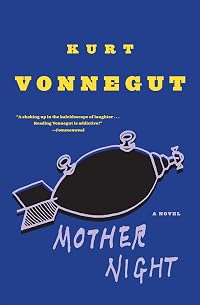
The appeal of Kurt Vonnegut, especially to bright younger readers of the past few decades, may be attributed partly to the fact that he is one of the few writers who have successfully straddled the imaginary line between science-fiction/fantasy and "real literature." He was born in Indianapolis and attended Cornell University, but his college show more education was interrupted by World War II. Captured during the Battle of the Bulge and imprisoned in Dresden, he received a Purple Heart for what he calls a "ludicrously negligible wound." After the war he returned to Cornell and then earned his M.A. at the University of Chicago.He worked as a police reporter and in public relations before placing several short stories in the popular magazines and beginning his career as a novelist. His first novel, Player Piano (1952), is a highly credible account of a future mechanistic society in which people count for little and machines for much. The Sirens of Titan (1959), is the story of a playboy whisked off to Mars and outer space in order to learn some humbling lessons about Earth's modest function in the total scheme of things. Mother Night (1962) satirizes the Nazi mentality in its narrative about an American writer who broadcasts propaganda in Germany during the war as an Allied agent. Cat's Cradle (1963) makes use of some of Vonnegut's experiences in General Electric laboratories in its story about the discovery of a special kind of ice that destroys the world. God Bless You, Mr. Rosewater (1965) satirizes a benevolent foundation set up to foster the salvation of the world through love, an endeavor with, of course, disastrous results. Slaughterhouse-Five; or The Children's Crusade (1969) is the book that marked a turning point in Vonnegut's career. Based on his experiences in Dresden, it is the story of another Vonnegut surrogate named Billy Pilgrim who travels back and forth in time and becomes a kind of modern-day Everyman. The novel was something of a cult book during the Vietnam era for its antiwar sentiments. Breakfast of Champions (1973), the story of a Pontiac dealer who goes crazy after reading a science fiction novel by "Kilgore Trout," received generally unfavorable reviews but was a commercial success. Slapstick (1976), dedicated to the memory of Laurel and Hardy, is the somewhat wacky memoir of a 100-year-old ex-president who thinks he can solve society's problems by giving everyone a new middle name. In addition to his fiction, Vonnegut has published nonfiction on social problems and other topics, some of which is collected in Wampeters, Foma and Granfalloons (1974). He died from head injuries sustained in a fall on April 11, 2007. (Bowker Author Biography) show less
Some Editions
Awards and Honors
Awards
Notable Lists
Series
Belongs to Publisher Series
Work Relationships
Is contained in
The Sirens of Titan • Mother Night • Cat's Cradle • God Bless You, Mr. Rosewater • Slaughterhouse-Five by Kurt Vonnegut
Slaughterhouse-Five • The Sirens of Titan • Player Piano • Cat's Cradle • Breakfast of Champions • Mother Night by Kurt Vonnegut
Cat's Cradle • The Sirens of Titan • God Bless You, Mr. Rosewater • Welcome to the Monkey House • Slaughterhouse Five by Kurt Vonnegut
Has as a student's study guide
Common Knowledge
- Canonical title*
- Les sirènes de Titan
- Original title
- The Sirens of Titan
- Original publication date
- 1959-10
- People/Characters
- Malachi Constant; Winston Niles Rumfoord; Beatrice Rumfoord; Chrono; Stony Stevenson; Salo (show all 10); George M. Helmholtz; Roberta Wiley; Boaz; Ransom K. Fern
- Important places
- Betelgeuse; California, USA; Hollywood, Los Angeles, California, USA; Indiana, USA; Indianapolis, Indiana, USA; Los Angeles, California, USA (show all 15); Mars; Mercury; Newport, Rhode Island, USA; Rhode Island, USA; Saturn; Titan; Tralfamadore; USA; Marion County, Indiana, USA
- Epigraph
- "Every passing hour brings the Solar System forty-three thousand miles closer to Globular Cluster M13 in Hercules—and still there are some misfits who insist that there is no such thing as progress."
—Ransom K. Fern - Dedication
- For Alex Vonnegut, special agent, with love
- First words
- Everyone now knows how to find the meaning of life within himself.
But mankind wasn’t always so lucky. Less than a century ago men and women did not have easy access to the puzzle boxes within them.
They cou... (show all)ld not name even one of the fifty-three portals to the soul. - Last words
- (Click to show. Warning: May contain spoilers.)"Don't ask me why, old sport," said Stony, "but somebody up there likes you."
- Blurbers
- Aldiss, Brian W.
- Original language
- English US
*Some information comes from Common Knowledge in other languages. Click "Edit" for more information.
Classifications
Statistics
- Members
- 11,674
- Popularity
- 764
- Reviews
- 151
- Rating
- (4.00)
- Languages
- 23 — Czech, Danish, Dutch, English, Estonian, Finnish, French, German, Hebrew, Hungarian, Italian, Japanese, Lithuanian, Norwegian (Bokmål), Norwegian, Polish, Romanian, Russian, Slovenian, Spanish, Swedish, Turkish, Portuguese (Brazil)
- Media
- Paper, Audiobook, Ebook
- ISBNs
- 87
- UPCs
- 1
- ASINs
- 85