On This Page
Description
"Bear proves herself to be one of the most talented writers currently working in the field.". "Extraordinary ... exactly the kind of brilliantly detailed, tightly plotted, roller-coaster book she has led her readers to expect, replete with a fantastic cast of characters.". HTML:On a broken ship orbiting a doomed sun, dwellers have grown complacent with their aging metal world. But when a serving girl frees a captive noblewoman, the old order is about to change....
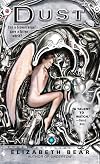
Ariane, Princess of the show more House of Rule, was known to be fiercely cold-blooded. But severing an angel's wings on the battlefield--even after she had surrendered--proved her completely without honor. Captive, the angel Perceval waits for Ariane not only to finish her off--but to devour her very memories and mind. Surely her gruesome death will cause war between the houses--exactly as Ariane desires. But Ariane's plan may yet be opposed, for Perceval at once recognizes the young servant charged with her care.
Rien is the lost child: her sister. Soon they will escape, hoping to stop the impending war and save both their houses. But it is a perilous journey through the crumbling hulk of a dying ship, and they do not pass unnoticed. Because at the hub of their turning world waits Jacob Dust, all that remains of God, following the vapor wisp of the angel. And he knows they will meet very soon.
From the Paperback edition.
. show less
Tags
Recommendations







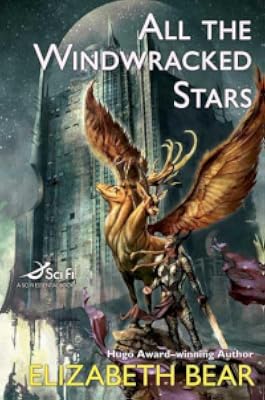





Member Recommendations
Member Reviews
This is an original and engrossing version of a 'generation' colony ship gone wrong. I liked that Elizabeth Bear didn't slow down and didn't infodump. She presented me with two strong but vulnerable characters under threat, added a constant stream of action that kept me turning the pages and gave me all the threads I needed to weave my own understanding of this strange world.
The story is enabled by technology so advanced that it sometimes feels like magic but it isn't, it's just broken machine intelligence that has healed twisted, combined with a nanotech-engineered human evolution, tainted by the religious aspirations of the founders of the colony ship and soured by unintended generations spent aboard a stranded ship. It seemed to me show more that the thinking behind the evolution of the machine intelligence and the nanotech-infested humans was original and rigorous.
The storytelling style contrasts with the hardcore Science Fiction contents. The story is told through the eyes of two young women, estranged sisters brought together when one of them is maimed by the leader of the household in which the other has been raised as a hostage and it is as much a story about the love and loyalty that grows between them as it is about a ship in space. The story is structured as a quest. The two sisters travel through the ship, encountering enemies and allies (although it's hard to know who is which) and working towards a journeying towards a common goal. The result is that, while 'Dust' is a generation colony ship story that I'd normally think of as space opera, the experience of reading the book is much more like reading a sword and sorcery fantasy.
For me, this unusual tension between style and content worked well. It felt fresh and it kept me thinking about what was going on.
For most of the book, I was eagerly turning the pages to see what would happen next but the final few chapters didn't feel as intense to me. The ending was a mix of challenging concepts, intense action and emotionally charged decisions. It worked but I had to work at it.
Even so, I'm looking forward to reading 'Chill' the next book in the series show less
The story is enabled by technology so advanced that it sometimes feels like magic but it isn't, it's just broken machine intelligence that has healed twisted, combined with a nanotech-engineered human evolution, tainted by the religious aspirations of the founders of the colony ship and soured by unintended generations spent aboard a stranded ship. It seemed to me show more that the thinking behind the evolution of the machine intelligence and the nanotech-infested humans was original and rigorous.
The storytelling style contrasts with the hardcore Science Fiction contents. The story is told through the eyes of two young women, estranged sisters brought together when one of them is maimed by the leader of the household in which the other has been raised as a hostage and it is as much a story about the love and loyalty that grows between them as it is about a ship in space. The story is structured as a quest. The two sisters travel through the ship, encountering enemies and allies (although it's hard to know who is which) and working towards a journeying towards a common goal. The result is that, while 'Dust' is a generation colony ship story that I'd normally think of as space opera, the experience of reading the book is much more like reading a sword and sorcery fantasy.
For me, this unusual tension between style and content worked well. It felt fresh and it kept me thinking about what was going on.
For most of the book, I was eagerly turning the pages to see what would happen next but the final few chapters didn't feel as intense to me. The ending was a mix of challenging concepts, intense action and emotionally charged decisions. It worked but I had to work at it.
Even so, I'm looking forward to reading 'Chill' the next book in the series show less
I keep hearing Elizabeth Bear in all my regular haunts, I knew she had a lot of writing with nanotech, heavy-sf, and mythology, all of which I'm particularly fond. So why haven't I picked up her works before now?
I'm an idiot. I can't think of a more accurate reason.
So here I am, reading Dust and seeing a serving girl rescue a princess who just got her wings torn off and the lady of the household is preparing for war. All good and fine for a fantasy novel, only they're preparing for war within a generational spaceship that broke down, it's all-encompassing AI gone schizo, and everyone wants to put humpty-dumpty back together again by eating each other's minds until "The One" can become the Captain.
Okay! I was wondering where this was show more going. Now I know, and I really like it! But wait, the schizo AI is really fragmented and spun out conflicting personas that are called Angels and like to stab each other in the backs. And they're also godlike. And they like to mess around in the destinies of mere bio-and-nano enhanced humans living in this experimental breeding ground. Who's good? Who's bad?
Our serving girl gets an upgrade, and our rescued princess tells her that she's her half-sister. (What? Oh wait, that makes sense after you see how inbred everyone is on a generational spaceship.) Politics plays a big role throughout the novel, but only in the sense of gods playing with mere mortals, fathers using their children as bargaining chips, and the sense that we've all just been sent into a final battle royale.) The sibling's love can get rather complicated, but their regard never wavers, even when the two get pitted on either side of a tug of war between gods. Good conflict there, I suppose, but it didn't quite have the outcome the setup might have warranted.
Am I dissatisfied with the outcome? I'm not sure. Something nags at me about the entire direction of the novel, and it's more of a forest question, not the trees. The trees were just fine. I like the ending. I just wonder if we could have had more directed conflict in the middle or even a few more reversals. The confusion of the main characters was fine, I just wonder if there should have been a bit more tugging from the non-godlike characters.
That being said, I'm excited to read the other two books in the trilogy.
Spoiler alert!
Computronium is people. COMPUTRONIUM IS PEOPLE! I like the development where we've all been turned into breeding farms for smart swarms of nanos in order to retroactively fix the starship. There's a hell of a lot of fun in here once you get beyond the angel's machinations. It's a much smarter fix for the Duracell argument.
Do I recommend? Hell yes if you want a good dose of symbolism and nanos, a-la Zelazny's Lord of Light, but not as powerful. show less
I'm an idiot. I can't think of a more accurate reason.
So here I am, reading Dust and seeing a serving girl rescue a princess who just got her wings torn off and the lady of the household is preparing for war. All good and fine for a fantasy novel, only they're preparing for war within a generational spaceship that broke down, it's all-encompassing AI gone schizo, and everyone wants to put humpty-dumpty back together again by eating each other's minds until "The One" can become the Captain.
Okay! I was wondering where this was show more going. Now I know, and I really like it! But wait, the schizo AI is really fragmented and spun out conflicting personas that are called Angels and like to stab each other in the backs. And they're also godlike. And they like to mess around in the destinies of mere bio-and-nano enhanced humans living in this experimental breeding ground. Who's good? Who's bad?
Our serving girl gets an upgrade, and our rescued princess tells her that she's her half-sister. (What? Oh wait, that makes sense after you see how inbred everyone is on a generational spaceship.) Politics plays a big role throughout the novel, but only in the sense of gods playing with mere mortals, fathers using their children as bargaining chips, and the sense that we've all just been sent into a final battle royale.) The sibling's love can get rather complicated, but their regard never wavers, even when the two get pitted on either side of a tug of war between gods. Good conflict there, I suppose, but it didn't quite have the outcome the setup might have warranted.
Am I dissatisfied with the outcome? I'm not sure. Something nags at me about the entire direction of the novel, and it's more of a forest question, not the trees. The trees were just fine. I like the ending. I just wonder if we could have had more directed conflict in the middle or even a few more reversals. The confusion of the main characters was fine, I just wonder if there should have been a bit more tugging from the non-godlike characters.
That being said, I'm excited to read the other two books in the trilogy.
Spoiler alert!
Computronium is people. COMPUTRONIUM IS PEOPLE! I like the development where we've all been turned into breeding farms for smart swarms of nanos in order to retroactively fix the starship. There's a hell of a lot of fun in here once you get beyond the angel's machinations. It's a much smarter fix for the Duracell argument.
Do I recommend? Hell yes if you want a good dose of symbolism and nanos, a-la Zelazny's Lord of Light, but not as powerful. show less
A successful and diverting entry in the 'science so advanced it seems like magic' sci-fi genre: angels, basilisks, biotech symbionts and nanotech shackles. Good times! The style wore on me as the book progressed, but a fun read. The author apparently pitched it as:
"Amber:Gormenghast::Upstairs:Downstairs, in SPAAAAAAAAAACE!"
"Amber:Gormenghast::Upstairs:Downstairs, in SPAAAAAAAAAACE!"
Not since I committed the slight error of letting the Wizard-Knight series be my first Gene Wolfe reads have I been so baffled and yet intrigued by a book as I was as I started Elizabeth Bear's Dust, the first book in her "Jacob's Ladder" series.
Superficially, the two works have a fair bit in common: mysterious, half-mythological worlds strange technology that looks like magic/magic that looks like technology, strong theological overtones*, opaque and ambivalent secondary characters, puzzling and multilayered sub-worlds. Ultimately, though Dust is better regarded as a more accessible version of some other Gene Wolfe work, his Long Sun series, which takes place aboard a generational spaceship inside a comet, governed by "gods" that are show more software copies of the consciousnesses of various rulers from the homeworld's deep and almost forgotten past. But where the Whorl is one complete world through which characters can travel just like they might have on Urth, Jacob's Ladder, the dying generational ship through which our two protagonists move trying to prevent a catastrophic war, is compartmentalized to the point of atomization, with each sub-world either denying the existence of others or hostile to them. Pseudo-feudalism prevails, with the most important class distinction between those whose bodies have been altered and lives extended via colonies of nanomachinery and those who have not.
As our story starts, an "Exalt" woman (i.e. a person benefiting from nanomachines) from the "Engine" world, named Sir Perceval (don't ask), has been captured in some kind of skirmish and awaits the pleasure of the petty tyrant of another sub-world, the Rule. By a Dickensian coincidence, the Mean (no nanites) assigned to keep Perceval alive turns out to be Perceval's long-lost sister**, Rien, who brings news that the petty tyrant has designs on taking over the whole of Jacob's Ladder and ruling it the way her distant ancestor, the Captain did long ago when the ship actually moved around. Naturally this ambition is inimical not only to the ways of life of every other population on the ship, but to the ship itself, which is just barely held together through the efforts of weird and mutually hostile fragments of the machine consciousness that once ran and directed the ship on its journey of exploration and colonization before disaster struck centuries ago.
Part of the story is told from the perspective of one of these god-fragments, Jacob Dust, who watches events unfold from deep inside the substance of the ship and who is only able indirectly to influence them, through a set of nanomechanical wings he has managed to graft onto Perceval's back to replace those cut off when she was captured. His motives are unclear; his interactions with other fragments intriguing but weirdly directionless, his love for Perceval and Rien infectious. The mystery of what he/it was really up to is what really propelled me through this novel.
And I needed some propelling, because once the setting and situation became clear, so did the fact that pretty much every person or entity on board Jacob's Ladder is pretty repellent, with the possible exception of Rien and Perceval, but sometimes even they are hard to take. And not in that fun, love to hate 'em way. These beings are nasty pieces of work, and descended from even nastier pieces of work, and seem kind of naturally inclined to take decisions that are, well, repellent -- even with the excuse that the deeds they contemplate are necessary for their survival.
Dust has two sequels so far, Chill and Grail, but I don't see myself hurrying to read them anytime soon. Their blurbs indicate to me that the alienating qualities that made me sort of drag my feet in reading Dust are still very much a part of the greater narrative, and I have too many books on the infinite to-be-read pile as it is, you know?
But still -- interesting.
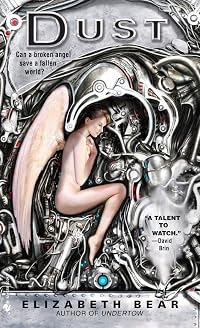
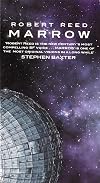
*Though I strongly object to the cover blurb "Can a broken angel save a fallen world?" Even combined with the pleasingly H. R. Gigeresque cover art, that's a pretty misleading bit of copy, and one that put me off the book for quite a while; this is not a religious allegory or bible story in genre fiction trappings, after all.
**Everybody who is anybody turns out to be related to everybody else in this novel. It thus teems with weird bits of dialogue like "Chief Engineer, I need to talk to your about our brother, and our daughter." Um. show less
Superficially, the two works have a fair bit in common: mysterious, half-mythological worlds strange technology that looks like magic/magic that looks like technology, strong theological overtones*, opaque and ambivalent secondary characters, puzzling and multilayered sub-worlds. Ultimately, though Dust is better regarded as a more accessible version of some other Gene Wolfe work, his Long Sun series, which takes place aboard a generational spaceship inside a comet, governed by "gods" that are show more software copies of the consciousnesses of various rulers from the homeworld's deep and almost forgotten past. But where the Whorl is one complete world through which characters can travel just like they might have on Urth, Jacob's Ladder, the dying generational ship through which our two protagonists move trying to prevent a catastrophic war, is compartmentalized to the point of atomization, with each sub-world either denying the existence of others or hostile to them. Pseudo-feudalism prevails, with the most important class distinction between those whose bodies have been altered and lives extended via colonies of nanomachinery and those who have not.
As our story starts, an "Exalt" woman (i.e. a person benefiting from nanomachines) from the "Engine" world, named Sir Perceval (don't ask), has been captured in some kind of skirmish and awaits the pleasure of the petty tyrant of another sub-world, the Rule. By a Dickensian coincidence, the Mean (no nanites) assigned to keep Perceval alive turns out to be Perceval's long-lost sister**, Rien, who brings news that the petty tyrant has designs on taking over the whole of Jacob's Ladder and ruling it the way her distant ancestor, the Captain did long ago when the ship actually moved around. Naturally this ambition is inimical not only to the ways of life of every other population on the ship, but to the ship itself, which is just barely held together through the efforts of weird and mutually hostile fragments of the machine consciousness that once ran and directed the ship on its journey of exploration and colonization before disaster struck centuries ago.
Part of the story is told from the perspective of one of these god-fragments, Jacob Dust, who watches events unfold from deep inside the substance of the ship and who is only able indirectly to influence them, through a set of nanomechanical wings he has managed to graft onto Perceval's back to replace those cut off when she was captured. His motives are unclear; his interactions with other fragments intriguing but weirdly directionless, his love for Perceval and Rien infectious. The mystery of what he/it was really up to is what really propelled me through this novel.
And I needed some propelling, because once the setting and situation became clear, so did the fact that pretty much every person or entity on board Jacob's Ladder is pretty repellent, with the possible exception of Rien and Perceval, but sometimes even they are hard to take. And not in that fun, love to hate 'em way. These beings are nasty pieces of work, and descended from even nastier pieces of work, and seem kind of naturally inclined to take decisions that are, well, repellent -- even with the excuse that the deeds they contemplate are necessary for their survival.
Dust has two sequels so far, Chill and Grail, but I don't see myself hurrying to read them anytime soon. Their blurbs indicate to me that the alienating qualities that made me sort of drag my feet in reading Dust are still very much a part of the greater narrative, and I have too many books on the infinite to-be-read pile as it is, you know?
But still -- interesting.
*Though I strongly object to the cover blurb "Can a broken angel save a fallen world?" Even combined with the pleasingly H. R. Gigeresque cover art, that's a pretty misleading bit of copy, and one that put me off the book for quite a while; this is not a religious allegory or bible story in genre fiction trappings, after all.
**Everybody who is anybody turns out to be related to everybody else in this novel. It thus teems with weird bits of dialogue like "Chief Engineer, I need to talk to your about our brother, and our daughter." Um. show less
Bear gives us an excellent demonstration of Clarke's Third Law, set in a derelict generation ship where the ancestors of the current inhabitants bequeathed their descendants a set of medieval social structures enforced by the artificial intelligences that run the ship. The characters have a seamlessly integrated viewpoint mixing fantastic metaphor and hard science.
The tale itself concerns intrigue among the aristocratic families that rule the ship's populace and the artificial intelligences that control its mechanisms. The struggle for control of the vessel has a very literal deadline: the binary star system in which the vessel is marooned is very close to becoming a Type Ia supernova. An engaging read; I'm looking forward to the show more sequel, Chill. show less
The tale itself concerns intrigue among the aristocratic families that rule the ship's populace and the artificial intelligences that control its mechanisms. The struggle for control of the vessel has a very literal deadline: the binary star system in which the vessel is marooned is very close to becoming a Type Ia supernova. An engaging read; I'm looking forward to the show more sequel, Chill. show less
Bear, Elizabeth. Dust. Jacob’s ladder No. 1. Spectra, 2008.
It is at first not obvious that Elizabeth Bear’s Dust is a generation starship story. It is crammed with the ambiance and iconography of epic fantasy. There are angels with names that would be at home in Milton, Homer, or Mallory. Warriors wield weapons called “unblades” and there are many strange and powerful creatures that are obstacles to the quests characters must pursue. The social structure seems medieval. At one point a character says that primogeniture is a dumb way to crew a starship. But in the end, Dust is a hard-ish science fiction story with genetic engineering and nanotechnology, artificial intelligence, and consciousness upload—and all the tropes and show more iconography of far-future scifi. That Bear gets this mélange to work is a testament to her skill as a writer. show less
It is at first not obvious that Elizabeth Bear’s Dust is a generation starship story. It is crammed with the ambiance and iconography of epic fantasy. There are angels with names that would be at home in Milton, Homer, or Mallory. Warriors wield weapons called “unblades” and there are many strange and powerful creatures that are obstacles to the quests characters must pursue. The social structure seems medieval. At one point a character says that primogeniture is a dumb way to crew a starship. But in the end, Dust is a hard-ish science fiction story with genetic engineering and nanotechnology, artificial intelligence, and consciousness upload—and all the tropes and show more iconography of far-future scifi. That Bear gets this mélange to work is a testament to her skill as a writer. show less
Holy shit, my heart. This story was so complex and vibrant, utterly unique from anything I can remember reading. Don't read it when you're tired; you'll need your wits about you to keep up. Definitely recommend, though!
Also, one of the main characters is ace. Score!
Also, one of the main characters is ace. Score!
Members
- Recently Added By
Lists

Best Science Fiction Novels
816 works; 430 members

Sword & Planet / Futuristic Fantasy
16 works; 4 members

Generation Ship
28 works; 7 members

speculative fiction to read
4 works; 1 member

Unbound Worlds 100 Best SF Books
100 works; 8 members

LGBTQ+ Speculative Fiction
821 works; 51 members

sandstone78's AI Reading List
34 works; 4 members
Favorite Science Fiction
457 works; 223 members
Author Information

176+ Works 16,502 Members

Elizabeth Bear is a LibraryThing Author, an author who lists their personal library on LibraryThing.
Some Editions
Awards and Honors
Awards
Series

Common Knowledge
- Original title
- Dust
- Alternate titles
- Pinion
- Original publication date
- 2008
- People/Characters
- Perceval; Ariane; Rien; Dust; Gavin
- Important places
- Jacob's Ladder
- Dedication
- This book is for Jaime, Leah, Steve, and Roger. And you.
- First words
- At the corner of the window, a waxen spider spun.
- Last words
- (Click to show. Warning: May contain spoilers.)The angel smiled his snaggled smile. "We are under way."
- Disambiguation notice
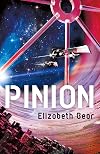
- Original title Dust; reissued title Pinion
Classifications
Statistics
- Members
- 775
- Popularity
- 36,289
- Reviews
- 42
- Rating
- (3.65)
- Languages
- English
- Media
- Paper, Audiobook, Ebook
- ISBNs
- 9
- ASINs
- 5