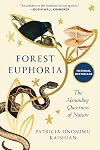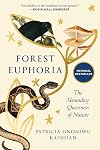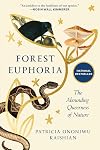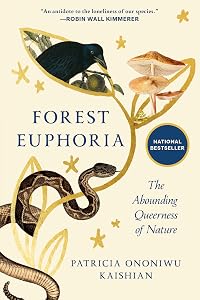
Forest Euphoria: The Abounding Queerness of Nature
by Patricia Ononiwu Kaishian
On This Page
Description
A thrilling book about the abounding queerness of the natural world that challenges our expectations of what is normal, beautiful, and possible. Growing up, Patricia Kaishian felt most at home in the swamps and culverts near her house in the Hudson Valley. A child who frequently felt out of place, too much of one thing or not enough of another, she found acceptance in these settings, among other amphibious beings. In snakes, snails, and, above all, fungi, she saw her own developing show more identities as a queer, neurodivergent person reflected back at her-and in them, too, she found a personal path to a life of science. In Forest Euphoria, Kaishian shows us this making of a scientist and introduces readers to the queerness, literal and otherwise, of all the life around us. Fungi, we learn, commonly have more than two biological sexes-and some as many as twenty-three thousand. Some intersex slugs mutually fire calcium carbonate "love darts" at each other during courtship. Glass eels are sexually undetermined until their last year of life, which stumped scientists once dubbed "the eel question." Nature, Kaishian shows us, is filled with the unusual, the overlooked, and the marginalized-and they have lessons for us all. Wide-ranging, richly observant, and full of surprise, Forest Euphoria will open your eyes and change how you look at the world around you. "An antidote to the loneliness of our species."-ROBIN WALL KIMMERER "A master class in how to love the world."-MARGARET RENKL. show lessTags
Recommendations







Member Reviews
I loved reading about all of the often overlooked queer beings in the natural world. The Snails, the Bowerbirds, the Mushrooms all intertwined with the authors own experiences as a queer, Armenian-Irish-American human. Very reminiscent of some of my favorite nature writers like Robin Wall Kimmerer (who was possibly one of the author's professors?), Lyanda Lynn Haupt, and Margaret Renkl. I knew nothing about Mushrooms (and still don't know much), but I would definitely read more about mycology from Patricia Ononiwu Kaishian.
I would love to read similar works from desert dwellers, but it seems the lush landscapes are what the algorithm keeps putting in front me. The woods of the Northeast and the Pacific Northwest have featured heavily in show more my reading lately, not just nonfiction, but also in books like The God of the Woods, North Woods, and So Far Gone. Time to hunt down more desert books to remind me that it is not dry and barren but filled with adaptable, hardy beings that can thrive in highly variable conditions. show less
I would love to read similar works from desert dwellers, but it seems the lush landscapes are what the algorithm keeps putting in front me. The woods of the Northeast and the Pacific Northwest have featured heavily in show more my reading lately, not just nonfiction, but also in books like The God of the Woods, North Woods, and So Far Gone. Time to hunt down more desert books to remind me that it is not dry and barren but filled with adaptable, hardy beings that can thrive in highly variable conditions. show less
Real Rating: 4.75* of five
The Publisher Says: A thrilling book about the abounding queerness of the natural world that challenges our expectations of what is normal, beautiful, and possible.
Growing up, Patricia Ononiwu Kaishian felt most at home in the swamps and culverts near her house in the Hudson Valley. A child who frequently felt out of place, too much of one thing or not enough of another, she found acceptance in these settings, among other amphibious beings. In snakes, snails, and, above all, fungi, she saw her own developing identities as a queer, neurodivergent person reflected back at her—and in them, too, she found a personal path to a life of science.
In Forest Euphoria, Kaishian shows us this making of a scientist and show more introduces readers to the queerness of all the life around us. Fungal species, we learn, commonly encompass more than two biological sexes—and some as many as twenty-three thousand. Some intersex slugs mutually fire calcium carbonate “love darts” at each other during courtship. Glass eels are sexually undetermined until their last year of life, a mystery that scientists once dubbed “the eel question.” Nature, Kaishian shows us, is filled with the unusual, the overlooked, and the marginalized—and they have lessons for us all.
Wide-ranging, richly observant, and full of surprises, Forest Euphoria will open your eyes and change how you look at the world.
I RECEIVED A DRC FROM THE PUBLISHER VIA EDELWEISS+. THANK YOU.
My Review: Honestly, our very much elder siblings the fungi, part of a family we do not share but the most distant connection with, have more to teach us about Life than I expected. Author Kaishian is a very well qualified guide into their world, having several degrees in mycological subjects and being the New York State museum's curator of mycology. An unimpeachable fount of expert knowledge, then.
I've never really thought about the gender realities of fungi before now. I knew they were ubiquitous...the wood-wide web...and enormous (that several-square-mile honey fungus in Oregon), for two memorable examples...but how they got it on was hazy, limited to fruiting bodies producing spores in my infobase. I am of greatly expanded consciousness now.
Fungus is just the beginning of queerness, of "gender non-conformity" that culture-specific ungeneralizable concept, in Nature. The examples are weird...eels? what the hell my dudes?...slugs *shudder* doing unspeakable things to each other after sex...and the list isn't even fairly begun. Vertebrates, our fellow spine-havers, get themselves up to some wild shenanigans, like the fish harems where the physically largest female becomes male when the old one dies. How do they know? Who first thought this was a good idea?
But, overall, the thing I loved about this read was not the fount of factfulness but the fountain of meditative, calm reflection that Author Patty (she refers to herself as such on her website so I'm presuming to do so too) uses to soothe away the hurts being queer in a hostile world has wrought. Her Irish-Armenian heritages, her neurodivergent presentation of self, her life experiences, all give her the invaluable, painful gift of Otherhood. It is a thing I've been grateful for in my older years of life. It takes Otherhood to see the absurdity of the prejudices most people use in place of learning, thinking, meditating. Author Patty gets this on such a core level that as she lets us in on her uncoverings it feels organic (!) instead of calculated as is so often the case. Even her coinage of "eco-spirituality" to describe this manner of being in the world feels uncondescending. It could easily have read brummagem and insulting. Instead it's all of a piece with her shared factual information as viewed through her lens of personal reflection. Like this:
I think the last word has been had. I'm just that hair away from five stars because I still find slugs utterly repugnant and with a gardener's eye of loathing. show less
The Publisher Says: A thrilling book about the abounding queerness of the natural world that challenges our expectations of what is normal, beautiful, and possible.
Growing up, Patricia Ononiwu Kaishian felt most at home in the swamps and culverts near her house in the Hudson Valley. A child who frequently felt out of place, too much of one thing or not enough of another, she found acceptance in these settings, among other amphibious beings. In snakes, snails, and, above all, fungi, she saw her own developing identities as a queer, neurodivergent person reflected back at her—and in them, too, she found a personal path to a life of science.
In Forest Euphoria, Kaishian shows us this making of a scientist and show more introduces readers to the queerness of all the life around us. Fungal species, we learn, commonly encompass more than two biological sexes—and some as many as twenty-three thousand. Some intersex slugs mutually fire calcium carbonate “love darts” at each other during courtship. Glass eels are sexually undetermined until their last year of life, a mystery that scientists once dubbed “the eel question.” Nature, Kaishian shows us, is filled with the unusual, the overlooked, and the marginalized—and they have lessons for us all.
Wide-ranging, richly observant, and full of surprises, Forest Euphoria will open your eyes and change how you look at the world.
I RECEIVED A DRC FROM THE PUBLISHER VIA EDELWEISS+. THANK YOU.
My Review: Honestly, our very much elder siblings the fungi, part of a family we do not share but the most distant connection with, have more to teach us about Life than I expected. Author Kaishian is a very well qualified guide into their world, having several degrees in mycological subjects and being the New York State museum's curator of mycology. An unimpeachable fount of expert knowledge, then.
I've never really thought about the gender realities of fungi before now. I knew they were ubiquitous...the wood-wide web...and enormous (that several-square-mile honey fungus in Oregon), for two memorable examples...but how they got it on was hazy, limited to fruiting bodies producing spores in my infobase. I am of greatly expanded consciousness now.
Fungus is just the beginning of queerness, of "gender non-conformity" that culture-specific ungeneralizable concept, in Nature. The examples are weird...eels? what the hell my dudes?...slugs *shudder* doing unspeakable things to each other after sex...and the list isn't even fairly begun. Vertebrates, our fellow spine-havers, get themselves up to some wild shenanigans, like the fish harems where the physically largest female becomes male when the old one dies. How do they know? Who first thought this was a good idea?
But, overall, the thing I loved about this read was not the fount of factfulness but the fountain of meditative, calm reflection that Author Patty (she refers to herself as such on her website so I'm presuming to do so too) uses to soothe away the hurts being queer in a hostile world has wrought. Her Irish-Armenian heritages, her neurodivergent presentation of self, her life experiences, all give her the invaluable, painful gift of Otherhood. It is a thing I've been grateful for in my older years of life. It takes Otherhood to see the absurdity of the prejudices most people use in place of learning, thinking, meditating. Author Patty gets this on such a core level that as she lets us in on her uncoverings it feels organic (!) instead of calculated as is so often the case. Even her coinage of "eco-spirituality" to describe this manner of being in the world feels uncondescending. It could easily have read brummagem and insulting. Instead it's all of a piece with her shared factual information as viewed through her lens of personal reflection. Like this:
I like blurring the line between human and nature because I believe we, as a species, have become profoundly lonely in our self-enforced isolation. And it’s because of this that the planet is spinning through a devastating loss in biodiversity. The species that have brought me the most companionship, assurance, and inspiration are those furthest banished from human society, those least associated with the “desirable” traits of being human—upright and logical, two-legged and binary-sexed. My personal connections to these organisms have brought me a sense of queer belonging and comfort in the heaviest of times. In exchange, I hope to do my small part by sharing their stories. And I hope that in sharing these stories, you too will feel the closeness of the earth, the lack of space between our cells, and the memory of each other.
I think the last word has been had. I'm just that hair away from five stars because I still find slugs utterly repugnant and with a gardener's eye of loathing. show less
Forest Euphoria is an utterly original exploration of the relations and connections between humans and the physical world around us. The author approaches nature aware that she is perceived as different both because of her queerness and her neurodiversity. She asks question many of us would never think to ask and finds her own ways of "fitting in."
I'm not a scientist, but to extent I am "science-y" I'm pretty committed to the "scientific method," which is good at weeding out the unlikely or impossible, but is not necessarily good at learning to see in new ways. Patricia Ononiwu Kaishian offers ways to see the world around me in a way that moves beyond "just the facts" and broadens my intellectual and imaginative vision.
I'm not a scientist, but to extent I am "science-y" I'm pretty committed to the "scientific method," which is good at weeding out the unlikely or impossible, but is not necessarily good at learning to see in new ways. Patricia Ononiwu Kaishian offers ways to see the world around me in a way that moves beyond "just the facts" and broadens my intellectual and imaginative vision.
In 2004, I read a news article about a pair of gay penguins named Roy and Silo. I was a sophomore in high school and we were doing research on the struggle for gay marriage. One of the awful arguments against LGBT rights was that it was unnatural and against the order of things, yet here was an article demonstrating that nature wasn't black and white. It left a big impression on me.
I picked up Forest Euphoria hoping - expecting - that this was a book full of those types of stories. Unfortunately, it's very much not.
What the book turns out to be is a memoir about the author's somewhat uninteresting life. To put it even more bluntly, nature and science often take a backseat and are primarily used to provide context or metaphor related to show more a story from the author's past.
Here's an example. Early on there's a chapter about snails and slugs, and we learn a bit about their unusual characteristics and sexual behaviors. What follows is a lighthearted anecdote about the author bringing slugs to school for show-and-tell, only to then abruptly shift to an account of her being sexually assaulted. It was quite the shock.
That's an important, traumatizing moment in her life, but it's not at all what I expected in a book like this. I wanted to read about nature being gay and strange, not a very personal story from a stranger.
The whole book is like this. An extended section about bowerbirds leads to a trite metaphor about dating after a bad breakup and meeting her husband. A chapter on eels dovetails into thoughts about generational trauma from the Armenian genocide. There's a whole sub-chapter on how she liked the color purple as a kid. It's pretty ridiculous.
The phrase I kept coming back to was "vanity project". It's abundantly clear the author is very happy with her life, and it seems she wants us to be equally interested in it too. It's braggadocios and immensely self-centered, not things I expect from a book supposedly about the queerness of nature.
Speaking of queerness, I want to briefly touch on how that's depicted. The word "queer" shows up 137 times throughout the book, which is about once every 1-2 pages. The cause of this high count is because just about everything is labeled as queer: psychedelic mushrooms are queer, Armenia is queer, crows are queer, the Voyager expeditions were queer, subjective time is queer, spring ephemerals are queer, the color purple is queer, and so forth.
I think the author believes that anything she likes or resonates with is queer because she herself is queer. I'm just a boring straight guy, so I'm not sure I'm allowed an opinion about that, but that seems like a unusual and off-putting message.
Finally, my greatest irritation throughout this book was the author's frequent habit of prescribing human qualities, emotions, and motivations onto extremely nonhuman entities. She talks about microscopic fungi experiencing friendship with their host beetle, bacteria being lonely, crows empathizing with a breakup, and so on.
I can't overstate how much I hate this, and it's the *exact opposite* of what I was looking for. It's such a small, narrow way of looking at the world, anthropocentrism disguised as interconnection, and it's disheartening to hear it from someone claiming to be an environmental scientist. I've read scifi books with better understanding and respect for the idea of nonhuman lives.
Ultimately, I don't think this should have been a book at all but rather a series of editorials in a magazine or newspaper. I don't recommend this. show less
I picked up Forest Euphoria hoping - expecting - that this was a book full of those types of stories. Unfortunately, it's very much not.
What the book turns out to be is a memoir about the author's somewhat uninteresting life. To put it even more bluntly, nature and science often take a backseat and are primarily used to provide context or metaphor related to show more a story from the author's past.
Here's an example. Early on there's a chapter about snails and slugs, and we learn a bit about their unusual characteristics and sexual behaviors. What follows is a lighthearted anecdote about the author bringing slugs to school for show-and-tell, only to then abruptly shift to an account of her being sexually assaulted. It was quite the shock.
That's an important, traumatizing moment in her life, but it's not at all what I expected in a book like this. I wanted to read about nature being gay and strange, not a very personal story from a stranger.
The whole book is like this. An extended section about bowerbirds leads to a trite metaphor about dating after a bad breakup and meeting her husband. A chapter on eels dovetails into thoughts about generational trauma from the Armenian genocide. There's a whole sub-chapter on how she liked the color purple as a kid. It's pretty ridiculous.
The phrase I kept coming back to was "vanity project". It's abundantly clear the author is very happy with her life, and it seems she wants us to be equally interested in it too. It's braggadocios and immensely self-centered, not things I expect from a book supposedly about the queerness of nature.
Speaking of queerness, I want to briefly touch on how that's depicted. The word "queer" shows up 137 times throughout the book, which is about once every 1-2 pages. The cause of this high count is because just about everything is labeled as queer: psychedelic mushrooms are queer, Armenia is queer, crows are queer, the Voyager expeditions were queer, subjective time is queer, spring ephemerals are queer, the color purple is queer, and so forth.
I think the author believes that anything she likes or resonates with is queer because she herself is queer. I'm just a boring straight guy, so I'm not sure I'm allowed an opinion about that, but that seems like a unusual and off-putting message.
Finally, my greatest irritation throughout this book was the author's frequent habit of prescribing human qualities, emotions, and motivations onto extremely nonhuman entities. She talks about microscopic fungi experiencing friendship with their host beetle, bacteria being lonely, crows empathizing with a breakup, and so on.
I can't overstate how much I hate this, and it's the *exact opposite* of what I was looking for. It's such a small, narrow way of looking at the world, anthropocentrism disguised as interconnection, and it's disheartening to hear it from someone claiming to be an environmental scientist. I've read scifi books with better understanding and respect for the idea of nonhuman lives.
Ultimately, I don't think this should have been a book at all but rather a series of editorials in a magazine or newspaper. I don't recommend this. show less
This volume is a generally enjoyable read, as much a memoir of queer identity, child of displaced grandparents, and trauma survivor as an exploration of biology—and the relationship with the environment is very personal.
Unfortunately, this is not a book I would pick up again b/c I’m not a nature lover. An admirer, but not a lover, it seems. It was very interesting to see animals in a new light, to explore just how queer nature is and how natural that is. The author does have a gentle way of witting and expressing themselves, so even though this was not my cup of tea, it was written quite lovely. If we could all embrace queerness as a natural part of humanity the way nature does, I think we could live in greater harmony together, with a better understanding of one another. I was given this book in exchange for my honest review.
There are a lot of nature books that combine memoir with nature writing. I've read a lot of them, and I'm a fan of nature writing, but generally don't enjoy memoirs. This book has too much memoir, not enough nature, so I gave up after the first two chapters.
Members
- Recently Added By
Lists

Queer Nonfiction (Owned TBR)
25 works; 1 member

The Best LGBTQ Nonfiction
217 works; 70 members
Author Information

2 Works 212 Members
Some Editions
Awards and Honors
Common Knowledge
- Original title
- Forest Euphoria: The Abounding Queerness of Nature
- Original publication date
- 2025
- Epigraph
- Call upon the help of those who love you. These helpers take many forms: animal, element, bird, angel, saint, stone, or ancestor.
-Joy Harjo - Dedication
- To my family -- human and otherwise, blood and otherwise -- I love you.
- First words
- At my childhood home in the foothills of New York's Hudson Highlands, snakes were abundant.
- Last words
- (Click to show. Warning: May contain spoilers.)And by rational, I mean that what they show us, completely and utterly, is that all life is interdependent.
- Publisher's editor
- McGarvey, Joey
- Blurbers
- Kimmerer, Robin Wall; Jahren, Hope; Yong, Ed; Renkl, Margaret; Majumdar, Megha; Imbler, Sabrina (show all 7); Yuknavitch, Lidia
- Original language
- English
Classifications
Statistics
- Members
- 212
- Popularity
- 154,460
- Reviews
- 7
- Rating
- (4.17)
- Languages
- English
- Media
- Paper, Audiobook, Ebook
- ISBNs
- 4
- ASINs
- 2