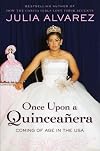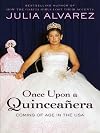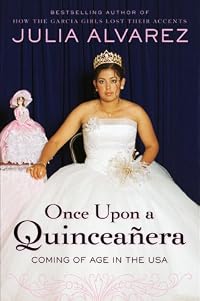
Once Upon a Quinceanera: Coming of Age in the USA
by Julia Alvarez
On This Page
Description
The quinceañera, the fifteenth birthday celebration for a Latina girl, is quickly becoming an American event. This legendary party is a sight to behold: lavish ball gowns, extravagant catered meals, DJs, limousines, and multi-tiered cakes. The must-haves for a "quince" are becoming as numerous and costly as a prom or wedding. And yet, this elaborate ritual also hearkens back to traditions from native countries and communities, offering young Latinas a chance to connect with their heritage. show more Writer Alvarez explores this celebration that brings a Latina girl into womanhood, attending the quince of a young woman in Queens, and weaving in interviews with other quince girls, her own memories of coming of age as an immigrant, and the history of the custom itself. The result is an enlightening, accessible, and entertaining portrait of contemporary Latino culture.--From publisher description. show lessTags
Recommendations
























Member Reviews
Alvarez is deeply conflicted about the quinceañera. In a time where Latina teens have such distressingly high drop-out and pregnancy rates, is the "princess in the patriarchy fantasy" helping or hurting? Should working-class families really be going into debt to throw a fancy ball for their fifteen-year-olds? Does the quinceañera honor community and ethnicity, or is it an US-ian insta-tradition? Is it stimulating Hispanic economy, or is it playing into American consumerism? Is it an expression of hope for the girls' futures, or pessimism about them? Or both?
And given all her feminist-liberal doubts about the quinceañera, why, why does Alvarez get weepy over them? Is it the concrete demonstration of the community's love and hope for show more each of these girls? Or is she, in the end, just another sucker for a sparkly pink princess dress?
Interwoven into her exploration of the role and history of the modern quinceañera, she tells the story of her own prolonged and halting efforts to learn how to be a Latina adult in the U.S., to invent a role herself that is neither Marianisma nor Malinche. Which, of course, leads back to the question: what does it mean, as a Latina girl, to come of age? And if you were going to have a ritual to mark that---or to guide girl on her way---what should that ritual be?
As you might imagine, there are far more questions here than answers---although in her exploration of the questions, there's a lot she shares about culture, community, family, and history. But even if there are more questions than answers, sometimes there's as much value in figuring out what the questions can and should be, than in figuring out their answers. show less
And given all her feminist-liberal doubts about the quinceañera, why, why does Alvarez get weepy over them? Is it the concrete demonstration of the community's love and hope for show more each of these girls? Or is she, in the end, just another sucker for a sparkly pink princess dress?
Interwoven into her exploration of the role and history of the modern quinceañera, she tells the story of her own prolonged and halting efforts to learn how to be a Latina adult in the U.S., to invent a role herself that is neither Marianisma nor Malinche. Which, of course, leads back to the question: what does it mean, as a Latina girl, to come of age? And if you were going to have a ritual to mark that---or to guide girl on her way---what should that ritual be?
As you might imagine, there are far more questions here than answers---although in her exploration of the questions, there's a lot she shares about culture, community, family, and history. But even if there are more questions than answers, sometimes there's as much value in figuring out what the questions can and should be, than in figuring out their answers. show less
This was an interesting journey into the coming of age ceremony for many young Latina women. I only became aware of Quinceaneras within the past 20 years, and wonder if that's a factor of a second generation actually being born here in the US rather than being newly immigrated from elsewhere. Alvarez;s own story and journey through her own coming of age was interesting as well. It makes me want to re-read her fiction and poetry with a different eye, now.
There were passages when I felt something was beautifully expressed, but unfortunately, as I listened to this as an audio book, I couldn't mark them to record here. A definite disadvantage to mixed media, for sure.
There were passages when I felt something was beautifully expressed, but unfortunately, as I listened to this as an audio book, I couldn't mark them to record here. A definite disadvantage to mixed media, for sure.
An interesting look at a tradition I was unfamiliar with. Alvarez seems to remain ambivalent about what, if anything, this coming of age really means or does for the girls and their families. Frankly, I can't say I blame her.
Unfortunately, I just couldn't get into this book. I gave it a go for 100 pages, thought to myself "why not just tough it out for the rest of the way?", but ultimately decided that there were just so many other things on my plate right now that it wasn't worth forcing it. I had recently read Rebecca Mead's One Perfect Day: The Selling of the American Wedding and perhaps this book reminded me too much of that and I'd just had enough of that style of book. The book is a combination of social commentary, description of one particular girl's quince, and Alvarez's personal memoir of growing up as a Dominican immigrant in America and navigating cultural contradictions.
The problem I had was that Alvarez telegraphs her message pretty clearly show more and constantly throughout the book - she's saddened by the fact that Latinos spend so much money on a single day's worth of celebration when the community is burdened with poverty, but she understands that the celebration can be vital to cementing a girl's relationship with her family, community, and identity - and the consistent repetition of this message meant that I didn't really get a sense of how her exploration of quinceaneras changed any of her feelings over time. I felt like she ended up pretty much where she started (confession, I skipped to the end and read her ultimate conclusion about the event's meaning and significance). I did feel like I learned a bit about a celebration that I didn't know anything about prior to reading this book, but ultimately it just wasn't compelling enough for me to stick with it. show less
The problem I had was that Alvarez telegraphs her message pretty clearly show more and constantly throughout the book - she's saddened by the fact that Latinos spend so much money on a single day's worth of celebration when the community is burdened with poverty, but she understands that the celebration can be vital to cementing a girl's relationship with her family, community, and identity - and the consistent repetition of this message meant that I didn't really get a sense of how her exploration of quinceaneras changed any of her feelings over time. I felt like she ended up pretty much where she started (confession, I skipped to the end and read her ultimate conclusion about the event's meaning and significance). I did feel like I learned a bit about a celebration that I didn't know anything about prior to reading this book, but ultimately it just wasn't compelling enough for me to stick with it. show less
Acclaimed Latina author Julia Alvarez examines the tradition of the quinceanera, and what it means to the young women who experience it.
With frequent dips into her personal history, Alvarez looks at the contradictions that make up the quinceanera - a "sweet fifteen" party for Latinas - a ceremony that celebrates Hispanic women, at the same time it reinforces traditional gender roles. An entire industry has sprung up around these ceremonies, and Alvarez picks apart the strange web of commerce and custom surrounding this coming of age party.
Alvarez is an excellent writer, and when she gets going, her descriptions of quinceanera disrupted by hurricanes or photo shoots that take the place of the party and are smooth and illuminating. show more However, a number of things keep this book from being a totally compelling read. One is Alvarez's determination to link the quinceanera experience to her own adolescence, even though Alvarez herself never had a quinceanera, and seems to experience her teenage self in a completely different way than the girls she's focusing on.
Another problem is Alvarez's decision to focus on a single quinceanera, and frequently interrupt the telling to flashback on her own life, visit other quinceanera, interview an expert, or some other diversion. I like a non-linear narrative as much as the next person, but the device doesn't work well here.
Finally, Alvaraez can't seem to make up her mind about the quinceanera -- she flip-flops on it's meaning and place modern society. Alvarez's indecision makes the book feel watered down and wishy washy. show less
With frequent dips into her personal history, Alvarez looks at the contradictions that make up the quinceanera - a "sweet fifteen" party for Latinas - a ceremony that celebrates Hispanic women, at the same time it reinforces traditional gender roles. An entire industry has sprung up around these ceremonies, and Alvarez picks apart the strange web of commerce and custom surrounding this coming of age party.
Alvarez is an excellent writer, and when she gets going, her descriptions of quinceanera disrupted by hurricanes or photo shoots that take the place of the party and are smooth and illuminating. show more However, a number of things keep this book from being a totally compelling read. One is Alvarez's determination to link the quinceanera experience to her own adolescence, even though Alvarez herself never had a quinceanera, and seems to experience her teenage self in a completely different way than the girls she's focusing on.
Another problem is Alvarez's decision to focus on a single quinceanera, and frequently interrupt the telling to flashback on her own life, visit other quinceanera, interview an expert, or some other diversion. I like a non-linear narrative as much as the next person, but the device doesn't work well here.
Finally, Alvaraez can't seem to make up her mind about the quinceanera -- she flip-flops on it's meaning and place modern society. Alvarez's indecision makes the book feel watered down and wishy washy. show less
Notes:
Illuminating commentary about a high stakes tradition in the Latina culture. Factual yet readable, information and history is interwoven with a personalized account of Monica's quince celebration. Important read for anyone who will work with today's youth considering the growing Latino population in the United States.
Illuminating commentary about a high stakes tradition in the Latina culture. Factual yet readable, information and history is interwoven with a personalized account of Monica's quince celebration. Important read for anyone who will work with today's youth considering the growing Latino population in the United States.
Alvarez, writes about the Latino tradition of the quinceanera, an “elaborate, ritualized fiesta” on a girl’s fifteenth birthday. She traveled to various Latino communities in the U.S. and documented all the details of the quince: the mandatory limo, the photographer, the court and their professionally choreographed dances, the cake, and the gown. She researched the history of the ritual, from Mayan ceremonies to Spanish balls. The quinceanera thrives today in the U.S., as a way for girls to keep in touch with their culture.
Members
- Recently Added By
Author Information

34+ Works 18,550 Members
Julia Alvarez was born in New York City on March 27, 1950 and was raised in the Dominican Republic. Before becoming a full-time writer, she traveled across the country with poetry-in-the-schools programs and then taught at the high school level and the college level. In 1991, she earned tenure at Middlebury College and published her first book How show more the Garcia Girls Lost Their Accent, which won the PEN Oakland/Jefferson Miles Award for excellence in 1991. Her other works include In the Time of the Butterflies, The Other Side of El Otro Lado, and Once upon a Quinceañera: Coming of Age in the USA. (Bowker Author Biography) show less
Awards and Honors
Awards
Distinctions
Common Knowledge
- Original publication date
- 2007-08-07
- Blurbers
- Pipher, Mary; Hinosa, Maria; Garcia, Cristina
Classifications
- Genres
- Nonfiction, General Nonfiction
- DDC/MDS
- 395.24 — Society, Government, and Culture Customs, etiquette & folklore Customs, Clothing, Celebrations Etiquette for Weddings, Funerals, and Other Ceremonies Etiquette for Coming-of-age ceremonies
- LCC
- GT2490 .A45 — Geography, Anthropology and Recreation Manners and customs (General) Manners and customs (General) Customs relative to private life
- BISAC
Statistics
- Members
- 248
- Popularity
- 130,419
- Reviews
- 11
- Rating
- (3.26)
- Languages
- English, Spanish
- Media
- Paper, Audiobook, Ebook
- ISBNs
- 9
- ASINs
- 9