On This Page
Description
"When a wealthy wine merchant is shot and killed in Paris, Inspector Maigret must investigate a long list of family, colleagues and lovers to uncover just who could have committed the crime. Delving into the depths of the man's personality, Maigret discovers that the victim may have made one too many enemies on his way to the top."--Provided by publisher.Tags
Recommendations











































Member Reviews
Summary: Maigret investigates the murder of a wealthy wine merchant, a womanizer and a ruthless employer.
Theo Stiernat is something of a pathetic young man. He bludgeoned his grandmother to death for a few francs. He “didn’t mean to do it” yet savagely beat her. While Maigret interrogates him Oscar Chabut, a wealthy wine merchant, also meets his death, gunned down in front of a high class brothel. Maigret knows the place, the Rue Fortuny and Madame Blanche, its proprietor.
He questions her and Chabut’s secretary, the latest of many lovers. Chabut was a notorious womanizer. Jeanne Chabut, his wife knows all about it. More than that, she furnishes Maigret with a list of all his known lovers. Many were married and it seems Chabut show more delighted in humiliating the husbands. No one is broken up over his death. But it is not clear who hated him enough to kill him.
All through the investigation, Maigret is down with the flu, frustrating his wife who cooks him magnificent meals, while trying to keep him in his bed.
Then the calls start coming. And the caller knows his whereabouts, but eludes attempts to capture him. Could this be the murderer? Maigret thinks so–in this case a troubled soul who wants to tell his story but has to be sure someone will listen without roughing him up. And so Maigret waits for the murderer to come to him.
There’s an interesting insight in this tightly written plot. The murderers are figures worth listening to and pitiable. But so are their victims, whether an old grandmother or a rich wine merchant. And it is this that drives Maigret, even when the victim is a wealthy man whose death no one mourned. He was a human being. show less
Theo Stiernat is something of a pathetic young man. He bludgeoned his grandmother to death for a few francs. He “didn’t mean to do it” yet savagely beat her. While Maigret interrogates him Oscar Chabut, a wealthy wine merchant, also meets his death, gunned down in front of a high class brothel. Maigret knows the place, the Rue Fortuny and Madame Blanche, its proprietor.
He questions her and Chabut’s secretary, the latest of many lovers. Chabut was a notorious womanizer. Jeanne Chabut, his wife knows all about it. More than that, she furnishes Maigret with a list of all his known lovers. Many were married and it seems Chabut show more delighted in humiliating the husbands. No one is broken up over his death. But it is not clear who hated him enough to kill him.
All through the investigation, Maigret is down with the flu, frustrating his wife who cooks him magnificent meals, while trying to keep him in his bed.
Then the calls start coming. And the caller knows his whereabouts, but eludes attempts to capture him. Could this be the murderer? Maigret thinks so–in this case a troubled soul who wants to tell his story but has to be sure someone will listen without roughing him up. And so Maigret waits for the murderer to come to him.
There’s an interesting insight in this tightly written plot. The murderers are figures worth listening to and pitiable. But so are their victims, whether an old grandmother or a rich wine merchant. And it is this that drives Maigret, even when the victim is a wealthy man whose death no one mourned. He was a human being. show less
Fairly standard late-period Maigret: bad weather, Maigret has 'flu, and the process of discovering what sort of a man the victim was — in this case, a womaniser on a practically Simenonic scale — is far more interesting than the sordid business of finding the murderer.
Wine merchant Oscar Chabut is murdered as he emerges from a notorious Paris brothel. As Inspector Maigret tracks down his killer, he finds that he has many suspects as Chabut was not a well liked man. He was notorious for sleeping with the wives of his friends and business acquaintances and did not hide that he did so. As well he abused his employees forcing the women into sexual relationships and the men into fearing him.
This is a readable mystery that seems to impart the notion that almost every married person in Paris is unfaithful.
This is a readable mystery that seems to impart the notion that almost every married person in Paris is unfaithful.
Maigret has the flu and is very grumpy throughout this story. He becomes frustrated about a man who can see him but Maigret cannot see him. It is a case of humiliation with an interesting ending.
Absolute spoiler. Look at all those covers. The one in our library has a library binding. May be part of Simenon project. I am pretty sure I read this before. A prominent wine merchant is shot in the street as he is leaving a house of ill repute which both provides facilities for illicit couples and women for partnerless men. This guy is there with his secretary. He is a compulsive womanizer (huh) and a real bastard to everybody. Maigret wanders around, with the cold or the flu, talking to people who don't tell him much. The wife who put up with the guy is given significant descriptive treatment. Maigret is contacted by a man who wants him to know how bad the murder victim was and who turns out to be the murderer. He comes to confess to show more Maigret at home in the middle of the night.
I read this with Maigret and the Man on the Bench and they share the important plot point of a man who loses his job and doesn't tell his horrible wife but pretends to keep working & somehow brings home money. There are differences (of course) but it is a theme. show less
I read this with Maigret and the Man on the Bench and they share the important plot point of a man who loses his job and doesn't tell his horrible wife but pretends to keep working & somehow brings home money. There are differences (of course) but it is a theme. show less
Maigret and the Shy Suspect
Review of the Penguin Classics paperback (September 2019) of a new translation* by Ros Schwartz of the French language original "Maigret et Le Marchand De Vin" (1970)
Maigret and the Wine Merchant shows the more compassionate side of the Chief Inspector as he unravels the mystery behind the shooting of a cheap blended wine merchant. The victim is revealed to have been unscrupulous in his business and personal practices and to have alienated even his own family. His wife and current mistress react very calmly and coldly to the news of his death but have no specific ideas about possible enemies. Gradually an informant makes his presence clear by stalking Maigret and dropping hints about the character of the show more victim via phone messages and letters. Maigret realizes that the informant wishes to be caught and he proceeds to close the case with as much dignity and sympathy as he can offer to the now prime suspect.
See cover at http://www.trussel.com/maig/covers/vin-86.jpg
The cover of the original French language edition of "Maigret and the Wine Merchant" as published by Press de la Cité, France 1970. Image sourced from Maigret of the Month.
I read the first dozen Maigret novellas earlier this year and then intended to proceed with several of Simenon's romans durs (French: hard novels) which he considered his more serious work, as opposed to the lighter fare involving the Chief Inspector. The non-Maigrets are more difficult to source however and there seem to be less than a dozen in current editions from Penguin Classics. Anyway, to keep the Simenon pipeline flowing, I thought I'd add several of the late Maigrets to my ongoing Simenon reading survey.
In a rarity for completists, this is Maigret #71 in both the recent Penguin Classics series of new translations (2013-2019) of the Inspector Maigret novels and in the previous standard Maigret Series Listopia as listed on Goodreads.
Trivia and Links
* The earlier English translations also gave the title as Maigret and the Wine Merchant.
There is extensive background and a detailed plot description (spoilers obviously) about Maigret and the Wine Merchant at Maigret of the Month.
Maigret and the Wine Merchant has been adapted for television twice: The first adaptation was in a 1978 French language television episode of the long running series Les enquêtes du commissaire Maigret (The Investigations of Inspector Maigret) (1967-1990) starring Jean Richard as Inspector Maigret.
The second adaptation was in a 2002 French language television episode of the revival series Maigret (1991-2005) starring Bruno Cremer as Inspector Maigret.
There is an article about the Penguin Classics re-translations of the Inspector Maigret novels at Maigret, the Enduring Appeal of the Parisian Sleuth by Paddy Kehoe, RTE, August 17, 2019. show less
Review of the Penguin Classics paperback (September 2019) of a new translation* by Ros Schwartz of the French language original "Maigret et Le Marchand De Vin" (1970)
Maigret and the Wine Merchant shows the more compassionate side of the Chief Inspector as he unravels the mystery behind the shooting of a cheap blended wine merchant. The victim is revealed to have been unscrupulous in his business and personal practices and to have alienated even his own family. His wife and current mistress react very calmly and coldly to the news of his death but have no specific ideas about possible enemies. Gradually an informant makes his presence clear by stalking Maigret and dropping hints about the character of the show more victim via phone messages and letters. Maigret realizes that the informant wishes to be caught and he proceeds to close the case with as much dignity and sympathy as he can offer to the now prime suspect.
See cover at http://www.trussel.com/maig/covers/vin-86.jpg
The cover of the original French language edition of "Maigret and the Wine Merchant" as published by Press de la Cité, France 1970. Image sourced from Maigret of the Month.
I read the first dozen Maigret novellas earlier this year and then intended to proceed with several of Simenon's romans durs (French: hard novels) which he considered his more serious work, as opposed to the lighter fare involving the Chief Inspector. The non-Maigrets are more difficult to source however and there seem to be less than a dozen in current editions from Penguin Classics. Anyway, to keep the Simenon pipeline flowing, I thought I'd add several of the late Maigrets to my ongoing Simenon reading survey.
In a rarity for completists, this is Maigret #71 in both the recent Penguin Classics series of new translations (2013-2019) of the Inspector Maigret novels and in the previous standard Maigret Series Listopia as listed on Goodreads.
Trivia and Links
* The earlier English translations also gave the title as Maigret and the Wine Merchant.
There is extensive background and a detailed plot description (spoilers obviously) about Maigret and the Wine Merchant at Maigret of the Month.
Maigret and the Wine Merchant has been adapted for television twice: The first adaptation was in a 1978 French language television episode of the long running series Les enquêtes du commissaire Maigret (The Investigations of Inspector Maigret) (1967-1990) starring Jean Richard as Inspector Maigret.
The second adaptation was in a 2002 French language television episode of the revival series Maigret (1991-2005) starring Bruno Cremer as Inspector Maigret.
There is an article about the Penguin Classics re-translations of the Inspector Maigret novels at Maigret, the Enduring Appeal of the Parisian Sleuth by Paddy Kehoe, RTE, August 17, 2019. show less
A quick read that was OK, but not great. For a change, I think I prefer watching the TV series to reading the books. Maigret is an interesting character.
Members
- Recently Added By
Lists

Huxley's Reading Log 2018
37 works; 1 member

1970 Club
85 works; 2 members

Reading LIst
648 works; 1 member
Author Information

1,331+ Works 63,059 Members
The prolific Belgian-born writer Georges Simenon produced hundreds of fictional works under his own name and 17 pseudonyms, in addition to more than 70 books about Inspector Maigret, long "the favorite sleuth of highbrow detective-story readers" (SR). More than 50 "Simenons" have been made into films. In addition to his mystery stories, he wrote show more what he called "hard" books, the serious psychological novels numbering well over 100. The autobiographical Pedigree, set in his native town of Liege, is perhaps his finest work. The publication of Simenon's intimate memoirs also attracted considerable attention. Simenon himself once said that he would never write a "great novel." Yet Gide called him "a great novelist, perhaps the greatest and truest novelist we have in French literature today," and Thornton Wilder (see Vol. 1) found that Simenon's narrative gift extends "to the tips of his fingers." The following are some of Simenon's novels, exclusive of the Maigret detective stories, that are in print. (Bowker Author Biography) Georges Simenon was born on February 13, 1903 in Liege, Belgium. He wrote more than 200 fiction works under 16 different pseudonyms. His first book, The Case of Peter the Lent led to 80 more of the like including the main character, Inspector Maigret. He published over 400 books that were translated into 50 different languages and sold by the millions. He also wrote psychological novels, including The Man Who Watched the Train Go By. He died on September 4, 1989 in Lausanne. (Bowker Author Biography) show less
Some Editions
Series

Belongs to Publisher Series
Work Relationships
Common Knowledge
- Canonical title
- Maigret and the Wine Merchant
- Original title
- Maigret et le marchand de vin
- Alternate titles*
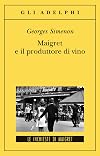
- Maigret e il commerciante di vini
- Original publication date
- 1970
- People/Characters
- Jules Maigret; Gilbert Pigou; Madame Blanche; Madame Chabut
- Important places
- Paris, France
- Related movies*
- Maigret et le marchand de vin (1978 | IMDb); Maigret et le marchand de vin (2002 | IMDb)
- First words
- "You killed her in order to steal from her, didn't you?"
"You killed her to rob her, didn't you?" - Quotations*
- Maigret non si era mai sentito a suo agio in quell'ambiente, con quella borghesia opulenta chelo faceva sentire goffo e fuori posto. Le persone della lista che Jeanne Chabut gli aveva consegnato, per esempio, appartenevano t... (show all)utte, chi più chi meno, a una stessa cerchia che aveva le sue regole, le sue abitudini, i suoi tabù, il suo linguaggio. Si ritrovavano a teatro, al ristorante, nei locali notturni, la domenica in case di campagna che si assomigliavano tutte, e d'estate a Cannes o a Saint-Topez.
Poi si ritrovò in una chiesa che assomigliava alla sala di Madame Blanche, ma molto più grande. Lungo il corridoio centrale sfilavano alcune coppie, come durante un matrimonio. Qualcuno suonava il pianoforte, ma quella che ... (show all)si sentiva era una musica d'organo.
Aveva una missione da compiere, ma non sapeva quale, e Oscar Chabut lo guardava, con aria beffarda. Via via che le coppie gli passavano davanti, salutava le donne chiamandole per nome.
L'assassinio di Chabut non era frutto di un gesto impulsivo. Chi lo aveva commesso lo aveva a lungo meditato, esitando, alimentando il proprio rancore per decidersi ad agire.
E ora il nemico era morto. In fondo era come se... (show all), d'improvviso, l'assassino avesse perso ogni ragione di vita. La vittima veniva descritta come un uomo brillante,uno straordinario uomo d'affari. Nessuno parlava di chi l'aveva ucciso, né delle ragioni che l'avevano indotto a farlo.
Quando la signora Maigret arrivò con il caffè e gli toccò la spalla, ebbe la tentazione, come gli succedeva da bambino, di dirle che non si sentiva bene, e che pensava proprio di dover rimanere a letto, al caldo. - Last words
- (Click to show. Warning: May contain spoilers.)But were they not simply tears of self pity?
(Click to show. Warning: May contain spoilers.)But was he not just feeling sorry for himself? - Original language
- French
*Some information comes from Common Knowledge in other languages. Click "Edit" for more information.
Classifications
Statistics
- Members
- 504
- Popularity
- 59,841
- Reviews
- 12
- Rating
- (3.52)
- Languages
- 13 — Catalan, Danish, Dutch, English, Finnish, French, German, Italian, Japanese, Polish, Portuguese, Spanish, Swedish
- Media
- Paper, Audiobook, Ebook
- ISBNs
- 34
- ASINs
- 15