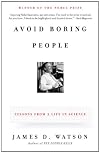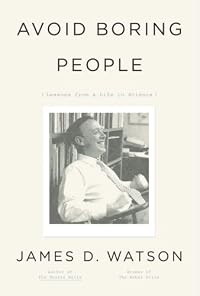
Avoid Boring People: Lessons from a Life in Science
by James D. Watson
On This Page
Description
From a living legend--James D. Watson, who shared the Nobel Prize for revealing the structure of DNA--comes a personal account of the making of a scientist. Watson shares the less revolutionary secrets he has found to getting along and getting ahead in a competitive world. Each phase of his experience yields age-specific practical advice. A believer in the intellectual promise of youth, Watson offers pointers to beginning scientists about choosing the projects that will shape their careers, show more the supreme importance of collegiality, and dealing with competitors within the same institution, even one who is a former mentor. Later he addresses the role and needs of science at large universities. Scorning political correctness, this irreverent romp through Watson's life and learning is a guide to anyone plotting a career in science (or most anything else), addressed both to the next generation and those who are entrusted with their minds.--From publisher description. show lessTags
Recommendations















Member Reviews
I've never been a big fan of biographies, one of the things that puts me off is the vanity and self importance usually required in an individual to make them think they are interesting enough for other people to want to read about them, whether they write the book or get someone else to do it. However, there are a certain few who I think warrant an entire book devoted to their life, which is probably the case here. James Watson, aside from contributing greatly to the field of molecular genetics, is an amusing writer. He possesses no great literary skill, but makes up for it with his honest tone of writing and the way his personal character comes through.
I doubt this book would be of much interest to anyone not familiar with much show more science, a lot of the funniest parts of the book are in the recollection of exchanges or anecdotes he has to tell us about other well known scientists. He perhaps over does the name dropping, but I think a part of it is his eagerness to show that he was not working alone and that others were involved in the scientific breakthroughs just as much as he was.
After each chapter there are a series of pieces of advice that he has to offer other scientists, based on what he learnt during that part of his life, including how he would have done things differently if he had the chance. This is interesting to me, as I have studied biology at university and am at the point when I have to think seriously how best to make the most of the early years of a career in scientific research. Not all the advice will be relevant to everyone, but to scientists it will be interesting to know the opinions of Watson on such varied matters, even if you disregard it.
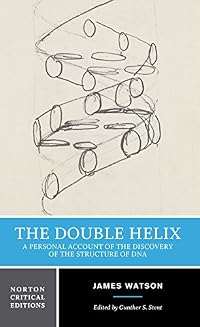
His other book, the Double Helix, covers just the time around the discovery of the structure of DNA, and is thus a more exciting read. This book documents from his time in school, all the way through his career, and will for this reason not be quite so gripping, but it does provide a fuller picture of his life. show less
I doubt this book would be of much interest to anyone not familiar with much show more science, a lot of the funniest parts of the book are in the recollection of exchanges or anecdotes he has to tell us about other well known scientists. He perhaps over does the name dropping, but I think a part of it is his eagerness to show that he was not working alone and that others were involved in the scientific breakthroughs just as much as he was.
After each chapter there are a series of pieces of advice that he has to offer other scientists, based on what he learnt during that part of his life, including how he would have done things differently if he had the chance. This is interesting to me, as I have studied biology at university and am at the point when I have to think seriously how best to make the most of the early years of a career in scientific research. Not all the advice will be relevant to everyone, but to scientists it will be interesting to know the opinions of Watson on such varied matters, even if you disregard it.
His other book, the Double Helix, covers just the time around the discovery of the structure of DNA, and is thus a more exciting read. This book documents from his time in school, all the way through his career, and will for this reason not be quite so gripping, but it does provide a fuller picture of his life. show less
This was a fab book - I do love a science book that I don't quite understand...
I loved the science - obviously Mr Watson contributed a lot to modern science, especially to what we know about DNA, as well as in other spheres - but it was almost more fascinating to read about him and his peers. I was surprised to find that to me he was slightly unlikeable, I suppose because you don't expect that when someone has written a book about themself. Or because he should have been a jolly, affable professor type. This, strangely, made me enjoy the book even more. The story - science and a chronological anecdotal history - moved along at a good pace and kept me reading.
For me, this was an exposure to a high level, ground breaking scientific show more community, but it was also modern history come alive, and I think that is what made it so enjoyable. show less
I loved the science - obviously Mr Watson contributed a lot to modern science, especially to what we know about DNA, as well as in other spheres - but it was almost more fascinating to read about him and his peers. I was surprised to find that to me he was slightly unlikeable, I suppose because you don't expect that when someone has written a book about themself. Or because he should have been a jolly, affable professor type. This, strangely, made me enjoy the book even more. The story - science and a chronological anecdotal history - moved along at a good pace and kept me reading.
For me, this was an exposure to a high level, ground breaking scientific show more community, but it was also modern history come alive, and I think that is what made it so enjoyable. show less
Best known for his Nobel Prize winning work on helping identify the double helix structure of DNA, scientist James D. Watson presents his autobiography Avoid Boring People: Lessons from a Life in Science as an anecdote filled instruction manual - chunking off different segments of his career and then reflecting on the points to be learned from his experiences. The titular phrase "Avoid Boring People" takes on two meanings in the book. Watson advises young scientists to avoid boring people (with the middle word as an adjective) saying that those early in their careers should associate only with people engaging in exciting new science. The second meaning comes as advice to older researchers and Watson warns that in the twilight of their show more careers, scientists should avoid boring other people - with boring now becoming a verb.
(One wonders if Watson has taken this second piece of advice too far to heart as in recent years his public appearances have kept him newsworthy not for any breakthrough work he has accomplished, but in his ability to anger audiences with racist, sexist, atheistic, and anti-establishment comments. It is only by putting aside my knowledge of his recent personal beliefs that I was able to even open this book for reading, let alone reviewing.)
With that said, Watson does tell an engaging story. The history and science presented are told with a light anecdotal feel and some of the most interesting chapters were the portions of Watson's experience - for example, his work as a presidential science adviser - that were not as highly publicized as his Nobel winning work. I would have enjoyed the book more if Watson had more respect for his female associates. Though some of them are described as "bright" or "intelligent" more often than not these adjectives are proceeded by "cute", "stunning" or "blond". Unlike for his male coworkers, the women in the book have their minds and intellects overshadowed by their looks. Overall, I think the book presents an adequate picture of the life of James Watson which, while intriguing and intelligent, lacks likability. show less
(One wonders if Watson has taken this second piece of advice too far to heart as in recent years his public appearances have kept him newsworthy not for any breakthrough work he has accomplished, but in his ability to anger audiences with racist, sexist, atheistic, and anti-establishment comments. It is only by putting aside my knowledge of his recent personal beliefs that I was able to even open this book for reading, let alone reviewing.)
With that said, Watson does tell an engaging story. The history and science presented are told with a light anecdotal feel and some of the most interesting chapters were the portions of Watson's experience - for example, his work as a presidential science adviser - that were not as highly publicized as his Nobel winning work. I would have enjoyed the book more if Watson had more respect for his female associates. Though some of them are described as "bright" or "intelligent" more often than not these adjectives are proceeded by "cute", "stunning" or "blond". Unlike for his male coworkers, the women in the book have their minds and intellects overshadowed by their looks. Overall, I think the book presents an adequate picture of the life of James Watson which, while intriguing and intelligent, lacks likability. show less
Loved the title of this book and was excited to pick it up, having read other memoirs of scientists (Richard Feynman, memorably). Found though that this book didn't resonate. Liked the idea of the Remembered Lessons at the end of each chapter but found them unexpectedly uninspiring (e.g. Work on Sundays, College is for learning how to think, Use snappy sentences to open your chapters, etc.).
Way too many unnecessary details which makes it very hard (or very easy if you skip them) to read. He listed all of the people who he has been met but didn't provide too much stories for them - boring.
Though I still can see some wisdoms of him and I'm kind of like this guy after I finished this book.
Though I still can see some wisdoms of him and I'm kind of like this guy after I finished this book.
Autobiography of the surviving co-discoverer of DNA's structure. The ambiguous main title accounts for 2 of the 108 "lessons." Unsurprisingly, the chapters on the Nobel prize and the publication of _The Double Helix_ are the most engaging.
He didn't avoid boring me.
I really, really wanted to like this book, too. I struggled through 100 pages and just couldn't go on.
I really, really wanted to like this book, too. I struggled through 100 pages and just couldn't go on.
Members
- Recently Added By
Author Information

34+ Works 6,105 Members
James Dewey Watson James D. Watson was born on April 6, 1928. Watson was an extremely industrious student and entered the University of Chicago when he was only 15. He received his Bachelor of Science degree in Zoology four years later, and went on to earn a Ph.D. in the same subject at Indiana University. He was performing research at the show more University of Copenhagen in Denmark, when he first learned of the biomolecular research at the Cavendish Laboratory of Cambridge University in England. Watson joined Francis Crick in this work in 1951. At the age of 25, he and colleague Crick discovered the structure of DNA, the double helix. Watson went on to become a Senior Research Fellow in Biology at the California Institute of Technology, before returning to Cambridge in 1955. The following year he moved to Harvard University, where he became Professor of Biology, a post he held until 1976. Watson and Crick won the 1962 Nobel Laureate in Medicine for their discoveries concerning the molecular structure of nuclear acids and its significance for information transfer in living material. In 1968, Watson published his account of the DNA discovery, "The Double Helix." The book became an international best-seller. Watson became the Director and later President of the Cold Spring Harbor Laboratory. In 1988 he served as Director of the Human Genome Project at the National Institutes of Health, a massive project to decipher the entire genetic code of the human species. Watson has received many awards and medals for his work, along with the Nobel Prize, he has also received the Presidential Medal of Freedom. (Bowker Author Biography) show less
Awards and Honors
Notable Lists
Work Relationships
Is abridged in
Common Knowledge
- Canonical title
- Avoid Boring People: Lessons from a Life in Science
- Alternate titles
- Avoid Boring People
- Original publication date
- 2007
- People/Characters
- James D. Watson
- Important places
- Chicago, Illinois, USA; Boston, Massachusetts, USA
Classifications
Statistics
- Members
- 347
- Popularity
- 90,694
- Reviews
- 7
- Rating
- (3.04)
- Languages
- English, Russian, Spanish
- Media
- Paper, Ebook
- ISBNs
- 7
- ASINs
- 6