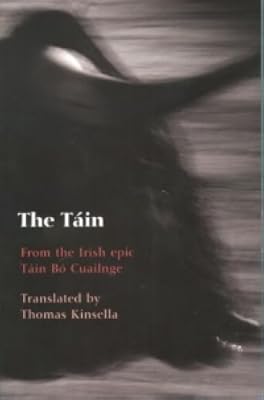
The Táin
by Anonymous
On This Page
Description
The Ta in Bo Cuailnge, centre-piece of the eighth-century Ulster cycle of heroic tales, is Ireland's greatest epic. It tells the story of a great cattle-raid, the invasion of Ulster by the armies of Medb and Ailill, queen and king of Connacht, and their allies, seeking to carry off the great Brown Bull of Cuailnge. The hero of the tale is Cuchulainn, the Hound of Ulster, who resists the invaders single-handed while Ulster's warriors lie sick. Thomas Kinsella presents a complete and living show more version of the story. His translation is based on the partial texts in two medieval manuscripts. show lessTags
Recommendations













Member Recommendations

bertilak and the city China Miéville
Member Reviews
Irish Queen Medb is pissed. The only thing separating her wealth from her husband Ailill's is a supernatural bull, which should be hers except that he defected to Ailill's herd because he didn't want to be owned by a woman. Very regressive, this is the 8th century already, come on. So she decides to invade the neighboring province of Ulster to steal this other supernatural bull and even the score. Ailill goes along because sure, nothing more fun than a good cattle rustling war.
Bolstering their chances is the fact that all the men of Ulster are suffering labor pains. Ok, see, they once forced this pregnant woman named Macha to race the King's horses while she was heavily pregnant. She won and gave birth at the finish line, to twins, but show more she wasn't happy. She laid a curse on all the men of the province that they would be laid out with labor pangs for 5 days and 4 nights whenever they most needed their strength.
Even better, for some reason this situation lasts for 3 months while Medb's army is in Ulster; the contradiction goes unremarked. Pretty rough, fellows. However, there is one man in Ulster unaffected, the hero Cúchulainn, who seems to be spared because his natural father is both the mortal Sualtam and the god Lug. Not really sure how that works, but okay.
Cúchulainn single handedly fights the invading army for months, sometimes through ritual single combat, but at other times going on rampages in which he kills dozens and even hundreds of men. He's not invincible, but he's pretty close to it, and he can do various superhuman feats you might expect to find in an ancient epic tale. You've heard the expression "contorts with rage"; Cúchulainn has a version that Kinsella memorably translates as "warp-spasm":
A generally entertaining epic, though it suffers from internal inconsistencies, contradictions, and the epic's consistent weakness for dull list making. The personal comment made by the 12th Century scribe who copied down the story in the manuscript known as the Book of Leinster is a notable contribution to the corpus of medieval scribal notes in hand copied manuscripts: "I who have copied down this story, or more accurately fantasy, do not credit the details of the story, or fantasy. Some things in it are devilish lies, and some poetical figments; some seem possible and others not; some are for the enjoyment of idiots." show less
Bolstering their chances is the fact that all the men of Ulster are suffering labor pains. Ok, see, they once forced this pregnant woman named Macha to race the King's horses while she was heavily pregnant. She won and gave birth at the finish line, to twins, but show more she wasn't happy. She laid a curse on all the men of the province that they would be laid out with labor pangs for 5 days and 4 nights whenever they most needed their strength.
Even better, for some reason this situation lasts for 3 months while Medb's army is in Ulster; the contradiction goes unremarked. Pretty rough, fellows. However, there is one man in Ulster unaffected, the hero Cúchulainn, who seems to be spared because his natural father is both the mortal Sualtam and the god Lug. Not really sure how that works, but okay.
Cúchulainn single handedly fights the invading army for months, sometimes through ritual single combat, but at other times going on rampages in which he kills dozens and even hundreds of men. He's not invincible, but he's pretty close to it, and he can do various superhuman feats you might expect to find in an ancient epic tale. You've heard the expression "contorts with rage"; Cúchulainn has a version that Kinsella memorably translates as "warp-spasm":
His body made a furious twist inside his skin, so that his feet and shins switched to the rear and his heels and calves switched to the front... His face and features became a red bowl: he sucked one eye so deep into his head that a wild crane couldn't probe it onto his cheek out of the depths of his skull; the other eye fell out along his cheek. His mouth weirdly distorted: his cheek peeled back from his jaws until the gullet appeared, his lungs and his liver flapped in his mouth and throat, his lower jaw struck the upper a lion-killing blow, and fiery flakes large as a ram's fleece reached his mouth from his throat... Then, tall and thick, steady and strong, high as the mast of a noble ship, rose up from the dead centre of his skull a straight spout of black blood darkly and magically smoking like the smoke from a royal hostel when a king is coming to be cared for at the close of a winter day.The only warrior who comes close to matching Cúchulainn is Ferdia, his ex-foster brother and training companion. They engage in a 3 day long single combat, and despite their past bond engage in some trash talk, an Epic Rap Battle:
Ferdia:Cúchulainn kills Ferdia after 3 solid days of combat but is now seriously wounded and needs to recuperate. Fortunately the men of Ulster have finally recovered from their labor pains and show up for the final battle, which is rather unimportant and anti-climactic in comparison to Cúchulainn's heroics. Medb misses the end of the battle when she gets her period; off by herself taking care of business, Cúchulainn finds her but does not kill her, the story making the obviously false claim that he doesn't kill women.
'It is I who will kill,
I who will destroy,
I who will drive
Ulster's hero to flight
before all eyes
By my doing
they'll rue their loss
early and late.'
Cúchulainn:
'You have reached your doom,
your hour is come
My sword will slash
and not softly
When we meet you will fall
at a hero's hands
Never again
will you lead men
A generally entertaining epic, though it suffers from internal inconsistencies, contradictions, and the epic's consistent weakness for dull list making. The personal comment made by the 12th Century scribe who copied down the story in the manuscript known as the Book of Leinster is a notable contribution to the corpus of medieval scribal notes in hand copied manuscripts: "I who have copied down this story, or more accurately fantasy, do not credit the details of the story, or fantasy. Some things in it are devilish lies, and some poetical figments; some seem possible and others not; some are for the enjoyment of idiots." show less
Ages ago I read a simpler version of this epic tale, I suppose tidied up for younger people. I had a passion for folklore as a child and my mother was always finding treasures. So. The folk of Ulster have a great Brown bull and the folk of Connacht, a great White bull. The Connacht greedily want both and so steal the Ulster Brown bull. Now the complication is that the Ulstermen suffer a thing called 'the Pangs' for a week or two once a year. During this time they undergo the severe pains of childbirth and are entirely unable to function. For some reason the young Cúchulainn, nephew of Conchobar, King of the Ulsterfolk, does not get the pangs and so comes to the rescue fighting off the Connacht until the Ulster warriors recover. He show more kills everyone he meets and in the end even has to kill his best friend, Ferdia. Badly wounded he has to step out but just then the Ulster warriors are recovered and show up. As with many ancient works, lineages are paramount and there are pages and pages of descriptions of the warriors--titles, status, prowess as warriors, where from, who related to, what wearing, what weapons and all the rest. Tedious, but restful too. Also, as with much ancient story-telling there is the 'how-this-place-got-its-name' theme as well. Hyperbole is de rigeur also. I kind of assume that when a king turns up with three thousand men, actually it is a local chieftain with thirty men. But whatever. The point of such tales, I think, while to provide entertainment was more importantly to remind the people of their history and heritage, and also, to some degree their values (or lack thereof) and to provide a kind of physical map of the area--very ancient indeed. Plot, character development etcetera was entirely irrelevant. There are moments of humor (Medb is happy to sleep with anyone if that would help them fight for her, they constantly offer their daughter to any reluctant warrior as well, even after she has died) and moments of true pathos (Ferdia's death). Kinsella includes the conclusory remarks of the scribe of the version in The Book of Leinster:
First: "A blessing on everyone who will memorise the Táin faithfully in this form and not put any other form on it."
Then: "I who have copied down this story, or more accurately fantasy, do not credit the details of the story, or fantasy. Some things in it are devilish lies, and some poetical figments: some seem possible and others not; some are for the enjoyment of idiots." Rating must be ***** but truly no rating is necessary. show less
First: "A blessing on everyone who will memorise the Táin faithfully in this form and not put any other form on it."
Then: "I who have copied down this story, or more accurately fantasy, do not credit the details of the story, or fantasy. Some things in it are devilish lies, and some poetical figments: some seem possible and others not; some are for the enjoyment of idiots." Rating must be ***** but truly no rating is necessary. show less
Queen Medb and King Ailill squabble about who is the most amazing and there's a war about a cow. Just when I think the genealogies and place naming is all a bit much, something loopy happens and it's enjoyable again. The hero of the story is Cuchulainn. He's a baby faced berserker hybrid of Rostam and Heracles, who likes to do battle party tricks. The descriptions of his strength and battle prowess are exaggerated to comical levels of wonder. I love the search for a fake beard, the preoccupation with rich clothing and the point where Cuchulainn has killed so many men the bard gives up using different names and starts grouping the dead by name: 'seven named Conall, seven named Aengus, seven named Uargus . . . '
While there's much to show more enjoy, I have mixed feelings about the story. I weary of the repetition - the same battle sequence over and over, with Cuchulainn killing someone at a place then named after the dead man. It's silly to say an epic tale is repetitive, because that's what traditional oral tales are like, but it's not engaging me in this particular story. I'm not sure why, but I do know there is more to this story than I'm willing to consider. My copy is translated by Thomas Kinsella and has some of Louis le Brocquy's illustrations. I can see other reviews here praise Ciaran Carson's translation for its liveliness, so another time I'd like to read it and see. I'm glad I read this version so I could experience Le Brocquy's illustrations, but perhaps the translation or my current mood are doing this tale an injustice. show less
While there's much to show more enjoy, I have mixed feelings about the story. I weary of the repetition - the same battle sequence over and over, with Cuchulainn killing someone at a place then named after the dead man. It's silly to say an epic tale is repetitive, because that's what traditional oral tales are like, but it's not engaging me in this particular story. I'm not sure why, but I do know there is more to this story than I'm willing to consider. My copy is translated by Thomas Kinsella and has some of Louis le Brocquy's illustrations. I can see other reviews here praise Ciaran Carson's translation for its liveliness, so another time I'd like to read it and see. I'm glad I read this version so I could experience Le Brocquy's illustrations, but perhaps the translation or my current mood are doing this tale an injustice. show less
Really a reread, though it's been forever since I read it. I decided to read it again in anticipation of Ciaran Carson's translation that I'm told is less than literal--though if you want to get technical about it, Kinsella's translation also isn't a literal word-for-word translation. But I still love the story and the illustrations in this version, which are purposely primitive, add so much.
However, I can't always find I'm sympathetic to Ulster simply because of the origins of the pangs. Kind of serves them right--the king does speak for his people after all, and therefore he caused his people to suffer. That's not to say Maeve of the Friendly Thighs is not a bit greedy herself. Nor Ailill. Really, everyone's to blame, except our hero show more CuChulain, who just goes so crazy when challenged that he's never at fault. But then, that's what happens when your father is a god. show less
However, I can't always find I'm sympathetic to Ulster simply because of the origins of the pangs. Kind of serves them right--the king does speak for his people after all, and therefore he caused his people to suffer. That's not to say Maeve of the Friendly Thighs is not a bit greedy herself. Nor Ailill. Really, everyone's to blame, except our hero show more CuChulain, who just goes so crazy when challenged that he's never at fault. But then, that's what happens when your father is a god. show less
I don't know Gaelic, so I don't know how true this statement is, but this book felt to me like reading the Tain in the closest to the original that I could get without learning its language. The grammar doesn't feel particularly English, and the wild images and events of the story are not softened for an English-speaking audience (as happens in Lady Gregory's retelling, for example). I strongly recommend the book for those interested in the Tain yet ignorant of classical Gaelic; but for those who don't know the Ulster Cycle, Lady Gregory's retelling (/Cuchulain of Murthemney/) or the Dover Books reprint /Myths and Legends of the Celts/ (T.W. Rolleston) might be a better starting point.
I didn't like the vast majority of this saga. The one exception is the story of Etain. Otherwise, we're stuck with a whole bunch of stories about the overly stuffed with testosterone boy, Cuchulainn, who does nothing but steal from the queen (I was rooting for her). It's nothing but war and cattle- the Decemberists capture the feeling of the stories very well in their album "The Tain."
The unexpected treasure of my senior year required reading list. This is ancient Ireland's fantasy universe, where even heroes are bloodthirsty and Fairy Land is a strange and sinister place. Recommended to anyone who loved their Homer or wants to know more about Ireland.
Members
- Recently Added By
Lists

Epic Fiction
42 works; 12 members

Best of World Literature
435 works; 52 members

Best of Irish Literature
37 works; 7 members

100 Books to Read in a Lifetime (That Are Older Than 200 Years)
415 works; 175 members

Literary Works Read in College
316 works; 15 members
Author Information
1 Work 1,586 Members
Some Editions
Awards and Honors
Work Relationships
Is contained in
Is retold in
Has the adaptation
Has as a student's study guide
Common Knowledge
- Canonical title
- The Táin
- Original title
- Táin Bó Cúailnge
- Alternate titles
- The Cattle Raid of Cooley
- Original publication date
- circa 800
- People/Characters
- Cú Chulainn; Queen Medb; Fer Diad; King Ailil; Ailill; Etain (show all 9); Medb; Finnabair; Fergus Mac Róich
- Important places
- Ulster, Ireland; Emain Macha, County Antrim, Northern Ireland, UK (a.k.a. Navan Fort); Navan Fort, County Antrim, Northern Ireland, UK (a.k.a. Emain Macha)
- Dedication
- In memory of the storyteller John Campbell of Mullaghbawm, Co. Armagh, born 1933, died 2006.
- First words
- One night when the royal bed had been prepared for Ailill and Medb in Crúachan Fort in Connacht, they engaged in pillow talk
- Quotations
- If the salmon were swimming in the rivers or river-mouths I'd give you one and share another. If a flock of wild birds were to alight on the plain I'd give you one and share another; with a handful of cress or sea-herb and a ... (show all)handful of marshwort; and a drink out of the sand; and myself in your place in the ford of battle, watching while you slept.
- Last words
- (Click to show. Warning: May contain spoilers.)The men of Connacht went back to their own country, and the men of Ulster returned in triumph to Emain Macha.
- Original language
- Irish
Classifications
- Genres
- Fiction and Literature, Poetry
- DDC/MDS
- 891.6231 — Literature & rhetoric Literatures of other languages East Indo-European and Celtic literatures Celtic languages Irish Irish fiction –1171
- LCC
- PB1397 .T3 .E513 — Language and Literature Modern languages. Celtic languages and literature Modern languages. Celtic languages Celtic languages and literature Irish
- BISAC
Statistics
- Members
- 1,595
- Popularity
- 14,244
- Reviews
- 14
- Rating
- (4.09)
- Languages
- 6 — English, French, German, Irish, Italian, Japanese
- Media
- Paper, Ebook
- ISBNs
- 34
- ASINs
- 17
