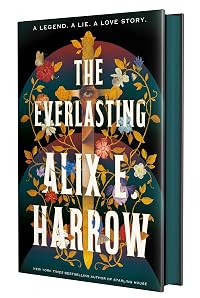
The Everlasting
by Alix E. Harrow
On This Page
Description
Sir Una Everlasting was Dominion's greatest hero: the orphaned girl who became a knight, who died for queen and country. Her legend lives on in songs and stories, in children's books and recruiting posters -- but her life as it truly happened has been forgotten. Centuries later, Owen Mallory -- failed soldier, struggling scholar -- falls in love with the tale of Una Everlasting. Her story takes him to war and then into the past itself. Una and Owen are tangled together in time, bound to show more retell the same story over and over again, no matter what it costs. But that story always ends the same way. If they want to rewrite Una's legend, they'll have to rewrite history itself. show lessTags
Recommendations


Member Reviews
I have made my love for Alix E. Harrow's novels known since I read her first one, THE TEN THOUSAND DOORS OF JANUARY. She became a favorite author after ONCE AND FUTURE WITCHES. Her Fractured Fables put her on my auto-read list. I say all this to make it clear that I had high expectations about Ms. Harrow's newest novel, and yet, THE EVERLASTING still blew my mind with its excellence.
THE EVERLASTING is one of those novels that leaves you at a loss for words. The emotions you feel throughout the story are so strong that it takes some time to shake them off when you close the book. Even more, Ms. Harrow's ability to insert the reader into the story means that emotions are not the only thing you have to shake off. She blurs the line show more between reality and fiction so well that you forget Dominion does not exist.
And yet, the notion that history is nothing but a story is all too familiar, all too timely. When news headlines continue to identify school districts and colleges and universities throughout the country amending their curricula to appease a very vocal, racist agenda, you realize that history is what remains in the history books and not what actually happened. In that way, history IS a story, maybe not to the extreme that it is in THE EVERLASTING, but the connection is clear.
What makes THE EVERLASTING even more powerful is the fact that it is really difficult to hate the villain. Vivian is not wrong when she spits about how her efforts must exceed some unattainable standard to get the same plaudits as a man in her same position. Every woman faces this bias, no matter where they excel. Sure, she is proof that absolute power corrupts absolutely, and her actions are selfish and self-serving. Yet, her reason for doing so, the never-ending fight she has to maintain any power as a woman, is something every female in the world experiences. As such, you can't hate her as much as you want to because she is you.
As for the love story within THE EVERLASTING, the less I say about it, the better. It is so well-written, so heartfelt, so beautiful that I look upon it with reverence. On paper, Owen and Una should not work, but Ms. Harrow doesn't just make them work. She makes them the romantic couple you want every couple to be. Una and Owen are what you dream of when you dream of your ideal relationship and make you yearn to find someone as special in your life.
THE EVERLASTING is Una and Owen, just as Una and Owen are everlasting. Their story is the heart and soul of Ms. Harrow's novel, told with such love that it takes your breath away. At the same time, THE EVERLASTING is not just a romance. It is a complex story about the stories we tell ourselves and the stories that last throughout history that form who we are. It is the type of book you can read multiple times and discover something new every time. THE EVERLASTING is a true classic of our time. show less
THE EVERLASTING is one of those novels that leaves you at a loss for words. The emotions you feel throughout the story are so strong that it takes some time to shake them off when you close the book. Even more, Ms. Harrow's ability to insert the reader into the story means that emotions are not the only thing you have to shake off. She blurs the line show more between reality and fiction so well that you forget Dominion does not exist.
And yet, the notion that history is nothing but a story is all too familiar, all too timely. When news headlines continue to identify school districts and colleges and universities throughout the country amending their curricula to appease a very vocal, racist agenda, you realize that history is what remains in the history books and not what actually happened. In that way, history IS a story, maybe not to the extreme that it is in THE EVERLASTING, but the connection is clear.
What makes THE EVERLASTING even more powerful is the fact that it is really difficult to hate the villain. Vivian is not wrong when she spits about how her efforts must exceed some unattainable standard to get the same plaudits as a man in her same position. Every woman faces this bias, no matter where they excel. Sure, she is proof that absolute power corrupts absolutely, and her actions are selfish and self-serving. Yet, her reason for doing so, the never-ending fight she has to maintain any power as a woman, is something every female in the world experiences. As such, you can't hate her as much as you want to because she is you.
As for the love story within THE EVERLASTING, the less I say about it, the better. It is so well-written, so heartfelt, so beautiful that I look upon it with reverence. On paper, Owen and Una should not work, but Ms. Harrow doesn't just make them work. She makes them the romantic couple you want every couple to be. Una and Owen are what you dream of when you dream of your ideal relationship and make you yearn to find someone as special in your life.
THE EVERLASTING is Una and Owen, just as Una and Owen are everlasting. Their story is the heart and soul of Ms. Harrow's novel, told with such love that it takes your breath away. At the same time, THE EVERLASTING is not just a romance. It is a complex story about the stories we tell ourselves and the stories that last throughout history that form who we are. It is the type of book you can read multiple times and discover something new every time. THE EVERLASTING is a true classic of our time. show less
At first, this seems like any very good historical fantasy novel, with a scholar and a lady knight (Sir Una Everlasting) and a queen, a country called Dominion and a castle called Cavallon, on an island that's vaguely British.
*Spoilers*
But then, the story explodes out of its apparent lane: there's time travel, and alternate timelines, and an alternating second person narrative structure (sometimes historian Owen Mallory is telling the story to Una; sometimes Una is telling it to him), and dragons.
Power-hungry modern politician Vivian Rolfe has eerie similarities to ancient Queen Yvanne, Owen has memories he shouldn't, and Una's uncanny abilities are in fact born of repetition, with the story tweaked and varied each time to suit show more present needs - to make history into a story.
The question becomes: Can Owen and Una escape the story Yvanne/Vivian is trying to control? Can they save themselves, and their children, and Dominion? Where, in a thousand years, is safe?
See also: The Bright Sword by Lev Grossman, This Is How You Lose the Time War by Amal El-Mohtar and Max Gladstone, Life After Life by Kate Atkinson, The Future of Another Timeline by Annalee Newitz
Quotes
That lost, fearful expression had returned to your face, as if you had been walking for a long time in a country you did not know under stars you could not name. As if you had forgotten where you had meant to go in the first place, and no longer believed it was worth it.
...It was the look of...someone with a crack running down the center of them, so that all the honor and courage ran out and left nothing but shaky hands and bad dreams behind. (Owen Mallory observing Una, 47)
"I am not sure which I prefer: To be taken for something I am not, or to fail at being what I am." (Una, 68)
I might wonder if I'd ever return to my own time, or if I was lost here, like an arrow loosed into the past and never recovered. (70)
It was all lies, but what did I care? If I couldn't have you or heal you or save you - if I couldn't love you - then I would make all of Dominion love you, forever and ever. (75)
My whole life existed only to bear witness to yours, and God! It was worth it. (84)
A brave man would have stood at the gates and let the past take its course, for the sake of the future. But I was too much a coward to watch you die, Una. (90)
"In order to have a future worth fighting for, you must have a past worth remembering." (Vivian Rolfe, 104)
"I thought it would be enough....But it's never enough, simply to be competent." (Vivian, 105)
Only one thing had mattered to me, and now it was done, and all I wanted was to fall asleep or disappear, to excuse myself from reality like a man escaping a long and awful dinner party. (109)
Was that not how you loved someone? By hammering your body into whatever shape they liked best, and handing yourself to them like a hilt? (151)
"There are only two kinds of stories worth telling: the ones that send children to sleep, and the ones that send men to war." (Vivian, 161)
"It is not a lesson, until we learn it. It is not a story, until we tell it. And every story serves someone." (Professor Sawbridge, 180)
It was a quick and simple cipher - one simply made a great number of punctuation errors in a given text. If there were an even number of errors, you wrote down the first letter following the mistake; if there were an odd number, you wrote the second. (183)
Was it a ladder she had climbed, or a pile of bodies? Was it justice, if it only served one person? (194)
History no longer simply happened, like an accident; it was told, like a story. (198)
Was I a man or merely a palimpsest, scrubbed clean and rewritten so man times that my oldest memories were obscured entirely? (242)
"Love makes cowards of us all." (249)
I thought, despairingly, that love didn't make cowards of us, after all; it made heroes, and heroes usually didn't survive. (252)
...because a nation is a story we tell about ourselves, and stories change, if you let them. (253)
It took so many tragedies, to make a nation. (258)
"...ambition...is the future on purpose." (Vivian, 286)
This is our second happily ever after, you see, and we know they only last as long as you are willing to fight for them. (307)
From the Acknowledgments: "If you'd like to be a fantasy author, it's not absolutely necessary to have a mother who is writing professor, falconer, archer, and horse trainer - but it doesn't hurt." show less
*Spoilers*
But then, the story explodes out of its apparent lane: there's time travel, and alternate timelines, and an alternating second person narrative structure (sometimes historian Owen Mallory is telling the story to Una; sometimes Una is telling it to him), and dragons.
Power-hungry modern politician Vivian Rolfe has eerie similarities to ancient Queen Yvanne, Owen has memories he shouldn't, and Una's uncanny abilities are in fact born of repetition, with the story tweaked and varied each time to suit show more present needs - to make history into a story.
The question becomes: Can Owen and Una escape the story Yvanne/Vivian is trying to control? Can they save themselves, and their children, and Dominion? Where, in a thousand years, is safe?
See also: The Bright Sword by Lev Grossman, This Is How You Lose the Time War by Amal El-Mohtar and Max Gladstone, Life After Life by Kate Atkinson, The Future of Another Timeline by Annalee Newitz
Quotes
That lost, fearful expression had returned to your face, as if you had been walking for a long time in a country you did not know under stars you could not name. As if you had forgotten where you had meant to go in the first place, and no longer believed it was worth it.
...It was the look of...someone with a crack running down the center of them, so that all the honor and courage ran out and left nothing but shaky hands and bad dreams behind. (Owen Mallory observing Una, 47)
"I am not sure which I prefer: To be taken for something I am not, or to fail at being what I am." (Una, 68)
I might wonder if I'd ever return to my own time, or if I was lost here, like an arrow loosed into the past and never recovered. (70)
It was all lies, but what did I care? If I couldn't have you or heal you or save you - if I couldn't love you - then I would make all of Dominion love you, forever and ever. (75)
My whole life existed only to bear witness to yours, and God! It was worth it. (84)
A brave man would have stood at the gates and let the past take its course, for the sake of the future. But I was too much a coward to watch you die, Una. (90)
"In order to have a future worth fighting for, you must have a past worth remembering." (Vivian Rolfe, 104)
"I thought it would be enough....But it's never enough, simply to be competent." (Vivian, 105)
Only one thing had mattered to me, and now it was done, and all I wanted was to fall asleep or disappear, to excuse myself from reality like a man escaping a long and awful dinner party. (109)
Was that not how you loved someone? By hammering your body into whatever shape they liked best, and handing yourself to them like a hilt? (151)
"There are only two kinds of stories worth telling: the ones that send children to sleep, and the ones that send men to war." (Vivian, 161)
"It is not a lesson, until we learn it. It is not a story, until we tell it. And every story serves someone." (Professor Sawbridge, 180)
It was a quick and simple cipher - one simply made a great number of punctuation errors in a given text. If there were an even number of errors, you wrote down the first letter following the mistake; if there were an odd number, you wrote the second. (183)
Was it a ladder she had climbed, or a pile of bodies? Was it justice, if it only served one person? (194)
History no longer simply happened, like an accident; it was told, like a story. (198)
Was I a man or merely a palimpsest, scrubbed clean and rewritten so man times that my oldest memories were obscured entirely? (242)
"Love makes cowards of us all." (249)
I thought, despairingly, that love didn't make cowards of us, after all; it made heroes, and heroes usually didn't survive. (252)
...because a nation is a story we tell about ourselves, and stories change, if you let them. (253)
It took so many tragedies, to make a nation. (258)
"...ambition...is the future on purpose." (Vivian, 286)
This is our second happily ever after, you see, and we know they only last as long as you are willing to fight for them. (307)
From the Acknowledgments: "If you'd like to be a fantasy author, it's not absolutely necessary to have a mother who is writing professor, falconer, archer, and horse trainer - but it doesn't hurt." show less
Alix E. Harrow has a recurrent interest in storytelling, and how the possibilities of stories can be literalized through sfnal devices like alternate universes. The Ten Thousand Doors of January represents portal fantasies as places that can be accessed through, well, portals; her two "Fractured Fables" novellas made alternate versions of fairy tales into alternate universes her main characters could jump between, Everything Everywhere All at Once–style.
Instead of alternate universes, The Everlasting explores storytelling through the device of time travel. (Note that I experienced this book largely knowing nothing about it, but I'm going to give away some aspects of the premise here that I discovered as a reader myself, though I show more assume they're probably in the cover blurb, which I never read.) One of the two main characters is Owen Mallory, a scholar who specializes in legends of Sir Una Everlasting, a mythical figure from the history of his country of Dominion, a figure who resonates with the Arthur mythos from our world. (She's sort of King Arthur and his knights all in one.) Thanks to time travel, he's able to back to when Sir Una was alive, but what he discovers is that her story has been edited over time through time travel, adjusted to fit the needs of the present. In his time, Dominion has recently concluded a war, and Una serves as an inspiration to the populace and the soldiers—including Owen himself.
I found this a cracker of a premise. I'm very much interested in stories about stories, about the ways that the stories can change people and society. And I'm very much a sucker for stories that take a metaphor and literalize it through some kind of sfnal premise. In The Everlasting, stories aren't just being tweaked over time in the telling to suit the needs of the present-day society, they're actually being tweaked via time travel. The historian actually goes back in time in order to alter the story to make it work out the way it needs to!
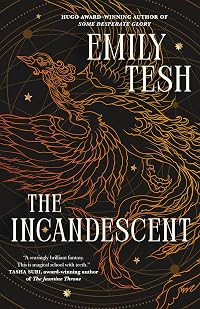
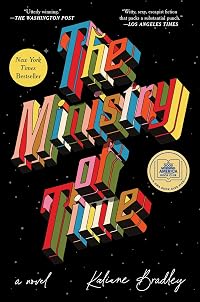
There are definitely shades of Howard Zinn's A People's History of the United States here; imagine if people could go back in time and make Columbus into the hero history needed him to be! I was reminded also of David Mattingly's history of Britain under Rome that I recently read, where he makes the point that when Britain had an empire in the nineteenth century, that was the point where the British told stories about how Britain being part of the Roman Empire was a good thing, actually, that helped the British. Me being me, I was also spending my reading triangulating the book in terms of the contemporary genre, and I think it would appeal to fans of Some Desperate Glory by Emily Tesh and The Ministry of Time by Kaliane Bradley. Those aren't two books that it occurred to me to put together until now, but all three are about time travel, nationalism, and storytelling; Ministry of Time and The Everlasting are very different books in execution, but both are about someone who falls in love with their object of historical study while their government uses time travel for nefarious purposes!
I liked the main characters, Una and Owen, a lot, though I perhaps liked the side characters of Owen's father and professor even more; every return appearance by them was gold. On a prose level, Harrow is a strong writer, as I just really enjoyed reading it. Sometimes stories in this area can be a bit "twee" or "precious" in my opinion (see: oh-so-many Tordotcom novellas), but Harrow isn't that at all.
At the two-thirds mark, I thought this book was amazing. Unfortunately, the last third or so moves the book in a different direction than the one I've laid out here, which I found less interesting. It's not bad, but the book previously had been working on two registers: the social commentary of the time travel/storytelling idea, and the personal level of Owen and Una's story. But near the end,1) the focus of the novel squarely becomes on Owen and Una escaping from the time travel trap, and 2) a lot of that is done via the character of Vivian, who is the novel's villain. But making it all about Owen and Una and Vivian and their personal struggles means that the political/social stuff about the power and importance of stories kind of drops away in favor of time travel mechanics and romance. Which are both interesting, sure, but I found the book more interesting when it was doing all three at once.
Basically the social stuff totally vanishes from the narrative, and I found that disappointing compared to how big of a role it played in the beginning, especially considering it was the clever thing that drew me into the book to begin with. Especially given that ultimately pinning everything on Vivian (and she literally turns out to be responsible for everything bad in Dominion history) really undercuts the book's commentary on the way this kind of thing does happen in the real world. The book does gesture at pointing out it's not all down to Vivian near the end:
This may seem like a lot of criticism, but ultimately I very much enjoyed the book. It did a lot of interesting things. I just wish it could have carried those things through to the end more consistently. show less
Instead of alternate universes, The Everlasting explores storytelling through the device of time travel. (Note that I experienced this book largely knowing nothing about it, but I'm going to give away some aspects of the premise here that I discovered as a reader myself, though I show more assume they're probably in the cover blurb, which I never read.) One of the two main characters is Owen Mallory, a scholar who specializes in legends of Sir Una Everlasting, a mythical figure from the history of his country of Dominion, a figure who resonates with the Arthur mythos from our world. (She's sort of King Arthur and his knights all in one.) Thanks to time travel, he's able to back to when Sir Una was alive, but what he discovers is that her story has been edited over time through time travel, adjusted to fit the needs of the present. In his time, Dominion has recently concluded a war, and Una serves as an inspiration to the populace and the soldiers—including Owen himself.
I found this a cracker of a premise. I'm very much interested in stories about stories, about the ways that the stories can change people and society. And I'm very much a sucker for stories that take a metaphor and literalize it through some kind of sfnal premise. In The Everlasting, stories aren't just being tweaked over time in the telling to suit the needs of the present-day society, they're actually being tweaked via time travel. The historian actually goes back in time in order to alter the story to make it work out the way it needs to!
There are definitely shades of Howard Zinn's A People's History of the United States here; imagine if people could go back in time and make Columbus into the hero history needed him to be! I was reminded also of David Mattingly's history of Britain under Rome that I recently read, where he makes the point that when Britain had an empire in the nineteenth century, that was the point where the British told stories about how Britain being part of the Roman Empire was a good thing, actually, that helped the British. Me being me, I was also spending my reading triangulating the book in terms of the contemporary genre, and I think it would appeal to fans of Some Desperate Glory by Emily Tesh and The Ministry of Time by Kaliane Bradley. Those aren't two books that it occurred to me to put together until now, but all three are about time travel, nationalism, and storytelling; Ministry of Time and The Everlasting are very different books in execution, but both are about someone who falls in love with their object of historical study while their government uses time travel for nefarious purposes!
I liked the main characters, Una and Owen, a lot, though I perhaps liked the side characters of Owen's father and professor even more; every return appearance by them was gold. On a prose level, Harrow is a strong writer, as I just really enjoyed reading it. Sometimes stories in this area can be a bit "twee" or "precious" in my opinion (see: oh-so-many Tordotcom novellas), but Harrow isn't that at all.
At the two-thirds mark, I thought this book was amazing. Unfortunately, the last third or so moves the book in a different direction than the one I've laid out here, which I found less interesting. It's not bad, but the book previously had been working on two registers: the social commentary of the time travel/storytelling idea, and the personal level of Owen and Una's story. But near the end,
Basically the social stuff totally vanishes from the narrative, and I found that disappointing compared to how big of a role it played in the beginning, especially considering it was the clever thing that drew me into the book to begin with. Especially given that ultimately pinning everything on Vivian (and she literally turns out to be responsible for everything bad in Dominion history) really undercuts the book's commentary on the way this kind of thing does happen in the real world. The book does gesture at pointing out it's not all down to Vivian near the end:
The poor downtrodden folk of Dominion, Vivian had called them, but they didn't strike me a victims. I had seen them send their sons cheerfully to war; I had seen them beaten bloody for protesting it. They had put a medal around my neck for something I hadn't done, and spit on my boots simply for being born. And they hadn't been tricked or forced into any of it—they had chosen, over and over, cruelly or kindly, selfishly or bravely. (254)It's a good bit, but it feels tacked on because 1) narratively, the focus of the ending is all on stopping Vivian, and 2) we never really get a sense of what a history of Dominion without Una would be like. I especially wondered what a version of Dominion history where the good aspects of Una's story were emphasized without the bad ones could be like—if such a thing is even possible. Without that, I feel like the book has the depressing conclusion of pointing at a vast social problem, and then just saying that there's no way of fixing it, so all you can do is get out with your loved ones.
This may seem like a lot of criticism, but ultimately I very much enjoyed the book. It did a lot of interesting things. I just wish it could have carried those things through to the end more consistently. show less
I was promised a sapphic Arthurian-inspired story with Alix Harrow’s latest, the Everlasting, and while I don’t think it quite hits that specific mark she does not disappoint at all. The tale follows a struggling scholar and the historic female knight on which his county’s mythos is founded upon, which is a simple enough narrative premise until Harrow throws him back in time with a magical book and a quest to put her story into writing. Even with this twist, Harrow could have taken a straightforward path through their story, playing with themes of myth creation, never meeting your hero(ine)s, and all the trappings of nations founded by roving knights and their rulers, but instead she bends time to her will (in similar fashion to show more the story’s villain) and circles the characters through an everlasting loop of life and death until they figure out a way to fight back and take their tale into their own hands. Her attention to detail is expectedly perfection (and is very much a requirement for a narrative like this), with endless imagery that harks back to the Arthurian cycles, English folklore, and time travel narratives that have come before, to build into a slow burning story that doesn’t quite own its full power until we start to see the patterns begin to unravel. But oh, once we see Owen and Una begin to weave their own threads into the complications that their nemesis has wrought to build her kingdom for the ages the magic is nothing less than exhilarating. show less
This is just... extraordinary. It's harrowing and thoughtful and twisty and melancholy and hopeful all at once. There is so much to it and yet it never feels overburdened, not even when you realize the mechanism of the story and the necessary repetition that falls from that -- the entire thing is so elegantly constructed that you never feel anything but eager for the next bit. Do yourself a favor and don't read anything about this book at all -- every review seems to have spoilers -- just read the book.
This is a beautiful fantasy filled with knights and quests, wars and governments to overthrow, innocents to save, and dragons to slay, carrying so much heart alongside some tough questions. I could not put it down. I gasped, I cried, and I did not see where it was going until we were already headed there. I am always wary of time travel, but it is done wonderfully here. This is a love story, but it is also about discovering who you are and what things are worth fighting for, about what makes someone a coward or a hero. It wrestles with patriotism and control, allegiance and obligation, and what we truly owe one another and ourselves. I loved the main characters completely. I would read about them in every timeline. I want to know more show more about the people who loved them and shaped them. The world felt familiar enough to slip into and rich enough that I wanted to see more. I loved this book. I want to read it again for the first time. I want you to read it. I want a gorgeous adaptation so I can see it come alive again in a new way.
Thanks to NetGalley and Tor Books for access to this book. show less
Thanks to NetGalley and Tor Books for access to this book. show less
Owen, Mallory grew up with the legend of Lady Knight Una Everlasting. The hero of dominion used as a beacon of Hope as modern Dominion once again enters a war. But what if the stories were true? What if Una lived a thousand lives? What if Owen loved her?
This is such a great rumination on the stories we tell and the heroes behind the legends. Who benefits from their acts and who becomes the villain? How many would kill and manipulate the timeline just to force the outcome? So relevant, so timely, so thought-provoking.
It makes you consider where stories come from and how sometimes different cultures have their own variations on the same story, and how small alterations are made throughout time and in certain circumstances to fit a show more certain narrative.
The story took a bit for me to get comfortable and settled within. The first "section" or "death" is really a setup and from there as we move with the knowledge that all of this has happened before and all of this will happen again, it moves along at a good clip. Alix E. Harrow understood the important parts to expand upon and others to speed through on the subsequent retellings. Also her concept of time travel was handled in a very palpable way. Still complicated, but not so much that the logistics don't make sense. Also, this idea of two people fighting for each other throughout time just pulls at the heartstrings.
The audiobook was wonderful. I love that it's listening to a story so it goes well with actually hearing that story told. The dual narration of Una and Owen was done particularly well and I'm currently deciphering the instances where one narrator was used over the other. Mainly, Owen is our narrator because Owen is our storyteller within the context of the book. So it's like we're actually listening to his version of Una. I liked the acknowledgement of certain aspects (particularly true names) that are left out and how this highlights a sense of holding something close and private that is not for the outside world's consumption. I think it speaks greatly as a remark of this sense that nowadays it seems like nothing is left private regardless that much of what we see tends to be carefully cultivated snapshot of someone's life for a purpose. Similarly the way all stories hold different meaning for those reading them and those telling them. I think this was a wonderfully clearly contemplated effort on the author's part.
I've read most all of Alix E Harrow's backlog, and I'm always prepared for her to deliver a thought-provoking story, but this one was nearly perfect in every way and I cannot recommend it enough. show less
This is such a great rumination on the stories we tell and the heroes behind the legends. Who benefits from their acts and who becomes the villain? How many would kill and manipulate the timeline just to force the outcome? So relevant, so timely, so thought-provoking.
It makes you consider where stories come from and how sometimes different cultures have their own variations on the same story, and how small alterations are made throughout time and in certain circumstances to fit a show more certain narrative.
The story took a bit for me to get comfortable and settled within. The first "section" or "death" is really a setup and from there as we move with the knowledge that all of this has happened before and all of this will happen again, it moves along at a good clip. Alix E. Harrow understood the important parts to expand upon and others to speed through on the subsequent retellings. Also her concept of time travel was handled in a very palpable way. Still complicated, but not so much that the logistics don't make sense. Also, this idea of two people fighting for each other throughout time just pulls at the heartstrings.
The audiobook was wonderful. I love that it's listening to a story so it goes well with actually hearing that story told. The dual narration of Una and Owen was done particularly well and I'm currently deciphering the instances where one narrator was used over the other. Mainly, Owen is our narrator because Owen is our storyteller within the context of the book. So it's like we're actually listening to his version of Una. I liked the acknowledgement of certain aspects (particularly true names) that are left out and how this highlights a sense of holding something close and private that is not for the outside world's consumption. I think it speaks greatly as a remark of this sense that nowadays it seems like nothing is left private regardless that much of what we see tends to be carefully cultivated snapshot of someone's life for a purpose. Similarly the way all stories hold different meaning for those reading them and those telling them. I think this was a wonderfully clearly contemplated effort on the author's part.
I've read most all of Alix E Harrow's backlog, and I'm always prepared for her to deliver a thought-provoking story, but this one was nearly perfect in every way and I cannot recommend it enough. show less
Members
- Recently Added By
Lists

Books Read in 2026
1,943 works; 66 members

2026 Hugo Awards -- Eligible Works -- Novels
18 works; 2 members
Author Information

24+ Works 15,639 Members
Some Editions
Awards and Honors
Awards
Distinctions
Common Knowledge
- Canonical title*
- The Everlasting
- Original title
- The Everlasting
- Original publication date
- 2025-10-18
- People/Characters
- Una Everlasting; Owen Mallory
- Important places
- Dominion
- Epigraph
- Again and again, even though we know love's landscape
and the little churchyard with its lamenting names
and the terrible reticent gorge in which the others
end: again and again the two of us walk out together
und... (show all)er the ancient trees, lay ourselves down again and again
among the flowers, and look up into the sky.
-- "Again and again, even though we know love's landscape" from Uncollected Poems
by Rainer Maria Rilke,
translated by Edward Snow - Dedication*
- For Nick, again and always
- First words*
- Proloog
It begins where it ends: beneath the yew tree.
Chapter 1
Several years after the war, during the mid-afternoon hour I generally put aside to fantasize about setting fire to my manuscript and disappearing into the countryside to raise goats, I received a book... (show all) in the post. - Quotations*
- Again and again, even though we know
love's landscape
and the little churchyard whit its
lamenting names
and the terrible reticent gorge in which the
others
end: again and again the two of us walk out
... (show all)together
under the ancient trees, lay ourselves
down again and again
among the flowers, and look up into the
sky
- "Again and again, even though we know love's landscape" from Uncollected Poems by Rainer Maria Rilke, translated by Edward Snow - Last words*
- (Click to show. Warning: May contain spoilers.)They say it ends where it began: Beneath the yew tree.
- Original language
- English
*Some information comes from Common Knowledge in other languages. Click "Edit" for more information.
Classifications
Statistics
- Members
- 1,078
- Popularity
- 23,746
- Reviews
- 33
- Rating
- (4.31)
- Languages
- Dutch, English
- Media
- Paper, Audiobook, Ebook
- ISBNs
- 11
- ASINs
- 4