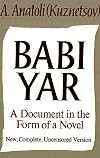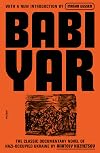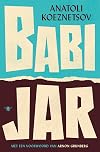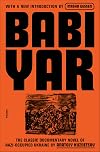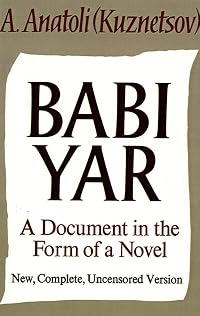
Babi Yar: A Document in the Form of a Novel
by Anatoly Kuznetsov, Anatoly Kuznetsov
On This Page
Description
An internationally acclaimed documentary novel that describes the fateful collision of Russia, Ukraine, and Nazi Germany, and one of the largest mass executions of the Holocaust"I wonder if we will ever understand that the most precious thing in this world is a man's life and his freedom? Or is there still more barbarism ahead? With these questions I think I shall bring this book to an end. I wish you peace. And freedom."At the age of 12, Anatoly Kuznetsov experienced the Nazi invasion of show more Ukraine, and soon began keeping a diary of the brutal occupation of Kiev that followed. Years later, he combined those notebooks with other survivors' memories to create a classic work of documentary witness in the form of a novel. When Babi Yar was first published in a Soviet magazine in 1966, it became a literary sensation, not least for its powerful and unprecedented narratives of the Nazi massacre of the city's Jews, and later Roma, prisoners of war, and other victims, at the Babi Yar ravine--one of the largest mass killings of the Holocaust. After Kuznetsov defected to Great Britain in 1969, he republished the book in a new edition that included extensive passages censored by Soviets, and later reflections.In its fully realized form, Babi Yar is a classic of Holocaust and World War II testimony. With sustained immediacy, it relates a scrappy but principled boy's day to day fight to survive, and provide for his family. He dodges bullets and transport to Germany, befriends black market horse dealers and prerevolutionary aristocrats, wonders at the pomp of the Nazi's opera performances, overhears his mother and grandparents debate the merits of German and Soviet rule, collects grenades, digs hiding places, and confronts the moral dilemmas of assisting neighbors or looting stores--all the while hearing the constant hum of bullets at the Babi Yar ravine nearby. In a bravura feat of reporting, he tells the story of what happened at Babi Yar--from the deceptive roundup of the city's Jews and execution of the national soccer team to the memoires of the site's few survivors, and the story of a daring escape. The book's once-censored passages explore the Soviet effort to hide the realities of the massacre, and other facts about wartime the regime did not want discussed. In the manner of Elie Wiesel's Night or The Diary of Anne Frank, here is a book that tells some of the most uncomfortable truths of the past century--and the most essential. show lessTags
Recommendations




















Member Recommendations

Cecrow Thomas borrowed several passages from Kuznetsov.
Member Reviews
“The person who today ignores politics will regret it.”
Don’t let the horrifying atrocities that the Nazis committed at Babi Yar put you off from reading this book. Yes, there are portions of it that will have you reaching to hug a loved one or weeping silently, and they are incredibly powerful, but they are just part of what’s captured here. This is dissident author Anatoly Kuznetsov writing in the mid to late 1960’s about his experiences as a 12 to 14 year old in Kyiv over 1941-43, notable for having endured brutality under both the Nazi occupation and Soviet rule before and after. This period of history is mind boggling, and he puts you right there, capturing details, the larger historical context, and writing with honesty. show more It’s a brilliant book.
Part of what made this so dangerous to Soviet leaders, even when conceived under the “Khrushchev Thaw,” was the obvious parallel between Hitler and Stalin that comes out in Kuznetsov’s writing. When it was first published in the Soviet Union in 1966, significant portions were censored, but he retained the original on microfilm, and when he sought asylum in England, he published it again in 1970. In a brilliant move, he put the writing which had been cut by censors in boldface, and then put square brackets around the material he would add while writing in England. The result is a fascinating additional window into the Soviet state, where the sensitivities were, and how difficult it was as a writer.
Kuznetsov and his family had suffered along with the rest of Ukraine during the Holodomor of 1932-33, Stalin’s brutal use of hunger to subjugate Ukraine, killing 3.5 to 5 million people. Eight years later, the Nazis invaded, and were at first a welcome sight for some Ukrainians, such as Kuznetsov’s irascible grandfather. When the Soviets retreated, the NKVD planted explosives in key places in the city, caring not about civilian casualties, including at the Kiev-Pechersk Monastery, which had long been a thorn in their side as a religious site. As a wave of these were detonated in the first week of the occupation in the Kreshchatik, the heart of the city, the Nazis used this as a pretext to have all Jewish citizens report to a meeting area, whereupon they were systematically murdered in the ravine at Babyn Yar. In the first two days, the Nazis executed close to 34,000 people.
One of the most extraordinary chapters in the book was the result of Kuznetsov the adult later interviewing Dina Mironovna Pronicheva, a woman who miraculously survived the execution by feigning death, hiding out in the pile of corpses upon corpses, and slowly crawling her way into the forest. Most of these people not killed in the first line of machine gun fire had fallen into a pile of bodies, and were then knocked over the head and/or thrown back in, with earth then thrown hastily over the top, some still moving. Pronicheva miraculously escaped, was re-captured, and then escaped again.
Over the following couple of years, the site would continue to be used on Jews, Romani, Soviet POW’s, Ukrainian nationals, members of the press, citizens suspected of any wrongdoing, those too exhausted to continue working at the nearby Syrets concentration camp, and even members of the Kyiv Dynamo team (playing as Start, Bakery No. 1) for having the temerity to beat the Germans in a match (though the causality for this last bit is still debated) – all resulting in 100,000 – 150,000 total executions. “The machine-gun chattered away in the ravine every day,” Kuznetsov writes.
Later, when the Nazis realized they had to retreat, they attempted to hide the atrocities by digging up the massive number of corpses and burning them. It was done with forced labor, with the bodies burned in piles of roughly 2,000 at a time, and Kuznetsov writes of the German precision in each phase – hooking the bodies out of the ground in a specific way so that they wouldn’t fall apart, the soaking of hair in oil and arrangement of heads outwards so that would ignite in a gigantic bonfire, and crushing any bones afterwards which hadn’t been completely burnt. Prisoners who couldn’t sustain their work were simply thrown into the pyres alive.
Kuznetsov writes with great honesty, describing civilian looting of the city, including himself, and the cruelty of non-Jewish Ukrainians on the Jews being rounded up, in some cases stealing their belongings right out of their hands, and in others, informing on those that were hiding. He describes Konstantin Mikhailovich Tishchenko, the Ukrainian thug who was made head of the concentration camp Darnitsa’s police force, and who was “more brutal than the Germans themselves,” and how other people in charge of that camp, like a man named Bizer, who would personally shoot 20-30 people a day, were never put on trial after the war. He’s candid about the insidious rise of fascism, saying that in addition to the Soviet Union having praised and glorified Hitler until he invaded, that it was also “possible even to find among the Jews of Kiev some enthusiastic admirers of Hitler as an able statesman.” Before the war, during the famine, there were cases of cannibalism, and after the war, there was a wave of anti-Semitism which caused D.M. Pronicheva to conceal the fact that she had escaped from Babi Yar.
He’s also of course direct about the atrocities of the Germans, gang-raping women before stabbing them with bayonets, ripping babies from the arms of mothers and throwing them over walls, and packing hospital patients into mobile gas chambers where exhaust gasses were piped directly into the van. They also shipped Ukrainians off to Germany under the promises of gainful employment, when the reality was they were treated as slaves, reviled by the German public, kept alive on the slimmest of rations, and women turned into prostitutes. When the allies intensified their bombing campaigns, these workers were not allowed to seek cover in air-raid shelters, and the work continued. In the Syrets concentration camp, the sadistic Paul von Radomsky and his henchmen routinely executed workers for the slightest of offenses. “They shot people for standing in the meal queue for a second time; they beat men with ‘automatics’ for not removing their hats. When the ‘hospital’ dugouts became overcrowded with sick people, they drove them outside, laid them on the ground and sprayed them with fire from submachine-guns,” Kuznetsov writes. Radomsky also devised cruel executions, like forcing prisoners to climb up into a tall tree, which was then sawed down by others, and if the victim should by chance survive, being finished off with a spade.
The propaganda was that the Germans were “bringing about cultural reform of the whole world,” with the insane belief that they were elevating it, when aside from their mass murders and sadistic brutality, the tawdry reality was that their soldiers could be seen “stealing the dirty underwear from people being executed and hooking cigarettes out of packets.”
As for life in the Soviet Union, the anecdotes he shares echo those of other dissident authors, and include the always evolving list of “enemies of the people” who would then be cut out of textbooks or photographs, the constant fear of being informed on and sent away, the assassinations of political rivals, and the long queues for basic goods.
I only had a little taste of Kyiv when I visited for a few days in 2013, but it’s devastating to read of horrifying events I traipsed by as a tourist, like the young girl near the Opera who had thrown herself out of a window, and nobody had bothered to remove the body for some time. Or Kuznetsov and his mother fleeing during an air raid to the narrow, twisting St. Andrew’s Hill (Andriivs'kyi descent), where Bulgakov’s house had been. Or clambering up a child to the domes of a building which held some of the last frescoes painted by Mikhail Vrubel.
With all of the terrible events taking place, it may be easy to overlook the quality of Kuznetsov’s writing. While my review is probably tilted towards the historical aspects, he writes of his activities during the war, like going out in search of food, logging, seeing films in the theater, learning how to make sausages out of an old donkey, and getting shot at several times. He was great at painting a picture of the people in his life through dialogue. We see the conflicts within the family, how his grandfather despised bolshevism and looked at the Nazis as liberators, while his mother and father believed in the revolution.
Through it all, his mother emerges as incredibly perceptive in her comments, some of which I extract below. The adult Kuznetsov, having witnessed brutality and endured life under dictatorships, has dark, sober views of humanity, and part of his intention, related in various asides, is to attempt to stop the patterns of history from repeating themselves. These kinds of things point out the relevance of learning about all this, in case it wasn’t already obvious, and when you look at the events occurring in the world in the present, his words burn like fire.
One of the sad aspects in the aftermath of the war was that Soviet authorities, in an anti-Semitic wave of their own, downplayed the massacre and blamed the destruction of the city on the Nazis. They attempted to fill the ravine with water and mud, resulting in a tragic flood in 1961 that killed 1500 people, and simply built apartment buildings over the concentration camp. That’s another part of what makes Kuznetsov’s writing, bearing witness, so important. I think it’s telling that when Russia invaded Ukraine in 2022, one of the first missiles to hit Kyiv landed in Babyn Yar, destroying part of the construction of a memorial there. The fact that Putin has also been destroying Ukrainian grain supplies, echoing Stalin’s use of famine, is also a bitter parallel. It seems for Ukraine, just as for Poland, these historical injustices have a way of repeating themselves. Perhaps the bitterest irony of all is in the growth of Nazi groups within Ukraine, completely oblivious to the evil this ideology wreaked in their country eight decades earlier.
Quotes:
On barbarism, and the similarity of Nazi Germany to Soviet Russia:
“In the face of such barbarism, the most precious achievements of civilization may prove quite ineffective. For example, just as in the ancient world culture was overrun by the barbarians, so in Russia, after all the achievements of philosophy, literature, and striving towards democracy, barbarism triumphed again and there was no longer any philosophy, democracy or culture, just one big concentration camp.
Then the neighboring concentration camp, in which a similar process had taken place and which wanted to extend its possession to cover at least the whole world, declared war on the other one. The U.S.S.R.’s ‘holy’ war against Hitler was nothing more than a heart-rending struggle by people who wanted to be imprisoned in their own concentration camp rather than in a foreign one, while still cherishing the hope of extending their own camp to cover the whole world.”
On books being banned; this from Kuznetsov’s mother:
“I have no faith any more. In this world there’s neither goodness nor peace nor good sense. The world is governed by evil-minded idiots. And books are always being burnt. The library at Alexandria went up in flames, the Inquisitors hid their bonfires, Radishchev was burnt, books were burnt under Stalin, there have been bonfires in the squares under Hitler, and there will always be more and more of them burnt. There are always more and more people to burn books than to write them. You have your life ahead of you, Tolya, so just remember that this is the first sign of trouble – if books are being banned, that means things are going wrong. It means that you are surrounded by force, fear, and ignorance, that power is in the hands of barbarians.”
On communism in the Soviet Union:
“Lenin caused more people to suffer than all the Tsars who went before him. And as for what Stalin did, no Tsar, not even the most brutal despot, ever dreamt of such things. We had people like Ivan the Terrible and Peter, but God apparently decided to send us a man like Stalin only just before the end of the world. We lived to see the day when a man was afraid of his own shadow. There were informers everywhere and you were afraid to open your mouth. All you could do was shout: ‘Glory to the party.’”
On the claims of not knowing of atrocities after the fact, both of Soviet and Nazis:
“A lot of books appeared by such ‘honest Communists,’ anxious to dissociate from Stalin and the party from crimes which they attributed to Yezhov or Beria.
Hypocrites. If they told the truth, they all knew and understood perfectly well everything that was going on. Only a person who DID NOT WANT TO KNOW remained ‘unaware.’ … In just the same way, following the defeat of Hitler, certain ‘honest’ Nazis declared that they had not known about the monstrous crimes committed in the death camps, or that they had believed that the Gestapo alone was to blame for everything. Hypocrites.”
On “fake news,” my goodness, the parallel to MAGA couldn’t be clearer:
“A former high-ranking officer in the Gestapo declared recently in an interview that there had never been any death camps, ovens, or gas-chambers, that all such things had been invented by propagandists. He stated, quite simply, that they had never existed. He was not as mad as he might seem. He goes on living and working like an automaton, conditioned by rules based on the principle of ‘Keep on lying – something will stick; call black white, death happiness, the Leader a god, and promise mountains of gold in the future – there will always be people ready to believe you.
… All these systems based on lies and the use of force have exposed very clearly and turned to their own advantage one of man’s weakest spots: his credulity.
… If you tell them out loud, to their faces, that they are being deceived, and that they are no more than cannon fodder and tools in the hands of scoundrels, they won’t listen. They will say it is only a malicious slander. And if you produce facts, they just won’t believe you. They will say, ‘Such things never happened.’”
On fascism, again, from his mother, in response to a German article indicating that the people were suffering from “too much education,” and that “excessively clever people are the enemies of action.”:
“Now we know where we are. The twentieth century needs manpower with some education but not too much. The slaves must know how to sign their names, read their orders and count. But excessively brainy people were always enemies of dictatorships.”
On God:
“I came to the conclusion that there probably wasn’t a God after all. And, if He did exist, why did He torment people in this way, treating them so cruelly and being so heartless towards old women and little children who had only just arrived in this world? It was a fine form of amusement the Almighty had devised for Himself. If I should ever come across Him I would not think of praying to Him but I’d want to punch Him in the face for what He had done on earth. I couldn’t respect such a God. He simply didn’t exist. It was people who made it that way.”
On human nature:
“Unhappy people: what have you done to deserve such a fate? You are born like hungry, cold, homeless puppies on a rubbish dump. The rain whips down on you, the frosts bite you, and death threatens you. You can’t escape anywhere; there’s nowhere to hide. So where is all this justice you talk about, where are you all, clever people of this world?
Just throw the word ‘compassion’ out of the vocabulary. There is no such thing. There is no compassion on this earth.”
On power:
“They’re all as bad as one another, Lena said. It’s the same story over and over again: whoever happens to be the latest scoundrel to get into power always declares right away that till he came along everything was wrong, that the struggle for a better future was only just beginning, and that therefore people would have to make sacrifices. Right from the outset – sacrifices! Sacrifices! The scoundrels!”
On wars to “liberate,” an interesting parallel to Putin’s propaganda:
“Then an absolutely fabulous war with Poland broke out. With Hitler coming from the west and us coming from the east, there was soon nothing left of Poland. Of course, for the sake of appearances we called it ‘the liberation of Western Ukraine and Byelorussia’ and put up posters showing a ragged Ukrainian embracing a brave Red-Army man – his liberator. But that was the usual thing. Anyone who attacks is always liberating somebody from something or other.” show less
Don’t let the horrifying atrocities that the Nazis committed at Babi Yar put you off from reading this book. Yes, there are portions of it that will have you reaching to hug a loved one or weeping silently, and they are incredibly powerful, but they are just part of what’s captured here. This is dissident author Anatoly Kuznetsov writing in the mid to late 1960’s about his experiences as a 12 to 14 year old in Kyiv over 1941-43, notable for having endured brutality under both the Nazi occupation and Soviet rule before and after. This period of history is mind boggling, and he puts you right there, capturing details, the larger historical context, and writing with honesty. show more It’s a brilliant book.
Part of what made this so dangerous to Soviet leaders, even when conceived under the “Khrushchev Thaw,” was the obvious parallel between Hitler and Stalin that comes out in Kuznetsov’s writing. When it was first published in the Soviet Union in 1966, significant portions were censored, but he retained the original on microfilm, and when he sought asylum in England, he published it again in 1970. In a brilliant move, he put the writing which had been cut by censors in boldface, and then put square brackets around the material he would add while writing in England. The result is a fascinating additional window into the Soviet state, where the sensitivities were, and how difficult it was as a writer.
Kuznetsov and his family had suffered along with the rest of Ukraine during the Holodomor of 1932-33, Stalin’s brutal use of hunger to subjugate Ukraine, killing 3.5 to 5 million people. Eight years later, the Nazis invaded, and were at first a welcome sight for some Ukrainians, such as Kuznetsov’s irascible grandfather. When the Soviets retreated, the NKVD planted explosives in key places in the city, caring not about civilian casualties, including at the Kiev-Pechersk Monastery, which had long been a thorn in their side as a religious site. As a wave of these were detonated in the first week of the occupation in the Kreshchatik, the heart of the city, the Nazis used this as a pretext to have all Jewish citizens report to a meeting area, whereupon they were systematically murdered in the ravine at Babyn Yar. In the first two days, the Nazis executed close to 34,000 people.
One of the most extraordinary chapters in the book was the result of Kuznetsov the adult later interviewing Dina Mironovna Pronicheva, a woman who miraculously survived the execution by feigning death, hiding out in the pile of corpses upon corpses, and slowly crawling her way into the forest. Most of these people not killed in the first line of machine gun fire had fallen into a pile of bodies, and were then knocked over the head and/or thrown back in, with earth then thrown hastily over the top, some still moving. Pronicheva miraculously escaped, was re-captured, and then escaped again.
Over the following couple of years, the site would continue to be used on Jews, Romani, Soviet POW’s, Ukrainian nationals, members of the press, citizens suspected of any wrongdoing, those too exhausted to continue working at the nearby Syrets concentration camp, and even members of the Kyiv Dynamo team (playing as Start, Bakery No. 1) for having the temerity to beat the Germans in a match (though the causality for this last bit is still debated) – all resulting in 100,000 – 150,000 total executions. “The machine-gun chattered away in the ravine every day,” Kuznetsov writes.
Later, when the Nazis realized they had to retreat, they attempted to hide the atrocities by digging up the massive number of corpses and burning them. It was done with forced labor, with the bodies burned in piles of roughly 2,000 at a time, and Kuznetsov writes of the German precision in each phase – hooking the bodies out of the ground in a specific way so that they wouldn’t fall apart, the soaking of hair in oil and arrangement of heads outwards so that would ignite in a gigantic bonfire, and crushing any bones afterwards which hadn’t been completely burnt. Prisoners who couldn’t sustain their work were simply thrown into the pyres alive.
Kuznetsov writes with great honesty, describing civilian looting of the city, including himself, and the cruelty of non-Jewish Ukrainians on the Jews being rounded up, in some cases stealing their belongings right out of their hands, and in others, informing on those that were hiding. He describes Konstantin Mikhailovich Tishchenko, the Ukrainian thug who was made head of the concentration camp Darnitsa’s police force, and who was “more brutal than the Germans themselves,” and how other people in charge of that camp, like a man named Bizer, who would personally shoot 20-30 people a day, were never put on trial after the war. He’s candid about the insidious rise of fascism, saying that in addition to the Soviet Union having praised and glorified Hitler until he invaded, that it was also “possible even to find among the Jews of Kiev some enthusiastic admirers of Hitler as an able statesman.” Before the war, during the famine, there were cases of cannibalism, and after the war, there was a wave of anti-Semitism which caused D.M. Pronicheva to conceal the fact that she had escaped from Babi Yar.
He’s also of course direct about the atrocities of the Germans, gang-raping women before stabbing them with bayonets, ripping babies from the arms of mothers and throwing them over walls, and packing hospital patients into mobile gas chambers where exhaust gasses were piped directly into the van. They also shipped Ukrainians off to Germany under the promises of gainful employment, when the reality was they were treated as slaves, reviled by the German public, kept alive on the slimmest of rations, and women turned into prostitutes. When the allies intensified their bombing campaigns, these workers were not allowed to seek cover in air-raid shelters, and the work continued. In the Syrets concentration camp, the sadistic Paul von Radomsky and his henchmen routinely executed workers for the slightest of offenses. “They shot people for standing in the meal queue for a second time; they beat men with ‘automatics’ for not removing their hats. When the ‘hospital’ dugouts became overcrowded with sick people, they drove them outside, laid them on the ground and sprayed them with fire from submachine-guns,” Kuznetsov writes. Radomsky also devised cruel executions, like forcing prisoners to climb up into a tall tree, which was then sawed down by others, and if the victim should by chance survive, being finished off with a spade.
The propaganda was that the Germans were “bringing about cultural reform of the whole world,” with the insane belief that they were elevating it, when aside from their mass murders and sadistic brutality, the tawdry reality was that their soldiers could be seen “stealing the dirty underwear from people being executed and hooking cigarettes out of packets.”
As for life in the Soviet Union, the anecdotes he shares echo those of other dissident authors, and include the always evolving list of “enemies of the people” who would then be cut out of textbooks or photographs, the constant fear of being informed on and sent away, the assassinations of political rivals, and the long queues for basic goods.
I only had a little taste of Kyiv when I visited for a few days in 2013, but it’s devastating to read of horrifying events I traipsed by as a tourist, like the young girl near the Opera who had thrown herself out of a window, and nobody had bothered to remove the body for some time. Or Kuznetsov and his mother fleeing during an air raid to the narrow, twisting St. Andrew’s Hill (Andriivs'kyi descent), where Bulgakov’s house had been. Or clambering up a child to the domes of a building which held some of the last frescoes painted by Mikhail Vrubel.
With all of the terrible events taking place, it may be easy to overlook the quality of Kuznetsov’s writing. While my review is probably tilted towards the historical aspects, he writes of his activities during the war, like going out in search of food, logging, seeing films in the theater, learning how to make sausages out of an old donkey, and getting shot at several times. He was great at painting a picture of the people in his life through dialogue. We see the conflicts within the family, how his grandfather despised bolshevism and looked at the Nazis as liberators, while his mother and father believed in the revolution.
Through it all, his mother emerges as incredibly perceptive in her comments, some of which I extract below. The adult Kuznetsov, having witnessed brutality and endured life under dictatorships, has dark, sober views of humanity, and part of his intention, related in various asides, is to attempt to stop the patterns of history from repeating themselves. These kinds of things point out the relevance of learning about all this, in case it wasn’t already obvious, and when you look at the events occurring in the world in the present, his words burn like fire.
One of the sad aspects in the aftermath of the war was that Soviet authorities, in an anti-Semitic wave of their own, downplayed the massacre and blamed the destruction of the city on the Nazis. They attempted to fill the ravine with water and mud, resulting in a tragic flood in 1961 that killed 1500 people, and simply built apartment buildings over the concentration camp. That’s another part of what makes Kuznetsov’s writing, bearing witness, so important. I think it’s telling that when Russia invaded Ukraine in 2022, one of the first missiles to hit Kyiv landed in Babyn Yar, destroying part of the construction of a memorial there. The fact that Putin has also been destroying Ukrainian grain supplies, echoing Stalin’s use of famine, is also a bitter parallel. It seems for Ukraine, just as for Poland, these historical injustices have a way of repeating themselves. Perhaps the bitterest irony of all is in the growth of Nazi groups within Ukraine, completely oblivious to the evil this ideology wreaked in their country eight decades earlier.
Quotes:
On barbarism, and the similarity of Nazi Germany to Soviet Russia:
“In the face of such barbarism, the most precious achievements of civilization may prove quite ineffective. For example, just as in the ancient world culture was overrun by the barbarians, so in Russia, after all the achievements of philosophy, literature, and striving towards democracy, barbarism triumphed again and there was no longer any philosophy, democracy or culture, just one big concentration camp.
Then the neighboring concentration camp, in which a similar process had taken place and which wanted to extend its possession to cover at least the whole world, declared war on the other one. The U.S.S.R.’s ‘holy’ war against Hitler was nothing more than a heart-rending struggle by people who wanted to be imprisoned in their own concentration camp rather than in a foreign one, while still cherishing the hope of extending their own camp to cover the whole world.”
On books being banned; this from Kuznetsov’s mother:
“I have no faith any more. In this world there’s neither goodness nor peace nor good sense. The world is governed by evil-minded idiots. And books are always being burnt. The library at Alexandria went up in flames, the Inquisitors hid their bonfires, Radishchev was burnt, books were burnt under Stalin, there have been bonfires in the squares under Hitler, and there will always be more and more of them burnt. There are always more and more people to burn books than to write them. You have your life ahead of you, Tolya, so just remember that this is the first sign of trouble – if books are being banned, that means things are going wrong. It means that you are surrounded by force, fear, and ignorance, that power is in the hands of barbarians.”
On communism in the Soviet Union:
“Lenin caused more people to suffer than all the Tsars who went before him. And as for what Stalin did, no Tsar, not even the most brutal despot, ever dreamt of such things. We had people like Ivan the Terrible and Peter, but God apparently decided to send us a man like Stalin only just before the end of the world. We lived to see the day when a man was afraid of his own shadow. There were informers everywhere and you were afraid to open your mouth. All you could do was shout: ‘Glory to the party.’”
On the claims of not knowing of atrocities after the fact, both of Soviet and Nazis:
“A lot of books appeared by such ‘honest Communists,’ anxious to dissociate from Stalin and the party from crimes which they attributed to Yezhov or Beria.
Hypocrites. If they told the truth, they all knew and understood perfectly well everything that was going on. Only a person who DID NOT WANT TO KNOW remained ‘unaware.’ … In just the same way, following the defeat of Hitler, certain ‘honest’ Nazis declared that they had not known about the monstrous crimes committed in the death camps, or that they had believed that the Gestapo alone was to blame for everything. Hypocrites.”
On “fake news,” my goodness, the parallel to MAGA couldn’t be clearer:
“A former high-ranking officer in the Gestapo declared recently in an interview that there had never been any death camps, ovens, or gas-chambers, that all such things had been invented by propagandists. He stated, quite simply, that they had never existed. He was not as mad as he might seem. He goes on living and working like an automaton, conditioned by rules based on the principle of ‘Keep on lying – something will stick; call black white, death happiness, the Leader a god, and promise mountains of gold in the future – there will always be people ready to believe you.
… All these systems based on lies and the use of force have exposed very clearly and turned to their own advantage one of man’s weakest spots: his credulity.
… If you tell them out loud, to their faces, that they are being deceived, and that they are no more than cannon fodder and tools in the hands of scoundrels, they won’t listen. They will say it is only a malicious slander. And if you produce facts, they just won’t believe you. They will say, ‘Such things never happened.’”
On fascism, again, from his mother, in response to a German article indicating that the people were suffering from “too much education,” and that “excessively clever people are the enemies of action.”:
“Now we know where we are. The twentieth century needs manpower with some education but not too much. The slaves must know how to sign their names, read their orders and count. But excessively brainy people were always enemies of dictatorships.”
On God:
“I came to the conclusion that there probably wasn’t a God after all. And, if He did exist, why did He torment people in this way, treating them so cruelly and being so heartless towards old women and little children who had only just arrived in this world? It was a fine form of amusement the Almighty had devised for Himself. If I should ever come across Him I would not think of praying to Him but I’d want to punch Him in the face for what He had done on earth. I couldn’t respect such a God. He simply didn’t exist. It was people who made it that way.”
On human nature:
“Unhappy people: what have you done to deserve such a fate? You are born like hungry, cold, homeless puppies on a rubbish dump. The rain whips down on you, the frosts bite you, and death threatens you. You can’t escape anywhere; there’s nowhere to hide. So where is all this justice you talk about, where are you all, clever people of this world?
Just throw the word ‘compassion’ out of the vocabulary. There is no such thing. There is no compassion on this earth.”
On power:
“They’re all as bad as one another, Lena said. It’s the same story over and over again: whoever happens to be the latest scoundrel to get into power always declares right away that till he came along everything was wrong, that the struggle for a better future was only just beginning, and that therefore people would have to make sacrifices. Right from the outset – sacrifices! Sacrifices! The scoundrels!”
On wars to “liberate,” an interesting parallel to Putin’s propaganda:
“Then an absolutely fabulous war with Poland broke out. With Hitler coming from the west and us coming from the east, there was soon nothing left of Poland. Of course, for the sake of appearances we called it ‘the liberation of Western Ukraine and Byelorussia’ and put up posters showing a ragged Ukrainian embracing a brave Red-Army man – his liberator. But that was the usual thing. Anyone who attacks is always liberating somebody from something or other.” show less
This book is brilliant -- by far a top-tier Holocaust book and World War II book in general. The author was a boy of twelve when the Nazi occupation of Kiev began, and began recording his experiences then; these jottings were part of the basis for this book, which is both a memoir and a documentary nonfiction.
Although the story centers around the September 1941 mass murder of some 33,000 Jews at Babi Yar, a ravine outside Kiev, that's not all this story is. Kuznetsov's writing encompasses far more than that, and you really get a feel of what life must be like in a war-ravaged city. His description of the destruction of the Kreshchatik (the oldest and most beautiful section of Kiev) made me think of how New York City must have been like show more after 9-11 -- except the Kreshchatik bombings were a lot worse. In his list of "the number of times I should have been shot," Kuznetsov shows that all the inhabitants of Kiev (not just the Jews or soldiers or political activists or partisans, but EVERYONE) had to risk their lives every day, and how many lost their lives simply by being there. He includes printings of actual primary source documents such as memos, reports, handbills etc., from this time period as well as his own writings.
Most intriguingly: Babi Yar was initially published in Russia during the 1960s. I'm surprised it was published at all, as it was very critical of the Soviet regime. In any case the Soviet censors redacted large parts of it. When Kuznetsov defected to England, he took the original manuscript with him on microfilm, and added parts to it before publishing it in full in the West. The original Soviet text is in regular type, the parts the Soviet censors cut out are in boldface, and the parts Kuznetsov added after his arrival in England are in brackets. It's interesting to see what was taken out and what was allowed -- they made some surprising choices.
I really cannot recommend this book highly enough, for Holocaust scholars and World War II scholars alike. show less
Although the story centers around the September 1941 mass murder of some 33,000 Jews at Babi Yar, a ravine outside Kiev, that's not all this story is. Kuznetsov's writing encompasses far more than that, and you really get a feel of what life must be like in a war-ravaged city. His description of the destruction of the Kreshchatik (the oldest and most beautiful section of Kiev) made me think of how New York City must have been like show more after 9-11 -- except the Kreshchatik bombings were a lot worse. In his list of "the number of times I should have been shot," Kuznetsov shows that all the inhabitants of Kiev (not just the Jews or soldiers or political activists or partisans, but EVERYONE) had to risk their lives every day, and how many lost their lives simply by being there. He includes printings of actual primary source documents such as memos, reports, handbills etc., from this time period as well as his own writings.
Most intriguingly: Babi Yar was initially published in Russia during the 1960s. I'm surprised it was published at all, as it was very critical of the Soviet regime. In any case the Soviet censors redacted large parts of it. When Kuznetsov defected to England, he took the original manuscript with him on microfilm, and added parts to it before publishing it in full in the West. The original Soviet text is in regular type, the parts the Soviet censors cut out are in boldface, and the parts Kuznetsov added after his arrival in England are in brackets. It's interesting to see what was taken out and what was allowed -- they made some surprising choices.
I really cannot recommend this book highly enough, for Holocaust scholars and World War II scholars alike. show less
If you were only ever going to read one WW II book which was told by civilians living in occupied territory, this is the book to read. It's a war story, a survivor story, a story of genocide, horror, hardship, and devastation.
Babi Yar is a true story. A. Anatoli (Kuznetsov) was 12 years old when Germany invaded Kiev in 1941. He documented everything he saw, heard, and endured during the 2 years of German occupation. A few years later, as an adult back under Soviet rule, he wrote the book and had it published. But it wasn't until 1969 when he escaped Russia with his original manuscript that he had the full uncensored story published in the United States.
Babi Yar was a ravine on the outskirts of Kiev. The Germans turned it into a grave show more site for hundreds of thousands of people of Jewish descent, gypsies, and any civilian that rubbed them the wrong way; innocent people, the elderly and ill, women, and children. A concentration camp; a death camp;a massive grave. Anatoli never entered the barbed wire gates of the death camp but listened to daily gunshots, smelled the rancid odor of burning flesh, and even talked to the guards on at least one occasion. Every day of those 2 years of German occupation was a challenge of survival for Anatoli. Weakened to the point of near starvation he somehow summoned the energy and courage to search for food for himself and his mother while avoiding the clutches of the German soldiers. And all the while he kept a journal documenting stories of those who avoided Babi Yar and several survivors who escaped from inside Babi Yar. Anatoli had the mature fore-site to put his experiences in writing and the moral commitment to make sure the world learned the truth.
This is an incredible book. The reader can envision war's horrible consequences from the eyes of many different people. And if you ever wondered how people could have just "stood by" and watched the holocaust happen, this book brings to light how it happened.
It is a tragedy that there is no memorial for those who perished in Babi Yar. The Soviet communist party did not think it was worthy of any special recognition. "In fact, with the spread of government inspired anti-Semitism between 1948 and 1953 the question of erecting a monument was dropped". For decades after the war ended the Soviet government declared there were no concentration camps in the USSR. The Germans had called Babi Yar a "building site". Today the sight is covered with houses and a huge television centre (studio). No evidence of the crimes committed remains. "the ashes were blown away and the bones buried deep under the earth". The book serves as the memorial. show less
Babi Yar is a true story. A. Anatoli (Kuznetsov) was 12 years old when Germany invaded Kiev in 1941. He documented everything he saw, heard, and endured during the 2 years of German occupation. A few years later, as an adult back under Soviet rule, he wrote the book and had it published. But it wasn't until 1969 when he escaped Russia with his original manuscript that he had the full uncensored story published in the United States.
Babi Yar was a ravine on the outskirts of Kiev. The Germans turned it into a grave show more site for hundreds of thousands of people of Jewish descent, gypsies, and any civilian that rubbed them the wrong way; innocent people, the elderly and ill, women, and children. A concentration camp; a death camp;a massive grave. Anatoli never entered the barbed wire gates of the death camp but listened to daily gunshots, smelled the rancid odor of burning flesh, and even talked to the guards on at least one occasion. Every day of those 2 years of German occupation was a challenge of survival for Anatoli. Weakened to the point of near starvation he somehow summoned the energy and courage to search for food for himself and his mother while avoiding the clutches of the German soldiers. And all the while he kept a journal documenting stories of those who avoided Babi Yar and several survivors who escaped from inside Babi Yar. Anatoli had the mature fore-site to put his experiences in writing and the moral commitment to make sure the world learned the truth.
This is an incredible book. The reader can envision war's horrible consequences from the eyes of many different people. And if you ever wondered how people could have just "stood by" and watched the holocaust happen, this book brings to light how it happened.
It is a tragedy that there is no memorial for those who perished in Babi Yar. The Soviet communist party did not think it was worthy of any special recognition. "In fact, with the spread of government inspired anti-Semitism between 1948 and 1953 the question of erecting a monument was dropped". For decades after the war ended the Soviet government declared there were no concentration camps in the USSR. The Germans had called Babi Yar a "building site". Today the sight is covered with houses and a huge television centre (studio). No evidence of the crimes committed remains. "the ashes were blown away and the bones buried deep under the earth". The book serves as the memorial. show less
[b:Babi Yar: A Document in the Form of a Novel; New, Complete, Uncensored Version|123905839|Babi Yar A Document in the Form of a Novel; New, Complete, Uncensored Version|Anatoly Kuznetsov|https://i.gr-assets.com/images/S/compressed.photo.goodreads.com/books/1680035040l/123905839._SY75_.jpg|145239443] by [a:Anatoly Kuznetsov|2283304|Anatoly Kuznetsov|https://images.gr-assets.com/authors/1225370671p2/2283304.jpg] is a documentary novel about the Nazi occupation of Kyiv in Ukraine and the massacres at Babi Yar. The two-day murder of 33,771 Jewish civilians on 29–30 September 1941, in the Kyiv ravine was one of the largest single mass killings of the Holocaust. After the initial massacre of Jewish people, Babi Yar remained in use as an show more execution site for Soviet prisoners of war and the Roma people. Soviet accounts after the war estimate in the region of 100,000 men women and children were murdered here.
This is the new uncensored form, as a censored version was first published in a soviet magazine in 1966. In this this new version we get Anatoly’s story in full and as it was meant to be read. Words, sentences, paragraphs and whole pages that were erased by Soviet censorship from the first edition are now highlighted for the reader in the version of the book. This was such an interesting aspect of the book, to see how the censors cut away large chunks of the story and how this would would have affected reading the book at the time it was published.
This is not by any means an easy read, its a heartbreaking and quite a daunting book, but for me an important documentary novel that will stay with me forever. It’s not a book I can recommend easily to bookish friends as it’s a slow burn, harrowing and did take me a few weeks to get through. Having said that I have learned so much about Ukraine and Babi Yar and was such an enlightening read and important read for me.
I think its worth quoting [a:Anatoly Kuznetsov|2283304|Anatoly Kuznetsov|https://images.gr-assets.com/authors/1225370671p2/2283304.jpg]’s last few lines in the novel and remembering they were written pre 1966.
I wonder if we shall ever understand that the most precious thing in this world is a man’s life and his freedom? or is there still more barbarism ahead?
With these questions I think I shall bring this book to an end. I wish you peace. [And freedom].
I think there is a lengthy bookclub discussion in these few lines alone. show less
This is the new uncensored form, as a censored version was first published in a soviet magazine in 1966. In this this new version we get Anatoly’s story in full and as it was meant to be read. Words, sentences, paragraphs and whole pages that were erased by Soviet censorship from the first edition are now highlighted for the reader in the version of the book. This was such an interesting aspect of the book, to see how the censors cut away large chunks of the story and how this would would have affected reading the book at the time it was published.
This is not by any means an easy read, its a heartbreaking and quite a daunting book, but for me an important documentary novel that will stay with me forever. It’s not a book I can recommend easily to bookish friends as it’s a slow burn, harrowing and did take me a few weeks to get through. Having said that I have learned so much about Ukraine and Babi Yar and was such an enlightening read and important read for me.
I think its worth quoting [a:Anatoly Kuznetsov|2283304|Anatoly Kuznetsov|https://images.gr-assets.com/authors/1225370671p2/2283304.jpg]’s last few lines in the novel and remembering they were written pre 1966.
I wonder if we shall ever understand that the most precious thing in this world is a man’s life and his freedom? or is there still more barbarism ahead?
With these questions I think I shall bring this book to an end. I wish you peace. [And freedom].
I think there is a lengthy bookclub discussion in these few lines alone. show less
Babi Yar was included on so many Top 100 lists that I was intrigued, and I can't say I was disappointed in the book, but it wasn't the gripping expose I'd expected. The free-flowing structure makes for an easy read, with anecdotal vignettes loosely fitted together, like pages of an autobiography scattered about in a war-torn field (and not necessarily put back together in the "proper" order.) It is an idealistic anti-fascist testimony that documents the massacre of Ukrainian Jews and so many others--some arbitrary bystanders--the Nazis found to be "undesirable." Its compelling account of the sheer circumstances of how some live and many do not survive a war is captivating, and I believe I will remember this book for quite some time. show more I've spent countless hours examining the horrid images on the U.S. Holocaust Museum website, and Babi Yar gives voice to the helplessness and fatalism that must have been pervasive for all of those tragic victims of the war. show less
Babi Yar is a ravine near the city of Kiev where the Nazis massacred thousands of Jews during World War II, primarily shooting them as they stood naked on the edge of the ravine. The author was a 12 year old boy living in Kiev, and this book describes his experiences surviving under the Nazi occupation of Kiev. As he narrates, he frequently reminds the reader that everything he is saying is true.
The author did not directly witness the atrocities at Babi Yar, although he and other residents of Kiev heard the constant sound of gunfire, day after day. He does, however, include what he says are close to verbatim accounts by some of those who narrowly escaped death at Babi Yar. The author himself, although not a Jew, frequently had to dodge show more deportation to Germany to work in the factories, and daily faced starvation.
I had long heard of this book, and expected a lot more from it than I got, perhaps because there have been so many more personal accounts of surviving the Holocaust that were published after Babi Yar. Babi Yar was important at the time it was published, because it was one of the first, if not the first, open admission by the Soviets that these events occurred. This book, along with Yevtushenko's moving poem opened the dialogue in the Soviet Union, and the world on the massacre. show less
The author did not directly witness the atrocities at Babi Yar, although he and other residents of Kiev heard the constant sound of gunfire, day after day. He does, however, include what he says are close to verbatim accounts by some of those who narrowly escaped death at Babi Yar. The author himself, although not a Jew, frequently had to dodge show more deportation to Germany to work in the factories, and daily faced starvation.
I had long heard of this book, and expected a lot more from it than I got, perhaps because there have been so many more personal accounts of surviving the Holocaust that were published after Babi Yar. Babi Yar was important at the time it was published, because it was one of the first, if not the first, open admission by the Soviets that these events occurred. This book, along with Yevtushenko's moving poem opened the dialogue in the Soviet Union, and the world on the massacre. show less
I first read Babi Yar as a teenager, maybe for school? I always hate to say that I "enjoyed" a book about something as horrific as the Holocaust, but I did enjoy reading the book back then. I recently got a box of books about the Holocaust & have been slowly going through them, separating the ones I wanted to read or reread from the rest. I decided to reread Babi Yar. It's a very honest & blunt look at the horror of the event. I don't remember it being so slow-going when I read it the first time, but as an adult I did notice the pace seemed slow. This is not a bad thing, however, as I think the pace gives you more time to digest & think about what is going on. It is of course one of those classic Holocaust books that every amateur show more historian needs to read at least once. show less
Members
- Recently Added By
Lists

Russian Literature
184 works; 35 members

A Ukraine Reading List
121 works; 90 members

All Things Russia
459 works; 11 members
Author Information

17 Works 714 Members
2 Works 678 Members
Some Editions
Awards and Honors
Distinctions
Common Knowledge
- Canonical title
- Babi Yar: A Document in the Form of a Novel
- Original title
- Babi Yar
- Alternate titles
- Babi Yar: The Shattering Documentary Novel of Nazi Inhumanity
- Original publication date
- 1966 (censored edition) (censored edition); 1970 (complete edition) (complete edition)
- Important places
- Kyiv, Ukraine; Babi Yar, Ukraine
- Important events
- Holocaust
- Epigraph*
- /
- Dedication*
- /
- First words
- This book contains nothing but the truth.
- Quotations
- That there is in this world neither brains, nor goodness, nor good sense, but only brute force. Bloodshed. Starvation. Death. That there was not the slightest hope not even a glimmer of hope, of justice being done. It would n... (show all)ever happen. No one would ever do it. The world was just one big Babi Yar. And there two great forces had come up against each other and were striking against each other like hammer and anvil, and the wretched people were in between, with no way out; each individual wanted only to live and not be maltreated, to have something to eat, and yet they howled and screamed and in their fear they were grabbing at each other's throats, while I, little blob of watery jelly, was sitting in the midst of this dark world. Why? What for? Who had done it all? There was nothing, after all, to hope for! Winter. Night.
- Last words
- (Click to show. Warning: May contain spoilers.)I wish you peace. And freedom.
- Original language
- Russian
- Canonical DDC/MDS
- 891.7344
- Canonical LCC
- PG3478.N34
*Some information comes from Common Knowledge in other languages. Click "Edit" for more information.
Classifications
- Genre
- Fiction and Literature
- DDC/MDS
- 891.7344 — Literature & rhetoric Literatures of other languages East Indo-European and Celtic literatures Russian and East Slavic languages Russian fiction USSR 1917–1991 Late 20th century 1917–1991
- LCC
- PG3478 .N34 — Language and Literature Slavic languages and literatures. Baltic languages. Albanian language Slavic. Baltic. Albanian Russian literature Individual authors and works 1961-2000
- BISAC
Statistics
- Members
- 677
- Popularity
- 42,355
- Reviews
- 16
- Rating
- (4.20)
- Languages
- 9 — Dutch, English, French, German, Hebrew, Italian, Norwegian (Bokmål), Russian, Swedish
- Media
- Paper, Ebook
- ISBNs
- 26
- ASINs
- 15