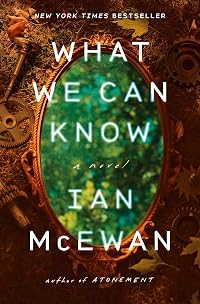
What We Can Know
by Ian McEwan
On This Page
Description
2014: At a dinner for close friends and colleagues, renowned poet Francis Blundy honors his wife's birthday by reading aloud a new poem dedicated to her, 'A Corona for Vivien'. Much wine is drunk as the guests listen, and a delicious meal consumed. Little does anyone gathered around the candlelit table know that for generations to come people will speculate about the message of this poem, a copy of which has never been found, and which remains an enduring mystery. 2119: Just over one hundred show more years in the future, much of the western world has been submerged by rising seas following a catastrophic nuclear accident. Those who survive are haunted by the richness of the world that has been lost. In the water-logged south of what used to be England, Thomas Metcalfe, a lonely scholar and researcher, longs for the early twenty-first century as he chases the ghost of one poem, 'A Corona for Vivian'. How wild and full of risk their lives were, thinks Thomas, as he pores over the archives of that distant era, captivated by the freedoms and possibilities of human life at its zenith. When he stumbles across a clue that may lead to the elusive poem's discovery, a story is revealed of entangled loves and a brutal crime that destroy his assumptions about people he thought he knew intimately well. What We Can Know is a masterpiece, a fictional tour de force, a love story about both people and the words they leave behind, a literary detective story which reclaims the present from our sense of looming catastrophe and imagines a future world where all is not quite lost. show lessTags
Recommendations





Member Reviews
He called it A Corona for Vivien: fourteen sonnets linked head to tail, each feeding upon the last. A perfect ring — like love, or delusion.” - Ian McEwan 2025
Ian McEwan’s latest novel, Wha We Can Know is an interesting look at our world through the eyes of a scholar. Professor Thomas Metcalfe is living a thousand years in the future, on an island in what was once part of an area in southern England. Coupled with the professor’s personal life in the 22nd century we learn of the world pre and post “the Derangement” which was brought about not with a bang but a whimper.
Great Britain has been reduced to an archipelago. The continents largely under water, major cities have vanished under oceans. Oceans transformed into seas. show more Small islands are scattered throughput the globe, though some large land masses still exist. Nigeria and the USA still exist though changed. The USA has become a battleground of warlords, much like Europe in the time of Charlemagne. All this being the result of wars, AI and the climate crisis which have together brought humanity to a world where a new order is yet to develop.
We see both worlds through the eyes of the 22nd century professor, Tom. He’s immediate research interest is that of finding the lost corona, A poem that was written by the celebrated fictional 21st century English poet Francis Blundy to his wife in the mid 21st century.
There’s lots to keep the reader entertained, love affairs, betrayals, even a murder. Looking at our own world through the eyes of people living in the not so distant future is fascinating. This is unlike so many post apocalypses novels, where the emphasis is on the Earth’s destruction and the distant future. The 22nd century people in the novel are close enough in time to our own zeitgeist for us to relate. It is interesting to speculate on how they see our world and what they understand and what they don’t.
What Can Know is McEwan at his best. The novel entertains, is erudite, clever, and its structure echoes the corona form, the subject of one particular poem being the mystery that is the major plot of the novel.
Highly recommended. show less
Ian McEwan’s latest novel, Wha We Can Know is an interesting look at our world through the eyes of a scholar. Professor Thomas Metcalfe is living a thousand years in the future, on an island in what was once part of an area in southern England. Coupled with the professor’s personal life in the 22nd century we learn of the world pre and post “the Derangement” which was brought about not with a bang but a whimper.
Great Britain has been reduced to an archipelago. The continents largely under water, major cities have vanished under oceans. Oceans transformed into seas. show more Small islands are scattered throughput the globe, though some large land masses still exist. Nigeria and the USA still exist though changed. The USA has become a battleground of warlords, much like Europe in the time of Charlemagne. All this being the result of wars, AI and the climate crisis which have together brought humanity to a world where a new order is yet to develop.
We see both worlds through the eyes of the 22nd century professor, Tom. He’s immediate research interest is that of finding the lost corona, A poem that was written by the celebrated fictional 21st century English poet Francis Blundy to his wife in the mid 21st century.
There’s lots to keep the reader entertained, love affairs, betrayals, even a murder. Looking at our own world through the eyes of people living in the not so distant future is fascinating. This is unlike so many post apocalypses novels, where the emphasis is on the Earth’s destruction and the distant future. The 22nd century people in the novel are close enough in time to our own zeitgeist for us to relate. It is interesting to speculate on how they see our world and what they understand and what they don’t.
What Can Know is McEwan at his best. The novel entertains, is erudite, clever, and its structure echoes the corona form, the subject of one particular poem being the mystery that is the major plot of the novel.
Highly recommended. show less
Summary: A researcher in 2119 seeks a lost poem read at a famous dinner in 2014, reconstructing the circumstances of the dinner.
In 2014, famous poet Francis Blundy hosted a dinner in honor of his wife’s birthday. During the dinner, he read a poem written for Vivien in the form of a corona. A corona is a “crown of sonnets” consisting of fifteen sonnets, often addressed to one person. The last line of each sonnet is repeated in the first line of the next. Finally, the fifteenth sonnet consists of the last lines of the first fourteen, and makes sense! Blundy wrote it out on vellum and, after the reading, presented it to Vivian, After the dinner, its whereabouts became unknown. The dinner became known as the Second Immortals Dinner. show more The first was in 1817, with Wordsworth, Keats, and Charles Lamb among the guests of painter Ben Haydon.
In the 2030’s, cataclysmic events occurred. Climate change resulted in wars over resources, including the limited use of nuclear weapons. One of these, intended for the United States landed in the mid-Atlantic, creating a giant tsunami inundating the low lying areas of the Americas and Europe and western Africa. Paradoxically, these bombs resulted in a cooling of the planet. The period was called the Derangement and by the following century, the Earth’s population was down to four billion.
McEwan envisions a world in 2119 that suffered both the loss of much and retained the vestiges of advanced civilization. Regions of the United States are at war. Nigeria controls the internet. But there are still universities in what is left of the United Kingdom. Among the researchers, Thomas Metcalfe studies the years prior to the Derangement. His interest has focused in on the dinner and the lost poem. Instead of the coup of discovery, all he can know are the circumstances surrounding the dinner. Particularly, this included the lives and loves of the guests.
He knows of the tragic first marriage of Vivien Blundy to Percy. This big bear of a man built beautiful musical instruments, including working on a replica of a Guarnieri violin. That is, until early onset Alzheimer’s struck. He knows of the dalliances with Blundy’s brother-in-law Harry, and the meeting pf Francis and Vivien. All this took place prior to Percy’s death from a fall. Vivien subsequently married Francis, setting up in her own studio near the main building called the Barn.
But Metcalfe’s career and life seem stalled. He’s in an off again/on again relationship with Rose, a fellow lecturer on the period. They even teach classes together. Research trips to the Blundy archives turn up lots of trivia about the Blundy’s but nothing on the poem. That is, until an archivist passes along a slip of paper. On it are scratched numbers that Thomas figures out are map coordinates.
When students, no longer interested in how writers dealt with or avoided the impending Derangement, walk out of Thomas and Rose’s class, they conclude it’s time to seek out the coordinates. It turns out they are on the site of the home where Vivien lived after Francis’ death. Could this be the poem’s hiding place? Thomas and Rose embark on a boat trip to an isolated island, hike through overgrowth, find the site and dig up a sealed container.
This is all in the first part of the novel. The second part tells us what they found, and will answer the question of what happened to the poem. It reveals how much they did not know. McEwan leaves the impact of discovery to our imagination.
McEwan foregrounds the quest for a lost poem and what a scholar can know of its past, and that of its author. But part of the work he and Rose do is study the literature leading up to the Derangement. The unspoken question is why so many knew and did so much yet failed to do what was needed. McEwan also creates a situation in which civilization doesn’t end in a cataclysm but withers by degree. It is telling that Rose and Thomas’s students take no interest in what they can know of the past but think they can create a future on a blank slate. They take no interest in knowing the folly of forebears who refused to face and act on what they knew.
It leaves one wondering what historians a century from now, if such still exist, will write about our time. And I can’t help wondering if they will write about what we knew and failed to act upon. Will they wonder about our grand projects and petty squabbles while our own Derangement loomed? I wonder. show less
In 2014, famous poet Francis Blundy hosted a dinner in honor of his wife’s birthday. During the dinner, he read a poem written for Vivien in the form of a corona. A corona is a “crown of sonnets” consisting of fifteen sonnets, often addressed to one person. The last line of each sonnet is repeated in the first line of the next. Finally, the fifteenth sonnet consists of the last lines of the first fourteen, and makes sense! Blundy wrote it out on vellum and, after the reading, presented it to Vivian, After the dinner, its whereabouts became unknown. The dinner became known as the Second Immortals Dinner. show more The first was in 1817, with Wordsworth, Keats, and Charles Lamb among the guests of painter Ben Haydon.
In the 2030’s, cataclysmic events occurred. Climate change resulted in wars over resources, including the limited use of nuclear weapons. One of these, intended for the United States landed in the mid-Atlantic, creating a giant tsunami inundating the low lying areas of the Americas and Europe and western Africa. Paradoxically, these bombs resulted in a cooling of the planet. The period was called the Derangement and by the following century, the Earth’s population was down to four billion.
McEwan envisions a world in 2119 that suffered both the loss of much and retained the vestiges of advanced civilization. Regions of the United States are at war. Nigeria controls the internet. But there are still universities in what is left of the United Kingdom. Among the researchers, Thomas Metcalfe studies the years prior to the Derangement. His interest has focused in on the dinner and the lost poem. Instead of the coup of discovery, all he can know are the circumstances surrounding the dinner. Particularly, this included the lives and loves of the guests.
He knows of the tragic first marriage of Vivien Blundy to Percy. This big bear of a man built beautiful musical instruments, including working on a replica of a Guarnieri violin. That is, until early onset Alzheimer’s struck. He knows of the dalliances with Blundy’s brother-in-law Harry, and the meeting pf Francis and Vivien. All this took place prior to Percy’s death from a fall. Vivien subsequently married Francis, setting up in her own studio near the main building called the Barn.
But Metcalfe’s career and life seem stalled. He’s in an off again/on again relationship with Rose, a fellow lecturer on the period. They even teach classes together. Research trips to the Blundy archives turn up lots of trivia about the Blundy’s but nothing on the poem. That is, until an archivist passes along a slip of paper. On it are scratched numbers that Thomas figures out are map coordinates.
When students, no longer interested in how writers dealt with or avoided the impending Derangement, walk out of Thomas and Rose’s class, they conclude it’s time to seek out the coordinates. It turns out they are on the site of the home where Vivien lived after Francis’ death. Could this be the poem’s hiding place? Thomas and Rose embark on a boat trip to an isolated island, hike through overgrowth, find the site and dig up a sealed container.
This is all in the first part of the novel. The second part tells us what they found, and will answer the question of what happened to the poem. It reveals how much they did not know. McEwan leaves the impact of discovery to our imagination.
McEwan foregrounds the quest for a lost poem and what a scholar can know of its past, and that of its author. But part of the work he and Rose do is study the literature leading up to the Derangement. The unspoken question is why so many knew and did so much yet failed to do what was needed. McEwan also creates a situation in which civilization doesn’t end in a cataclysm but withers by degree. It is telling that Rose and Thomas’s students take no interest in what they can know of the past but think they can create a future on a blank slate. They take no interest in knowing the folly of forebears who refused to face and act on what they knew.
It leaves one wondering what historians a century from now, if such still exist, will write about our time. And I can’t help wondering if they will write about what we knew and failed to act upon. Will they wonder about our grand projects and petty squabbles while our own Derangement loomed? I wonder. show less
This novel had me from page one: the narrator visits a library. But something is off — the Bodleian is now on a mountain in Snowdonia; Oxford is submerged. Great Britain in the early years of the 22nd century is a “sleepy overlooked archipelago republic”.
So yes, this is one of the many novels to appear in recent years set in the time after. At one point, the narrator, a professor of English literature, reports on the effect of “the Derangement” (as climate change is referred to in retrospect) on fiction a hundred years earlier (that is, our day): “The conventions of fictional realism, with its close attention to the mundane, the personal and the assumed continuity of everyday life, were inadequate. New forms were needed to show more frame the physical and moral consequences of a global catastrophe and certain writers were struggling to find them”. We can now count Ian McEwan among them.
But while this conceit provides the setting, the author’s overriding theme is our obsession with the past and the question of how well a biographer can ever know his subject. Tom, the narrator, specializes in the early 21st-century poet Francis Blundy, either second only to Seamus Heaney or second to none, depending on whom you ask. Tom’s quest is to find — well, not quite the grail, but Bundy’s most famous poem, oddly enough, one that no one has ever read. It was a corona, a series of fifteen interconnected sonnets dedicated to his wife, Vivien, on her fifty-fourth birthday. He prepared only one copy of it, elaborately hand-written on vellum, which he read out to her and their dinner guests. No one knows what became of the scroll after that.
Tom is aided by Rose, a colleague, friend, and then wife. She alternately encourages and cautions him in his obsession; she repeatedly criticizes the license Tom permits himself to fill gaps in the sources with speculation and educated guesses (shades of Edmund Morris’s Reagan bio, Dutch). But their relationship is a love triangle. Tom’s nostalgia for a past from which he is excluded extends to his idealization of Blundy’s wife, Vivien, and Rose resents having a rival for his affections who has been dead for one hundred years. The trope of two literary couples living a century apart reminded me of the premise of A. S. Byatt’s Possession, but McEwan’s treatment of this is his own.
I enjoyed this novel throughout, except for a chapter near the middle that recounted the events of the 21st century and felt like it dragged. But what kicked the novel into high gear for me was the second part, with its subversion of much of the first half. I won’t write more about that, so I will spare the spoiler alert. show less
So yes, this is one of the many novels to appear in recent years set in the time after. At one point, the narrator, a professor of English literature, reports on the effect of “the Derangement” (as climate change is referred to in retrospect) on fiction a hundred years earlier (that is, our day): “The conventions of fictional realism, with its close attention to the mundane, the personal and the assumed continuity of everyday life, were inadequate. New forms were needed to show more frame the physical and moral consequences of a global catastrophe and certain writers were struggling to find them”. We can now count Ian McEwan among them.
But while this conceit provides the setting, the author’s overriding theme is our obsession with the past and the question of how well a biographer can ever know his subject. Tom, the narrator, specializes in the early 21st-century poet Francis Blundy, either second only to Seamus Heaney or second to none, depending on whom you ask. Tom’s quest is to find — well, not quite the grail, but Bundy’s most famous poem, oddly enough, one that no one has ever read. It was a corona, a series of fifteen interconnected sonnets dedicated to his wife, Vivien, on her fifty-fourth birthday. He prepared only one copy of it, elaborately hand-written on vellum, which he read out to her and their dinner guests. No one knows what became of the scroll after that.
Tom is aided by Rose, a colleague, friend, and then wife. She alternately encourages and cautions him in his obsession; she repeatedly criticizes the license Tom permits himself to fill gaps in the sources with speculation and educated guesses (shades of Edmund Morris’s Reagan bio, Dutch). But their relationship is a love triangle. Tom’s nostalgia for a past from which he is excluded extends to his idealization of Blundy’s wife, Vivien, and Rose resents having a rival for his affections who has been dead for one hundred years. The trope of two literary couples living a century apart reminded me of the premise of A. S. Byatt’s Possession, but McEwan’s treatment of this is his own.
I enjoyed this novel throughout, except for a chapter near the middle that recounted the events of the 21st century and felt like it dragged. But what kicked the novel into high gear for me was the second part, with its subversion of much of the first half. I won’t write more about that, so I will spare the spoiler alert. show less
What a glorious, thought-provoking novel. I loved how it was structured - beginning a hundred years into the future where the humanities professor is trying to recreate the "Second Immortal Dinner," and falling in love with the female writer, secure in his belief that he really knew these people from a hundred years ago. The second half is from the perspective of the female writer and demonstrates how very wrong the future humanities professor was. I loved the imagery of two people on bridges across a river half a mile or a mile from each other and each in a different time period. Time is so often described as a flowing river. But by the end of the novel, I detested everything about Vivien, the female writer. This is a novel that will show more stick with me for quite a while. show less
McEwan’s uncanny ability to pose interesting moral dilemmas in his fiction has impressed me since reading “Amsterdam.” WHAT WE CAN KNOW is in a similar vein but much more ambitious and daring. Its structure is complex and difficult to classify. Is it a dystopia or literary mystery? Is it a meditation on the historical evolution of knowledge, a romance, an examination of mental illness in aging or just a true crime story? Clearly, it’s all of the above. For me its appeal comes from the big questions McEwan ruminates on and the narrative shifts between two periods roughly a century apart focusing on two interesting, but flawed protagonists.
McEwan alludes to his principal focus in his title. Can we ever really know people and show more events from the past? For that matter, can we ever really know ourselves? How do we muddle our motivations and memories? He wraps all of this in two settings: one contemporary and the other about 100 years into the future.
Thomas Metcalfe is a literature professor living in a much-changed Britain of 2119. It’s now an archipelago due to an inundation caused by a nuclear accident and climate degradation. People now quizzically refer to the latter as “the derangement.” Metcalfe’s research involves a poem written by a major poet for his wife during the early 21st century. The only copy has long-since disappeared. People refer to a birthday gathering where it was read by the author but can only speculate about its content. Likewise McEwan teases with it, but never really reveals much about it. Metcalfe’s academic reputation rests on finding that poem, but his research seems to have reached a dead end.
Vivien Blundy is probably one of McEwan’s most complex female characters. She is the poet’s wife. Francis Blundy is her second husband. Her first died of Alzheimer’s shortly before she married the poet. She readily explores her sexuality, while providing a care giving role for her first husband. Moreover, she sacrifices a promising academic career to dutifully serve her second. Francis clearly has abundant talent and fame but also is a self-involved narcissist.
McEwan crafts an intriguing relationship between Thomas and Vivien in spite of a time/space gap that would be daunting for most writers. While never losing focus on the story, he challenges his characters to navigate complex relationships and personal ambitions. The dual settings also provide an opportunity to reflect on the present from the perspective of an uncertain future.
As we have come to expect from McEwan, the prose is polished and reflective. Yet the slow pace requires patience. For those expecting a high-stakes thriller, searching for a lost poem may seem ho-hum. However, the scenes where Thomas searches for it in a surprisingly hostile environment are indeed gripping.
While questions abound in the novel, solid answers are not readily apparent. Maybe that’s the point. We can’t know everything. show less
McEwan alludes to his principal focus in his title. Can we ever really know people and show more events from the past? For that matter, can we ever really know ourselves? How do we muddle our motivations and memories? He wraps all of this in two settings: one contemporary and the other about 100 years into the future.
Thomas Metcalfe is a literature professor living in a much-changed Britain of 2119. It’s now an archipelago due to an inundation caused by a nuclear accident and climate degradation. People now quizzically refer to the latter as “the derangement.” Metcalfe’s research involves a poem written by a major poet for his wife during the early 21st century. The only copy has long-since disappeared. People refer to a birthday gathering where it was read by the author but can only speculate about its content. Likewise McEwan teases with it, but never really reveals much about it. Metcalfe’s academic reputation rests on finding that poem, but his research seems to have reached a dead end.
Vivien Blundy is probably one of McEwan’s most complex female characters. She is the poet’s wife. Francis Blundy is her second husband. Her first died of Alzheimer’s shortly before she married the poet. She readily explores her sexuality, while providing a care giving role for her first husband. Moreover, she sacrifices a promising academic career to dutifully serve her second. Francis clearly has abundant talent and fame but also is a self-involved narcissist.
McEwan crafts an intriguing relationship between Thomas and Vivien in spite of a time/space gap that would be daunting for most writers. While never losing focus on the story, he challenges his characters to navigate complex relationships and personal ambitions. The dual settings also provide an opportunity to reflect on the present from the perspective of an uncertain future.
As we have come to expect from McEwan, the prose is polished and reflective. Yet the slow pace requires patience. For those expecting a high-stakes thriller, searching for a lost poem may seem ho-hum. However, the scenes where Thomas searches for it in a surprisingly hostile environment are indeed gripping.
While questions abound in the novel, solid answers are not readily apparent. Maybe that’s the point. We can’t know everything. show less
In the next century, due to climate and nuclear disasters, Britain is a series of archipelagos. Humanities academic Tom Metcalfe is obsessed with finding a lost poem from 2014, a supposed masterpiece. When he finds a clue as to the possible location of the only copy that was ever made, he sets off to locate it. In the second part of the book, the reader learns the true events surrounding the poem.
I don’t typically choose futuristic or dystopian novels. But I like Ian McEwan’s writing, and when I read the synopsis about the apocalyptic future and with what is going on right now in the world, it didn’t seem so science fiction to me.
There is such depth to this story. There were many passages that I saved (I read ebooks, so I screen show more shoot) to go back to revisit and savor. There is a wealth of thought-provoking ideas. Most germane for me are the astute and unsettling observations of the present political situation and climate denial and the dystopian consequences it could bring. The novel also explores themes of legacy, the persistence of myths (or shadows of truth), guilt, relationships, and the encroachment of technology on our privacy.
The novel poses an important question: How much do we truly know about the past? Despite the enduring legacy of what lives on in the digital realm, what can we know?
The tempo shifts in the second part of the book. Some readers will prefer the first section, others the second.
Thanks to #NetGalley and @aaknopf for the DRC. show less
I don’t typically choose futuristic or dystopian novels. But I like Ian McEwan’s writing, and when I read the synopsis about the apocalyptic future and with what is going on right now in the world, it didn’t seem so science fiction to me.
There is such depth to this story. There were many passages that I saved (I read ebooks, so I screen show more shoot) to go back to revisit and savor. There is a wealth of thought-provoking ideas. Most germane for me are the astute and unsettling observations of the present political situation and climate denial and the dystopian consequences it could bring. The novel also explores themes of legacy, the persistence of myths (or shadows of truth), guilt, relationships, and the encroachment of technology on our privacy.
The novel poses an important question: How much do we truly know about the past? Despite the enduring legacy of what lives on in the digital realm, what can we know?
The tempo shifts in the second part of the book. Some readers will prefer the first section, others the second.
Thanks to #NetGalley and @aaknopf for the DRC. show less
Regardless of how it’s classified, if it’s written by Ian McEwan, I know it’ll be worth reading.
There are dual timelines just over a century apart. In 2014 at his wife Vivian’s birthday dinner attended by a few friends, renowned poet Francis Blundy reads aloud a sequence of 15 sonnets, a corona, he wrote for her. The poem is never published; Vivian is given the only copy. For generations people have speculated about this corona, a copy of which has never been found, but it is generally regarded as the great lost poem of the climate crisis.
In 2119, in the aftermath of a hydrogen bomb disaster in 2042, much of the western world has been submerged by rising seas and Britain is now an archipelago. In the south of what used to be show more England, Thomas Metcalfe, a humanities scholar, has dedicated himself to finding “A Corona for Vivian.” He pores over print and digital archives and considers himself an expert on the lives of Francis and Vivian Blundy: “I know all that they knew – and more, for I know some of their secrets and their futures, and the dates of their deaths.” When led to a site which he believes is the hiding spot for the corona, he uncovers a truth he had not expected.
This first part of the novel is narrated by Thomas in the first person. He makes clear that he is captivated by Vivian, so much so that his relationship with his partner Rose is affected. Besides his obsession with the poem, he has an almost obsessive nostalgia for Francis and Vivian’s time period which is, of course, our era: “The Blundys and their guests lived in what we would regard as a paradise. There were more flowers, trees, insects, birds and mammals in the wild . . . The wines . . . were superior to ours, their food was certainly more delicious and varied and came from all over the world. The air they breathed was purer and less radioactive. Their medical services . . . were better resourced and organized.”
It is this re-creation of our era as seen from a dystopian future which I found very interesting. Thomas summarizes our time: “What brilliant invention and bone-headed greed. . . . people flying 2,000 miles for a one-week vacation . . . razing ancient forests to make paper to wipe their backsides . . . they watched amazed as the decades sped by and . . . the weapons proliferated and they did little, even as they knew what was coming and what was needed.” The term Derangement is used, “a shorthand for the usual list of global heating’s consequences . . . [but the term also hints] at collective responsibility for our innate cognitive bias in favour of short-term comfort over long-term benefits. Humanity itself was deranged.” Thomas also comments that in that past, “many of humanity’s problems would have been solved. When too few understood how sublime their natural and man-made worlds were.” Rose argues that Thomas ignores the past’s “squalor and cruelty and morbid greed” and lists a litany of problems with our behaviour: “The stupidity and waste . . . the nastiness of social media, then run for profit rather than as a public service . . . the self-serving short-sightedness or plain folly or mendacity or viciousness of political leaders . . . the quiescence or craven idiocy or terror of their populations . . . people’s careless love of autocrats . . . the poisons they left in the oceans, the forests they stole, the soils and rivers they ruined and the Derangement they acknowledged but would not prevent.” The message for us is abundantly clear.
As the title suggests, the novel asks what we can really know. Thomas is convinced of his knowledge based on his perusal of journals and letters and the digital data such as emails and texts. In fact, he feels burdened by the amount of research material at his disposal: “three million internet mentions of Francis Blundy in his lifetime, the 219,000 messages that were written to him and by him and the near-infinite references since.” When writing about the Blundys and the corona, especially the birthday dinner, Thomas decides it is acceptable “where the source material did not exist . . . to make educated guesses about the subjective states and lines of thought of people who had died a hundred years ago. . . . When faced with the essential but undisclosed inner life, invent within the confines of the probable.” He regards it “an essential freedom to speculate, infer, make educated guesses and animate circumstances and states of mind with the reasonable projection of a common humanity unchanged across the intervening century” because his duty “is to vitality, to convey the experience of lived and felt life.” Rose, on the other hand, disagrees and argues that Thomas’ “only duty is to the truth . . . whereof you do not know, therof you must be silent.”
Vivian is the narrator in the second part and what she reveals suggests that there are boundaries to our understanding; in fact, we can know very little. Random details and records, even personal ones, may not tell the entire story. I keep a journal but can I really say that it’s unbiased or that I haven’t lied by omission? Trying to extrapolate motives, feelings, the full truth, from a series of disparate sources may mean that we are like Francis: our certitude may suggest brilliance but actually indicates our foolishness. The next time I read a biography, I will remember McEwan’s caveat.
There is so much in this book, so much I could parse. There’s the complex characterization where everyone has both positive and negative traits, and there’s more nuance to characters than initially shown. In the end I found no one really likeable, but that’s okay. There’s humour: “inter-racial marriage increased to the extent that within a mere three or four generations, the descendants of many whites have realised the old sunbathers’ dream.” And there are more ideas explored that I haven’t even touched on. In other words, this is another Ian McEwan masterpiece.
Note: I received an eARC from the publisher via NetGalley.
Please check out my reader's blog (https://schatjesshelves.blogspot.com/) or substack (https://doreenyakabuski.substack.com/) for over 1,200 of my book reviews. show less
There are dual timelines just over a century apart. In 2014 at his wife Vivian’s birthday dinner attended by a few friends, renowned poet Francis Blundy reads aloud a sequence of 15 sonnets, a corona, he wrote for her. The poem is never published; Vivian is given the only copy. For generations people have speculated about this corona, a copy of which has never been found, but it is generally regarded as the great lost poem of the climate crisis.
In 2119, in the aftermath of a hydrogen bomb disaster in 2042, much of the western world has been submerged by rising seas and Britain is now an archipelago. In the south of what used to be show more England, Thomas Metcalfe, a humanities scholar, has dedicated himself to finding “A Corona for Vivian.” He pores over print and digital archives and considers himself an expert on the lives of Francis and Vivian Blundy: “I know all that they knew – and more, for I know some of their secrets and their futures, and the dates of their deaths.” When led to a site which he believes is the hiding spot for the corona, he uncovers a truth he had not expected.
This first part of the novel is narrated by Thomas in the first person. He makes clear that he is captivated by Vivian, so much so that his relationship with his partner Rose is affected. Besides his obsession with the poem, he has an almost obsessive nostalgia for Francis and Vivian’s time period which is, of course, our era: “The Blundys and their guests lived in what we would regard as a paradise. There were more flowers, trees, insects, birds and mammals in the wild . . . The wines . . . were superior to ours, their food was certainly more delicious and varied and came from all over the world. The air they breathed was purer and less radioactive. Their medical services . . . were better resourced and organized.”
It is this re-creation of our era as seen from a dystopian future which I found very interesting. Thomas summarizes our time: “What brilliant invention and bone-headed greed. . . . people flying 2,000 miles for a one-week vacation . . . razing ancient forests to make paper to wipe their backsides . . . they watched amazed as the decades sped by and . . . the weapons proliferated and they did little, even as they knew what was coming and what was needed.” The term Derangement is used, “a shorthand for the usual list of global heating’s consequences . . . [but the term also hints] at collective responsibility for our innate cognitive bias in favour of short-term comfort over long-term benefits. Humanity itself was deranged.” Thomas also comments that in that past, “many of humanity’s problems would have been solved. When too few understood how sublime their natural and man-made worlds were.” Rose argues that Thomas ignores the past’s “squalor and cruelty and morbid greed” and lists a litany of problems with our behaviour: “The stupidity and waste . . . the nastiness of social media, then run for profit rather than as a public service . . . the self-serving short-sightedness or plain folly or mendacity or viciousness of political leaders . . . the quiescence or craven idiocy or terror of their populations . . . people’s careless love of autocrats . . . the poisons they left in the oceans, the forests they stole, the soils and rivers they ruined and the Derangement they acknowledged but would not prevent.” The message for us is abundantly clear.
As the title suggests, the novel asks what we can really know. Thomas is convinced of his knowledge based on his perusal of journals and letters and the digital data such as emails and texts. In fact, he feels burdened by the amount of research material at his disposal: “three million internet mentions of Francis Blundy in his lifetime, the 219,000 messages that were written to him and by him and the near-infinite references since.” When writing about the Blundys and the corona, especially the birthday dinner, Thomas decides it is acceptable “where the source material did not exist . . . to make educated guesses about the subjective states and lines of thought of people who had died a hundred years ago. . . . When faced with the essential but undisclosed inner life, invent within the confines of the probable.” He regards it “an essential freedom to speculate, infer, make educated guesses and animate circumstances and states of mind with the reasonable projection of a common humanity unchanged across the intervening century” because his duty “is to vitality, to convey the experience of lived and felt life.” Rose, on the other hand, disagrees and argues that Thomas’ “only duty is to the truth . . . whereof you do not know, therof you must be silent.”
Vivian is the narrator in the second part and what she reveals suggests that there are boundaries to our understanding; in fact, we can know very little. Random details and records, even personal ones, may not tell the entire story. I keep a journal but can I really say that it’s unbiased or that I haven’t lied by omission? Trying to extrapolate motives, feelings, the full truth, from a series of disparate sources may mean that we are like Francis: our certitude may suggest brilliance but actually indicates our foolishness. The next time I read a biography, I will remember McEwan’s caveat.
There is so much in this book, so much I could parse. There’s the complex characterization where everyone has both positive and negative traits, and there’s more nuance to characters than initially shown. In the end I found no one really likeable, but that’s okay. There’s humour: “inter-racial marriage increased to the extent that within a mere three or four generations, the descendants of many whites have realised the old sunbathers’ dream.” And there are more ideas explored that I haven’t even touched on. In other words, this is another Ian McEwan masterpiece.
Note: I received an eARC from the publisher via NetGalley.
Please check out my reader's blog (https://schatjesshelves.blogspot.com/) or substack (https://doreenyakabuski.substack.com/) for over 1,200 of my book reviews. show less
Members
- Recently Added By
Lists

Books Read in 2025
4,128 works; 98 members

2026 Tournament of Books Longlist
70 works; 2 members

Top Five Books of 2025
954 works; 303 members

Books recommended by Barack Obama
295 works; 28 members

Books Read in 2026
2,064 works; 69 members

2026 Tournament of Books
18 works; 4 members

Take Four Books
130 works; 1 member
Author Information

80+ Works 100,128 Members
Ian McEwan was born in Aldershot, England on June 21, 1948. He received a B.A. in English Literature from the University of Sussex and an M.A. in English Literature from the University of East Anglia. He writes novels, plays, and collections of short stories including In Between the Sheets, The Cement Garden, The Comfort of Strangers, The show more Innocent, Black Dogs, The Daydreamer, Enduring Love, Sweet Tooth, The Children Act and Nutshell. He has won numerous awards including the 1976 Somerset Maugham Award for First Love, Last Rites; the 1987 Whitbread Novel Award and the 1993 Prix Fémina Etranger for The Child in Time; the 1998 Booker Prize for Fiction for Amserdam; the 2002 W. H. Smith Literary Award, the 2003 National Book Critics' Circle Fiction Award, the 2003 Los Angeles Times Prize for Fiction, and the 2004 Santiago Prize for the European Novel for Atonement; and the 2006 James Tait Black Memorial Prize for Saturday. (Bowker Author Biography) show less
Some Editions
Awards and Honors
Awards
Distinctions
Common Knowledge
- Canonical title
- What We Can Know
- Original title
- What We Can Know
- Original publication date
- 2025-09-18
- Epigraph
- It concerns the kind of human truth, poised between fact and fiction, which a biographer can make as he tells the story of another's life, and thereby make it both his own (like a friendship) and the public's (like a betrayal... (show all)). It asks what we can know, and what we can believe, and finally what we can love.
Richard Holmes, Dr Johnson & Mr Savage (1993) - Dedication
- To Timothy Garton Ash
- First words
- “On May 20th 2119 I took the overnight ferry from Port Marlborough and arrived in the late afternoon at the small quay near Maentwrog-under-Sea that serves the Bodleian Snowdonia library.”
- Last words
- (Click to show. Warning: May contain spoilers.)“The Confessions of Vivien Blundy, edited and with notes by Professor Thomas Metcalfe, with an introduction by Rose Church, Gibbon Professor of History, was published in 2125 by the University of the South Downs Press.”
- Original language
- English
Classifications
Statistics
- Members
- 1,179
- Popularity
- 21,290
- Reviews
- 38
- Rating
- (3.86)
- Languages
- 8 — Dutch, English, Finnish, German, Italian, Norwegian, Portuguese, Swedish
- Media
- Paper, Audiobook, Ebook
- ISBNs
- 33
- ASINs
- 9