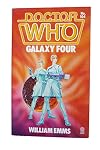
Doctor Who: Galaxy Four
by William Emms
Doctor Who: Target Novelisations: Broadcast order (18), Doctor Who: Target Novelisations: Doctor Who Library order (104), Doctor Who: Target Novelisations: Publication order (104), Doctor Who {non-TV} (Novelisations — Novelisation)
On This Page
Description
When the Tardis lands on an arid planet, it seems as though the whole place is desolate and lifeless. But then the Doctor, Steven and Vicki discover two crashed spaceships: one contains the Drahvins, a race of stunning beauty, the other contains the hideous Rills. However, as the team soon find out, appearances can be deceptive. It emerges that the beauty of the Drahvins hides a colony of mindless clones who are controlled by the cruel, powerful matriarch Maaga, whereas the ugly Rills are show more friendly and intelligent explorers. The Rills tell the Doctor that the dried-up planet is about to die. Back in the control room of the Tardis, he discovers they are right, but things are worse than they thought. There is only one day of life left - one day to escape. show lessTags
Recommendations








Member Reviews
My last first Doctor novelisation brings us to Galaxy Four and the 1980s. This is a third and final stage in the progression through novelisations I've been chronicling here on LibraryThing and on my blog. First we had the three that were books first and novelisations second, ones designed to just be Doctor Who in a world where the show could not be rewatched: The Daleks (1964), The Zarbi (1965), The Crusaders (1966). Then we had two from an era where the first Doctor was no longer the Doctor, but still ones designed to fill in significant parts of the show's history for viewers a decade later: The Tenth Planet (1976), The Dalek Invasion of Earth (1977). Now we're into the third and final stage: gap filling. Galaxy Four is not a major show more piece of Doctor Who lore or even a minor one; by 1985, it is simply a story that has not been novelised yet and thus needs to be. In publication order, the first Doctor novelisations that preceded and followed this were The Gunfighters and The Savages. Hardly Doctor Who's greatest hits.
But the value of this service cannot be understated. This is a story I have not seen, not the animation, not even the single existing episode, so the entirety of it was new to me (though I was familiar with the broad strokes of the plot from reading many reference guides over the years). Now I very rarely come to an novelisation having not seen the story, but in this case, my approach was much like that of the audience of 1985.
What we have here is a fairly solid read, if a bit creaky. It's a decent showing for the Doctor, Vicki, and Steven. Emms adds in a bunch of small introspective moments on the part of the Doctor (more on those later), most of which worked well for me. Neither Vicki nor Steven get big moments, but they do their bits well, Emms showcasing Vicki's curiosity and compassion, and Steven's determination and cleverness throughout the story.
The fundamental idea that the gross alien monsters turn out to be the good guys is a decent ones... but undermined by the fact that the Drahvins are so clearly baddies from the moment they first appear. And even by the standards of Doctor Who science, it doesn't seem like Emms has a very good grasp of, well, anything. Do planets blow up and take their stars with them? Why is the first chapter called "Four Hundred Dawns"? This number of dawns is at no point alluded to in the text. And, to be honest, I'm not convinced very much actually happens here. The characters move back and forth between two crashed spaceships a lot; the Doctor pumps some power into one of them; the end.
But like I said up top, this is the first first Doctor novelisation I've read (for this project) from the 1980s. By this time, fans and Doctor Who creators alike had a much deeper sense of Doctor Who as something with a continuity. While Terrance Dicks did some minor smoothing out in Dalek Invasion and Gerry Davis was willing to tweak the details of The Tenth Planet a bit, this is the first time I've seen a writer really take what was established later on and fold it back into the original Doctor's run. I'm sure some purists found these annoying, but I rather enjoyed them. Emms anticipates The Tenth Planet by depicting a Doctor who's aware that his body is running out of steam; he even draws on the Pertwee era in mentioning his multiple hearts. There are lots of little references to this being just one of many bodies the Doctor can have, and indeed, Emms anticipates "The Timeless Children" by making it clear this isn't his first body; there's a bit where the Doctor notes that he's never bothered to register how tall he is in this incarnation! Emms does a good bit of capturing the cosmic perspective of a Time Lord. show less
But the value of this service cannot be understated. This is a story I have not seen, not the animation, not even the single existing episode, so the entirety of it was new to me (though I was familiar with the broad strokes of the plot from reading many reference guides over the years). Now I very rarely come to an novelisation having not seen the story, but in this case, my approach was much like that of the audience of 1985.
What we have here is a fairly solid read, if a bit creaky. It's a decent showing for the Doctor, Vicki, and Steven. Emms adds in a bunch of small introspective moments on the part of the Doctor (more on those later), most of which worked well for me. Neither Vicki nor Steven get big moments, but they do their bits well, Emms showcasing Vicki's curiosity and compassion, and Steven's determination and cleverness throughout the story.
The fundamental idea that the gross alien monsters turn out to be the good guys is a decent ones... but undermined by the fact that the Drahvins are so clearly baddies from the moment they first appear. And even by the standards of Doctor Who science, it doesn't seem like Emms has a very good grasp of, well, anything. Do planets blow up and take their stars with them? Why is the first chapter called "Four Hundred Dawns"? This number of dawns is at no point alluded to in the text. And, to be honest, I'm not convinced very much actually happens here. The characters move back and forth between two crashed spaceships a lot; the Doctor pumps some power into one of them; the end.
But like I said up top, this is the first first Doctor novelisation I've read (for this project) from the 1980s. By this time, fans and Doctor Who creators alike had a much deeper sense of Doctor Who as something with a continuity. While Terrance Dicks did some minor smoothing out in Dalek Invasion and Gerry Davis was willing to tweak the details of The Tenth Planet a bit, this is the first time I've seen a writer really take what was established later on and fold it back into the original Doctor's run. I'm sure some purists found these annoying, but I rather enjoyed them. Emms anticipates The Tenth Planet by depicting a Doctor who's aware that his body is running out of steam; he even draws on the Pertwee era in mentioning his multiple hearts. There are lots of little references to this being just one of many bodies the Doctor can have, and indeed, Emms anticipates "The Timeless Children" by making it clear this isn't his first body; there's a bit where the Doctor notes that he's never bothered to register how tall he is in this incarnation! Emms does a good bit of capturing the cosmic perspective of a Time Lord. show less
http://nhw.livejournal.com/871029.html
Galaxy Four was the first story from the third season, shown in 1966 (odd to think of it as the Classic Who equivalent of Smith and Jones). It's the only one from that year I haven't yet seen/heard, but I got the novel for free yesterday with the SFX Doctor Who special and read it pretty quickly. It's actually rather good, up there with the average Missing Adventure of the Virgin series. with Emms (who wrote nothing else for Doctor Who) letting us inside the mind of the Doctor very convincingly, and also attempting to flesh out his rather one-dimensional villain, Maaga, leader of the female Drahvin warriors. Must try and catch up with the actual series now, though I have a suspicion this may be one show more of the cases where the novel is better than the story.
https://fromtheheartofeurope.eu/galaxy-four-the-newish-dvd/
Coming back to it fifteen years on, I remain favourably impressed. Emms was clearly a fan, and fills out the narrative not only with scenes that he would have liked to include in the actual show, but also with subsequent Who lore – most of the references to the TARDIS crew being from Earth are removed, and there are several mentions of the Doctor having two hearts, which of course wouldn’t become TV canon for another five years. We also find out that the Rills don’t share our concept of time. It’s well done. show less
Galaxy Four was the first story from the third season, shown in 1966 (odd to think of it as the Classic Who equivalent of Smith and Jones). It's the only one from that year I haven't yet seen/heard, but I got the novel for free yesterday with the SFX Doctor Who special and read it pretty quickly. It's actually rather good, up there with the average Missing Adventure of the Virgin series. with Emms (who wrote nothing else for Doctor Who) letting us inside the mind of the Doctor very convincingly, and also attempting to flesh out his rather one-dimensional villain, Maaga, leader of the female Drahvin warriors. Must try and catch up with the actual series now, though I have a suspicion this may be one show more of the cases where the novel is better than the story.
https://fromtheheartofeurope.eu/galaxy-four-the-newish-dvd/
Coming back to it fifteen years on, I remain favourably impressed. Emms was clearly a fan, and fills out the narrative not only with scenes that he would have liked to include in the actual show, but also with subsequent Who lore – most of the references to the TARDIS crew being from Earth are removed, and there are several mentions of the Doctor having two hearts, which of course wouldn’t become TV canon for another five years. We also find out that the Rills don’t share our concept of time. It’s well done. show less
Its a Target Novellisation, give it a break.
A very simple tale of goodies versus baddies in a very black and white world. But the Doctor, Steven and Vicki come across well and it occupies a couple of hours easily enough.
A very simple tale of goodies versus baddies in a very black and white world. But the Doctor, Steven and Vicki come across well and it occupies a couple of hours easily enough.
Ratings
Members
- Recently Added By
Author Information

5 Works 396 Members
Series


Common Knowledge
- Canonical title
- Doctor Who: Galaxy Four
- Original publication date
- 1985-11
- People/Characters
- The Doctor (1st); Vicki Pallister; Steven Taylor
Classifications
Statistics
- Members
- 278
- Popularity
- 116,257
- Reviews
- 3
- Rating
- (3.10)
- Languages
- English
- Media
- Paper, Audiobook, Ebook
- ISBNs
- 5
- ASINs
- 6