
Moon Shot: The Inside Story of America's Race to the Moon
by Alan Shepard, Jay Barbree, Howard Benedict, Deke Slayton (Author)
On This Page
Description
On October 4, 1957, the Soviet Union launched Sputnik I, and the space race was born. Desperate to beat the Russians into space, NASA put together a crew of the nation's most daring test pilots: the seven men who were to lead America to the moon. The first into space was Alan Shepard; the last was Deke Slayton, whose irregular heartbeat kept him grounded until 1975. They spent the 1960s at the forefront of NASA's effort to conquer space, and Moon Shot is their inside account of what many show more call the twentieth century's greatest feat-landing humans on another world. Collaborating with NBC's veteran space reporter Jay Barbree, Shepard and Slayton narrate in gripping detail the story of America's space exploration from the time of Shepard's first flight until he and eleven others had walked on the moon. show lessTags
Recommendations
















Member Reviews
If The Right Stuff is the trashy tabloid tell-all, Moon Shot is the authorized biography version of the heroic age of the American space program, from Mercury to Apollo. The overall tone is one of awed cosmism. Astronauts are larger than life figures, top test pilots and engineers who manage to save their own lives and the mission by taming faulty space capsules. Beyond the atmosphere, floating weightless in zero-G, and looking down on our fragile blue marble, they serve as both the most exceptional Americans, and as pan-national unifying archetypes. Arrayed against them is of course the hostility of space, but also the small-minded cowardice of bureaucrats and Congress, who are unwilling to let these brave men risk it all.
The book is show more structured as a mission by mission account, and is light on technical details in favor of somewhat repetitive purple prose. Alan Shepard and Deke Slayton are the clear protagonists, two of the original Mercury 7 astronauts grounded by medical issues, who beat the doctors to eventually fly on Apollo missions.
I did learn something from this book, like how vital Gemini was as a bridge to maneuvering in space, performing the precision burns and dockings vital to the Apollo mission plan. Shepard's Apollo 14 was almost a failure, with a docking problem between the capsule and LEM solved by ramming the docking ring at higher than designed speed, and a radar fault in the LEM fixed by turning it off and turning it back on again.
Moon Shot is a decent, if unambitious history, and probably a good first pass for more extensive reading on the space age. show less
The book is show more structured as a mission by mission account, and is light on technical details in favor of somewhat repetitive purple prose. Alan Shepard and Deke Slayton are the clear protagonists, two of the original Mercury 7 astronauts grounded by medical issues, who beat the doctors to eventually fly on Apollo missions.
I did learn something from this book, like how vital Gemini was as a bridge to maneuvering in space, performing the precision burns and dockings vital to the Apollo mission plan. Shepard's Apollo 14 was almost a failure, with a docking problem between the capsule and LEM solved by ramming the docking ring at higher than designed speed, and a radar fault in the LEM fixed by turning it off and turning it back on again.
Moon Shot is a decent, if unambitious history, and probably a good first pass for more extensive reading on the space age. show less
I really enjoyed this. Although it isn't actually written by Shepard and Slayton themselves, they were clearly the main focuses of the journalist author's writing. The quality of the writing was I thought very evocative and moving and really brought home the majesty and significance of the Apollo missions. Marvellous, stirring stuff. 5/5
Alan Shepard and Deke Slayton’s Moon Shot: The Inside Story of America’s Race to the Moon traces the history of American spaceflight from the earliest postwar experiments with captured German V-2 rockets through Mercury, Gemini, Apollo, and the Skylab and Apollo-Soyuz Test Project flights. Shepard and Slayton worked with Jay Barbree and Howard Benedict, two journalists with experience writing about aerospace, in order to craft a narrative that both encompasses their lives and work as well as the activities driving spaceflight in the U.S. and Soviet Union, crosscutting between events as necessary to keep the reader apprised of the bigger picture that shaped Shepard and Slayton’s training and flights. Between Shepard and Slayton, show more the book encompasses an entire era of U.S. spaceflight and single-use rockets. Those familiar with Tom Wolfe’s The Right Stuff will find this a detailed narrative continuing the stories of two of the Mercury Seven. Christopher Grove does an admirable job narrating the unabridged audiobook, though his occasional attempts to mimic the speaking patterns of his subjects in direct quotes can be distracting. This 2011 edition includes a warning for NASA’s future when it was facing serious budget cuts and an uncertain future. With the hindsight of 2026, it shows what projects were in consideration prior to Artemis and ends with a reference to Konstantin Tsiolkovsky’s quote, “The Earth is the cradle of humanity, but mankind cannot stay in the cradle forever.” show less
I admit I had high hopes of this book. Someone had told me it was their favourite book on the Apollo programme, and the identities of the two authors promised much. Perhaps my expectations were too high...
Moon Shot covers the entire Space Race, from Sputnik to the Apollo Soyuz Test Project. It is an accessible read, written by two astronauts, Alan B Shepard and Donald K Slayton, who were important to the American effort. With the help of journalists Jay Barbree and Howard Benedict.
But. This is non-fiction, it is documented history... so I fail to understand how the authors can know what the Soviet Ambassador to the US was actually thinking when he heard of the Apollo 1 fire. Throughout the book, the authors imagine themselves in the show more heads of various people. Such "fictionalisation" of real people and events may make Moon Shot easier to read, but it also undermines its authority. How can it be an accurate depiction of events if it makes things up?
Read the rest of the review here : http://spacebookspace.blogspot.com/2009/03/moon-shot-alan-shepard-deke-slayton.h... show less
Moon Shot covers the entire Space Race, from Sputnik to the Apollo Soyuz Test Project. It is an accessible read, written by two astronauts, Alan B Shepard and Donald K Slayton, who were important to the American effort. With the help of journalists Jay Barbree and Howard Benedict.
But. This is non-fiction, it is documented history... so I fail to understand how the authors can know what the Soviet Ambassador to the US was actually thinking when he heard of the Apollo 1 fire. Throughout the book, the authors imagine themselves in the show more heads of various people. Such "fictionalisation" of real people and events may make Moon Shot easier to read, but it also undermines its authority. How can it be an accurate depiction of events if it makes things up?
Read the rest of the review here : http://spacebookspace.blogspot.com/2009/03/moon-shot-alan-shepard-deke-slayton.h... show less
Alan Shepard and Deke Slayton’s Moon Shot: The Inside Story of America’s Race to the Moon traces the history of American spaceflight from the earliest postwar experiments with captured German V-2 rockets through Mercury, Gemini, Apollo, and the Skylab and Apollo-Soyuz Test Project flights. Shepard and Slayton worked with Jay Barbree and Howard Benedict, two journalists with experience writing about aerospace, in order to craft a narrative that both encompasses their lives and work as well as the activities driving spaceflight in the U.S. and Soviet Union, crosscutting between events as necessary to keep the reader apprised of the bigger picture that shaped Shepard and Slayton’s training and flights. Between Shepard and Slayton, show more the book encompasses an entire era of U.S. spaceflight and single-use rockets. Those familiar with Tom Wolfe’s The Right Stuff will find this a detailed narrative continuing the stories of two of the Mercury Seven. show less
There are some events in the history of mankind which can never be duplicated. Only one person could be the first to orbit the earth in a spacecraft, or drift outside its confines, or walk on the face of our moon. The 1950s through the 1970s were a special time in the great, epic story of our race. A few dozen men with skill, nerve, and willingness to put their lives on the line to experience the impossible, for themselves and their fellow human beings, stepped up for perhaps the greatest endeavor in earth’s history. To land a man on the face of the moon and return him safely home. Aided by the sharpest minds in rocket science, aerospace engineering, and computer and communications systems, these men of courage expanded our frontier, show more some at the expense of their lives.
The four hundred pages of this book flew by for me. Beginning with the choice, in the waning days of World War II, of a group of German rocket scientists, led by Wernher von Braun, to surrender to the Americans, which became the genesis of the United States’ rocket program, the initial printing of this book ended with the Apollo-Soyuz mission (a joining, in 1975, of a U.S. and a Soviet spacecraft while they orbited the earth). Both astronauts involved in the writing, Alan Shepard and Deke Slayton, have passed away since the original printing in 1994. Journalist Jay Barbree wrote an update for the latter version, which I read, which has been rereleased in 2011 for the 50th anniversary of the advent of the space program. His update felt rushed and gave very little specific information about the space program since the last Apollo flight; I would have appreciated a less political stance and one which gave more concrete information.
If you are looking for a fast ride through the history of the U.S., and to a very minimal extent, the Soviet, race to the moon, this is a solid place to start. It is also a good book to read if you want to believe that there was very little tension and competition among the astronauts themselves and the various engineers-something that other writings lead me to know is patently untrue. While I can appreciate the desire of the authors to produce an account free from mudslinging, the book does have a “nicey-nice” ring to it that got a bit too saccharine at times. However, the passion of those involved in the early space programs, the spirit of the unknown that drove them, and their sheer love of what they were doing, comes through clearly in the exciting flow of the narrative. This book made me laugh, cry, and cheer, despite prose that verged on melodramatic at times.
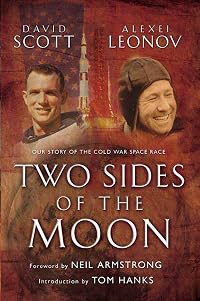
Moon Shot focuses on the United States’ side of the space race, but if you are interested in a balanced account which includes the parallel history of the Soviet side (albeit with much less information from the U.S. viewpoint than Moon Shot), I would like to suggest Two Sides of the Moon: Our Story of the Cold War Space Race. This book was written by U.S. astronaut David Scott-Apollo 15 commander, and Soviet cosmonaut Alexei Leonov-the first man to walk in space, and tells their simultaneous stories from opposing sides of the Iron Curtain. These two men also worked together on joint U.S. and Soviet projects later in their careers. As someone who grew up during the Cold War, I found this collaboration absolutely engrossing, although, like Moon Shot, it is not the most well-written of books. show less
The four hundred pages of this book flew by for me. Beginning with the choice, in the waning days of World War II, of a group of German rocket scientists, led by Wernher von Braun, to surrender to the Americans, which became the genesis of the United States’ rocket program, the initial printing of this book ended with the Apollo-Soyuz mission (a joining, in 1975, of a U.S. and a Soviet spacecraft while they orbited the earth). Both astronauts involved in the writing, Alan Shepard and Deke Slayton, have passed away since the original printing in 1994. Journalist Jay Barbree wrote an update for the latter version, which I read, which has been rereleased in 2011 for the 50th anniversary of the advent of the space program. His update felt rushed and gave very little specific information about the space program since the last Apollo flight; I would have appreciated a less political stance and one which gave more concrete information.
If you are looking for a fast ride through the history of the U.S., and to a very minimal extent, the Soviet, race to the moon, this is a solid place to start. It is also a good book to read if you want to believe that there was very little tension and competition among the astronauts themselves and the various engineers-something that other writings lead me to know is patently untrue. While I can appreciate the desire of the authors to produce an account free from mudslinging, the book does have a “nicey-nice” ring to it that got a bit too saccharine at times. However, the passion of those involved in the early space programs, the spirit of the unknown that drove them, and their sheer love of what they were doing, comes through clearly in the exciting flow of the narrative. This book made me laugh, cry, and cheer, despite prose that verged on melodramatic at times.
Moon Shot focuses on the United States’ side of the space race, but if you are interested in a balanced account which includes the parallel history of the Soviet side (albeit with much less information from the U.S. viewpoint than Moon Shot), I would like to suggest Two Sides of the Moon: Our Story of the Cold War Space Race. This book was written by U.S. astronaut David Scott-Apollo 15 commander, and Soviet cosmonaut Alexei Leonov-the first man to walk in space, and tells their simultaneous stories from opposing sides of the Iron Curtain. These two men also worked together on joint U.S. and Soviet projects later in their careers. As someone who grew up during the Cold War, I found this collaboration absolutely engrossing, although, like Moon Shot, it is not the most well-written of books. show less
In this revised edition of the 1994 book, astronauts Alan Shepard and Deke Slayton narrate the story of America’s space exploration from the time of the first suborbital flight until shortly after astronauts walked on the moon. Proclaimed “the ultimate inside story of the United States space program” by veteran newscaster Walter Cronkite, this is the compelling, detailed account of what is widely considered the greatest feat of the twentieth century: landing man on the surface of another world.
Told only as those intimately involved with the program could tell it, this is an insider’s narrative of the history of America’s manned spaceflight program. In collaboration with veteran space reporter Jay Barbree, the two astronauts show more offer a unique look at NASA’s manned spaceflight program. Alan Shepard was the first American in space aboard Freedom 7 for a fifteen-minute Project Mercury suborbital flight; Deke Slayton was the last as a member of the crew for the Apollo-Soyuz Test Project. [The book ends with its look at the Apollo-Soyuz program in 1975; the first space shuttle flight in 1981 is some six years in the future. The Skylab space station program, which began in 1973, is not included here.]
Highly recommended. show less
Told only as those intimately involved with the program could tell it, this is an insider’s narrative of the history of America’s manned spaceflight program. In collaboration with veteran space reporter Jay Barbree, the two astronauts show more offer a unique look at NASA’s manned spaceflight program. Alan Shepard was the first American in space aboard Freedom 7 for a fifteen-minute Project Mercury suborbital flight; Deke Slayton was the last as a member of the crew for the Apollo-Soyuz Test Project. [The book ends with its look at the Apollo-Soyuz program in 1975; the first space shuttle flight in 1981 is some six years in the future. The Skylab space station program, which began in 1973, is not included here.]
Highly recommended. show less
Members
- Recently Added By
Author Information

2 Works 1,641 Members

9 Works 1,781 Members
Jay Barbree has worked for NBC News for over 50 years. He is the only reporter to have covered all 166 American astronaut flights and moon landings. He received an Emmy for his coverage of Neil Armstrong's first walk on the moon. He wrote several books including Neil Armstrong: A Life of Flight and Moon Shot: The Inside Story of America's Apollo show more Moon Landings with astronauts Alan Shepard, Deke Slayton, and Neil Armstrong. (Bowker Author Biography) show less
6 Works 1,206 Members
All Editions
Some Editions
Awards and Honors
Distinctions
Common Knowledge
- Canonical title
- Moon Shot: The Inside Story of America's Race to the Moon
- Original title
- Moon Shot : The Inside Story of America's Race to the Moon
- Original publication date
- 1994
- People/Characters
- Alan B. Shepard, Jr. (Astronaut); Deke Slayton (Astronaut); Neil Armstrong; Buzz Aldrin; Pete Conrad (Astronaut); Alan Bean (show all 25); Edgar Mitchell; David Scott; James Irwin (Astronaut); John W. Young (Astronaut); Charles Duke; Eugene Cernan; Harrison Schmitt; Frank Borman (Astronaut); Jim Lovell; William Anders (Astronaut); Tom Stafford; Dick Gordon; Jack Swigert; Fried Haise; Stuart Roosa; Al Worden; John Young; Ken Mattingly; Ronald Evans
- Important places
- The Moon
- Important events
- Apollo program (1961 | 1975)
- Related movies
- The Right Stuff (1983 | IMDb); Apollo 13 (1995 | IMDb); Moon Shot (1994 | tt0124010) 3hr TBS documentary (1994 | IMDb)
- Dedication
- For Bobbie Jo Joy Louise the wives
- First words
- The two astronauts swooped toward the lunar landscape in their landing craft - the first of their kind to descend on the moon.
- Last words
- (Click to show. Warning: May contain spoilers.)And on that roll call there was now this name to remember. Always. Deke Slayton. Astronaut.
- Original language*
- Anglais (Etats-Unis) (Etats-Unis)
*Some information comes from Common Knowledge in other languages. Click "Edit" for more information.
Classifications
- Genres
- Science & Nature, Nonfiction, General Nonfiction, History, Biography & Memoir
- DDC/MDS
- 629.45 — Applied science & technology Engineering Transportation Vehicles Spacecraft & Vehicles Manned space flight
- LCC
- TL789.8 .U6 .A58177 — Technology Motor vehicles. Aeronautics. Astronautics Motor vehicles. Aeronautics. Astronautics Astronautics. Space travel
- BISAC
Statistics
- Members
- 1,189
- Popularity
- 21,096
- Reviews
- 18
- Rating
- (3.86)
- Languages
- English, French, Polish
- Media
- Paper, Audiobook, Ebook
- ISBNs
- 18
- ASINs
- 18