On This Page
Description
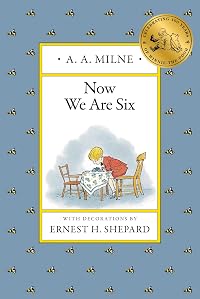
A collection of poems reflecting the experiences of a little English boy growing up in the early part of the twentieth century.Tags
Recommendations







Member Recommendations
Member Reviews
Like When We Were Very Young, this is also a terrific compilation. I love it when an adult can see through a child's eyes without losing his "adult-ness". Milne's poetry is simple and beautiful, and his humour can be enjoyed by adults and children alike.
Christopher Robin and Winnie-the-Pooh need no introduction. Quite a few of the poems in this book are about the duo. Milne accomplishes the extraordinary feat of seeing from the realistic and make-believe viewpoint at the same time (something which comes as second-nature to children, but we lose it as we grow up): therefore, Pooh is a live character to Christopher, even when he knows that he is nothing but a toy (the poem Us Two and The Friend).
There are a lot of nonsense poems about show more silly grownups, quite a few of them kings and emperors, but behaving like spoilt children-a child's view of himself, maybe! (Or a rather uncomfortable thought - is it so childish? Don't dictators behave like spoilt kids on a rampage - with much deadlier results than Milne's characters produce, of course.) There are poignant poems of a child's world which so incomprehensible to adults so that they shoo him away (Come Out With Me). Also, there is the delight only a child can experience, such as a race between two raindrops (Waiting At The Window). There are even profound philosophical questions which plague a young mind (Explained).
But for me, the poem which captures the quintessence of childhood in this collection is Buttercup Days, about Anne and her man(!), especially these four lines:
What has she got in that little brown head?
Wonderful thoughts which can never be said.
What has she got in that firm little fist of hers?
Somebody's thumb, and it feels like Christopher's.
Anne and Christopher, among the buttercups. Pure childhood bliss!
Five stars, all the way. show less
Christopher Robin and Winnie-the-Pooh need no introduction. Quite a few of the poems in this book are about the duo. Milne accomplishes the extraordinary feat of seeing from the realistic and make-believe viewpoint at the same time (something which comes as second-nature to children, but we lose it as we grow up): therefore, Pooh is a live character to Christopher, even when he knows that he is nothing but a toy (the poem Us Two and The Friend).
There are a lot of nonsense poems about show more silly grownups, quite a few of them kings and emperors, but behaving like spoilt children-a child's view of himself, maybe! (Or a rather uncomfortable thought - is it so childish? Don't dictators behave like spoilt kids on a rampage - with much deadlier results than Milne's characters produce, of course.) There are poignant poems of a child's world which so incomprehensible to adults so that they shoo him away (Come Out With Me). Also, there is the delight only a child can experience, such as a race between two raindrops (Waiting At The Window). There are even profound philosophical questions which plague a young mind (Explained).
But for me, the poem which captures the quintessence of childhood in this collection is Buttercup Days, about Anne and her man(!), especially these four lines:
What has she got in that little brown head?
Wonderful thoughts which can never be said.
What has she got in that firm little fist of hers?
Somebody's thumb, and it feels like Christopher's.
Anne and Christopher, among the buttercups. Pure childhood bliss!
Five stars, all the way. show less
Not a fan of this poetry collection. Perhaps it has too many kings and knights and less insight about the nature of children? Some extraneous Shepard illustrations of Pooh characters are shoehorned in to make it more palatable to Pooh fans, but the verse is not as lively or engaging as Milne's prose in the Pooh books.
(My Pooh Project: I love Winnie the Pooh, and so does my wife. Having a daughter gave us a chance to indoctrinate her into the cult by buying and reading her every Pooh book we came across. How many is that? I’m going to count them this year by reading and reviewing one every day and seeing which month I finally run out. Track my progress here:
https://www.goodreads.com/review/list/23954351-rod-brown?ref=nav_mybooks&she... show more ) show less
(My Pooh Project: I love Winnie the Pooh, and so does my wife. Having a daughter gave us a chance to indoctrinate her into the cult by buying and reading her every Pooh book we came across. How many is that? I’m going to count them this year by reading and reviewing one every day and seeing which month I finally run out. Track my progress here:
https://www.goodreads.com/review/list/23954351-rod-brown?ref=nav_mybooks&she... show more ) show less
What a darling collection of poems! I don’t think I enjoyed them quite as much as When We Were Very Young, but these are well worth reading, anyway. These poems are full of fun and whimsy, of imagination and story, and the mementos of a childhood lived well. Some of my particular favorites are “The Old Sailor” (oh, I could relate to him!) and “Waiting at the Window” (because I remember doing the same thing as a child). I loved being able to read this book to my siblings, and they loved them, too. Milne’s writings will always have a dear place in my heart. If you haven’t read this book yet, but love poetry…well, you ought to.
This and the previous volume When We Were Very Young has reconfirmed my faith both in enduring literature (enjoyed by adults and children alike) and in poetry: it has rhythm, rhymes and tells a story and isn't just a string of words apparently meaninglessly stringed together. Perhaps the reason I enjoy these two books is because they were written to be enjoyed (also) by children. But it also fairly well describes my knowledge of and severely limited/restricted appreciation for poetry.
Of course, I read this more than 50 years ago when I was a child (although older than 6, naturally). I loved all of A.A. Milne’s children’s books (although I didn’t know Once Upon A Time or The Red House Mystery, the latter of which I’ve bought but have yet to read).
Did I like it as much when I reread it at 65? No, but I think that’s because I always loved When We Were Very Young more, which has my very favorite Milne poems, “Disobedience,” “Buckingham Palace” (turned into a song), “The King’s Breakfast” and “Vespers”; however, in that book, every poem is a winner.
Still, I am very glad that I re-read Now We Are Six. I had confused which poems were where, so I was left missing my favorites; that said, this show more sequel of sorts has plenty of exceptional poems, too. These were my particular favorites: “Sneezles,” “Buttercup Days,” “The Engineer,” “Journey’s End,” “Come Out with Me,” “The Good Little Girl,” “Explained,” “In the Dark” — and my favorite from this volume, “Forgiven,” about a wayward pet beetle. Really a joy to read after all these decades!
In the interest of full disclosure, I received this book from NetGalley and Dover Publications in exchange for an honest review. show less
Did I like it as much when I reread it at 65? No, but I think that’s because I always loved When We Were Very Young more, which has my very favorite Milne poems, “Disobedience,” “Buckingham Palace” (turned into a song), “The King’s Breakfast” and “Vespers”; however, in that book, every poem is a winner.
Still, I am very glad that I re-read Now We Are Six. I had confused which poems were where, so I was left missing my favorites; that said, this show more sequel of sorts has plenty of exceptional poems, too. These were my particular favorites: “Sneezles,” “Buttercup Days,” “The Engineer,” “Journey’s End,” “Come Out with Me,” “The Good Little Girl,” “Explained,” “In the Dark” — and my favorite from this volume, “Forgiven,” about a wayward pet beetle. Really a joy to read after all these decades!
In the interest of full disclosure, I received this book from NetGalley and Dover Publications in exchange for an honest review. show less
Now we are six is the poem that I read for our Padlet on 3/30. This is a short and playful poem who is also the author of Winnie the Pooh. One of the strongest parts of this poem is how it reflects how children think and feel. The poems explore everyday moments like growing up, friendships and imagination. The age range would be early elementary and I would probably read it to kiddos who are around the 6 year old mark. This would be a good poem to use in my classroom to introduce poetry and use it around peoples birthdays to incorporate it into the lesson.
This book is a wonderful introduction to Winnie the Pooh. With it's childlike introduction, whimsical rhyming, but good natured and calming affection for the reader, the poems which flow from each work not only bring a sense of calm bliss, but also relieve any stress that a person may have felt prior to reading this work. In a way, books like these are a rarity, because of the presentation and the illustrations which are used. And given that Winnie the Pooh is a deeply loved children literature icon, it comes as no surprise why this book delivered.
Members
- Recently Added By
Lists

Favorite Animal Fiction
359 works; 156 members

Honey For a Child's Heart
1,152 works; 25 members

Childhood Favorites
427 works; 24 members

Sonlight Books
1,487 works; 25 members
Ambleside Books
459 works; 18 members

In and About the 1920s
181 works; 31 members

Blue Pyramid 1,276 Best Books of All Time
1,248 works; 32 members

Folio Society
831 works; 48 members

CCE 1000 Good Books List
1,033 works; 12 members

Guilty Pleasures
223 works; 86 members

HMS: Make Your Child a Lover of Books, Ages 5-7
17 works; 2 members

living room bookshelf
150 works; 1 member

Five star books
1,755 works; 107 members
1970s
657 works; 23 members

Books Read in 2017
4,249 works; 129 members

Books Read in 2021
5,361 works; 114 members

Books With Complete Sentence Titles
374 works; 15 members

Books With Numbers in the Title
308 works; 13 members
Ten Books That Have Stayed With Me
160 works; 30 members

Poetry Corner
187 works; 15 members

Books Read in 1992
8 works; 1 member
Author Information

1,419+ Works 86,127 Members
A prolific writer, A. A. Milne published 35 plays, 6 novels, 3 books of verse, 3 collections of short stories, and several works of nonfiction, including sketches for Punch magazine, of which he was the assistant editor. Nevertheless, his fame rests on four books for children: two of whimsical stories about the stuffed animals in his son's bedroom show more (Winnie-the-Pooh and The House at Pooh Corner) and two of verse (When We Were Very Young and Now We Are Six). All are considered classics and have been included among the Children's Literature Association's Touchstone books as the best in children's literature, on the Lewis Carroll Shelf list, and on the Choice magazine list of books for the academic library. He also wrote Toad of Toad Hall, a play based on Grahame's The Wind in the Willows, and Once upon a Time: A Fairy Tale for Grown-ups, both of which are sometimes included in volumes with the four classic works. Milne had a son, Christopher Robin, who served as the model for the little boy in his children's books. (Bowker Author Biography) show less
Some Editions
Awards and Honors
Series

Work Relationships
Is contained in
Has the adaptation
Is abridged in
Common Knowledge
- Canonical title
- Now We Are Six
- Original title
- Now We are Six
- Original publication date
- 1927-10-13
- People/Characters
- Alexander Beetle; Thomas Tom (sir, of Appledore); Winnie-the-Pooh; Piglet (in illustrations only); Eeyore (in illustrations only); Kanga (in illustrations only) (show all 10); Roo (in illustrations only); Good Bear; Bad Bear; Pinkle Purr
- Important places
- Appledore, Devon, England, UK; London, England, UK
- Dedication
- To Anne Darlington, now she is seven and because she is so speshal.
- First words
- Introduction: When you are reciting poetry, which is a thing we never do, you find sometimes, just as you are beginning, that Uncle John is still telling Aunt Rose that if he can't find his spectacles he won't be able to hea... (show all)r properly, and does she know where they are; and by the time everybody has stopped looking for them, you are at the last verse, and in another minute they will be saying, "Thank-you, thank-you," without really knowing what it was all about.
I have a house where I go
When there's too many people... - Last words
- (Click to show. Warning: May contain spoilers.)But now I am Six, I'm as clever as clever,
So I think I'll be six now for ever and ever. - Original language
- English
Classifications
Statistics
- Members
- 6,197
- Popularity
- 2,005
- Reviews
- 46
- Rating
- (4.19)
- Languages
- 10 — Chinese, Dutch, English, French, Hungarian, Norwegian (Bokmål), Norwegian, Swedish, Thai, Turkish
- Media
- Paper, Audiobook, Ebook
- ISBNs
- 84
- UPCs
- 1
- ASINs
- 125