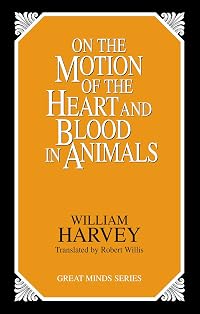
On the Motion of the Heart and Blood in Animals
by William Harvey
On This Page
Description
William Harvey's On the Motion of the Heart and Blood in Animals is a classic work of the scientific revolution and of modern medicine, for in it he famously argued, with extensive evidence based on dissections and vivisections, for the circulation of the blood. It also overturned the longstanding theories of the heart's movement and function. This new edition is suitable for classroom use and for general interest. In addition to an updated translation, it also contains an introductory essay show more and footnotes. show lessTags
Recommendations




















Member Reviews
Clearly chosen for its value as scientific literature and historical context, Harvey's work also shows a better understanding of anatomy than one might otherwise expect from the mid 1600's. He refutes the then current view that the lungs connect directly to the right side of the heart, filling that cavity with air but only goes so far as suggesting the need for further investigation as to why the lungs could need so much blood supply. The path of blood, purpose and function of valves, differences between arteries and veins -- these were all discovered by that time. He also demonstrates a clear understanding of the full spectrum of animals in showing the differences and similarities in their circulatory systems.
so. much. vivisection.
399/1450
Ratings
Members
- Recently Added By
Lists

How to Read a Book's Recommended Reading List
309 works; 10 members

Greatest Books, allegedly
484 works; 9 members

Robert B. Downs's Books that Changed the World
16 works; 1 member
Author Information

20+ Works 828 Members
Born in Folkestone, Kent, England, Harvey was a British physiologist whose discovery of the circulation of the blood drastically changed medicine. In fact, Harvey is generally regarded as the founder of modern physiology. The publication of his Exercitatio Anatomica de Motu Cordis et Sanguinis in Animalibus (1628) was a landmark event, widely show more considered the most important medical book ever published. His observations of the heart's functions and blood flow were based on anatomical studies on cadavers, animals, and himself. The son of a wealthy businessman, Harvey was a student at Cambridge University, where he studied medicine. He completed his medical training at the leading European medical school of the period, Padua, where he was a student of the famous anatomist Girolamo Fabricius. When he completed his doctorate in medicine in 1602 he returned to London and was appointed physician to St. Bartholomew's Hospital. His reputation grew, and he was elected to the Royal College of Physicians, with which he was associated for the rest of his career. Ten years prior to the publication of his great work, he was appointed as a physician to James I. After the Scottish civil war and the demise of James I, Harvey returned to London and resumed his medical practice. He continued to observe animal life wherever he traveled and wrote two additional works on animal locomotion and comparative and pathological anatomy. However, it was the publication of his book on the circulation of the blood that assured him "a place of first importance in the history of science and medicine. By this discovery he revolutionized physiological thought" (Dictionary of Scientific Biography). His work also encouraged others to study anatomy. Harvey's personal library, which he donated to the London College of Physicians, was unfortunately destroyed in the Great Fire of 1666. (Bowker Author Biography) show less
All Editions
Series
Belongs to Publisher Series
Work Relationships
Is contained in
Common Knowledge
- Canonical title
- On the Motion of the Heart and Blood in Animals
- Original publication date
- 1628
Classifications
Statistics
- Members
- 289
- Popularity
- 111,840
- Reviews
- 3
- Rating
- (3.63)
- Languages
- English, Italian, Latin
- Media
- Paper, Ebook
- ISBNs
- 20
- ASINs
- 26