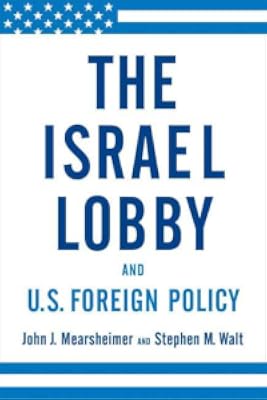
The Israel Lobby and U.S. Foreign Policy
by John J. Mearsheimer, Stephen M. Walt
On This Page
Description
"The Israel Lobby," by John J. Mearsheimer of the University of Chicago and Stephen M. Walt of Harvard's John F. Kennedy School of Government, was one of the most controversial articles in recent memory. Originally published in the London Review of Books in March 2006, it provoked both howls of outrage and cheers of gratitude for challenging what had been a taboo issue in America: the impact of the Israel lobby on U.S. foreign policy. Now in a work of major importance, Mearsheimer and Walt show more deepen and expand their argument and confront recent developments in Lebanon and Iran. They describe the remarkable level of material and diplomatic support that the United States provides to Israel and argues that this support cannot be fully explained on either strategic or moral grounds. This exceptional relationship is due largely to the political influence of a loose coalition of individuals and organizations that actively work to shape U.S. foreign policy in a pro-Israel direction. Mearsheimer and Walt provocatively contend that the lobby has a far-reaching impact on America's posture throughout the Middle East--in Iraq, Iran, Lebanon, and toward the Israeli-Palestinian conflict--and the policies it has encouraged are in neither America's national interest nor Israel's long-term interest. The lobby's influence also affects America's relationship with important allies and increases dangers that all states face from global jihadist terror. -- From publisher description. Describes how the remarkable level of material and diplomatic support that the United States provides to Israel is due to the influence of the Israel lobby, which has a far-reaching impact on America's foreign policy decisions throughout the Middle East. show lessTags
Recommendations





































Member Reviews
The Israel Lobby and US Foreign Policy, John J. Mearsheimer and Stephen Walt, Farrar Straus and Giroux, 2007
This book takes a much-needed look at the "special relationship" that exists between America and Israel.
First of all, the authors do not question that Israel has the right to exist within secure borders, or its right to lobby Washington for its interests, or that America should aid Israel if it is attacked. But, the current unconditional level of US support for Israel ($154 billion since 1948) cannot be justified on moral or strategic grounds.
Perhaps Israel was a strategic ally during the Cold War, but now it has become a growing liability. America’s one-sided support for Israel has helped fuel America’s terrorism problem, it show more has reinforced anti-Americanism around the world, and relations with key allies have suffered. The moral case for unconditional US support also is not compelling. Israel is a democracy, but no other democracy gets the same level of US support. Israel’s policies toward the Palestinians and its Arab neighbors have helped to destroy the myth of Israel as victim and the Arabs as aggressors.
Why does Israel keep receiving such one-sided support from America, even when its actions directly contradict US interests? Why is the discussion of Israeli actions more wide-ranging in Israel than in America? The "Israel Lobby" is a loose confederation of groups like AIPAC, the Anti-Defamation League and Christian Zionists, with Israel at the center. They don’t just lobby Washington and write newspaper op-eds, they also publicly smear anyone who says something of which they don’t approve.
An actual discussion of Israel’s influence in America, free of charges of anti-Semitism, is long overdue here in America. This book does a fine, and non-partisan, job of starting that discussion. It is very much recommended. show less
This book takes a much-needed look at the "special relationship" that exists between America and Israel.
First of all, the authors do not question that Israel has the right to exist within secure borders, or its right to lobby Washington for its interests, or that America should aid Israel if it is attacked. But, the current unconditional level of US support for Israel ($154 billion since 1948) cannot be justified on moral or strategic grounds.
Perhaps Israel was a strategic ally during the Cold War, but now it has become a growing liability. America’s one-sided support for Israel has helped fuel America’s terrorism problem, it show more has reinforced anti-Americanism around the world, and relations with key allies have suffered. The moral case for unconditional US support also is not compelling. Israel is a democracy, but no other democracy gets the same level of US support. Israel’s policies toward the Palestinians and its Arab neighbors have helped to destroy the myth of Israel as victim and the Arabs as aggressors.
Why does Israel keep receiving such one-sided support from America, even when its actions directly contradict US interests? Why is the discussion of Israeli actions more wide-ranging in Israel than in America? The "Israel Lobby" is a loose confederation of groups like AIPAC, the Anti-Defamation League and Christian Zionists, with Israel at the center. They don’t just lobby Washington and write newspaper op-eds, they also publicly smear anyone who says something of which they don’t approve.
An actual discussion of Israel’s influence in America, free of charges of anti-Semitism, is long overdue here in America. This book does a fine, and non-partisan, job of starting that discussion. It is very much recommended. show less
I recently saw an Intelligence Squared Debate (http://intelligencesquaredus.org/index.php/past-debates/the-us-should-step-back-from-its-special-relationship-with-israel/) where the motion called for the US to step back from its special relationship with Israel. Roger Cohen of the New York Times and Rashid Khalidi of Columbia University argued for the motion and in fact won the debate. The Israel Lobby and US Foreign Policy by John J. Mearsheimer and Stephen M. Walt makes a similar argument in a comprehensively researched and well written narrative. The genesis of the book was in an article commmissioned by the Atlantic Monthly in the fall of 2002. The authors worked on the project for about two years but their manuscript, incorporating show more most of the suggestions made by the magazine, was rejected in January 2005. The authors finally managed to publish the article in the London Review of Books in March 2006. The publication of the article led to a storm of protest and controversy, and severe criticism. The book represents the authors' attempt to respond to the criticism and to present a more detailed case with an extensive list of references and notes.
The book is divided in two sections. Part 1 deals with the special relationship that exists between the United States and Israel. The authors examine the reasons advanced by defenders of the relationship - is Israel an important strategic asset or is it actually a liability to US interests in the Middle East? The authors think it is the latter. They also question the moral justification of continued US economic, military and diplomatic support of Israel. Part 1 also identifies the loose collection of lobbyists, journalists and special interest groups that are collectively called "The Israel Lobby". The authors are at pains to emphasize that these groups are not necessarily coordinated or centrally organized and they are well within their democratic rights to influence US policy in a direction they deem most beneficial to both the United States and Israel.
Part 2 extensively discusses the affects of the lobby on US policy in the Middle East. It is in this section that the authors make their boldest claims. At least one of the conclusions, that the United States would not have invaded Iraq had the lobby not existed is difficult to accept. However, the authors make convincing arguments on the looby's potentially harmful long term affects on US interests in the Middle East. The chapters on Israel's treatment of the Palestinians and its conduct of the 2006 war in Lebanon are essential reading.
Debate about the relationship between the United States and Israel is unnaturally muted in the American media and this book makes a strong case for changing the status quo. The authors claim there is more debate within Israel than there is in the US media and their extensive bibliography is testament to that claim. I don't necessarily agree with all of the arguments made by Messrs Walt and Mearsheimer but this is an important book and I highly recommend it. show less
The book is divided in two sections. Part 1 deals with the special relationship that exists between the United States and Israel. The authors examine the reasons advanced by defenders of the relationship - is Israel an important strategic asset or is it actually a liability to US interests in the Middle East? The authors think it is the latter. They also question the moral justification of continued US economic, military and diplomatic support of Israel. Part 1 also identifies the loose collection of lobbyists, journalists and special interest groups that are collectively called "The Israel Lobby". The authors are at pains to emphasize that these groups are not necessarily coordinated or centrally organized and they are well within their democratic rights to influence US policy in a direction they deem most beneficial to both the United States and Israel.
Part 2 extensively discusses the affects of the lobby on US policy in the Middle East. It is in this section that the authors make their boldest claims. At least one of the conclusions, that the United States would not have invaded Iraq had the lobby not existed is difficult to accept. However, the authors make convincing arguments on the looby's potentially harmful long term affects on US interests in the Middle East. The chapters on Israel's treatment of the Palestinians and its conduct of the 2006 war in Lebanon are essential reading.
Debate about the relationship between the United States and Israel is unnaturally muted in the American media and this book makes a strong case for changing the status quo. The authors claim there is more debate within Israel than there is in the US media and their extensive bibliography is testament to that claim. I don't necessarily agree with all of the arguments made by Messrs Walt and Mearsheimer but this is an important book and I highly recommend it. show less
We all remember the events of 9/11, but can you remember your thoughts from 9/12? Were you confused, questioning the reason(s) for these attacks? Aren't we the good-guys, fostering human rights, democratic values, and the removal of authoritarian rulers? Clearly, there must be, or must have been, something about our foreign policy in the Middle East to cause such hate and anger toward us. Do you find President Bush's attempted explanation that "... they hate us for our freedom and our democracy" as weak and totally inadequate?
Well, this book isn't intended to answer the question as to why we were attacked on 9/11, but it does attempt to address some of the claims of unequal treatment toward peoples in the Middle East, and how or why show more some of the U.S. policies anger Muslim nations. It also might give some insight into why Arab leaders often claim that this Country is "controlled by the Jews" or by Jewish interests. We tend to trust our media and policy makers as fair and even handed, because they tell us they are. But if you're looking for a critical review of those statements, this book is a good place to start. I found this to be an eye-opening and enlightening book, and should be interesting to anyone groping for a deeper understanding of how some of our policies in the mid-east are developed and applied and how that affects us all. show less
Well, this book isn't intended to answer the question as to why we were attacked on 9/11, but it does attempt to address some of the claims of unequal treatment toward peoples in the Middle East, and how or why show more some of the U.S. policies anger Muslim nations. It also might give some insight into why Arab leaders often claim that this Country is "controlled by the Jews" or by Jewish interests. We tend to trust our media and policy makers as fair and even handed, because they tell us they are. But if you're looking for a critical review of those statements, this book is a good place to start. I found this to be an eye-opening and enlightening book, and should be interesting to anyone groping for a deeper understanding of how some of our policies in the mid-east are developed and applied and how that affects us all. show less
The Israel Lobby and U.S. Foreign Policy
by John J. Mearsheimer and Stephen M. Walt
Farrar, Straus and Giroux, New York, 2007
In March 2006 Mearsheimer and Walt published in number 6 of volume 28 of the London Review of Books a ten page article titled "The Israel Lobby". In that paper, the authors questioned the wisdom of the U.S. close relationship with Israel and the influence that the group of individuals and institutions they termed The Israel Lobby has in shapping that policy. This book, with more than three hundred and fifty pages plus notes, considerably extend the argument and provides a weealth of supporting references for their claim in more than one hundred fine printed pages of notes. The way the Israel lobby has been able to show more influence U.S. foreign policy is no secret to anyone interested in Middle Eastern and Israeli affairs and the same type of evidence is common knowledge in Europe, and has been repeatedly shown in the U.S. by writers such as Chomsky, Finkelstein, or Findley. But to see this argued by two pillars of the U.S. academic establishment is indeed a novelty, and one that outraged the lobby: after all, they could not dismiss the authors by calling them anti-semites, or member of the radical fringe, and they could hardly honestly contest the carefuly amassed and referenced evidence produced in the book. Is this the first crack on the most taboo issue in the U.S. foreign policy: its unswerving support for Israel? Given the role of the lobby in shapping the U.S. position vis-à-vis Iraq, Syria, Iran, Palestine, and its general regional policies, and given the counterproductive nature of its influence for the U.S. (and for Israel...) standing in the region, I would very much hope the answer to be yes! show less
by John J. Mearsheimer and Stephen M. Walt
Farrar, Straus and Giroux, New York, 2007
In March 2006 Mearsheimer and Walt published in number 6 of volume 28 of the London Review of Books a ten page article titled "The Israel Lobby". In that paper, the authors questioned the wisdom of the U.S. close relationship with Israel and the influence that the group of individuals and institutions they termed The Israel Lobby has in shapping that policy. This book, with more than three hundred and fifty pages plus notes, considerably extend the argument and provides a weealth of supporting references for their claim in more than one hundred fine printed pages of notes. The way the Israel lobby has been able to show more influence U.S. foreign policy is no secret to anyone interested in Middle Eastern and Israeli affairs and the same type of evidence is common knowledge in Europe, and has been repeatedly shown in the U.S. by writers such as Chomsky, Finkelstein, or Findley. But to see this argued by two pillars of the U.S. academic establishment is indeed a novelty, and one that outraged the lobby: after all, they could not dismiss the authors by calling them anti-semites, or member of the radical fringe, and they could hardly honestly contest the carefuly amassed and referenced evidence produced in the book. Is this the first crack on the most taboo issue in the U.S. foreign policy: its unswerving support for Israel? Given the role of the lobby in shapping the U.S. position vis-à-vis Iraq, Syria, Iran, Palestine, and its general regional policies, and given the counterproductive nature of its influence for the U.S. (and for Israel...) standing in the region, I would very much hope the answer to be yes! show less
Steven Rosen, the former AIPAC official, illustrates AIPAC's power for the New Yorker's magazine's Jeffrey Goldberg by putting a napkin in front of him and saying, "In twenty-four hours, we could have the signatures of seventy senators on this napkin." As Mearsheimer and Walt make clear, this is no idle boast, and they go on to say, "As will become clear, when issues relating to Israel come to the fore, Congress almost always votes to endorse the lobby's positions, usually in overwhelming numbers".
They note AIPAC President Howard Friedman telling the organization's members in August 2006, "AIPAC meets with every candidate running for Congress. These candidates receive in depth briefings to help them completely understand the show more complexities of Israel's predicament and that of the Middle East as a whole. We ask each candidate to author a "position paper" on their views of the U.S.-Israel relationship - so it is clear where they stand on the subject."
One congressional candidate (Harry Lonsdale) who went through this vetting process recounts that, "I found myself invited to AIPAC in Washington, D.C. fairly early in the campaign, for "discussions". It was an experience I will never forget. It wasn't enough that I was pro-Israel. I was given a list of vital topics and quizzed (read grilled) for my specific opinion on each. Actually I was told what my opinion must be, and exactly what words I was to use to express those opinions in public..... Shortly after that encounter at AIPAC, I was sent a list of American supporters of Israel..... that I was free to call for campaign contributions. I called, they gave, from Florida to Alaska."
AIPAC also keeps track of congressional voting records and direct funds to opponents of congressmen who don't follow their line.
Apart from Congress, Mearsheimer and Walt show successful Jewish activists in key government positions (particularly from the 1970's onwards), such as Paul Wolfowitz, Richard Perle, Douglas Feith, Elliott Abrahams, David Wurmser and Lewis "Scooter" Libby in the Clinton and Bush administrations. This political combination managed to steer George Bush, sideline Condoleeza Rice, and bully Colin Powell into the Iraq war . The authors show the enormous frustration of the CIA as their intelligence was distorted to support the lie of Iraqi WMD and start an unprovoked war that was not in the interests of the United States.
A feeble Congress votes record aid budgets to Israel (currently four billion dollars a year), with loans being converted to grants, and quick acquiescence to Israeli demands that aid be paid up front (which the U.S. government has borrow to give to them) rather than after tax collection, and to the Israeli refusal to account for how it is spent (both necessary conditions for other aid recipients).
The whole process is supported by Jewish Think Tank activists such as Daniel Pipes, Michael Rubin, and Joshua Muravchik at the American Enterprise Institute, and prominent journalists such as William Kristol, Michael Ladeen and Norman Podhoretz who are now agitating for America to declare war on Iran (and subsequently Syria and Saudi Arabia although they are not so open about this).
In their conclusion, Mearsheimer and Walt ask what can be done about the outlandish failure of the American government to act in the interests of America. They doubt that the Israel Lobby will relinquish its power in the press, campaign finance or government, so they suggest pressure for more open discourse, which seems to be happening. It was initially impossible to publish this book in America but it did eventually see the light of day after an article in the London Review of Books and an unprcedented 275.000 downloads of the working paper on Harvard's Kennedy School of Government website.
The authors see the (remote) possibility of congressmen treating Israel like any other country and they show clearly that the majority of American Jews aren't Likudniks and opposed the war in Iraq. They didn't like the AIPAC / Wolfowitz group but of course they lost out to the activists, so its not clear where all this goes, apart from generating some rumbling at the other end of the spectrum (for example, Robert Griffin's, "The Fame of a Dead Man's Deeds" ). show less
They note AIPAC President Howard Friedman telling the organization's members in August 2006, "AIPAC meets with every candidate running for Congress. These candidates receive in depth briefings to help them completely understand the show more complexities of Israel's predicament and that of the Middle East as a whole. We ask each candidate to author a "position paper" on their views of the U.S.-Israel relationship - so it is clear where they stand on the subject."
One congressional candidate (Harry Lonsdale) who went through this vetting process recounts that, "I found myself invited to AIPAC in Washington, D.C. fairly early in the campaign, for "discussions". It was an experience I will never forget. It wasn't enough that I was pro-Israel. I was given a list of vital topics and quizzed (read grilled) for my specific opinion on each. Actually I was told what my opinion must be, and exactly what words I was to use to express those opinions in public..... Shortly after that encounter at AIPAC, I was sent a list of American supporters of Israel..... that I was free to call for campaign contributions. I called, they gave, from Florida to Alaska."
AIPAC also keeps track of congressional voting records and direct funds to opponents of congressmen who don't follow their line.
Apart from Congress, Mearsheimer and Walt show successful Jewish activists in key government positions (particularly from the 1970's onwards), such as Paul Wolfowitz, Richard Perle, Douglas Feith, Elliott Abrahams, David Wurmser and Lewis "Scooter" Libby in the Clinton and Bush administrations. This political combination managed to steer George Bush, sideline Condoleeza Rice, and bully Colin Powell into the Iraq war . The authors show the enormous frustration of the CIA as their intelligence was distorted to support the lie of Iraqi WMD and start an unprovoked war that was not in the interests of the United States.
A feeble Congress votes record aid budgets to Israel (currently four billion dollars a year), with loans being converted to grants, and quick acquiescence to Israeli demands that aid be paid up front (which the U.S. government has borrow to give to them) rather than after tax collection, and to the Israeli refusal to account for how it is spent (both necessary conditions for other aid recipients).
The whole process is supported by Jewish Think Tank activists such as Daniel Pipes, Michael Rubin, and Joshua Muravchik at the American Enterprise Institute, and prominent journalists such as William Kristol, Michael Ladeen and Norman Podhoretz who are now agitating for America to declare war on Iran (and subsequently Syria and Saudi Arabia although they are not so open about this).
In their conclusion, Mearsheimer and Walt ask what can be done about the outlandish failure of the American government to act in the interests of America. They doubt that the Israel Lobby will relinquish its power in the press, campaign finance or government, so they suggest pressure for more open discourse, which seems to be happening. It was initially impossible to publish this book in America but it did eventually see the light of day after an article in the London Review of Books and an unprcedented 275.000 downloads of the working paper on Harvard's Kennedy School of Government website.
The authors see the (remote) possibility of congressmen treating Israel like any other country and they show clearly that the majority of American Jews aren't Likudniks and opposed the war in Iraq. They didn't like the AIPAC / Wolfowitz group but of course they lost out to the activists, so its not clear where all this goes, apart from generating some rumbling at the other end of the spectrum (for example, Robert Griffin's, "The Fame of a Dead Man's Deeds" ). show less
Mearsheimer and Walt are wrong in retrospect about Iraq so their basic thesis is undercut by the Coalition success in that country. Nonetheless, they provide a rationale for the continuing attacks on America, which this country should consider, the increasing unimportance of Israel as a strategic ally since the collapse of the Soviet Union. They advocate "offshore balancing" which sounds like it may have worked until the necessity of increased presence, particularly ground troops, in the Middle East.
The odd aspect of their thesis is undercut by the duplicity in the Obama regime. The Israel lobby, according to the authors, compromises American interests yet in the anti-Israel machinations of Obama, the lobby, if it can truly be said to show more exist, is silent on Obama. The "Israel Lobby" is is a no-show to the Middle Eastern debates and AIPAC has not played an important role in opposing Obama.
The Obama administration has obsessed about the necessity of Israel declaring its support for the "two-state solution" and yet the Israel lobby is not a significant factor.
The Road Map, which made the Palestinians oft-promised end to incitement and terrorism preconditions for further negotiations, has even been set aside by Obama in favor of advocating the Saudi 2002 Peace Plan, yet, still no important reaction on the part of the lobby.
On another point and player in the equation: Iran. Obama promotes a nuclear Iran and still no lobby to rear its influence.
What has been the response of American Jewry and the Mearsheimer-Walt Israel Lobby to the mounting threats to Israel promoted by Obama? Silence.
In Israel Jewish survival is the key; for American Jews the chimera of peace, in the form of any type of treaty, is paramount.
American Jews remained largely quiet during the Holocaust, partially because of their adulation of FDR, and Stephen Wise, the most influential voice in American Jewry, could not overcome his worship of FDR to challenge the latter's position that nothing could be done to save Jews other than win the War. (David Wyman's The Abandonment of the Jews reveals how much could have been done.)
American Jews are dazzled again. This time the object of their longing is Obama, who has thrown Jews under the bus. Likewise Clinton accomplished nothing for Jewry but the packaging of both has proven sufficient during the lack of accomplishment
The Israel Lobby of Walt and Mearsheimer obviously is vapid. Obama has made that clear.
Update: 13 July 2010
The influence of the Israel lobby is pervasive:
“Well I voted for Obama, I helped write one of his speeches,” Mortimer Zuckerman told Fox News’ Neil Cavuto.
Asked which speech he helped write, Zuckerman responded, “I’d rather not go into that.”
Zuckerman was identified by John Mearsheimer, political science professor at the University of Chicago, and Stephen Walt, academic dean of the Kennedy School of Government at Harvard University, as a a member of the media wing of the “Israeli lobby” in the United States. Zuckerman responded to the charge by stating he was “proud” to be part of the Israeli lobby.
"Influence over the executive branch derives in part from the impact Jewish voters have on presidential elections. Despite their small numbers in the population (less than 3 percent), American Jews make large campaign donations to candidates from both parties. . . . Furthermore, Jewish voters have high turnout rates are are concentrated in key states like California, Florida, Illinois, New Jersey, New York, and Pennsylvania, which increases the weight in determining who become president. Although they still favor the Democratic party, their support for Democratic candidates can no longer be taken for granted" (p. 163). show less
The odd aspect of their thesis is undercut by the duplicity in the Obama regime. The Israel lobby, according to the authors, compromises American interests yet in the anti-Israel machinations of Obama, the lobby, if it can truly be said to show more exist, is silent on Obama. The "Israel Lobby" is is a no-show to the Middle Eastern debates and AIPAC has not played an important role in opposing Obama.
The Obama administration has obsessed about the necessity of Israel declaring its support for the "two-state solution" and yet the Israel lobby is not a significant factor.
The Road Map, which made the Palestinians oft-promised end to incitement and terrorism preconditions for further negotiations, has even been set aside by Obama in favor of advocating the Saudi 2002 Peace Plan, yet, still no important reaction on the part of the lobby.
On another point and player in the equation: Iran. Obama promotes a nuclear Iran and still no lobby to rear its influence.
What has been the response of American Jewry and the Mearsheimer-Walt Israel Lobby to the mounting threats to Israel promoted by Obama? Silence.
In Israel Jewish survival is the key; for American Jews the chimera of peace, in the form of any type of treaty, is paramount.
American Jews remained largely quiet during the Holocaust, partially because of their adulation of FDR, and Stephen Wise, the most influential voice in American Jewry, could not overcome his worship of FDR to challenge the latter's position that nothing could be done to save Jews other than win the War. (David Wyman's The Abandonment of the Jews reveals how much could have been done.)
American Jews are dazzled again. This time the object of their longing is Obama, who has thrown Jews under the bus. Likewise Clinton accomplished nothing for Jewry but the packaging of both has proven sufficient during the lack of accomplishment
The Israel Lobby of Walt and Mearsheimer obviously is vapid. Obama has made that clear.
Update: 13 July 2010
The influence of the Israel lobby is pervasive:
“Well I voted for Obama, I helped write one of his speeches,” Mortimer Zuckerman told Fox News’ Neil Cavuto.
Asked which speech he helped write, Zuckerman responded, “I’d rather not go into that.”
Zuckerman was identified by John Mearsheimer, political science professor at the University of Chicago, and Stephen Walt, academic dean of the Kennedy School of Government at Harvard University, as a a member of the media wing of the “Israeli lobby” in the United States. Zuckerman responded to the charge by stating he was “proud” to be part of the Israeli lobby.
"Influence over the executive branch derives in part from the impact Jewish voters have on presidential elections. Despite their small numbers in the population (less than 3 percent), American Jews make large campaign donations to candidates from both parties. . . . Furthermore, Jewish voters have high turnout rates are are concentrated in key states like California, Florida, Illinois, New Jersey, New York, and Pennsylvania, which increases the weight in determining who become president. Although they still favor the Democratic party, their support for Democratic candidates can no longer be taken for granted" (p. 163). show less
Clear, comprehensive record of U.S.-Israeli relations in the Middle East during the first decade of the 21st century.
Members
- Recently Added By
Lists

Books Referenced by Khalidi's The Hundred Years' War on Palestine
181 works; 1 member

United States
35 works; 1 member
Author Information

18 Works 2,157 Members
He is R. Wendell Harrison Distinguished Service Professor of Political Science at the University of Chicago & a regular contributor to The New Republic & The Atlantic. (Bowker Author Biography)

14 Works 1,283 Members
Stephen M. Walt is the academic dean and the Robert and Renee Belfer Professor of International Affairs at Harvard University's John F. Kennedy School of Government
Awards and Honors
Distinctions
Common Knowledge
Classifications
- Genres
- Nonfiction, Politics and Government, General Nonfiction, History
- DDC/MDS
- 327.7305694 — Society, government, & culture Political science International Relations: Spies North America United States U.S.-Asian Relations
- LCC
- E183.8 .I7 .M428 — History of the United States United States History Diplomatic history. Foreign and general relations. Relations with individual countries
- BISAC
Statistics
- Members
- 946
- Popularity
- 28,026
- Reviews
- 10
- Rating
- (4.16)
- Languages
- 9 — Catalan, Danish, Dutch, English, French, German, Italian, Japanese, Croatian
- Media
- Paper, Audiobook, Ebook
- ISBNs
- 24
- ASINs
- 9