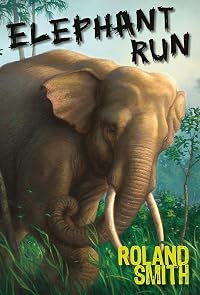
Elephant Run
by Roland Smith
On This Page
Description
Nick endures servitude, beatings, and more after his British father's plantation in Burma is invaded by the Japanese in 1941, and when his father and others are taken prisoner and Nick is stranded with his friend Mya, they plan a daring escape on elephants, risking their lives to save Nick's father and Mya's brother from a Japanese prisoner of war camp.Tags
Recommendations





















Member Recommendations
Member Reviews
I give kids' books a lot of latitude--I'll suspend my disbelief much higher than I would for an adult book and accept the deus ex machina plot device. The sharp edges of history can be sanded down a bit (like a long-time favorite, The Secret Cave) as long as they do not bend history into untruth to tell their story. While I wouldn't accuse Smith of outright changing history, I do have to vociferously object to his choice of the main premise of the story: that a parent in London during the Blitz would think that their son would be safer in Burma (now Myanmar). Anyone with a little knowledge of WWII in East Asia will tell you that this is absolutely ridiculous.
This painfully contrived arm-twist of a plot point allows Smith to do show more acceptable writerly things with his main character, Nick: use him to introduce readers to the world of a teak plantation harvested with the help of elephants, all from the eyes of an outsider. Props for that move.
Plot-wise and character-wise, there is quite a bit to like in this book. The story clips along nicely, quite a few characters are more complex than either all-bad or all-good, kids are resourceful but can't be completely independent from adults, the world-building is solid, and historical minefields like the Japanese invasion, forced labor, and the labor camp death marches are handled reasonably well for a young audience. Which makes it all the more disappointing that the book falls flat on its face in a few key areas:
1) History: I've explained that founding premise of the book is absurd, but I have one other key complaint. A Japanese character has a son being held in an American internment camp. Props to the author for dropping reference to this shocker--reading about Manzanar was absolutely hollowing for me when I first found out about it (as in, I felt hollow inside, like I'd lost something important, like my liver). But then Smith has this Japanese character receive letters from this son, which goes so far beyond credulity that I would argue it undoes the point Smith's trying to make. Assuming the kid reading this book doesn't yet know about the internment camps where the US held Japanese Americans during WWII, Smith has just implied that "inmates" were allowed to send letters--not just outside, but to the enemy. True, his son is sick. But how can we really believe that a country that allows an ailing little boy to write to his dear papa, who just happens to be a key figure in the army of the opponent, would not help said little boy? You think this is a leap, but note that this same Japanese character, for whom we've been asked to show sympathy in light of his concern about his trapped son, withholds incoming letters from his own captive. The very parallel that Smith has set up between the Japanese son & parent and Nick & parent drags other points of comparison into view, so we can't just ignore the implications of the different ways the US and the Japanese handle communications between their prisoners and the prisoners' families.
2) Racism: Everyone speaks lovely English. Fine, it's a kid's book, Myanmar was a British colony, all right--suspending my disbelief higher than usual. Then we get to this little gem:
Said by Burmese Mya to Nick, a white boy who hasn't been in the country for a year. That second line, the one that brings my disbelief crashing down, isn't even necessary--there are so many other ways to say that he looks tanner, slimmer, more physically fit, more worldly, whatever it is Smith is trying to say. Instead he goes for the one that indicates that a colonizer can "go native" through his own efforts...and can even do "native" better than the locals. It's said several times throughout the book that the Burmese can't decide whether it would be better to be occupied by the British or the Japanese. It's left to Nick's father, the benevolent white man who understands the primitive peoples' culture so well that he sees what they do not and knows what's best for them, to point out the unseen alternative: "It's time to give Burma back to the Burmese" (313). Gag.
3) Sexism: Only two female characters "on screen" and only one of them a main character, but I initially had high hopes for Mya. (The fact that she isn't even mentioned in the flap copy despite being half the story should have tipped me off.) Mya is a plucky, intelligent girl who's grown up on the teak plantation and has a gift for working with elephants, sneaking in trial runs whenever possible. Consider the following promising dialogue:
Snap! Traditional society insists that she can't become a mahout, but this is a kid's book, so her brother supports her ambitions and her father lets her drive an elephant not too long into the book (what is it with Disney stories and absent mothers?). She gets to be rebellious without rocking the boat too hard, which I do admire in a society that tends to paint women who want more as having no choice but to reject everything about their current situation.
Anyway, after some friendly introductory scenes that have me hoping that Nick and Mya will be fast friends, things start to go downhill. By page 96-97, "Nick had been looking at her a little differently since Indaw [her brother] pointed out how pretty she was. She had a beautiful olive-colored complexion*; her long black hair shone in the light of the campfires, and she had a wonderful smile." (*I know this isn't literal, but I always think of green olives when I read this phrase.)(Also, note the misuse of the semicolon.) Argh! No! Step away from the innocent children! Don't already start telling girls that they can't exist without a romantic interest!
I also feel compelled to complain that it's a bit disingenuous to tiptoe around the threat of rape--which would only be inflicted on *pretty*girls* like Mya--and substitute in the relatively benign threat of marriage. If we're pretending sex doesn't exist (this is a kid's book: mild gore=okay, body bits=bad) and consent is required for marriage, it doesn't logically make sense why Mya is in danger because she's pretty, or why her erstwhile suitor would do something as alarming as try to get into her room. Frankly, this kind of "inexplicable" behavior is almost scarier than at least saying something like, "Some bad people like to hurt people. They'll hurt anyone, but sometimes they especially like to hurt people who are pretty." Instead of offering some explanation to young readers of why Mya is afraid of a man who hasn't hit her and asks her permission to marry, there's this unspoken fear that, because it is not described, could be either large or small. Maybe this is just personal, but to me, all those unspoken, undescribed horrors were almost worse than just spelling it out: it left an amorphous dread of the implied but unknown. Rape is a horror, but one that can be identified, one that I could define in relation to myself. A mixed message like the one we get through Mya, though, that was unquantifiable--so how could I know that the warning did not apply to me? How can I be sure that I won't someday be in Mya's situation, but without the knowledge that the man isn't a good man? Basically, I think this kind of euphemism ("pretty") is far more toxic than helpful, and I view myself as a case in point. /End rant--since I could probably keep going on the personal note.
Anywho, back to the main program: So yes, while I did actually like quite a bit about the characters and the story and would really like the book if I read it in a vacuum (or fifteen years ago), the crimes of historical inaccuracy and the subtle colonialism are just a bit too much for me to get past. The sexism, sadly, is so culturally ingrained that it doesn't seem fair to dock points for that. But I'm really just hung up on the history. Was there NO other way to make this story work? What if something happened to Nick's caretaker in London--killed in the Blitz for a parent, drafted for an older sibling--and this was the explanation for his move from hot zone to hot zone? Why does the Japanese solder need to receive letters from his son to be worried about the fact that he's in a US internment camp?
Quote Roundup (for those quotes not already discussed)
149) Okay, not a quote, but another circumstance that beggars belief. Nick receives a letter from his father that's been smuggled in. Seems like paper should be scarce and the message should be unobtrusive. The letter, however, waxes lyrical about the details of his journeys, his work, and the ease of hiding things like his journal from his captors.
256) There was no barbwire around the mahout camp.
Who on earth copyedited this? It's "barbed wire": -ed space. I'd let it slide in dialogue, since this is an easy slip of the tongue, but in third-person writing that's not trying to sound casual, there's no reason this should be uncorrected.
I feel a bit guilty for being so hard on this book, but I think it's because I enjoyed enough of it that I probably would have really liked it when I was younger--and I'm aware now of the silent lessons the text would be teaching me.
Tagged "physically gorgeous" because I absolutely love the cover design. I am not ashamed to say that this was a case of judging a book by its cover when I first got it. I am ashamed to say that the cover is the only thing tempting me to keep the book. show less
This painfully contrived arm-twist of a plot point allows Smith to do show more acceptable writerly things with his main character, Nick: use him to introduce readers to the world of a teak plantation harvested with the help of elephants, all from the eyes of an outsider. Props for that move.
Plot-wise and character-wise, there is quite a bit to like in this book. The story clips along nicely, quite a few characters are more complex than either all-bad or all-good, kids are resourceful but can't be completely independent from adults, the world-building is solid, and historical minefields like the Japanese invasion, forced labor, and the labor camp death marches are handled reasonably well for a young audience. Which makes it all the more disappointing that the book falls flat on its face in a few key areas:
1) History: I've explained that founding premise of the book is absurd, but I have one other key complaint. A Japanese character has a son being held in an American internment camp. Props to the author for dropping reference to this shocker--reading about Manzanar was absolutely hollowing for me when I first found out about it (as in, I felt hollow inside, like I'd lost something important, like my liver). But then Smith has this Japanese character receive letters from this son, which goes so far beyond credulity that I would argue it undoes the point Smith's trying to make. Assuming the kid reading this book doesn't yet know about the internment camps where the US held Japanese Americans during WWII, Smith has just implied that "inmates" were allowed to send letters--not just outside, but to the enemy. True, his son is sick. But how can we really believe that a country that allows an ailing little boy to write to his dear papa, who just happens to be a key figure in the army of the opponent, would not help said little boy? You think this is a leap, but note that this same Japanese character, for whom we've been asked to show sympathy in light of his concern about his trapped son, withholds incoming letters from his own captive. The very parallel that Smith has set up between the Japanese son & parent and Nick & parent drags other points of comparison into view, so we can't just ignore the implications of the different ways the US and the Japanese handle communications between their prisoners and the prisoners' families.
2) Racism: Everyone speaks lovely English. Fine, it's a kid's book, Myanmar was a British colony, all right--suspending my disbelief higher than usual. Then we get to this little gem:
169) "You don't look anything like you did the day we picked you up ... You look almost Burmese."
Said by Burmese Mya to Nick, a white boy who hasn't been in the country for a year. That second line, the one that brings my disbelief crashing down, isn't even necessary--there are so many other ways to say that he looks tanner, slimmer, more physically fit, more worldly, whatever it is Smith is trying to say. Instead he goes for the one that indicates that a colonizer can "go native" through his own efforts...and can even do "native" better than the locals. It's said several times throughout the book that the Burmese can't decide whether it would be better to be occupied by the British or the Japanese. It's left to Nick's father, the benevolent white man who understands the primitive peoples' culture so well that he sees what they do not and knows what's best for them, to point out the unseen alternative: "It's time to give Burma back to the Burmese" (313). Gag.
3) Sexism: Only two female characters "on screen" and only one of them a main character, but I initially had high hopes for Mya. (The fact that she isn't even mentioned in the flap copy despite being half the story should have tipped me off.) Mya is a plucky, intelligent girl who's grown up on the teak plantation and has a gift for working with elephants, sneaking in trial runs whenever possible. Consider the following promising dialogue:
Mya: "Have you ever met a mahout stronger than his elephant?"
"No."
"So strength has little to do with controlling an elephant."
Snap! Traditional society insists that she can't become a mahout, but this is a kid's book, so her brother supports her ambitions and her father lets her drive an elephant not too long into the book (what is it with Disney stories and absent mothers?). She gets to be rebellious without rocking the boat too hard, which I do admire in a society that tends to paint women who want more as having no choice but to reject everything about their current situation.
Anyway, after some friendly introductory scenes that have me hoping that Nick and Mya will be fast friends, things start to go downhill. By page 96-97, "Nick had been looking at her a little differently since Indaw [her brother] pointed out how pretty she was. She had a beautiful olive-colored complexion*; her long black hair shone in the light of the campfires, and she had a wonderful smile." (*I know this isn't literal, but I always think of green olives when I read this phrase.)(Also, note the misuse of the semicolon.) Argh! No! Step away from the innocent children! Don't already start telling girls that they can't exist without a romantic interest!
I also feel compelled to complain that it's a bit disingenuous to tiptoe around the threat of rape--which would only be inflicted on *pretty*girls* like Mya--and substitute in the relatively benign threat of marriage. If we're pretending sex doesn't exist (this is a kid's book: mild gore=okay, body bits=bad) and consent is required for marriage, it doesn't logically make sense why Mya is in danger because she's pretty, or why her erstwhile suitor would do something as alarming as try to get into her room. Frankly, this kind of "inexplicable" behavior is almost scarier than at least saying something like, "Some bad people like to hurt people. They'll hurt anyone, but sometimes they especially like to hurt people who are pretty." Instead of offering some explanation to young readers of why Mya is afraid of a man who hasn't hit her and asks her permission to marry, there's this unspoken fear that, because it is not described, could be either large or small. Maybe this is just personal, but to me, all those unspoken, undescribed horrors were almost worse than just spelling it out: it left an amorphous dread of the implied but unknown. Rape is a horror, but one that can be identified, one that I could define in relation to myself. A mixed message like the one we get through Mya, though, that was unquantifiable--so how could I know that the warning did not apply to me? How can I be sure that I won't someday be in Mya's situation, but without the knowledge that the man isn't a good man? Basically, I think this kind of euphemism ("pretty") is far more toxic than helpful, and I view myself as a case in point. /End rant--since I could probably keep going on the personal note.
Anywho, back to the main program: So yes, while I did actually like quite a bit about the characters and the story and would really like the book if I read it in a vacuum (or fifteen years ago), the crimes of historical inaccuracy and the subtle colonialism are just a bit too much for me to get past. The sexism, sadly, is so culturally ingrained that it doesn't seem fair to dock points for that. But I'm really just hung up on the history. Was there NO other way to make this story work? What if something happened to Nick's caretaker in London--killed in the Blitz for a parent, drafted for an older sibling--and this was the explanation for his move from hot zone to hot zone? Why does the Japanese solder need to receive letters from his son to be worried about the fact that he's in a US internment camp?
Quote Roundup (for those quotes not already discussed)
149) Okay, not a quote, but another circumstance that beggars belief. Nick receives a letter from his father that's been smuggled in. Seems like paper should be scarce and the message should be unobtrusive. The letter, however, waxes lyrical about the details of his journeys, his work, and the ease of hiding things like his journal from his captors.
256) There was no barbwire around the mahout camp.
Who on earth copyedited this? It's "barbed wire": -ed space. I'd let it slide in dialogue, since this is an easy slip of the tongue, but in third-person writing that's not trying to sound casual, there's no reason this should be uncorrected.
I feel a bit guilty for being so hard on this book, but I think it's because I enjoyed enough of it that I probably would have really liked it when I was younger--and I'm aware now of the silent lessons the text would be teaching me.
Tagged "physically gorgeous" because I absolutely love the cover design. I am not ashamed to say that this was a case of judging a book by its cover when I first got it. I am ashamed to say that the cover is the only thing tempting me to keep the book. show less
A really lovely YA book about an unusual topic, the Japanese invasion of Burma in WWII. More than that though, this book is abuot loyalty and friendships, elephants and Buddhist monks, secret passageways and spies. It's very exciting and suspenseful at times, but the beautiful writing and balance of characters makes it more than the typical boys' war novel.
This was a beautifully structured, perfectly plotted adventure novel. The suspense kept me reading hungrily until the end. I was very favorably impressed. I also like how Smith didn't succumb to the obvious temptation to demonize any of the ethnic groups in the story -- the Burmese, the Europeans and the Japanese. The characters were just people, with the good, middling and bad equally represented.
Wonderful book about a boy who gets caught up in World War II events in Burma. Nick is sent from the bombings of London to live with his (divorced) father on his teak plantation. Nick is learning how to train elephants to log timber, and other details for eventually taking over his father's job, but soon the Japanese invade and everything changes. Nick and his new friend Mya, a Burmese girl whose father is an elephant "mahout," are taken prisoner in their own home, while Nick's father is sent to a labor camp to build railways for the invading army. Events in this book move very quickly and there's a lot of action and suspense; I enjoyed that but also the setting, which is really unique. There's an interesting amount of detail about show more Buddhism (one main character is an old Buddhist monk), the countryside of Burma, and elephant life in particular. A different look at the war, and at elephants, for a teen novel. show less
I loved the exotic setting of Elephant Run - Burma, WWIi, Japanese occupation. Buddhist mons and elephants just add to the setting. It is certainly a book for younger high school or middle school students because it presents a somewhat cleaned up picture of Japanese POW camps and occupying forces
All in all, a gripping novel with memorable characters!
All in all, a gripping novel with memorable characters!
I would have to say that the writing in the book is very good, it really links simple young adult reading with more refined style. I think this a solid transitional book for those wanting to maybe start "upgrading" their reading level. Roland Smith is not A. Dumas, but it was effective and well told, which is appreciated. As for the book itself, the story of Nick and his incredible story of running from the Germans just to get the Japanese was, in lack of better terms, fun! This kid just couldn't stay out of trouble! I would like to point out that it gives a great approach to the War, in that it was neither Euro-centric nor Anti Euro-centric in its historical approach. It did a great job at bridging world history without being bias to show more one or the other. Great book, i would recommend it. show less
Nick is a fourteen year old American boy living in London, who is caught in the fire of WWII. His mother, fearing for his safety from the falling bombs, sends him to live with his father, who owns a teak plantation in Burma. But the reach of the war proves too much, and Nick again finds himself in harms way as the Japanese seek to extend their influence throughout all of Southeast Asia. Through his struggles, Nick comes to see many examples of the goodness of humanity amidst the horrors of war, and ultimately realizes the importance of family in his life.
When Nick first arrives in Burma seeking refuge from the bombs of the Axis forces in London, he is a typical overweight teenager. He has not seen his father for over two years, and is show more elated to be near him again. Unfortunately for Nick, his arrival in Burma coincides with the Japanese infiltration and subsequent takeover. His father, as a member of the British group that originally colonized the Burmese, obviously does not support the Japanese attempts to take over Burma. So when Nick arrives, his father is unavailable to him because he is working day and night to try to use his influence to slow down the Japanese advance. We learn early on that Nick’s father, while a wealthy land owner descended from the original colonists, supports Burmese independence.
When Nick arrives in Burma, his father is off on important business, and welcoming him is left to a young Burmese woman named Mya. She shows him around the property, and he learns of her love of elephants. In Burma at this time, elephants are used to harvest the teak trees, thus those who train the elephants to do the work (mahouts) are considered very important members of society. Mya’s great-grandfather, Hilltop, was one of the original two mahouts who worked on this plantation and is considered a living legend, respected by all in the region. Mya also shares his gifts for working with and training elephants but is restricted by her gender. Women are prohibited from doing that sort of work, even if their abilities surpass that of their male counterparts.
Not too long after Nick arrives at the plantation, the Japanese military invade the plantation. They plan to use the area to construct a strategic airfield. Nick’s father and Mya’s older brother are sent to a work camp, while Nick, along with the rest of the Burmese workers, are put to work in various capacities serving the new holders of power. Nick and Mya are locked in at night and rarely see the outside world. It is during this period that Nick begins to grow and become a strong man. He must undergo beatings and works all day, in constant fear for his life. Hilltop is a great aide to him, showing him secret passages in the house, and modeling for him a posture of strength and forbearance. Mya’s situation is also dire because one of the Burmese men who has risen to a position of relative power by falling in with the Japanese, has set his sights on making her his wife.
As the situation at the plantation becomes more and more unstable, and they begin to sense that their lives are in danger, Hilltop insists that they make an escape for India, the nearest place not occupied by the Japanese. But Nick refuses to go without his father, and Hilltop finally consents to try to rescue Nick’s father from the work camp. While they are there, they will also try to rescue Mya’s brother. The rescue effort takes many twists and turns, but they do finally get Mya’s brother and Nick’s father out of the work camp. After a final tense scene where a mad elephant kills the two remaining men who are seeking to re-imprison them, they are free to go on their way.
The last chapter is set in Australia a few years later. Nick, his father, and Mya are living on a farm raising cattle. For Nick’s birthday that year, his father flies in his Mom and Mya’s brother to see them. show less
When Nick first arrives in Burma seeking refuge from the bombs of the Axis forces in London, he is a typical overweight teenager. He has not seen his father for over two years, and is show more elated to be near him again. Unfortunately for Nick, his arrival in Burma coincides with the Japanese infiltration and subsequent takeover. His father, as a member of the British group that originally colonized the Burmese, obviously does not support the Japanese attempts to take over Burma. So when Nick arrives, his father is unavailable to him because he is working day and night to try to use his influence to slow down the Japanese advance. We learn early on that Nick’s father, while a wealthy land owner descended from the original colonists, supports Burmese independence.
When Nick arrives in Burma, his father is off on important business, and welcoming him is left to a young Burmese woman named Mya. She shows him around the property, and he learns of her love of elephants. In Burma at this time, elephants are used to harvest the teak trees, thus those who train the elephants to do the work (mahouts) are considered very important members of society. Mya’s great-grandfather, Hilltop, was one of the original two mahouts who worked on this plantation and is considered a living legend, respected by all in the region. Mya also shares his gifts for working with and training elephants but is restricted by her gender. Women are prohibited from doing that sort of work, even if their abilities surpass that of their male counterparts.
Not too long after Nick arrives at the plantation, the Japanese military invade the plantation. They plan to use the area to construct a strategic airfield. Nick’s father and Mya’s older brother are sent to a work camp, while Nick, along with the rest of the Burmese workers, are put to work in various capacities serving the new holders of power. Nick and Mya are locked in at night and rarely see the outside world. It is during this period that Nick begins to grow and become a strong man. He must undergo beatings and works all day, in constant fear for his life. Hilltop is a great aide to him, showing him secret passages in the house, and modeling for him a posture of strength and forbearance. Mya’s situation is also dire because one of the Burmese men who has risen to a position of relative power by falling in with the Japanese, has set his sights on making her his wife.
As the situation at the plantation becomes more and more unstable, and they begin to sense that their lives are in danger, Hilltop insists that they make an escape for India, the nearest place not occupied by the Japanese. But Nick refuses to go without his father, and Hilltop finally consents to try to rescue Nick’s father from the work camp. While they are there, they will also try to rescue Mya’s brother. The rescue effort takes many twists and turns, but they do finally get Mya’s brother and Nick’s father out of the work camp. After a final tense scene where a mad elephant kills the two remaining men who are seeking to re-imprison them, they are free to go on their way.
The last chapter is set in Australia a few years later. Nick, his father, and Mya are living on a farm raising cattle. For Nick’s birthday that year, his father flies in his Mom and Mya’s brother to see them. show less
Members
- Recently Added By
Published Reviews
Gr 5–7—As German bombs fall on London, 14-year-old Nick is sent to Burma to live with his British father on their teak plantation. Unforeseen in this plan is the impending invasion that puts them, along with the locals, under Japanese rule. Nick is forced to work on the plantation for the brutal commanders and his father is placed in a labor camp. The boy's predicament escalates as his show more trust in the Burmese employees who once worked for his father is challenged by their newfound loyalty to the Japanese. Escape through the jungle, with the help of a well-respected monk and great-grandfather to the boy's new friend Mya, is the only way out. This novel is filled with intrigue, danger, surprising plot twists, and suspense. It's a well-developed historical adventure with villains and heroes that describes aspects of British colonization, forced occupation, and World War II.—Rita Soltan, Youth Services Consultant, West Bloomfield, MI
Copyright © Reed Business Information, a division of Reed Elsevier Inc. All rights reserved. show less
added by sriches
Lists

Children's Books about World War II (1939-1945)
143 works; 12 members
Author Information

50 Works 15,496 Members
Roland Smith was born in Portland, Oregon on November 30, 1951. He received a Bachelor's degree in English from Portland State University. His job working for a children's zoo began a 20-year career as a zookeeper. After working to save wildlife following the Exxon Valdez oil spill, his first non-fiction book, Sea Otter Rescue, was published in show more 1990. He continued to draw upon his zoo experiences for other non-fiction titles, including Journey of the Red Wolf, which won an Oregon Book Award in 1996. His first novel, Thundercave, was published in 1997. His other fiction books include The Captain's Dog: My Journey with the Lewis and Clark Tribe, Zach's Lie, Jack's Run, Cryptid Hunters, Peak, and Shatterproof. He also writes the I, Q. series and the Storm Runners series. (Bowker Author Biography) show less
Awards and Honors
Awards
Distinctions
Common Knowledge
- Important places
- London, England, UK; Burma
- Important events
- The Blitz; World War II
- First words
- When Nick Freestone was young, he and his mother lived on a farm in Kansas.
- Last words
- (Click to show. Warning: May contain spoilers.)Metal on metal, faint, but growing louder as the desert wind caught Hannibal's iron bell.
Classifications
- Genres
- Fiction and Literature, Tween, Kids
- DDC/MDS
- 813.54 — Literature & rhetoric American literature in English American fiction in English 1900-1999 1945-1999
- LCC
- PZ7 .S657655 .E — Language and Literature Fiction and juvenile belles lettres Fiction and juvenile belles lettres Juvenile belles lettres
- BISAC
Statistics
- Members
- 1,339
- Popularity
- 17,874
- Reviews
- 41
- Rating
- (4.14)
- Languages
- English
- Media
- Paper
- ISBNs
- 9
- ASINs
- 4