
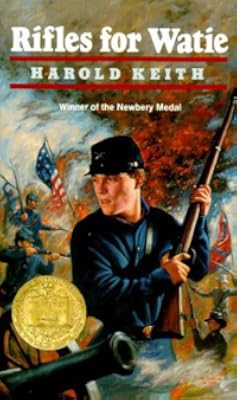
Rifles for Watie
by Harold Keith
On This Page
Description
With fighting erupting around his Kansas farm, 16-year-old Jefferson Davis Bussey can hardly wait to join the Union forces. He wants to defend his family from the dreaded Colonel Watie and his Cherokee Indian rebels. After enlisting, Jeff discovers the life of a soldier brings little glory and honor. During battle, his friends die around him. And when he infiltrates Watie's camp as a spy, he discovers the enemy is much like himself-only fighting for a different cause. As Jeff collects show more information, he wonders if he will be able to betray his new rebel companions when the time comes for him to return to the Union forces. Historian and author Harold Keith packs this well-researched novel with fascinating details and breath-taking action. Rifles for Watie was named an ALA Notable Children's Book and won the Lewis Carroll Shelf Award. Believable characters and vivid battle scenes burst from the pages of history with narrator Tom Stechschulte's dramatic performance. show lessTags
Recommendations





Member Reviews
One of the most interesting aspects of Rifles for Watie is that it is told from the perspective of multiple groups in and around the American civil war of April 1861 - April 1865. Keith visited actual battle locations to get a sense of the varying conflicts and not just the well known ones related to violent battle. Poverty, wealth, prejudice, pride, religion, gender, tribal feuding, slavery, freedom. Right or wrong, all of these issues collide.
Keith used diaries, journals, and personal letters to give Rifles for Watie first person authenticity. To personalize it even further, he used interviews conducted for his thesis. Between the years of 1940 and 1941 he visited with twenty two veterans and listened to their nostalgic reminiscing. show more These oral histories captured the large and small personal sacrifices of war. Ever in their debt, Keith was careful to give all twenty two individuals credit saying, "my obligation to all their memories is very deep" (Introduction, Rifles for Watie p 12). While General Watie and James G. Blunt were a real-life historical figures, the character of Jeffrey and the other soldiers in Rifles for Watie are Keith's imagination; I would like to think of them as a creative combination of all the men Harold Keith interviewed.
My favorite segment was when Jefferey was having a passionate argument with Lucy. Every side of the conflict is laid bare; because there are more than two sides to every truth. Good guys aren't necessarily all that good. Bad guys aren't that bad. Dogs are just dogs. show less
Keith used diaries, journals, and personal letters to give Rifles for Watie first person authenticity. To personalize it even further, he used interviews conducted for his thesis. Between the years of 1940 and 1941 he visited with twenty two veterans and listened to their nostalgic reminiscing. show more These oral histories captured the large and small personal sacrifices of war. Ever in their debt, Keith was careful to give all twenty two individuals credit saying, "my obligation to all their memories is very deep" (Introduction, Rifles for Watie p 12). While General Watie and James G. Blunt were a real-life historical figures, the character of Jeffrey and the other soldiers in Rifles for Watie are Keith's imagination; I would like to think of them as a creative combination of all the men Harold Keith interviewed.
My favorite segment was when Jefferey was having a passionate argument with Lucy. Every side of the conflict is laid bare; because there are more than two sides to every truth. Good guys aren't necessarily all that good. Bad guys aren't that bad. Dogs are just dogs. show less
Jeff Bussey walked briskly up the rutted wagon road toward Fort Leavenworth on his way to join the Union volunteers. It was 1861 in Linn County, Kansas, and Jeff was elated at the prospect of fighting for the North at last. In the Indian country south of Kansas there was dread in the air; and the name, Stand Watie, was on every tongue. A hero to the rebel, a devil to the Union man, Stand Watie led the Cherokee Indian Na-tion fearlessly and successfully on savage raids behind the Union lines. Jeff came to know the Watie men only too well. He was probably the only soldier in the West to see the Civil War from both sides and live to tell about it. Amid the roar of cannon and the swish of flying grape, Jeff learned what it meant to fight in show more battle. He learned how it felt never to have enough to eat, to forage for his food or starve. He saw the green fields of Kansas and Okla-homa laid waste by Watie's raiding parties, homes gutted, precious corn deliberately uprooted. He marched endlessly across parched, hot land, through mud and slash-ing rain, always hungry, always dirty and dog-tired. And, Jeff, plain-spoken and honest, made friends and enemies. The friends were strong men like Noah Babbitt, the itinerant printer who once walked from Topeka to Galveston to see the magnolias in bloom; boys like Jimmy Lear, too young to carry a gun but old enough to give up his life at Cane Hill; ugly, big-eared Heifer, who made the best sourdough biscuits in the Choctaw country; and beautiful Lucy Washbourne, rebel to the marrow and proud of it. The enemies were men of an-other breed - hard-bitten Captain Clardy for one, a cruel officer with hatred for Jeff in his eyes and a dark secret on his soul. This is a rich and sweeping novel-rich in its panorama of history; in its details so clear that the reader never doubts for a moment that he is there; in its dozens of different people, each one fully realized and wholly recognizable. It is a story of a lesser -- known part of the Civil War, the Western campaign, a part different in its issues and its problems, and fought with a different savagery. Inexorably it moves to a dramat-ic climax, evoking a brilliant picture of a war and the men of both sides who fought in it. show less
What a great look at the Civil War from a less seen perspective. The historical details of this novel make it particularly interesting, and the storyline is exciting. Jeff is likeable and has a character that is open and questioning, so that he can appreciate people for who they are on whichever side of the war they are on.
Jefferson Davis Bussey is sixteen when the Civil War breaks out. He can't wait to leave his Kansas farm and defend the Union against Colonel Watie, the leader of the dreaded Cherokee Indian rebels.
But Jeff soon learns that there's more to our war than honor and glory. As an infantry soldier, he must march for miles, exhausted and near starvation. He sees friends die in battle. He knows that each move he makes could be his last. Then Jeff is sent to infiltrate the enemy camp as a spy. And it is there that he makes his most important discovery: The rebels are just men - and boys - like him. The only difference between them is their cause. Passing himself off as a rebel, Jeff waits for the information he needs to help the Union conquer the show more enemy forces. But when the time comes, Jeff finds himself up against a very difficult decision. Should he betray the enemy? Or join them? show less
But Jeff soon learns that there's more to our war than honor and glory. As an infantry soldier, he must march for miles, exhausted and near starvation. He sees friends die in battle. He knows that each move he makes could be his last. Then Jeff is sent to infiltrate the enemy camp as a spy. And it is there that he makes his most important discovery: The rebels are just men - and boys - like him. The only difference between them is their cause. Passing himself off as a rebel, Jeff waits for the information he needs to help the Union conquer the show more enemy forces. But when the time comes, Jeff finds himself up against a very difficult decision. Should he betray the enemy? Or join them? show less
The story follows Jefferson Davis Bussey, an awkwardly-named boy from Kansas who joins the Union Army to fight against the raiders who threaten his home. The story moves quickly and is full of action as Jeff learns that soldiering isn't quite what he expected, experiences his first battles as a Union soldier, and then is forced into joining the Confederate Army while posing as a civilian on a scouting mission.
The backdrop of the novel is more interesting that your typical East Coast Civil War novel. Set out in the western war of Kansas, Missouri, Oklahoma and Texas, the book highlights the struggle over the question of "free or slave?" for the Territories, and the divided loyalties the issue caused. It also shows the choices and show more internal fractures confronting the Cherokee, Seminole and other Native American tribes as they tried to maintain some vestige of autonomy.
Perhaps the most notable aspect of the book is that there is no "right" side and "wrong" side in the way the war is portrayed; we are shown good and bad in both armies. By the end of the book, Jeff is honestly conflicted over where to give his allegiance. To the North lie home and family, a cause in which he believes, and the Army to which he gave his oath. To the South lie the individuals who have befriended him, men he has come to respect, and the girl whom he loves. In the end, both sides are portrayed just as individuals: tired, hungry, scared and fighting for a variety of reasons that have more to do with protecting families than political posturing back East.
In summary, not a bad read for any young adult readers in your household. Recommended...maybe even strongly once I think about it some more. show less
The backdrop of the novel is more interesting that your typical East Coast Civil War novel. Set out in the western war of Kansas, Missouri, Oklahoma and Texas, the book highlights the struggle over the question of "free or slave?" for the Territories, and the divided loyalties the issue caused. It also shows the choices and show more internal fractures confronting the Cherokee, Seminole and other Native American tribes as they tried to maintain some vestige of autonomy.
Perhaps the most notable aspect of the book is that there is no "right" side and "wrong" side in the way the war is portrayed; we are shown good and bad in both armies. By the end of the book, Jeff is honestly conflicted over where to give his allegiance. To the North lie home and family, a cause in which he believes, and the Army to which he gave his oath. To the South lie the individuals who have befriended him, men he has come to respect, and the girl whom he loves. In the end, both sides are portrayed just as individuals: tired, hungry, scared and fighting for a variety of reasons that have more to do with protecting families than political posturing back East.
In summary, not a bad read for any young adult readers in your household. Recommended...maybe even strongly once I think about it some more. show less
Anyway, Keith's acceptance speech isn't that interesting. He speaks of his background as sports publicity director for U. of OK as not being helpful, but as writing workshops teaching him the strategies of putting together a successful story.
There and in the introduction in the book itself he speaks of all the interviews he did with the aged veterans of the war. So, yes, the details of how the boys dealt with being soldiers, etc., do ring true.
However.
In the introduction he admits that the novel is entirely fiction, and especially that he knows of no record of Stand Watie, the Cherokee slave owner and leader of rebel Indians, attempting to secure repeating rifles.
That's just too much invention for me.
I want to know more about Watie, show more but not from this novel.
I read to p. 92, the introduction to Watie, and gave up. show less
There and in the introduction in the book itself he speaks of all the interviews he did with the aged veterans of the war. So, yes, the details of how the boys dealt with being soldiers, etc., do ring true.
However.
In the introduction he admits that the novel is entirely fiction, and especially that he knows of no record of Stand Watie, the Cherokee slave owner and leader of rebel Indians, attempting to secure repeating rifles.
That's just too much invention for me.
I want to know more about Watie, show more but not from this novel.
I read to p. 92, the introduction to Watie, and gave up. show less
An amazing look at what life in the Civil War was like for one boy from Kansas. Yes, he makes friends and he looses friends and some of the soldiers he meets wanted to be in battle and some were told to be, some were as young or younger than he was and some were adults, but beyond the typical stories of a soldier we learn what life was like in the area at the time. We don't just live the life of a soldier, we live with families from the Western Band of the Cherokee Nation, those who were sent on the Trail of Tears and forced to resettle. We learn what it was like to be a family member whose house was looted by soldiers who were starving and didn't want to do what they did, but necessity changed their character from kindly requesting show more food to simply snatching it over the course of a few months.
Freedom and equality are still being fought for to this day, so the ideas behind this book are hardly old or worn. Often as I was reading current events were brought to mind that I never would have thought to compare with times like these, where half of the country demands one right and half insists on the other. This is an excellent opportunity for young readers to learn of history, to learn of what it is to be a soldier, and to learn what it is to believe in something so deeply that you are willing to fight for the right to continue to hold that belief. Young readers might also be reminded of the politeness and mannerisms of the time, as that aspect is written so well I have found myself almost calling people Mam and Sir long after having finished the book. show less
Freedom and equality are still being fought for to this day, so the ideas behind this book are hardly old or worn. Often as I was reading current events were brought to mind that I never would have thought to compare with times like these, where half of the country demands one right and half insists on the other. This is an excellent opportunity for young readers to learn of history, to learn of what it is to be a soldier, and to learn what it is to believe in something so deeply that you are willing to fight for the right to continue to hold that belief. Young readers might also be reminded of the politeness and mannerisms of the time, as that aspect is written so well I have found myself almost calling people Mam and Sir long after having finished the book. show less
Members
- Recently Added By
Lists

Best Newbery Medal Winners
94 works; 54 members

Newbery Medal Winners - By Year
105 works; 7 members

Sonlight Books
1,487 works; 25 members

Mensa for Kids Excellence in Reading Award Program (Grades 7-8)
62 works; 3 members

Mensa for Kids Excellence in Reading Award Program (Grades 7-8)
62 works; 1 member

Books Read in 2019
4,052 works; 110 members

Beautiful Feet Books
304 works; 7 members

Best Newbery Honor Books
241 works; 31 members

The Story of the World: Activity Book Four: The Modern Age
333 works; 2 members

Ambleside Year 5
55 works; 1 member
Author Information

18+ Works 2,464 Members
Awards and Honors
Awards
Series
Belongs to Publisher Series
Common Knowledge
- Canonical title
- Rifles for Watie
- Original publication date
- 1957
- People/Characters
- Jefferson Davis "Jeff" Bussey; Jimmy Lear; Lucy Washbourne; Captain Clardy; John Chadwick; Stuart Mitchell (show all 13); General Blunt; David Gardner; Lee Washbourne; Emory Bussey; Leemon Jones; Noah Babbitt; Stand Watie
- Important places
- Linn County, Kansas, USA; Oklahoma, USA; Missouri, USA; Texas, USA; Prairie Grove, Arkansas, USA
- Important events
- American Civil War
- Dedication
- To Anne and Lane Livingston of Hutchinson, Kansas
- First words
- The mules strained forward strongly, hoofs stomping, harness jingling.
- Last words
- (Click to show. Warning: May contain spoilers.)Soon he began to breathe deeply and regularly.
- Original language
- English
Classifications
- Genres
- Fiction and Literature, Children's Books
- DDC/MDS
- 813.54 — Literature & rhetoric American literature in English American fiction in English 1900-1999 1945-1999
- LCC
- PZ7 .K255 .R — Language and Literature Fiction and juvenile belles lettres Fiction and juvenile belles lettres Juvenile belles lettres
- BISAC
Statistics
- Members
- 2,315
- Popularity
- 8,543
- Reviews
- 27
- Rating
- (3.93)
- Languages
- English
- Media
- Paper, Audiobook, Ebook
- ISBNs
- 28
- ASINs
- 19