
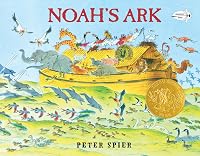
Noah's Ark
by Peter Spier
On This Page
Description
Retells in pictures how a pair of every manner of creature climbed on board Noah's ark and thereby survived the Flood.Tags
Recommendations







Member Reviews
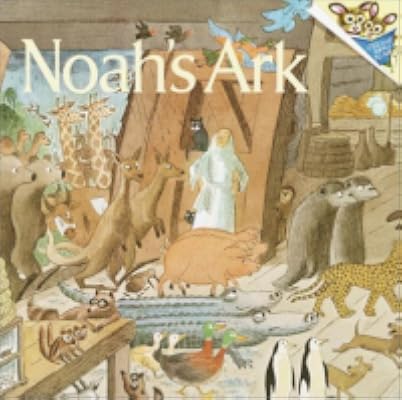
Opening with his own translation of The Flood, a poem from Dutch poet and theologian Jacobus Revius (1586-1658), author/illustrator Peter Spier then proceeds to retell the story of Noah's Ark in this otherwise wordless picture book. Many of the pages are split into panels, usually with one large and several smaller paintings, although some two-page spreads contain only one massive painting. The events of the story—the gathering of the animals, their feeding and upkeep during the flood, the landing of the Ark on Mt. Ararat—are retold through the artwork, and the story concludes with an image of the abandoned Ark, all chaos inside...
Published in 1977, Noah's Ark won the Caldecott Medal in 1978, and it is not difficult to see why. The show more artwork here is detailed and expressive, capturing both the pathos and humor of the famous biblical story in unexpected ways. There are amusing scenes aplenty, including those in which Mrs Noah is terrified of some mice, and Noah himself tends to various animals, but what struck me most were the tragic ones. It may be odd to say it, as someone who has known this story since I was a little girl, but I'd never really considered all the animals who didn't make it onto the Ark. The people left behind to perish, yes, I'd thought of them, with pity and horror, but I'd never really thought of all of the OTHER animals, besides the lucky two from each species, that were abandoned to their fate. Here their fate was brought to my attention in a heartbreaking sequence of scenes, as the Ark is closed up and the rest of the animals stand there, slowly being submerged in water. That sequence hit me like a gut-punch, and will be with me for some time. The near-destruction of humanity is heartbreaking of course, but there one can argue (at least within the structure of the story) that their own actions caused their suffering. What wrong did the animals do? None—and yet they too suffered, their fate tied to that of humanity. I was reminded of Cú Rua the fox, from Pat O'Shea fantasy masterpiece, The Hounds of the Morrigan, who declared that "it is a sad and puzzling fate to share the world with man, but what can we do?"
I'm not sure my reaction here would be the common one, but I suspect it is not solely owing to my age, and that I would have been likewise struck, as a child. This is a beautiful book, and well worth the accolades it won, but I am rather glad I didn't encounter it as a child... show less
Published in 1977, Noah's Ark won the Caldecott Medal in 1978, and it is not difficult to see why. The show more artwork here is detailed and expressive, capturing both the pathos and humor of the famous biblical story in unexpected ways. There are amusing scenes aplenty, including those in which Mrs Noah is terrified of some mice, and Noah himself tends to various animals, but what struck me most were the tragic ones. It may be odd to say it, as someone who has known this story since I was a little girl, but I'd never really considered all the animals who didn't make it onto the Ark. The people left behind to perish, yes, I'd thought of them, with pity and horror, but I'd never really thought of all of the OTHER animals, besides the lucky two from each species, that were abandoned to their fate. Here their fate was brought to my attention in a heartbreaking sequence of scenes, as the Ark is closed up and the rest of the animals stand there, slowly being submerged in water. That sequence hit me like a gut-punch, and will be with me for some time. The near-destruction of humanity is heartbreaking of course, but there one can argue (at least within the structure of the story) that their own actions caused their suffering. What wrong did the animals do? None—and yet they too suffered, their fate tied to that of humanity. I was reminded of Cú Rua the fox, from Pat O'Shea fantasy masterpiece, The Hounds of the Morrigan, who declared that "it is a sad and puzzling fate to share the world with man, but what can we do?"
I'm not sure my reaction here would be the common one, but I suspect it is not solely owing to my age, and that I would have been likewise struck, as a child. This is a beautiful book, and well worth the accolades it won, but I am rather glad I didn't encounter it as a child... show less
A seventeenth-century Dutch poem by Jacobus Revius is the inspiration for this gloriously detailed picture book, which earned a Caldecott Medal. Spier translated the poem which mentions
“Cow and moose,
Hare and goose,
Sheep and ox,
Bee and fox…”
The poem, itself, is on page 1, but the story really begins on the front inside cover and flyleaf, with a two-page panoramic spread that shows destruction of a village in the distance, while Noah and his family prosper on a hillside and the words “…But Noah found grace in the eyes of the Lord.”
This is followed by two more “double truck” pictorial panoramas showing the construction of the ark, while a parade of villagers streams past, and the stacks of provisions ready to be loaded show more aboard, before the poem is printed.
The rest of the book is entirely pictorial. And these are wonderful illustrations! I poured over them, noticing the pairs of different animals, and marveling at the minute details he included. There are even pairs of spiders, scorpions, dodos and echidnas! The big cats are carefully crated before being loaded aboard the Ark. Mrs Noah is obviously unhappy about the mice and creepy-crawlies. The animals and people left behind are slowly engulfed by the rising waters, as is the landscape.
I especially liked how Spier showed the work involved in caring for this menagerie … feeding the animals, mucking out stalls, providing water. Noah and his family members are delighted when new chicks hatch, or puppies are born, but visibly tired and worn as time passes and the rains continue. By the time the dove returns with the olive branch the people and animals are all equally relieved that their ordeal will soon be over. The elephants are first off, followed by a parade of animals and people. The slow-pokes – turtles and snails are the last to depart. The final panoramic spread, composing the back inside cover, shows the miraculous rainbow, and Noah on a hillside “…and he planted a vineyard.”
What I particularly appreciate about this richly drawn book is that it will allow children to use their imaginations to tell the story of what is happening in each panel. I don’t have any little ones in my life, but I want to go out and buy this book so I can look at the pictures again and again to my heart’s content. show less
“Cow and moose,
Hare and goose,
Sheep and ox,
Bee and fox…”
The poem, itself, is on page 1, but the story really begins on the front inside cover and flyleaf, with a two-page panoramic spread that shows destruction of a village in the distance, while Noah and his family prosper on a hillside and the words “…But Noah found grace in the eyes of the Lord.”
This is followed by two more “double truck” pictorial panoramas showing the construction of the ark, while a parade of villagers streams past, and the stacks of provisions ready to be loaded show more aboard, before the poem is printed.
The rest of the book is entirely pictorial. And these are wonderful illustrations! I poured over them, noticing the pairs of different animals, and marveling at the minute details he included. There are even pairs of spiders, scorpions, dodos and echidnas! The big cats are carefully crated before being loaded aboard the Ark. Mrs Noah is obviously unhappy about the mice and creepy-crawlies. The animals and people left behind are slowly engulfed by the rising waters, as is the landscape.
I especially liked how Spier showed the work involved in caring for this menagerie … feeding the animals, mucking out stalls, providing water. Noah and his family members are delighted when new chicks hatch, or puppies are born, but visibly tired and worn as time passes and the rains continue. By the time the dove returns with the olive branch the people and animals are all equally relieved that their ordeal will soon be over. The elephants are first off, followed by a parade of animals and people. The slow-pokes – turtles and snails are the last to depart. The final panoramic spread, composing the back inside cover, shows the miraculous rainbow, and Noah on a hillside “…and he planted a vineyard.”
What I particularly appreciate about this richly drawn book is that it will allow children to use their imaginations to tell the story of what is happening in each panel. I don’t have any little ones in my life, but I want to go out and buy this book so I can look at the pictures again and again to my heart’s content. show less
I have a love of all things Noah's Ark, and this is a standout "retelling". Spier's book starts with a translated Dutch poem, but the rest of the book is wordless. In place of prose are detailed, imaginative drawings that capture that ups and downs of the narrative. There's so much to look at and laugh over for both children and adults. Top of my list are the unique holding areas for different types of animals and the messes they leave behind! #relatable C definitely prefers books with words, but still spends a lot of time studying the images and reading the storyline in them.
I have a love of all things Noah's Ark, and this is a standout "retelling". Spier's book starts with a translated Dutch poem, but the rest of the book is wordless. In place of prose are detailed, imaginative drawings that capture that ups and downs of the narrative. There's so much to look at and laugh over for both children and adults. Top of my list are the unique holding areas for different types of animals and the messes they leave behind! #relatable C definitely prefers books with words, but still spends a lot of time studying the images and reading the storyline in them.
Peter Spier’s Noah’s Ark is a wordless and gentle retelling of the Bible story of Noah and his ark of animals rendered in watercolor and ink drawings. Spier evokes the forty days and nights of the great flood with washes of gray and blue soaking the pages. The parade of animal pairs is depicted more realistically than most, revealing the chaos of the animal exodus and the sorrow of the animals left behind. Noah as animal caretaker is accentuated, as well as the accumulating detritus of the voyage. The prelude and outcome of the voyage are literally the endpapers of this book; thus Noah’s Ark portrays the arduous and wearying passage of the protracted voyage and its affect on Noah and his animal passengers.
Peter Spier is an author and an illustrator, and a maybe little known fact about this man is that he spent time in Theresienstadt during WW 2. On the first page of Noah's Ark, in the background is a picture of a burning town with an army moving across the foreground. The text reads "...But Noah found grace in the eyes of the Lord." This could have a double meaning, for Mr. Spier regarding his experiences during the 1940s. A few pages later, Mr. Spier has included as an introduction a translated Dutch poem (1586-1658) The Flood. The rest of the book, until the very last page is just ilustrations. On the last page, the first comment is finished ...and he planted a vineyard." Peter Spier's "Noah's Ark" reminds me of the purpose of stained show more glass windows in cathedrals. The scenes in the windows were created to explain the Bible many could not read. The illustrations in "Noah's Ark" are so detailed they don't need a supporting text. They are beautiful watercolors telling a story to an emerging reader. show less
This book has great illustrations that tell a story without using words. At times, the pictures keep you so captive, you forget the book does not have words. Although each page only contains imaginary, it still engages the reader and allows each reader to create their own interpretation of the story. An example would be near the middle of the story when the illustrations show a picture of all the animals Noah is putting on the boat. Students may wonder, "Is going to put all the animals on the boat, or how is he going to fit them all?"
Members
- Recently Added By
Lists

Caldecott Medal Books
91 works; 15 members

Honey For a Child's Heart
1,152 works; 25 members

Sonlight Books
1,487 works; 25 members

Wordless Books
157 works; 15 members

CCE 1000 Good Books List
1,033 works; 12 members

A Book in Time World History Reading List
47 works; 2 members

Books Read in 2021
5,361 works; 114 members

Books Read in 2016
4,666 works; 199 members

Early Picture Books
467 works; 9 members

Precious People
119 works; 1 member

Read Aloud Revival
108 works; 4 members

The Peaceful Preschool Curriculum
58 works; 1 member
Author Information

67+ Works 12,618 Members
Peter Edward Spier was born in Amsterdam on June 6, 1927. His formal education ended in his early teens, about a year after the Nazis invaded the Netherlands in 1940. His father was imprisoned by the Nazis for an illustration of Hitler that speculated about what would have happened had he stayed a painter. Since the family was Jewish, they were show more all sent to the Theresienstadt concentration camp in Czechoslovakia. They were liberated by the Soviet Red Army in May 1945. Spier returned to the Netherlands after the war and served in the Royal Netherlands Navy for four years before immigrating to the United States in 1951. He worked in advertising before he began to write and illustrate children's books. His books included The Cow Who Fell in the Canal by Phyllis Krasilovsky, The Fox Went Out on a Chilly Night, Of Dikes and Windmills, and Circus! He received the Caldecott Medal for Noah's Ark. He died of congestive heart failure on April 27, 2017 at the age of 89. (Bowker Author Biography) show less
All Editions
Some Editions
Awards and Honors
Awards
Notable Lists
Work Relationships
Has the adaptation
Common Knowledge
- Canonical title
- Noah's Ark
- Alternate titles
- The Great Flood
- Original publication date
- 1977
- People/Characters
- Noah
- Important places
- Noah's Ark
- Important events
- The Flood
- Related movies
- Noah's Ark (1989 | IMDb)
- First words
- ...But Noah found grace in the eyes of the Lord.
- Last words
- (Click to show. Warning: May contain spoilers.)...and he plated a vineyard.
Classifications
Statistics
- Members
- 2,263
- Popularity
- 8,804
- Reviews
- 47
- Rating
- (4.04)
- Languages
- 6 — Chinese, Dutch, English, French, German, Swedish
- Media
- Paper, Ebook
- ISBNs
- 31
- ASINs
- 17