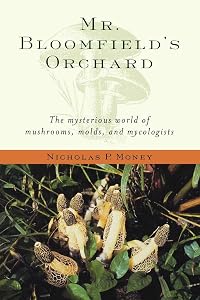
Mr. Bloomfield's Orchard: The Mysterious World of Mushrooms, Molds, and Mycologists
by Nicholas P. Money
On This Page
Description
Biologist Nicholas Money offers a personal view of the subject of mycology, drawing on his own investigations on fungal growth and reproduction. Money also showcases the lives of some eccentric mycologists.Tags
Recommendations












Member Reviews
The book is basically a sweeping overview of the entire field of mycology, from the viewpoint of one researcher and mycophile. That is, he tells not only of the fungi he's seen, but of the other researchers he's worked with and met, and the historical figures whose work he's drawn from (and been drawn into). The chapters jump from phallic fungi to fungal disease to life cycles to historical mycologists to fungal sex lifes. When I put it that way, it seems like a terribly disjointed book, but somehow Money pulled off such a broad scope beautifully and interestingly. It reads like you're sitting down having a conversation with him, and the conversation flows seamlessly from topic to topic, and sometimes goofy asides are made. Money is as show more good of a storyteller in writing as he is in person, and at some points I found myself in giggles. Despite reaching a decent level of technicality sometimes, the tone always remained light. This is how popular science should be written. show less
http://nwhyte.livejournal.com/1404653.html
The title of this short book is not explained until the last chapter, but the subtitle is clear: The mysterious world of mushrooms, molds and mycologists. I was fascinated. I had no idea of just how dangerous fungi can be - inhalation of spores, poison, corrosion of building materials to make our houses collapse. I had no idea of the massive Armillaria, probably the world's largest single organism, lurking under 2200 acres of Oregon woodland. I had no idea of the tiny Ingold fungi digesting flotsam in streams. And I had only the vaguest idea of why mushrooms are the shape they are.
It's fascinating stuff and unfortunately Money's writing style isn't always up to it; at times he is too technical show more for a general audience, and elsewhere is not as deft at weaving peronal reminiscence into his narrative as, say, Gould (though few could match him). But his enthusiasm shines through, particularly his almost inarticulate joy in the process of research and discovery; and his material is vastly more interesting than I had thought it could be. I enjoyed this book much more than I had expected to. show less
The title of this short book is not explained until the last chapter, but the subtitle is clear: The mysterious world of mushrooms, molds and mycologists. I was fascinated. I had no idea of just how dangerous fungi can be - inhalation of spores, poison, corrosion of building materials to make our houses collapse. I had no idea of the massive Armillaria, probably the world's largest single organism, lurking under 2200 acres of Oregon woodland. I had no idea of the tiny Ingold fungi digesting flotsam in streams. And I had only the vaguest idea of why mushrooms are the shape they are.
It's fascinating stuff and unfortunately Money's writing style isn't always up to it; at times he is too technical show more for a general audience, and elsewhere is not as deft at weaving peronal reminiscence into his narrative as, say, Gould (though few could match him). But his enthusiasm shines through, particularly his almost inarticulate joy in the process of research and discovery; and his material is vastly more interesting than I had thought it could be. I enjoyed this book much more than I had expected to. show less
If I was a botany post-grad, I'd give this 5 stars. If I was a professor teaching the phyisiology and taxonomy of non-vascular plants, I'd assign this in a heartbeat. But for a general nature reader? Yikes!
A Med school student would have trouble with the bizarre, foreign, terms dealing with microbiology and fungi reproduction. There's more Latin in here than a Sophomore Honors class. Even the author sprinkled in a couple apologies, before delving into pages of the most technical aspects of mycology. Sure, some of the sections on parasitism were interesting (and gross), and the lives of some of the eccentric mycologists, were interesting.
But Mr. Money is no Bill Bryson. This was not the most accessible of nature books. I learned quite a show more bit, and am glad I read it, but man-o-man, it was tough going... show less
A Med school student would have trouble with the bizarre, foreign, terms dealing with microbiology and fungi reproduction. There's more Latin in here than a Sophomore Honors class. Even the author sprinkled in a couple apologies, before delving into pages of the most technical aspects of mycology. Sure, some of the sections on parasitism were interesting (and gross), and the lives of some of the eccentric mycologists, were interesting.
But Mr. Money is no Bill Bryson. This was not the most accessible of nature books. I learned quite a show more bit, and am glad I read it, but man-o-man, it was tough going... show less
Ratings
Members
- Recently Added By
Lists

Non-technical works for the amateur mycophile
6 works; 2 members
Author Information
14 Works 527 Members
Nicholas P. Money teaches in the Department of Botany at Miami University, in Oxford, Ohio.
Common Knowledge
- Original publication date
- 2002
Classifications
Statistics
- Members
- 105
- Popularity
- 308,643
- Reviews
- 4
- Rating
- (3.36)
- Languages
- English
- Media
- Paper
- ISBNs
- 4