On This Page
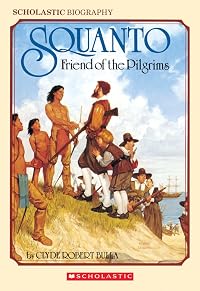
Description
A biography of the Indian who went to London with some of the first English explorers, was sold into slavery in Spain, and finally returned to America where he befriended the Pilgrims when they landed.Tags
Recommendations















Member Reviews
Bland, sanitized historical dramatization where the protagonist has to speak in stereotypical broken English because he's Native American, this despite years living amongst English speakers and being portrayed as an interpreter.
Whenever I hear people complain about history being erased nowadays, I always think of whitewashed history like this that has prevailed for centuries. Squanto is basically erased even in a book that's ostensibly about him, reducing him to his value to the white guys around him or making his fate dependent on the good graces of a series of white saviors.
Whenever I hear people complain about history being erased nowadays, I always think of whitewashed history like this that has prevailed for centuries. Squanto is basically erased even in a book that's ostensibly about him, reducing him to his value to the white guys around him or making his fate dependent on the good graces of a series of white saviors.
In my opinion, this is a great historical fiction book about an Indian who befriends the English Pilgrims after a long journey. The big idea of the story is the significance of bridging the cultural gap between two different types of people, and working together to create peace and happiness. One reason why I liked this book is because it pushes readers to think about tough issues and broaden their perspectives. Because this is a historical fiction book that dates back to the early 1620s, it forces readers to think about issues that wouldn’t happen nowadays. For instance, slavery was an issue in which Squanto was sold in Spain. Therefore, I like how this book teaches readers about the history of the Native Americans and makes them show more think about the horror of these real issues that occurred in history. I also really liked that the characters in the story are well-developed and realistic, which adds to the authenticity of this fictitious book. For instance, Squanto is described as an “old man with deep lines in his face. His long gray hair was tied so that it hung down his back like a foxtail,” (9). The reader not only learns about Squanto’s appearance but also that he speaks another language from the English and lives in a village, which is explained in the story. These details all enhanced the character, which gave me a clear vision of Squanto and all aspects of his life, which I really liked. show less
First this was more of a back story...leading up to "friend of the pilgrims."
It is definitely NOT nonfiction. At one point V asked, "how do they know what he was thinking?"
I read this after she talked about the pilgrims and Squanto in school, hoping to get a bit more in depth. For a K-1 grade level this was good. I was impressed they mentioned anything about slavery.
The characters were extremely wooden (even more than a typical young reader book.)
I didn't know that much about Squanto and was glad to learn more, though I take the facts in the book with a grain of salt.
It is definitely NOT nonfiction. At one point V asked, "how do they know what he was thinking?"
I read this after she talked about the pilgrims and Squanto in school, hoping to get a bit more in depth. For a K-1 grade level this was good. I was impressed they mentioned anything about slavery.
The characters were extremely wooden (even more than a typical young reader book.)
I didn't know that much about Squanto and was glad to learn more, though I take the facts in the book with a grain of salt.
This one's a kids' biography of Squanto, the Patuxet man who supposedly helped the Pilgrims learn to survive in the wilds of North America. It's an interesting tale, but I was left wondering just how accurate it was. After years of living amongst Englishmen, Squanto is still talking in broken English. One would think that he would have at least learned the verb "to be" in that time. Anyway, maybe this is a faithful recounting of Squanto's life, or maybe it's not. I don't have the knowledge to truly judge it. I do know, however, that it wasn't enjoyable enough to rate higher than waiting room material.
--J.
--J.
Squanto, a Wampanoag Indian, goes to London with some of the first English explorers, is sold into slavery in Spain, and finally returns to America where he befriends the Pilgrims when they land.
This is a great historical non fiction book about a indian named Squanto that becomes friends with the english in order to work together to create happy and more peaceful lives. I like this book because it shows how people worked together and made deals in the past the same as they do now. This book would be a great read for fifth graders.
the book to me was a good book about the history of this country I like how the book tell you of the struggles of the indian man and woman of that time I also like how the book tells how the indian people where looked at by those oppressors in that time era
Members
- Recently Added By
Published Reviews
ThingScore 50
The book is formula storytelling, but the truth of the various Squanto stories must be questioned. The myth is so ingrained that it is difficult to challenge. It is important that the child reader is aware that there may be "fiction" in these tales.
added by CourtyardSchool
[Under alternative title of "Squanto: Friend of the White Man"...] This is a fictionalized account of the life of "Squanto" (Tisquantum), his long sojourn in England, captivity in Spain, and subsequent aid to the newly arrived Pilgrims. In attempting to portray a lifelike character, the author attributes questionable attitudes to Squanto, for example, his admiration of the "wonderful white men."
added by CourtyardSchool
Lists

Sonlight Books
1,487 works; 25 members

Ambleside Books
459 works; 18 members

CCE 1000 Good Books List
1,033 works; 12 members

The Story of the World: Activity Book Three: Early Modern Times
191 works; 3 members

The Playful Pioneers
166 works; 1 member
Author Information

95+ Works 27,552 Members
Clyde Robert Bulla was born in King City, Missouri in 1914. His first school was a one-room country house. He started out writing stories. After numerous rejections, he finally sold a story to a pulp magazine. He sold more stories to magazines to earn money. He eventually turned to writing children's books. Bulla's first children's book "The show more Donkey Cart," was published in 1946. He has published over 80 titles including "Squanto: Friend of the Pilgrims," "The Chalk Box Kid," "Shoeshine Girl," "The Sword in the Tree" and "The Paint Brush Kid". Clyde Bulla passed away on May 23, 2007 in Warrenburg Missouri. (Bowker Author Biography) show less
Some Editions
Awards and Honors
Series

Belongs to Publisher Series
Vintage Scholastic (TX1335)
Work Relationships
Is contained in
Has the (non-series) sequel
Common Knowledge
- Canonical title
- Squanto: Friend of the Pilgrims
- Original title
- Squanto: Friend of the White Men
- Original publication date
- 1954
- People/Characters
- Squanto; Charles Robbins; George Weymouth (captain); John Smith (captain); Thomas Hunt (captain); Wawano (member of Patuxet tribe) (show all 18); John Slanie; Anne Slanie (daughter of John Slanie); Edward Slanie (son of John Slanie); Thomas Dermer; Massasoit; Ocomo; Samoset; Miles Standish; John Carver (governor); John Billington; John Alden; Ellen More
- Important places
- Patuxet, North America; London, England, UK; Malaga, Spain; Plymouth Colony
- Dedication
- To J. Rowland Whittaker
- First words
- The Indian boy lay hidden in the tall grass.
- Last words
- (Click to show. Warning: May contain spoilers.)"This is my home," said Squanto.
"Were you talking to the trees?" asked John Billington. "That's foolish, if you were. A tree doesn't know what you are saying."
But the little girl put her hand in Squanto's, as if she understood. - Original language
- English
Classifications
Statistics
- Members
- 3,309
- Popularity
- 5,164
- Reviews
- 10
- Rating
- (3.67)
- Languages
- English, German
- Media
- Paper
- ISBNs
- 16
- ASINs
- 21