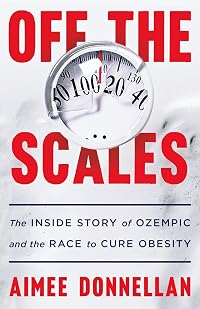
Off the Scales: The Inside Story of Ozempic and the Race to Cure Obesity
by Aimee Donnellan
On This Page
Description
"The inside story of the race to develop Ozempic, and its potentially revolutionary impact on public health and culture. A "cure" for obesity has long been the holy grail for the pharmaceutical industry, one that seemed unattainable until recent breakthroughs in type 2 diabetes research led to the development of Ozempic, a weight loss medication that activates hormones in the stomach, making people feel fuller for longer. The treatment is so effective that it is already disrupting many show more industries--from healthcare to fast food to fashion--and it has quickly made its creator, Denmark's Novo Nordisk, the most valuable company in Europe. But the impact of these drugs goes far beyond billion-dollar profits; a true long-term cure for obesity could save 40% of American adults from dangerous preventable illnesses. And as their success continues to grow, one question looms in the minds of investors, healthcare workers and politicians: are they too good to be true? In Off the Scales, Reuters journalist Aimee Donnellan illuminates the history of the latest medical breakthrough that is poised to change the world, while bringing difficult social questions about inequality and morality to the forefront. Through original reporting and rigorous research, she forecasts the future of Ozempic and similar medications--and examines what their explosive popularity tells us about our ideals of beauty, the lengths to which people will go in order to become thin, the current state of healthcare, and the inner workings of the pharmaceutical industry. Along the way, Donnellan profiles the scientist whose contributions to the discovery of GLP-1 were overlooked and her fight for recognition while her colleagues were thrust into the limelight, and offers new insights into the ways that the food and beauty industries made billions while promoting unhealthy and unrealistic body image standards and accelerating the obesity crisis. She also reveals the lengths that the celebrity class went to obtain this medication when supplies were limited and prescriptions were costly, and relates the first-hand accounts of several early Ozempic users and the transformative effect the drug has had on their weight loss journeys. Above all, Off the Scales is an informative and entertaining study of the unexpected social consequences of finally getting what we've wanted for so long"-- Provided by publisher. show lessTags
Recommendations




































Member Reviews
There can hardly be a person out there who isn’t aware, on some level, of the recent upheaval in the treatment of type 2 diabetes brought about by GLP-1 medications. These medications, of which Ozempic may be among the best known, mimic the action of certain hormones, lowering blood sugar levels and slowing gastric emptying.
It also very rapidly became apparent that one common side effect of this class of drugs was significant weight loss, and in a culture that has for decades equated thinness with beauty, demand for these drugs strictly as a weight-loss aid absolutely exploded.
Donellan here takes a broad-spectrum view of the phenomenon, dealing with such diverse factors as gender-bias in the scientific community, factors contributing show more to the 21st century’s “epidemic of obesity”, a sea change in the way the medical and scientific community looks at the underlying causes of that epidemic, what happens when a substance developed for legitimate medical purposes is hijacked by the beauty industry, financial realities for Big Pharma, the ripple effect of significant and widespread weight loss within a population, the drug’s boomerang effect on the positive body image movement, some of the frightening side effects of the drug when used specifically for weight-loss, and the medical / ethical / moral implications of its use to treat childhood obesity.
If that sounds like a plateful (sorry) -- it is. But Donellan understands that drugs like Ozempic-based Wegovy and its competitors are substances with the potential to literally reshape our society in both positive and negative ways. Even at 320 pages, there’s only enough room to skim the bare outlines of what the future may bring to the industry and to the society which seems to be hell-bent on supporting it.
In 1950, fewer than one in 10 Americans were clinically obese. By 2024, 75% of us were overweight or obese by clinical standards. What happened? Donellan looks at the many factors that have played into that frightening statistic, including the medical establishment’s long-held belief that managing body weight was simply a matter of self-control and lifestyle. She considers what happens when an apparently effortless method of weight loss becomes available, but at a price that puts it out of the reach of much of the population. She asks what level of negative side effects – and research cites plenty of them, some of which are truly frightening – will vanity-motivated consumers endure to drop from a Size 7 dress to a Size 3. These and other, broader implications of this whole new frontier of medical treatment are presented in a compelling fashion, but she never loses sight of its potential to genuinely improve the lives of millions of people who have fought obesity throughout their lifetimes.
It’s a fascinating, sometimes frightening read, and it raises some uncomfortable questions about who we are as a society, what we ultimately value, and whether a wish come true is really a nightmare in disguise. show less
It also very rapidly became apparent that one common side effect of this class of drugs was significant weight loss, and in a culture that has for decades equated thinness with beauty, demand for these drugs strictly as a weight-loss aid absolutely exploded.
Donellan here takes a broad-spectrum view of the phenomenon, dealing with such diverse factors as gender-bias in the scientific community, factors contributing show more to the 21st century’s “epidemic of obesity”, a sea change in the way the medical and scientific community looks at the underlying causes of that epidemic, what happens when a substance developed for legitimate medical purposes is hijacked by the beauty industry, financial realities for Big Pharma, the ripple effect of significant and widespread weight loss within a population, the drug’s boomerang effect on the positive body image movement, some of the frightening side effects of the drug when used specifically for weight-loss, and the medical / ethical / moral implications of its use to treat childhood obesity.
If that sounds like a plateful (sorry) -- it is. But Donellan understands that drugs like Ozempic-based Wegovy and its competitors are substances with the potential to literally reshape our society in both positive and negative ways. Even at 320 pages, there’s only enough room to skim the bare outlines of what the future may bring to the industry and to the society which seems to be hell-bent on supporting it.
In 1950, fewer than one in 10 Americans were clinically obese. By 2024, 75% of us were overweight or obese by clinical standards. What happened? Donellan looks at the many factors that have played into that frightening statistic, including the medical establishment’s long-held belief that managing body weight was simply a matter of self-control and lifestyle. She considers what happens when an apparently effortless method of weight loss becomes available, but at a price that puts it out of the reach of much of the population. She asks what level of negative side effects – and research cites plenty of them, some of which are truly frightening – will vanity-motivated consumers endure to drop from a Size 7 dress to a Size 3. These and other, broader implications of this whole new frontier of medical treatment are presented in a compelling fashion, but she never loses sight of its potential to genuinely improve the lives of millions of people who have fought obesity throughout their lifetimes.
It’s a fascinating, sometimes frightening read, and it raises some uncomfortable questions about who we are as a society, what we ultimately value, and whether a wish come true is really a nightmare in disguise. show less
Aimee Donnellan’s Off the Scales is a fascinating look at the rise of GLP-1 drugs, with a focus on their amazing ability to help people control their weight. In particular the book focuses on Novo Nordisk’s Ozempic, with its ability to help people lose 15 to 20% of their body weight.
Before Ozempic there was the discovery of the hormone glucagon-like peptide 1, or GLP-1. Just exactly who discovered GLP-1, and realized its significance as a treatment for diabetes, and its side effect of reducing obesity, and at what institution, are topics covered in the book. There is some dispute, and conflicting claims as to who was responsible for what, but Svetlana Mojsov is credited with the discovery of the hormone itself, and her research show more helped lay the groundwork for the development of treatments based on GLP-1 for diabetes and weight loss.
Donnellan takes us through those early days in the late 1970s and early 1980s. It would be decades between those initial discoveries and the release of Ozempic and other GLP-1 drugs. In the meantime, obesity was becoming a larger and larger problem. So, Donellan dives into the rise of high fat / high sugar ultra-processed foods, and the need for the makers of those foods to get us all to eat more of them to increase their bottom lines. As consumption of these foods, first in the US but now globally, increased, obesity tended to follow.
This all lays the groundwork for the rest of the book about the true believers in Ozempic at Novo Nordisk. Donnellan takes us inside their multiyear effort to champion the drug through internal politics and then clinical trials. The result? They finally get the drug to market, first for type 2 diabetes and then for weight loss. Donnellan focuses on the personalities and the timelines rather than taking too deep a dive into the science, and the result is a smart and highly readable account.
This is exactly the kind of book I enjoy — a highly readable overview of a scientific breakthrough. It’s easily the best reportorial nonfiction book I’ve read this year.
Four and a Half Stars ⭐⭐⭐⭐🌠 show less
Before Ozempic there was the discovery of the hormone glucagon-like peptide 1, or GLP-1. Just exactly who discovered GLP-1, and realized its significance as a treatment for diabetes, and its side effect of reducing obesity, and at what institution, are topics covered in the book. There is some dispute, and conflicting claims as to who was responsible for what, but Svetlana Mojsov is credited with the discovery of the hormone itself, and her research show more helped lay the groundwork for the development of treatments based on GLP-1 for diabetes and weight loss.
Donnellan takes us through those early days in the late 1970s and early 1980s. It would be decades between those initial discoveries and the release of Ozempic and other GLP-1 drugs. In the meantime, obesity was becoming a larger and larger problem. So, Donellan dives into the rise of high fat / high sugar ultra-processed foods, and the need for the makers of those foods to get us all to eat more of them to increase their bottom lines. As consumption of these foods, first in the US but now globally, increased, obesity tended to follow.
This all lays the groundwork for the rest of the book about the true believers in Ozempic at Novo Nordisk. Donnellan takes us inside their multiyear effort to champion the drug through internal politics and then clinical trials. The result? They finally get the drug to market, first for type 2 diabetes and then for weight loss. Donnellan focuses on the personalities and the timelines rather than taking too deep a dive into the science, and the result is a smart and highly readable account.
This is exactly the kind of book I enjoy — a highly readable overview of a scientific breakthrough. It’s easily the best reportorial nonfiction book I’ve read this year.
Four and a Half Stars ⭐⭐⭐⭐🌠 show less
While I enjoyed reading the history of GLP-1s I was hoping for more clinical trial stories. The few that are mentioned didn't go into much detail. A few of the side effects and positive effects are mentioned but mostly glossed over. What it takes to bring a drug to market is exhausting, years of research, testing, FDA approval and then on to EU approval. I understand better why drugs can cost so much and why a company tries to get every penny it can before the patent runs out. Generics benefit the consumer a great deal but if the company isn't careful they'll come out at a loss. Ozempic has been touted as a life changer but it seems to be temporary, also not the first of it's kind. My interest in these weight loss drugs has changed show more after reading the average results and being a life-long drug. It's treating the symptoms but not addressing what is now known as the cause. Most insurance companies won't pay for new to market drugs and if they do it's too expensive to be reasonable. The TV is bombarded with commercials showing happy people singing about the new miracle drug. I now know who I have to blame for the back to back commercials too.
I received a complimentary copy of this book. All opinions expressed in this review are completely my own.
#NetGalley #OfftheScales #AimeeDonnellan # St. Martin's Press #Ozempic # pharmaceutical #drug development #obesity #GLP-1 medications show less
I received a complimentary copy of this book. All opinions expressed in this review are completely my own.
#NetGalley #OfftheScales #AimeeDonnellan # St. Martin's Press #Ozempic # pharmaceutical #drug development #obesity #GLP-1 medications show less
Members
- Recently Added By
Lists

Guardian Books of the Day 2026
14 works; 1 member
Author Information
9 Works 43 Members
Awards and Honors
Distinctions
The Guardian Book of the Day (2026-01-15)
Classifications
- Genres
- Nonfiction, Business, General Nonfiction
- DDC/MDS
- 616.398 — Applied science & technology Medicine & health Diseases, Allergies, Skin Conditions Diseases of the digestive system Dietetic diseases
- LCC
- RM332.3 .D66 — Medicine Therapeutics. Pharmacology Therapeutics. Pharmacology Drugs and their actions
- BISAC
Statistics
- Members
- 26
- Popularity
- 1,044,960
- Reviews
- 3
- Rating
- (4.00)
- Languages
- English
- Media
- Paper, Audiobook, Ebook
- ISBNs
- 5
- ASINs
- 2